

A few months ago, a former student messaged me asking a version of the same question I now hear almost weekly: “I’m good at CI/CD and Kubernetes, so why does every MLOps job posting still reject me?” The honest answer is that DevOps skills get you partway there, but a model in production behaves nothing like a stateless microservice, and nobody hands you an MLOps roadmap that bridges that gap in plain terms.
This guide is that roadmap — written specifically for engineers who already know infrastructure and now need to learn what changes when the thing you’re deploying is a model instead of an application.
Why DevOps Engineers Already Have Half of an MLOps Roadmap Built?
The market pressure behind this shift is not subtle. The global MLOps market is forecast to grow by roughly USD 10.32 billion between 2027 and 2030, at a compound annual growth rate near 26.3%, and that growth is being driven almost entirely by companies that built AI prototypes in 2024 and 2025 and are now discovering how expensive it is to run them reliably at scale. That expense is operational, not scientific, which is exactly why DevOps engineers are being pulled into these teams instead of being replaced by data scientists.
Think about what you already carry into this transition: you understand version control discipline, you’ve built automated pipelines under pressure, you know what a bad rollout looks like at 2 a.m., and you’ve probably already debugged a flaky deployment that worked fine in staging.
None of that becomes useless when the deployable artifact changes from a container image to a trained model. What’s missing is the vocabulary and the specific checkpoints an MLOps roadmap needs that a standard CI/CD pipeline doesn’t — things like data drift, model versioning tied to a dataset snapshot, and a serving layer that behaves very differently under load than a typical web service.
Build those checkpoints into the pipelines you already know how to write, and you’ve effectively completed the hardest third of this transition before you’ve touched a single new platform.
The Skills Gap Your MLOps Roadmap Needs to Close
Here’s where most DevOps engineers underestimate the distance, and where an honest MLOps roadmap has to be specific rather than vague:
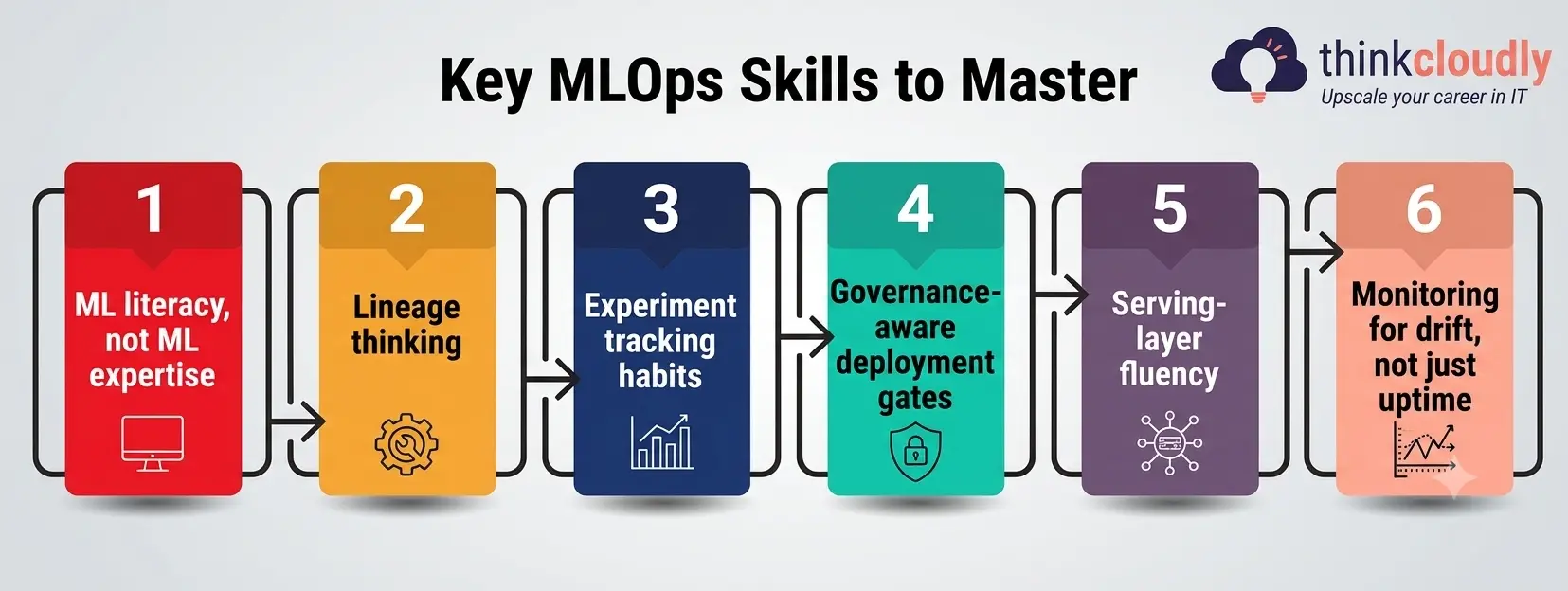
- ML literacy, not ML expertise — You need to understand training versus inference, what a feature store does, and why a model that scored well in validation can still degrade silently in production. You don’t need research-level math.
- Lineage thinking — Every model you push needs to be traceable back to its training code, its exact dataset snapshot, its hyperparameters, and whoever approved it. Git history alone won’t cover this.
- Experiment tracking habits — Teams that skip this end up with five “best” models and no record of which one actually shipped or why.
- Governance-aware deployment gates — A promotion to production should require more than passing tests; it should require a minimum evaluation score, a fairness check, and a documented rollback plan.
- Serving-layer fluency — This layer has its own failure modes around batching, GPU memory, and cold starts that a typical web service rarely hits.
- Monitoring for drift, not just uptime — A model can be “up” and still be quietly wrong, which standard infrastructure monitoring was never built to catch.
Close these gaps in roughly that order and the rest of the transition stops feeling like starting over from zero.
MLOps Tools Every DevOps Engineer Should Learn First
You don’t need to learn every platform on the market, and chasing every new release is a fast way to learn nothing well. A focused set of MLOps Tools covers almost everything a beginner-to-intermediate transition actually requires, and most teams that make this switch successfully stick to a short, well-understood list of MLOps Tools rather than constantly chasing whatever launched last week:
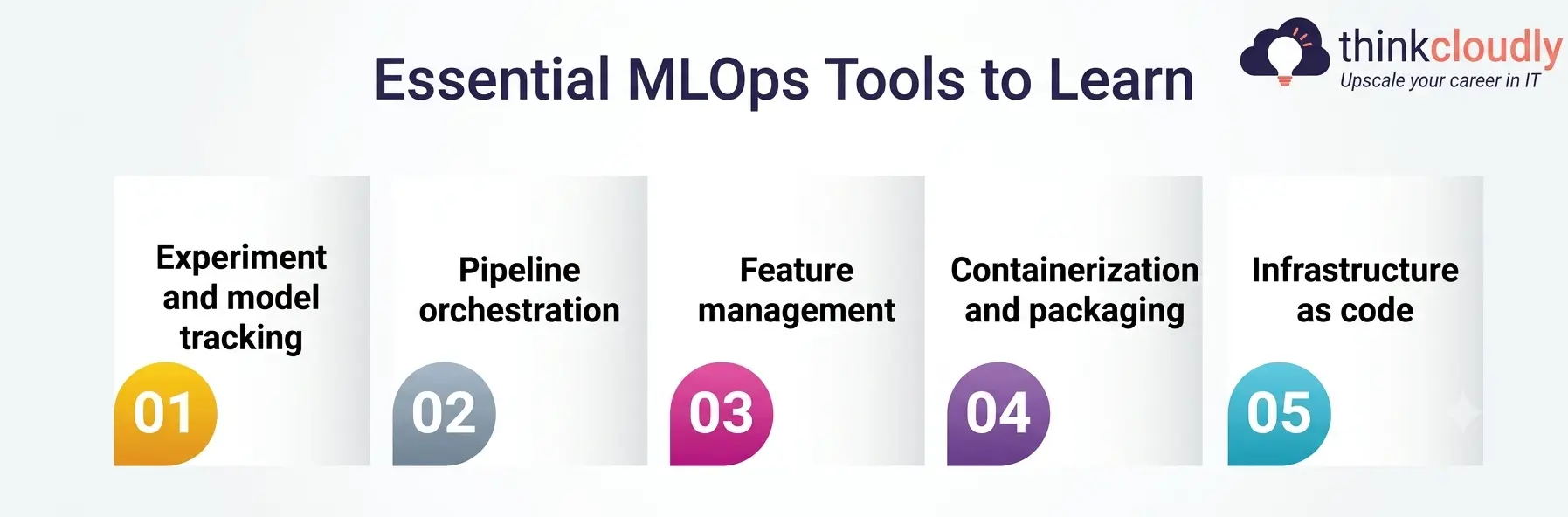
- Experiment and model tracking: MLflow is the open-source default most teams still standardize around, largely because it’s cloud-agnostic and easy to self-host.
- Pipeline orchestration: Kubeflow Pipelines or a cloud-native equivalent, depending on which cloud your employer already uses.
- Feature management: A feature store such as Feast, especially once you’re serving the same features consistently across training and inference.
- Containerization and packaging: Docker, which you likely already know, now wrapping a model artifact instead of (or alongside) an application.
- Infrastructure as code: Terraform, applied to GPU-backed compute and model endpoints rather than plain web servers.
Learning these five categories of MLOps Tools properly, instead of skimming fifteen platforms superficially, is what Pluralsight’s guide to becoming an MLOps engineer also points to directly — reuse what you already know from DevOps tooling, and expect genuine gaps only in the ML-specific layer. That layer is narrower than it looks from the outside, and these MLOps Tools cover nearly all of it for a first production system.
Model Serving: The Piece DevOps Instincts Don’t Automatically Cover
This is where I see the most confident DevOps engineers stumble first, because model serving looks like ordinary application deployment right up until it isn’t. A model endpoint has to manage GPU or CPU resource contention, batch incoming requests efficiently without adding unacceptable latency, and handle a cold start that can take far longer than spinning up a typical container.
Three practical lessons about model serving tend to matter most early on.
- First, autoscaling rules written for stateless web traffic usually fail here, because the expensive part of the request is the inference call itself, not the network hop around it.
- Second, a canary release for this layer needs a model-quality metric running alongside the usual latency and error-rate checks — a new model version can be fast and still be wrong.
- Third, batching strategy is a tuning problem specific to this part of the stack, not something you inherit for free from your existing load balancer configuration.
Get comfortable with managed endpoints first — most major clouds offer them — before reaching for a custom Kubernetes-based serving layer that adds operational weight you don’t yet need.
AI Model Governance Is Not Optional Anymore
If there’s one area where 2027 genuinely changed the rules, its AI model governance. Regulatory pressure caught up with deployment speed, and under the EU AI Act, obligations for high-risk AI systems become enforceable in August 2027, carrying fines that can reach into the tens of millions of euros for serious violations. That alone has pushed this from a “nice to have” into a hard deployment gate at any company operating internationally.
Practically, AI model governance means your pipelines need a few non-negotiable checkpoints: a documented evaluation threshold a model has to clear before promotion, an audit trail connecting every production model back to its training data and approver, and a bias or fairness check that runs automatically rather than relying on someone remembering to do it manually.
The NIST AI Risk Management Framework organizes this work around four functions — govern, map, measure, and manage — and it’s a genuinely useful structure to borrow even if your company never formally adopts it. Treat it the way you’d treat security reviews: a gate baked into the pipeline, not a document written after the fact.
Continuous Monitoring: Where Your Observability Background Pays Off
Here’s the good news: continuous monitoring is the part of this roadmap where your existing DevOps instincts transfer almost directly, because you already understand dashboards, alerting thresholds, and the discomfort of an alert that fires too late to matter. The difference is what you’re watching for.
Continuous monitoring for a model needs to track at least three signals your old observability stack never had to: data drift, where the live input distribution quietly diverges from what the model was trained on; prediction drift, where the model’s outputs shift even when nothing obvious changed upstream; and fairness or bias drift, where performance degrades unevenly across different user segments.
According to some data analysis of trustworthy AI systems, nearly 60% of IT leaders are introducing or updating AI governance principles this year, and this kind of monitoring is consistently named as the mechanism that turns those principles into something enforceable rather than aspirational. Wire it into the same alerting tools you already run for infrastructure, and extend the dashboards rather than building a parallel system nobody checks.
Comparing MLOps Platforms for DevOps Engineers in 2027
Choosing among MLOps Platforms is less about finding the “best” one and more about matching a platform to the cloud and team structure you already work inside. This table breaks down how the major options differ on the dimensions that matter most during a transition:
|
Platform |
Best Fit For | Strength |
Learning Curve |
|
MLflow |
Teams wanting an open, cloud-agnostic starting point | Lightweight experiment and model tracking |
Low |
|
Amazon SageMaker |
Teams already standardized on AWS | End-to-end lifecycle with strong automation |
Medium |
|
Azure Machine Learning |
Teams already standardized on Microsoft’s stack | Deep integration with Azure DevOps pipelines |
Medium |
|
Databricks (Mosaic AI) |
Teams with heavy data engineering needs | Unified data and ML workflows in one lakehouse |
Medium-High |
|
Kubeflow |
Teams committed to Kubernetes-native infrastructure | Full control over orchestration and scaling |
High |
Notice that none of these MLOps Platforms require abandoning your existing cloud relationship. If your company runs on AWS, start there; the platform choice matters far less than actually shipping one governed model end to end. Once that first model is live, comparing options for a second or third use case becomes a much easier, far less theoretical conversation.
A 90-Day MLOps Roadmap for DevOps Engineers
If you want a sequence instead of a scattered list of things to learn eventually, here’s a 90-day MLOps roadmap that mirrors how I’ve seen successful transitions actually unfold:
- Days 1–30: Learn ML fundamentals (training vs. inference, drift, evaluation metrics) and deploy one sample model to a managed endpoint using a cloud provider you already know.
- Days 31–60: Automate training, evaluation, and model registration into a single pipeline, adding a minimum evaluation-score gate before anything promotes to production.
- Days 61–90: Add drift and bias monitoring, document a rollback plan, and write a production runbook that a teammate could follow without you in the room.
Following that sequence turns an abstract MLOps roadmap into one real, defensible project — the single strongest thing you can point to in an interview, stronger than any certification sitting alone on a resume.
Common Mistakes DevOps Engineers Make on the Transition
A few patterns show up often enough to name directly. Treating a Jupyter notebook as a production artifact is one of the most common — notebooks are for exploration, not for anything that needs to survive a teammate’s absence.
Overbuilding a custom Kubernetes serving layer before trying a managed endpoint is another; it adds operational weight most early projects don’t need yet. Leaving AI model governance and drift monitoring until “later” is the most expensive mistake of all, because retrofitting an audit trail onto a model that’s already in production is far harder than building it in from day one.
And taking on a role that quietly combines data science, DevOps, security, and on-call duties into a single job description is a reliable path to burnout rather than a shortcut up the ladder.
A Personal Note
I’ve walked enough engineers through this exact transition to notice the same hesitation every time: a strong DevOps background makes people assume they’re starting from zero in MLOps, and that assumption is wrong. You’re not starting over — you’re adding a fairly narrow, learnable layer on top of skills you’ve already spent years building.
The engineers who struggle aren’t the ones who know the least; they’re the ones who try to learn every tool at once instead of shipping one small, governed, monitored model end to end. Pick one real use case, however modest, and take it the whole distance through this roadmap. That single finished project will teach you more than another six months of reading comparisons between platforms.