

Every project manager I talk to this year is asking some version of the same question: do I actually need an AI project manager certification, or is this just the latest badge everyone’s chasing because LinkedIn told them to?
Fair question, and it deserves a straight answer. I’ve spent the last few months watching this space shift—new exam content from the big institutes, a flood of AI-labeled bootcamps, and employers who suddenly expect project managers to speak fluently about model deployment and automation—and the honest conclusion is that this specific credential is worth real consideration for some people and a waste of money for others, depending entirely on where you’re standing right now.
This isn’t a credential that turns you into a data scientist overnight. It’s a signal—proof that you understand how artificial intelligence is reshaping planning, risk management, and delivery, and that you can work alongside the software instead of being replaced by it.
Whether that signal is worth the time and money depends on your current role, your target job, and how the 2027 job market is actually behaving. Let’s walk through it properly.
What Does an AI Project Manager Certification Actually Cover?
There isn’t one single, universally agreed exam the way there is for, say, a cloud certification. Instead, the term has become an umbrella covering a few different paths. The Project Management Institute has built AI content directly into its flagship credential: PMI’s refreshed PMP exam, launching in July 2027, adds emerging topics to the exam blueprint, and AI is listed first among them, alongside sustainability and value delivery, according to PMI’s own announcement.
That’s a meaningful shift—it means the world’s most recognized project management credential now expects candidates to understand AI-assisted planning and governance, not just traditional waterfall or agile mechanics.
Outside PMI, a wave of standalone programs has emerged, each branded with its own flavor of AI-focused training—covering prompt-based planning, AI-assisted risk forecasting, automated status reporting, and the basics of overseeing a model once it moves from a lab into a live, customer-facing environment.
Most of them also introduce candidates to the relevant software early, since reading about the concepts means very little if you’ve never touched the dashboards that actually run them. These programs vary wildly in rigor.
Some are built by universities and professional bodies with real assessment standards; others are little more than a video course and a certificate generator. That’s exactly why due diligence matters before you pay for one.
Is This Certification Worth It, or Just Resume Padding?
Does earning the credential guarantee you a better title or a bigger paycheck on its own? No—and anyone promising that outcome is overselling a course. Does it prove you can hold a credible conversation about AI-assisted delivery, risk, and tooling in an interview? That’s a much stronger yes, and it’s genuinely the point of pursuing one in the first place.
Here’s the honest framing: treat this type of credential as a floor, not a ceiling. As a floor—proof that you understand how AI changes planning, estimation, and reporting before you walk into a role that expects it—it earns its cost.
As a ceiling—something you hope substitutes for actual hands-on experience running a project where AI tools are embedded in the workflow—it will fall apart the moment a hiring manager asks a follow-up question about a real rollout you managed.
Pros of an AI Project Manager Certification
Here’s what you genuinely walk away with, laid out plainly so it’s easy to scan:
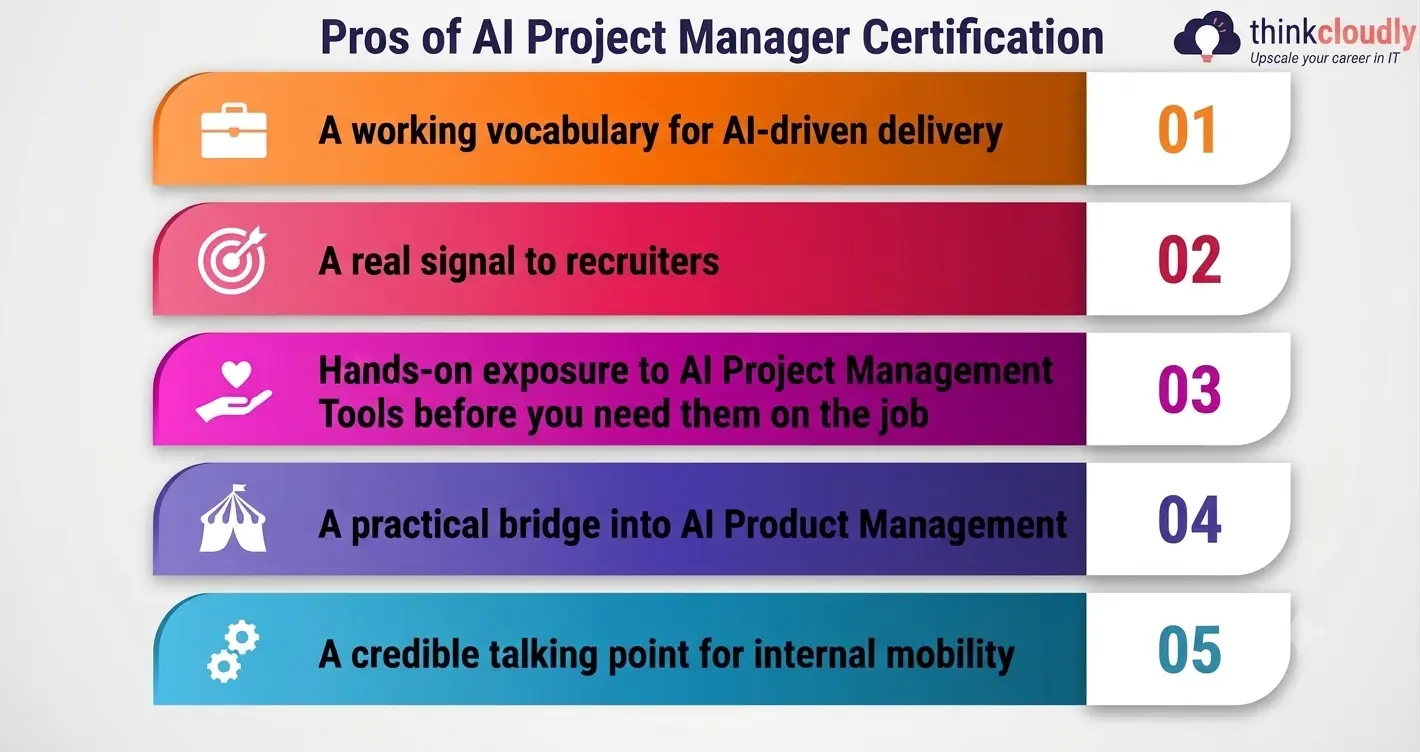
- A working vocabulary for AI-driven delivery. You’ll understand concepts like automated risk scoring, AI-assisted scheduling, and governance for agentic workflows well enough to follow a technical conversation without nodding blankly.
- A real signal to recruiters. Hiring teams screening resumes for AI-adjacent delivery roles increasingly treat this credential as evidence you’ve done more than skim a few AI headlines.
- Hands-on exposure to AI project management tools before you need them on the job. Most programs walk you through platforms that automate status updates, flag schedule risk, and summarize meeting notes, so the learning curve on your first AI-enabled project is shorter.
- A practical bridge into AI Product Management. Project managers who understand the full arc of AI model deployment—from training to rollout to monitoring—find it far easier to pivot sideways into product-facing roles that blend delivery discipline with product judgment.
- A credible talking point for internal mobility. Employees who complete a recognized program report it’s easier to get assigned to AI-related initiatives once the credential shows up on an internal profile.
None of these guarantee anything on their own. But stacked together, they make a legitimate case for investing the time, provided you pick a program with real substance behind it.
Cons of an AI Project Manager Certification
It would be dishonest to stop at the upside, so here’s where this credential has genuine limits:
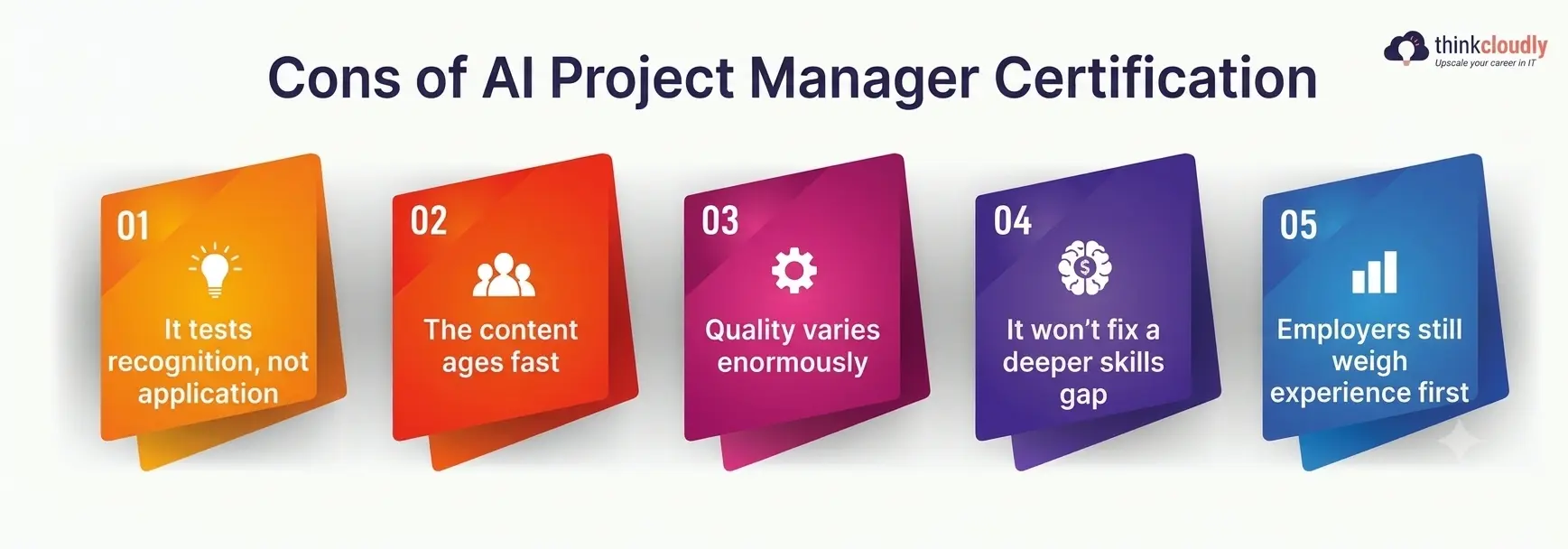
- It tests recognition, not application. Most exams ask you to select the right answer from a list rather than actually run an AI-assisted project from kickoff to delivery, so it can’t prove hands-on fluency the way real experience would.
- The content ages fast. AI tooling moves quickly enough that whatever you study this year will look dated within eighteen months, so treat any such program as a snapshot, not a permanent credential.
- Quality varies enormously. Because there’s no single accrediting body for this specific label, some programs are rigorous and some are little more than a marketing funnel with a certificate at the end.
- It won’t fix a deeper skills gap. If what’s actually holding back your project management career is weak stakeholder communication, budgeting, or scope control, no AI-focused badge solves that—those fundamentals matter more than any credential on this list.
- Employers still weigh experience first. A certificate helps you get noticed, but most hiring managers still want to see at least one real project where you oversaw a live AI rollout or an AI-assisted workflow under actual deadline pressure.
AI Project Manager Certification Options: A Quick Comparison
Numbers and categories are easier to absorb in one place, so here’s a snapshot of how the main paths compare.
|
Credential Type |
Best For | Typical Format | Rough Cost (USD) |
AI Depth |
|
PMI PMP (2027 refresh) |
Experienced PMs wanting a globally recognized credential | Multiple choice, proctored exam | 400–675 |
Moderate—AI woven into broader PM content |
|
Standalone AI PM certificate (university-backed) |
Mid-career PMs pivoting toward AI-heavy teams | Self-paced modules plus a capstone project | 300–1,200 |
High—dedicated AI planning and tooling focus |
|
Vendor-branded AI PM bootcamp |
Beginners wanting quick exposure | Short video course, light assessment | 50–400 |
Variable—ranges from solid to superficial |
|
AI Product Management certificate |
PMs eyeing a move into product roles | Cohort-based or self-paced, project-driven | 500–2,000 |
High—focused on model lifecycle and user value |
Where AI Project Management Tools Are Actually Reshaping the Job?
Access to AI project management tools has grown fast. Enterprise access to these tools climbed roughly 50% year over year, according to McKinsey’s Superagency in the Workplace research cited in a 2027 industry analysis from UC Today.
The catch is that adoption has outpaced results — only about 1% of companies describe themselves as mature in AI deployment, and fewer than a quarter report meaningful cost improvements from the AI they’ve already rolled out.
That gap is exactly why a solid AI project manager certification has real value right now: someone who understands how to responsibly govern AI model deployment, set realistic expectations, and avoid the hype trap is more useful to an employer than someone who can simply click through the software.
Deloitte’s 2027 State of AI in the Enterprise survey of more than 3,200 senior leaders found that only about a quarter of organizations have moved 40% or more of their AI pilots into production, while a third are still using AI only superficially. Gartner, meanwhile, projects that over 40% of agentic AI projects risk cancellation by 2027 without proper governance controls.
Translation: Companies desperately need people who can manage AI model deployment responsibly, not just enthusiastically, and that gap between flashy adoption and real maturity is where a trained project manager earns their keep.
Career Value: AI Project Manager Jobs in a Shifting Market
So does any of this translate into actual AI project manager jobs and real income? The broader labor market gives a mixed but generally encouraging picture. The U.S. Bureau of Labor Statistics put the median annual wage for project management specialists at roughly $100,750 as of May 2024, and PMP-certified professionals report earning somewhere between 23% and 33% more than uncertified peers.
The same analysis points to a projected global shortage of close to 30 million project management roles by 2030, driven by retirements and the sheer volume of digital transformation work still ahead.
On the AI side specifically, demand is tilting toward technical AI roles faster than toward AI-flavored project titles. LinkedIn’s 2027 fastest-growing jobs list placed AI engineers and AI consultants and strategists at the very top with median experience levels in the three-to-eight-year range rather than entry level.
That matters for anyone eyeing AI project manager jobs specifically: the title itself isn’t yet a dominant standalone category on most growth lists, but the skill set underneath it—fluency in tooling, governance, and model lifecycle—is unmistakably in demand across adjacent roles, including product-focused ones.
For a project management career more broadly, the honest picture is this: AI isn’t eliminating the need for project managers, but it is changing what a good one looks like. The ones who thrive are learning to supervise automated workflows rather than compete with them, and treating structured study as one input into that shift rather than the entire plan.
AI Product Management vs. AI Project Management: Don’t Confuse the Two
One mix-up I see constantly: people assume these two tracks cover the same ground. They don’t. AI Product Management is about deciding what gets built — which AI features solve a real user problem, how to prioritize a roadmap, and how to measure whether a model is actually delivering value.
AI project management is about how it gets built and shipped — timelines, resourcing, risk, and coordinating the people and tools involved once a system reaches live deployment. There’s real overlap, and professionals do move between the two, but a program built for one won’t automatically prepare you for the other.
If your goal is specifically a move into product strategy, look for a track that emphasizes user research and prioritization frameworks, not just delivery mechanics.
Who Should Actually Pursue This, and Who Should Skip It?
Not everyone building a project management career needs this credential right now, and it’s worth being direct about who should wait.
You should seriously consider earning one if you’re already managing delivery teams and your organization is actively rolling out AI Project Management Tools, if you’re trying to move laterally into AI-adjacent work without starting from zero, or if you want structured proof of AI literacy before applying to roles that explicitly mention AI Project Manager Jobs in the listing.
Skip it, for now, if you’re brand new to project management generally — core fundamentals matter more at that stage — or if you’re hoping a certificate replaces real hands-on experience overseeing a live AI Model Deployment, because no exam hands you that for free.
My Verdict for 2027
Is an AI project manager certification worth it? Yes, for the right person, at the right stage — and I’ll say that plainly rather than hedge it into mush. If you’re an experienced project manager watching AI reshape how your organization plans and delivers work, a credible program is a reasonable, relatively low-cost way to prove you’re keeping pace and to protect your project management career against being sidelined by people who can speak the new vocabulary fluently.
If you’re brand new to project management with no foundation at all, build that foundation first; an AI-flavored badge on top of nothing solid underneath will not carry the weight you’re hoping it will.
A Personal Note
I get asked some version of “should I get an AI project manager certification” almost every week now, usually from someone hoping I’ll either talk them out of the expense or hand them a shortcut past the work. I won’t do either.
The people who get genuine value from these programs are the ones who treat the certificate as a starting point — they finish the coursework, then immediately go find a small AI-assisted process at their own workplace to practice on, even if nobody asked them to.
The ones who end up disappointed are usually the ones who expected the paper alone to carry weight it was never built to carry. Figure out honestly which group you’re likely to be before you register, and the investment will feel like exactly what it should be: a reasonable, grounded next step, not a magic ticket.