
I still remember the exact moment a procurement manager friend of mine admitted she had no idea what her own IT department meant when they said “we’re moving the invoicing system to the cloud.”
She wasn’t being lazy. Nobody had ever explained it to her in plain English. Six months later, she had earned her Azure Fundamentals certification, picked up a new vocabulary for vendor conversations, and found herself with a seat at budget meetings she used to sit out of. That’s the real pitch for this credential, and it has nothing to do with learning to code.
This beginner-level credential exists for exactly one reason: to give people outside engineering a working, provable understanding of cloud computing without asking them to write a single line of script.
If you work in finance, HR, sales, marketing, procurement, legal, or general management and your company runs anything on Microsoft Azure, the Azure Fundamentals certification is the fastest legitimate way to stop nodding along in meetings and start contributing to them.
What the Azure Fundamentals Certification Actually Tests?
This credential is earned by passing one exam, known as AZ-900, and it is explicitly designed by Microsoft as an entry point rather than a technical gate. According to the official AZ-900 exam page, the exam runs 45 minutes, is delivered through Pearson VUE (or Certiport for students and educators), and is offered in thirteen languages, including English, Spanish, German, and Portuguese. There’s no prerequisite. You don’t need a technical background, a degree, or any prior Microsoft credentials to sit for the AZ-900 exam.
What it does test is your grasp of three broad areas: cloud concepts, core Azure services, and Azure management and governance. None of that requires touching a command line.
It requires understanding what a cloud is, how Azure is structured, and how organizations keep that structure under control—which is precisely the knowledge a non-technical professional needs to work effectively alongside a technical team.
|
Exam Area |
What a Non-Tech Professional Learns |
Why It Matters at Work |
|
Cloud Concepts |
Public, private, and hybrid cloud deployment models; shared responsibility |
Lets you evaluate vendor pitches and contracts intelligently |
|
Core Azure Services |
Compute, storage, networking basics |
Helps you follow technical roadmaps without a translator |
|
Pricing & Support |
Using the Azure pricing calculator, subscriptions, SLAs |
Enables you to sanity-check IT budget requests |
|
Governance & Compliance |
Azure resource management, policies, cloud governance tools |
Prepares you to sit in on audits and risk reviews |
|
Exam Logistics |
45-minute proctored exam, no prerequisites, retake after 24 hours |
Sets realistic expectations before you book the exam |
Why Should Non-Tech Professionals Bother With a Technical-Sounding Exam?
It’s a fair question. If you’re not going to deploy a virtual machine on a Tuesday afternoon, why spend weeks preparing for something with “Azure” in the title? Here’s the case, broken down plainly:
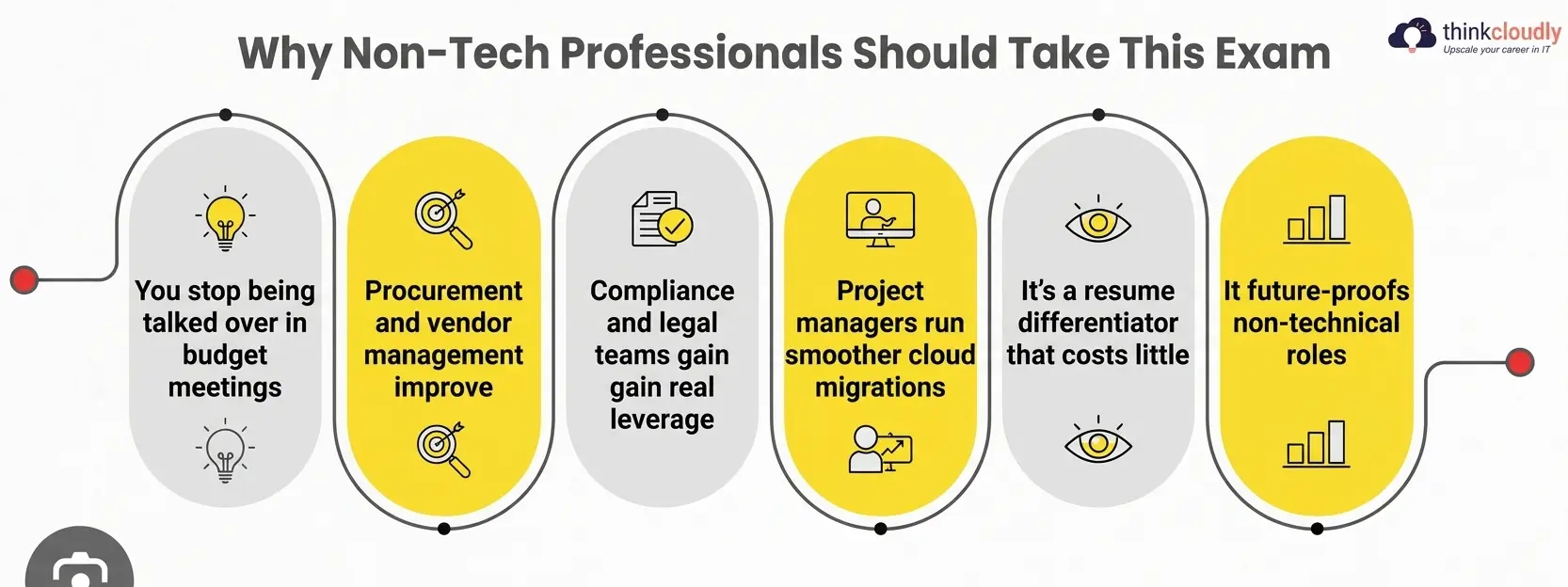
- You stop being talked over in budget meetings. When finance teams understand how the Azure pricing calculator works, they can question an IT spend estimate instead of rubber-stamping it.
- Procurement and vendor management improve. Knowing the difference between the main cloud deployment models—public, private, and hybrid—means you can read a vendor’s proposal and spot when “hybrid” is being used loosely as a buzzword.
- Compliance and legal teams gain real leverage. Governance concepts like data residency, policy enforcement, and access control show up constantly in contracts and audits, and this certification teaches the vocabulary for that conversation.
- Project managers run smoother cloud migrations. You don’t need to build the architecture to manage the timeline, but you do need to understand what the underlying resource structure involves when a vendor says a migration will take “six resource groups and four weeks.”
- It’s a resume differentiator that costs little. Compared to most professional credentials, this exam asks for a modest time investment and an even more modest fee, yet it signals initiative that recruiters notice.
- It future-proofs non-technical roles. As more back-office functions—HR systems, CRM platforms, and finance tools—move to cloud-hosted SaaS built on Azure, understanding the underlying platform stops being optional even for people who will never touch its console.
None of those benefits require you to become an engineer. They require you to become fluent—and fluency is exactly what the Azure Fundamentals certification is built to produce.
Cloud Deployment Models
One of the first concepts the exam covers, and one that trips up non-technical candidates the most, is deployment structure. There are three cloud deployment models, and the distinction matters more in a boardroom than it does on a server rack:
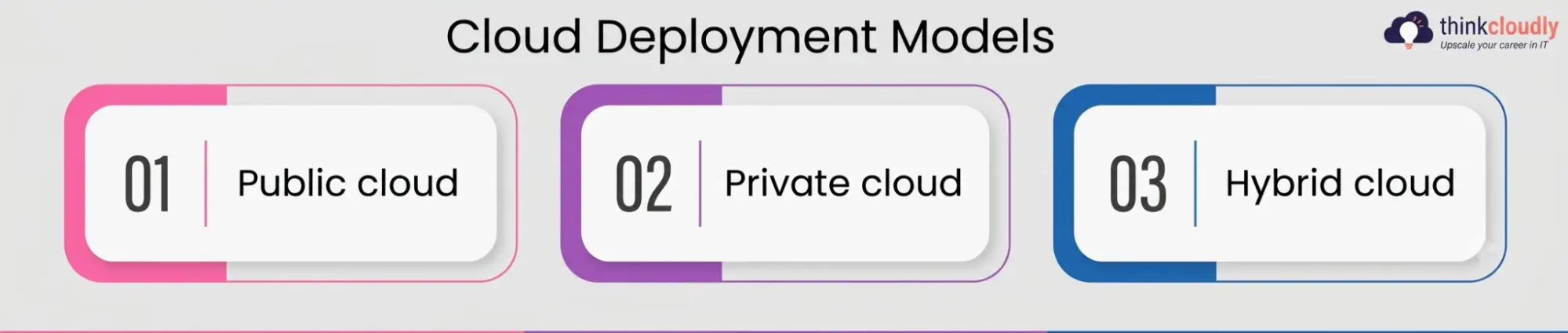
- Public cloud—resources are owned and run by Microsoft and shared across customers over the internet. Lowest upfront cost, fastest to deploy, but less control over the physical infrastructure.
- Private cloud—resources are dedicated to a single organization, often for regulatory or data-residency reasons. More control, generally higher cost.
- Hybrid cloud—a mix of public and private, letting an organization keep sensitive workloads in-house while using the public cloud for scale and flexibility.
Understanding these deployment models isn’t academic. A healthcare company explaining why it uses a hybrid setup, or a retailer justifying a pure public-cloud bet during peak shopping season, is making a decision that non-technical leaders are expected to sign off on. Grasping how cloud deployment models differ—exactly what the Azure Fundamentals certification teaches—means you’re signing off with understanding instead of blind trust.
Azure Resource Management: The Part That Keeps Budgets Honest
Azure resource management sounds like something only an IT administrator should care about, but it’s really an organizational concept wearing a technical name. In Azure, every virtual machine, database, storage account, and network component is a “resource,” and these resources get grouped into “resource groups” for billing, access control, and lifecycle management.
Why should a non-technical professional care? Because this is where cost overruns are either caught early or missed entirely. When a department requests five new resource groups for a project, understanding Azure resource management means you can ask reasonable questions: Are these being tagged for cost tracking? Who has access? What happens to them when the project ends? A finance or operations lead who picks up these basics from the certification syllabus can catch “zombie resources” — unused services still quietly generating a bill — months before an audit does.
The Azure Pricing Calculator: Your New Best Friend in Budget Season
If there’s one tool from the AZ-900 syllabus that pays for itself immediately, it’s the Azure pricing calculator. This free, public tool lets anyone — technical or not — estimate the monthly cost of Azure services before a single resource is deployed.
Here’s a practical use case: your IT team proposes migrating customer data storage to Azure and quotes a rough annual figure. Instead of accepting that number on faith, you open the pricing tool, plug in the storage tier, region, and redundancy option they mentioned, and get an estimate in minutes.
You don’t need to understand the underlying infrastructure to use the Azure pricing calculator effectively—you just need the vocabulary this certification gives you to ask the right questions and interpret the output. Finance professionals in particular find that a working knowledge of the calculator turns cloud budgeting from a black box into a spreadsheet they actually control.
Cloud Governance: Why “Who Can Do What” Matters More Than Ever
Cloud governance is the exam domain most directly relevant to compliance, legal, risk, and audit professionals—and it’s growing more important as regulators pay closer attention to where and how organizations store data.
Microsoft’s own Cloud Adoption Framework treats governance as a formal, sequential phase of cloud adoption, sitting right between deploying workloads and securing them, specifically because organizations keep learning—the hard way—that it can’t be an afterthought.
In practice, this discipline covers things like role-based access control (who can create or delete resources), policy enforcement (blocking non-compliant configurations automatically), cost management (budgets and alerts), and data residency (keeping data in approved geographic regions).
The Azure Fundamentals certification introduces each of these at a conceptual level, which is more than enough for a non-technical professional to participate meaningfully in governance committees, vendor risk assessments, and internal audits.
If your job involves signing off on data handling policies or responding to a regulator’s questions about where customer data physically lives, basic cloud governance literacy isn’t a nice-to-have anymore—it’s becoming a baseline expectation across industries.
Career Paths That Open Up After Certification
Earning the Azure Fundamentals certification doesn’t turn a marketing manager into a cloud architect overnight, and it isn’t meant to. What it does is make non-technical professionals credible participants in cloud-adjacent roles and conversations that are multiplying across every industry. Here’s where it tends to pay off:
- Cloud Vendor/Procurement Specialist—negotiating and managing Azure-based service contracts with real technical literacy
- IT Project Coordinator—running cloud migration timelines and budgets without depending entirely on engineers for basic terminology
- Compliance & Risk Analyst—reviewing governance and data residency commitments during audits
- Business Analyst (Cloud Programs)—translating business requirements into terms a technical team can act on, and vice versa
- Sales Engineer (Entry-Level) — supporting technical sales conversations for Azure-based SaaS products without needing a computer science background
- Finance/FP&A Analyst (Cloud Cost Focus) — using pricing and resource-tagging data to forecast and control cloud spend
None of these roles require the deeper, role-specific Azure certifications that engineers pursue. They require exactly what this beginner credential delivers: enough structural understanding to be useful in a room full of specialists.
A Realistic Study Plan for Busy Non-Technical Professionals
You do not need months. Most non-technical candidates preparing seriously for the AZ-900 exam report needing somewhere between two and four weeks of consistent, short study sessions — not because the material is trivial, but because it’s unfamiliar vocabulary rather than unfamiliar logic. A workable plan looks like this:
- Week 1: Work through Microsoft’s free official AZ-900 study guide to understand cloud concepts and the different deployment options.
- Week 2: Focus specifically on core services — compute, storage, networking — and spend real time inside the azure pricing calculator so the tool feels familiar before exam day.
- Week 3: Study azure resource management, identity basics, and cloud governance, since these are the areas that feel most abstract to non-technical learners, and spend an extra evening on real-world resource group examples if the terminology still feels slippery.
- Week 4: Take Microsoft’s official practice assessment, review weak areas, and book the exam once you’re consistently scoring well above the passing threshold.
Because the az 900 exam has no prerequisites and a short retake waiting period if you don’t pass the first time, there’s little downside to booking it as soon as you feel ready rather than waiting for perfect confidence.
Most candidates who follow a plan like this sit for the exam within a month of starting, which keeps momentum from fading the way it often does with longer, open-ended study timelines.
A Personal Note
I’ll be honest about something most certification blogs won’t tell you: the hardest part of preparing for this credential as a non-technical person isn’t the material — it’s giving yourself permission to study something that sounds like it belongs to someone else’s job title.
It doesn’t. Cloud computing stopped being purely an IT department’s problem years ago; it shows up in budgets, contracts, audits, and strategy decks that land on non-technical desks every single week. Getting the Azure Fundamentals certification isn’t about pretending to be an engineer. It’s about refusing to be the only person in the room who can’t follow the conversation.
If you’ve been putting this off because it felt out of your lane, that feeling is exactly what the certification is designed to fix — and in my experience watching colleagues go through this, it fixes it faster than people expect, usually within a single budget cycle.