

A hiring manager at a mid-size fintech told me last month that she’d posted a single job req and gotten resumes from DevOps engineers, MLOps engineers, and a few people who’d simply slapped both titles onto their LinkedIn profiles, hoping nobody would check.
That confusion is exactly why the MLOps vs DevOps question keeps landing in my inbox from students and working engineers alike. They’re not the same job wearing a different badge, and treating them as interchangeable is how teams end up with a pipeline that ships code beautifully and still can’t tell you why a model started making bad predictions three weeks after launch.
This guide breaks down the real differences—in skills, tools, daily work, and pay—so you can stop guessing which side of that line actually fits where you want your career to go.
Why the MLOps vs. DevOps Question Keeps Coming Up in 2027?
The honest answer is money and scale. Every company that spent 2024 and 2025 building AI prototypes is now spending 2027 figuring out how to run those models reliably without burning through its engineering budget.
That operational pressure is a big part of why the global MLOps market is forecast to grow by roughly USD 10.32 billion between 2027 and 2030, at a compound annual growth rate near 26.3%. That’s not a niche specialty anymore; it’s a fast-moving discipline pulling talent and budget away from traditional infrastructure teams.
At the same time, classic DevOps training work hasn’t gone anywhere. Applications still need to ship, servers still need patching, and someone still has to answer the page at 2 a.m. when a release goes sideways.
This conversation isn’t about one discipline replacing the other—it’s about understanding where they genuinely split, because treating them as the same job is how companies end up hiring the wrong person for the wrong gap.
MLOps vs DevOps: What Each Discipline Actually Covers
DevOps is the discipline of automating and operating the full lifecycle of a software application—build, test, deploy, monitor, and repeat, usually several times a day. The thing being shipped is deterministic: the same code, given the same input, produces the same output every time.
MLOps borrows that same operational mindset but applies it to something far less predictable: a trained model whose behavior depends on data it has never seen before. A model can pass every test in staging and still degrade quietly in production because the real world shifted under it.
That single difference—deterministic code versus a statistical model reacting to live data—is the root of almost every practical distinction between the two disciplines, and it’s why MLOps teams spend so much more time worrying about data quality than DevOps teams typically do.
Core Skills Compared: MLOps vs DevOps
Breaking this down skill by skill makes the overlap and the gap easier to see at a glance:
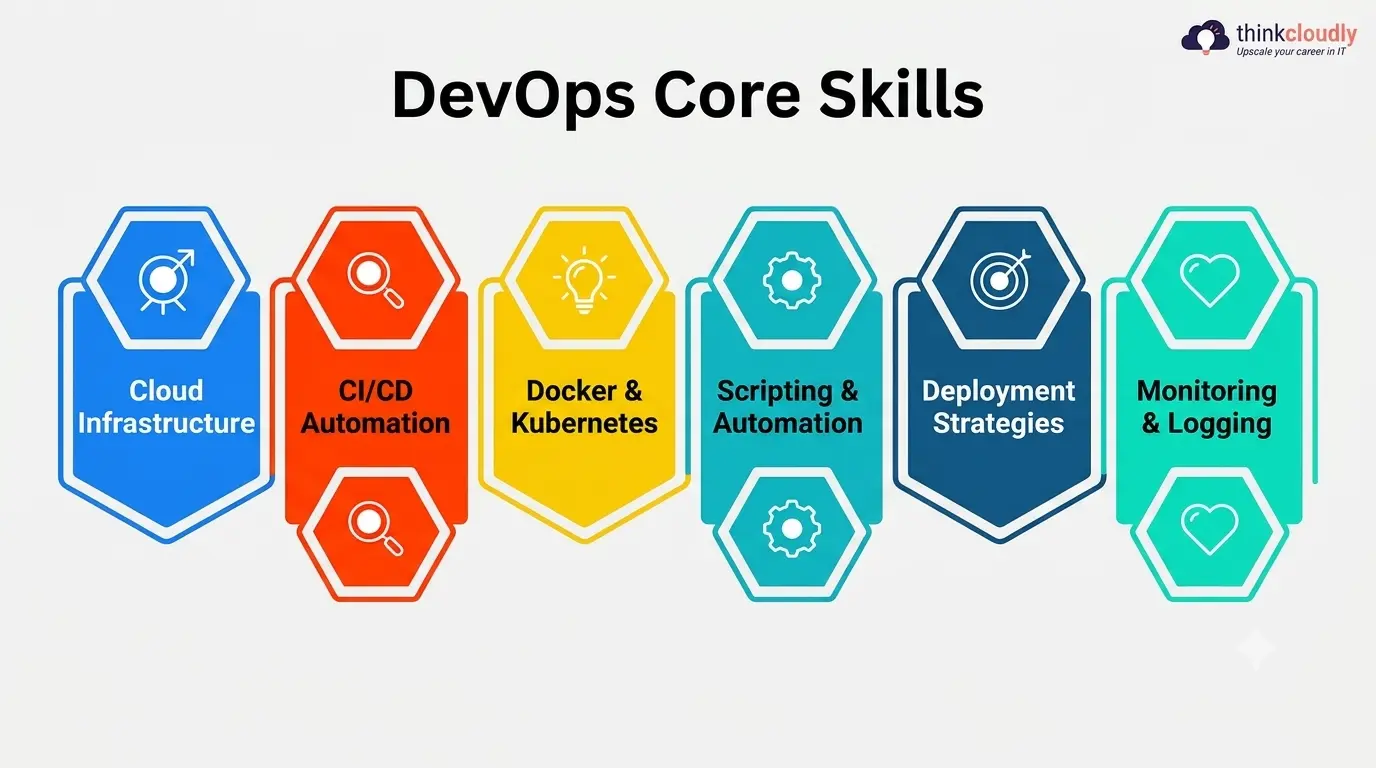
DevOps core skills:
- Cloud infrastructure fundamentals across compute, storage, and networking
- CI/CD Workflows design—build, test, and release automation
- Container orchestration with Docker and Kubernetes
- Scripting for Deployment Automation in Python, Bash, or Go
- Application release strategies: rolling, blue-green, and canary deployments
- Cloud monitoring and log analysis for uptime and performance
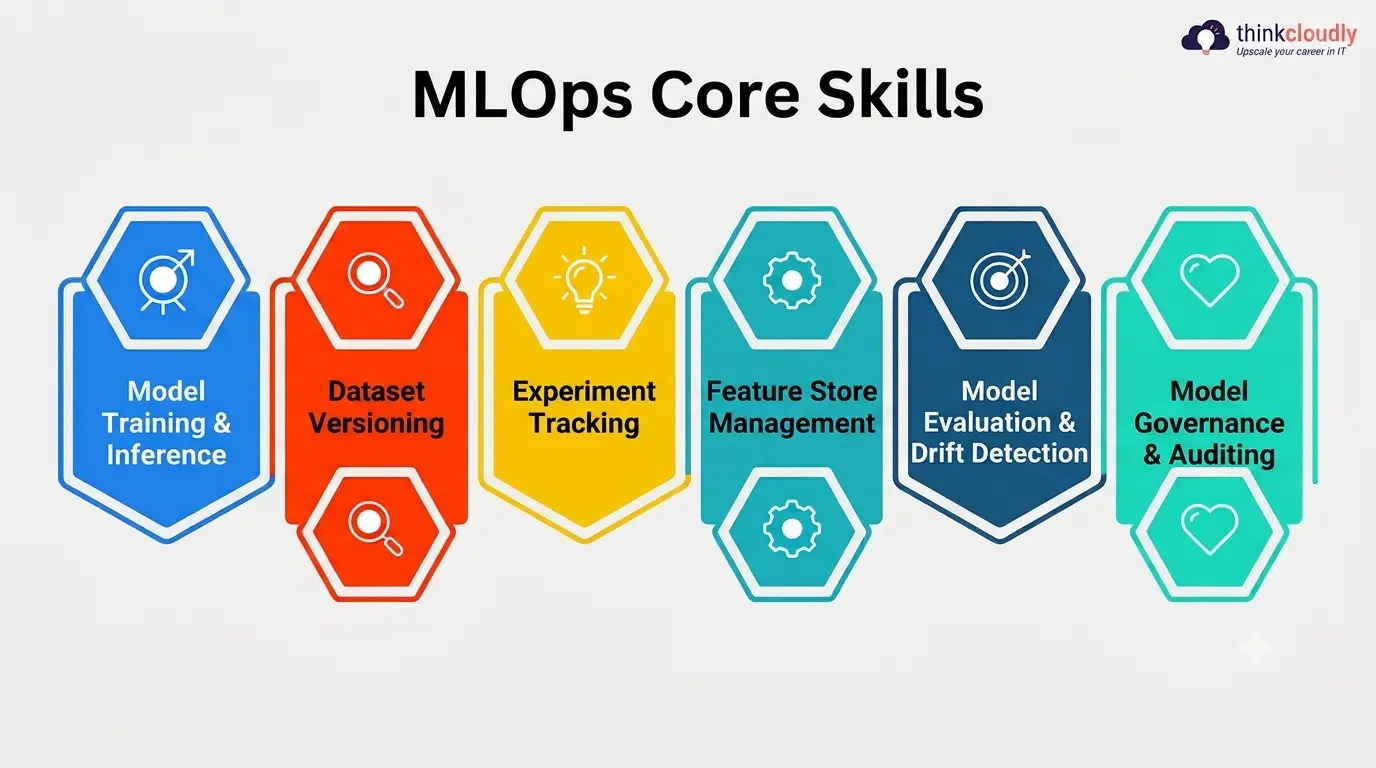
MLOps core skills:
- Everything above, plus a working understanding of training versus inference
- Dataset versioning and model lineage tracking
- Experiment tracking and reproducibility across training runs
- Feature store management for consistent training-to-serving data
- Model evaluation gates and drift detection before and after deployment
- Governance and audit trails tied to every model promoted to production
Notice that the MLOps list doesn’t replace the DevOps list—it sits on top of it. That’s exactly why so many MLOps teams are staffed by former DevOps engineers rather than data scientists learning operations from scratch.
Tools and Platforms: MLOps vs DevOps
The tooling split tells a similar story. Here’s how the stacks typically differ once a team scales past a handful of pilot projects:
1. Typical DevOps toolchain
- Git for version control and GitHub Actions or Jenkins for CI/CD workflows
- Terraform or Pulumi for Infrastructure as Code
- Docker and Kubernetes for container orchestration
- Prometheus and Grafana for cloud monitoring and alerting
- Ansible for configuration management across fleets of servers
2. Typical MLOps toolchain
- MLflow or Weights & Biases for experiment and model tracking
- Kubeflow Pipelines or Airflow for Data Pipeline Automation
- Feast or Tecton as a feature store
- Terraform again, but applied to GPU-backed compute and model endpoints
- A model registry with built-in evaluation gates before promotion
The repetition of Terraform and Kubernetes across both lists isn’t an accident. That shared configuration discipline and container orchestration are the foundation that makes it realistic for a DevOps engineer to pick up MLOps tooling without starting from zero.
CI/CD Workflows: Where the Two Disciplines Overlap and Diverge
A CI/CD pipeline is where the distinction between these two disciplines gets genuinely interesting, because the pipeline shape looks almost identical on paper and behaves very differently underneath. A standard DevOps CI/CD pipeline tests code correctness, builds an artifact, and promotes it through staging to production based on passing tests.
An MLOps pipeline borrows that same structure but has to test something a code reviewer can’t eyeball: whether the model’s predictions are actually good enough to ship. That means the pipeline in an MLOps context needs an evaluation score gate, a comparison against the currently deployed model, and often a fairness or bias check before anything gets promoted.
The global market for these tools reflects how central this has become—continuous integration tooling alone is projected to grow from roughly USD 1.69 billion in 2025 to USD 10.95 billion by 2035, at a CAGR of 20.55%. Teams that bolt a model evaluation step onto an existing release pipeline, rather than building a parallel system from scratch, tend to ship far faster.
Infrastructure as Code: The Shared Foundation Both Roles Rely On
If there’s one technical skill that genuinely transfers without modification across that divide, it’s Infrastructure as Code—defining infrastructure in version-controlled, reviewable configuration rather than clicking through a console.
A DevOps engineer typically writes that configuration for load balancers, autoscaling groups, and standard compute instances; an MLOps engineer applies the same discipline to GPU-backed training clusters, model-serving endpoints, and feature store infrastructure that needs to behave consistently across training and inference.
The market is growing accordingly—this category of tooling is projected to climb from USD 1.2 billion in 2027 to roughly USD 8.6 billion by 2035, a CAGR of 24.3%, which tracks closely with how much GPU and model-serving infrastructure companies are now provisioning. Learn it once, properly, and it travels with you across either career path.
Data Pipeline Automation and Cloud Monitoring: The New Battleground
This is the area where the gap between the two roles widens the most, because data pipeline automation and live system monitoring mean genuinely different things once a model enters the picture.
In a DevOps context, moving data between systems usually means shuttling logs, metrics, or application data from one place to another reliably and on schedule. Monitoring, similarly, is mostly about uptime, latency, and error rates—is the system up, and is it fast enough?
In an MLOps context, the same automation has to guarantee that training data and live inference data are processed through identical transformations, because even a small mismatch silently breaks model accuracy.
Monitoring has to expand to cover data drift, where live inputs quietly diverge from training data, and prediction drift, where outputs shift even though nothing upstream obviously changed. A model can be “up” by every traditional uptime metric and still be confidently wrong.
The observability tooling market reflects this expanding scope, with platforms built for exactly this kind of monitoring projected to grow by roughly USD 1.44 billion between 2027 and 2030, at a CAGR of 8.6%. Wire drift detection into the same dashboards your team already checks daily rather than building a second system nobody opens.
DevOps Engineer Salary vs. MLOps Engineer Salary in 2027
Pay is usually the real question underneath the MLOps vs. DevOps debate, so let’s look at it directly. DevOps engineer salary data for 2027 shows a fairly wide band depending on experience and location, and MLOps roles generally command a premium on top of that band because of the added ML-specific skill set.
|
Level |
DevOps Engineer Salary (2027, US average) | Typical MLOps Premium |
Core Driver of the Gap |
|
Entry-level |
$80,988 | +10–15% |
ML literacy and tooling ramp-up |
|
Mid-level |
$114,014 | +15–20% |
Pipeline orchestration and model governance |
|
Senior-level |
$131,642 | +20–25% |
End-to-end ownership of production ML systems |
These figures come from 2027 US market data compiled by ERI SalaryExpert, and the same source puts the broader DevOps tooling and services market at roughly $24.3 billion in 2027, climbing toward $125 billion by 2034.
The MLOps premium isn’t universal—it depends heavily on company size, industry, and whether the role genuinely owns production models end to end—but the pattern holds across most job boards tracking both titles in 2027.
Even at the senior level, base pay already sits comfortably into six figures before any MLOps premium is applied, which is worth remembering before assuming the AI label alone guarantees a jump in pay.
MLOps vs DevOps: Which Career Path Should You Choose?
There’s no universally correct answer here, but a few honest questions help narrow it down. Do you enjoy debugging why a system is slow, or do you enjoy debugging why a system is wrong? DevOps leans toward the former, MLOps toward the latter, and both are genuinely different kinds of satisfying.
Does your company already have machine learning models in production, or is it still building its first one? If the latter, strong DevOps fundamentals are the more valuable bet right now, because that’s what most teams actually need before they need dedicated MLOps specialists. If models are already shipping and breaking in unpredictable ways, that’s where the gap between these two roles is currently costing companies the most, and where the demand is growing fastest.
There’s also a quieter, practical consideration most guides skip: team size. A five-person startup usually can’t justify a dedicated MLOps hire and instead needs one DevOps-minded generalist who’s comfortable picking up model-specific checkpoints as needed.
A larger organization running dozens of models in production, on the other hand, genuinely needs the specialization, because the operational blast radius of one bad deployment is simply bigger. Knowing which environment you’re walking into matters as much as which skills you already have.
Common Misconceptions About MLOps vs DevOps
A few myths come up often enough to address directly:
- “MLOps is just DevOps for AI.” It borrows the operational mindset, but data drift, model governance, and evaluation gates have no real equivalent in standard DevOps.
- “You need a data science background to do MLOps.” Most MLOps roles are operational, not research roles — ML literacy, not ML expertise, is what’s actually required.
- “DevOps skills become obsolete once a team adopts MLOps.” The opposite is true; core automation, pipeline, and monitoring experience are prerequisites, not competitors.
- “MLOps always pays dramatically more.” The premium is real but modest in most cases, and senior-level DevOps pay often outpaces a junior MLOps role.
A Personal Note
I’ve sat across the table from enough engineers agonizing over this exact career decision to notice a pattern: the people who overthink the label almost always already know which kind of problem excites them more. If the idea of a model quietly drifting wrong keeps you curious rather than anxious, that’s your answer. If you’d rather own the pipeline that ships ten different services reliably every day, that’s yours.
Neither path is the “safer” one anymore — both are growing, both pay well, and both will still need people who actually understand the infrastructure underneath. Pick based on the kind of problem you want to be debugging five years from now, not on which title sounds more fashionable this year.