

Search “Azure certification salary” and you’ll get five different numbers from five different sites, and almost none of them tell you which job title, which region, or which year they’re quoting. That gap is exactly where UK candidates lose negotiating leverage—they walk into an offer conversation with a vague sense that certification “helps,” not a real number tied to the role they’re actually applying for.
This guide fixes that. Using live 2027 UK job-market data broken down by role, it lays out what an Azure certification salary actually looks like for an administrator, an architect, and an engineer, and why the gap between those titles is bigger than most people expect.
Why Are Azure Jobs Paying More in the UK Right Now?
Before the numbers, it helps to understand why employers keep raising the bar on pay for certified staff instead of just hiring more generalists.
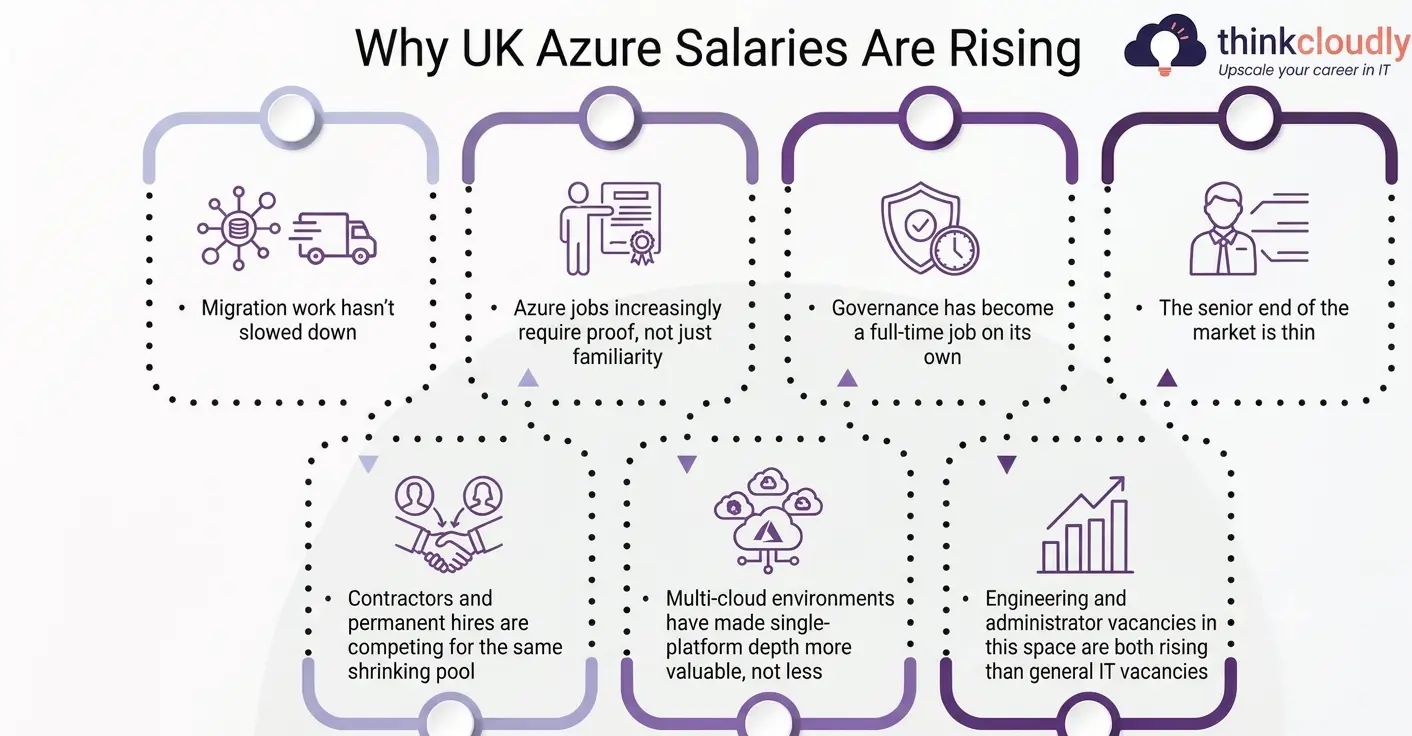
- Migration work hasn’t slowed down. UK enterprises are still moving legacy workloads onto Microsoft’s cloud, and every migration needs people who can design, secure, and run the environment—not just click through a portal.
- Azure jobs increasingly require proof, not just familiarity. Recruiters screen for a named exam because it’s a faster filter than reading every CV line by line, which pushes certified candidates ahead of equally skilled but uncertified ones.
- Governance has become a full-time job on its own. Identity, cost control, and compliance work that used to sit with one generalist now needs a dedicated specialist, and specialists cost more.
- The senior end of the market is thin. There are plenty of people who can pass an associate-level exam; far fewer can design a production-grade landing zone, which is why architect-level Azure jobs command such a steep premium over administrator-level ones.
- Contractors and permanent hires are competing for the same shrinking pool. When contract day rates climb, permanent salaries tend to follow within a year or two to stop good staff from leaving for freelance work.
- Multi-cloud environments have made single-platform depth more valuable, not less. Businesses running Azure alongside AWS or Google Cloud pay more for someone who genuinely knows one platform well than for someone with shallow exposure to three.
- Engineering and administrator vacancies in this space are both rising faster than general IT vacancies, which keeps bidding pressure on salaries at every level of the stack, from support through architecture.
Azure Certification Salary by Job Role in the UK
This table pulls together the most recent UK permanent-vacancy data available, covering the six months leading into late October 2027. It’s the clearest single picture of how an Azure certification salary actually splits by title.
|
Job Role |
UK Median Salary | 25th–75th Percentile |
Year-on-Year Change |
|
Azure Administrator (AZ-104) |
£65,000 | £54,625 – £69,000 |
+18.2% |
|
Azure Solutions Architect Expert (AZ-305) |
£90,000 | £82,500 – £100,000 |
−5.3% |
|
Cloud Engineer (Azure-focused) |
£70,000 | £55,000 – £87,500 |
+7.7% |
|
Cloud Infrastructure Engineer |
£62,500 | £53,750 – £80,000 |
−7.4% |
|
Cloud Administrator |
£85,000 | £50,625 – £125,000 |
+54.6% |
|
All roles citing “Azure certification” |
£62,500 | £50,000 – £85,000 |
+4.2% |
The cloud administrator figure is drawn from a smaller sample of quoted salaries, so treat it as directional rather than exact. Source: IT Jobs Watch, UK permanent vacancy data, six months to late October 2027.
It’s worth being upfront about where these figures come from, because that affects how much weight to put on them. Live job-board data reflects advertised salaries on current permanent vacancies, not a survey of everyone already working in the role, which means it tends to track what employers are willing to pay right now rather than the average pay of the whole existing workforce, including people who haven’t moved jobs in years.
That’s actually useful for anyone negotiating an offer in 2027, since it’s closer to “what the market will bear today” than an averaged figure that includes salaries set five years ago and never revisited.
Notice the spread isn’t a clean ladder. The architect tier sits well above everything else, the cloud administrator shows a wide and volatile range, and the general “all roles” median undersells how much a single title can be worth once you specialize. That’s the real story behind any Azure certification salary conversation: the certification opens the door, but the job title behind it decides how far your pay actually goes.
Azure Administrator: The Realistic Entry Point
For most people starting out, the AZ-104 and the administrator track are the first serious step into paid cloud work. Azure Administrators earned a median of £65,000, up sharply from the year before, with the bottom quarter of the market sitting around £54,600 and the upper quarter closer to £69,000.
Outside London, that median drops to roughly £48,500, which is worth knowing before you assume every offer should match a capital-city headline figure. This is also where most cloud administrator jobs live day to day—managing identities, subscriptions, storage, networking, and cost controls rather than designing the environment from scratch.
It’s unglamorous work, but it’s the foundation every higher-paid specialism in this list eventually builds on, and it’s usually the first real entry on anyone’s Azure certification salary history.
Azure Solutions Architect Expert: The Biggest Pay Jump in the Stack
If there’s one certification that changes the conversation entirely, it’s AZ-305 and the Azure Solutions Architect Expert title that sits behind it. UK architect-role data puts the median at £90,000, with the top quarter of the market clearing £100,000 and the 90th percentile reaching £115,000.
That’s not a small step up from administrator-level pay—it’s close to a 40% jump in median salary for moving from operating an environment to designing one. The role demands a different skill set entirely: landing zone design, network segmentation, disaster recovery planning, and the judgment to say no to a request that would blow the budget or the security model.
Employers pay for that judgment specifically, which is why this title consistently out-earns almost every other role on this list, even senior ones with more raw years of experience.
Cloud Engineer and Cloud Infrastructure Engineer: Close Titles, Different Pay
These two titles get used almost interchangeably in job postings, but the data shows they don’t pay quite the same. A cloud engineer role in the UK carries a median of £70,000, up close to 8% year-on-year, with the top quarter of postings clearing £87,500. A cloud infrastructure engineer role, by contrast, sits at a median of £62,500—and that median actually fell over the past year rather than rising.
The practical difference tends to be scope: the first title more often spans automation, CI/CD pipelines, and application-adjacent infrastructure work, while the second leans toward core networking, storage, and platform reliability.
Neither title is objectively better, but if you’re choosing which skills to build toward next, the automation-leaning path currently has stronger salary momentum behind it, and employers are clearly willing to pay more for that half of the skill set than the pure infrastructure half.
Cloud Administrator: The Wildcard Role
Cloud administrator jobs are the hardest to pin down in this entire dataset. The reported 2027 median of £85,000 looks enormous next to the £45,000 figure from outside London, and that gap tells you the sample is thin and the role definition varies wildly between employers.
Some of these roles are genuinely senior platform-ownership positions dressed in an entry-sounding title; others are closer to the administrator-track work covered above.
If you’re evaluating an offer for one of these roles, treat the title with some suspicion and ask directly what the day-to-day scope actually covers—identity and storage administration, or full platform governance—because the pay band attached to “administrator” in this category swings far wider than it does anywhere else on this list.
What Actually Moves Your Azure Certification Salary Beyond the Exam?
Passing an exam gets your CV past the first filter. It doesn’t, on its own, explain why two people holding the identical credential can sit £30,000 apart in annual pay. A few variables do most of that work.
Region remains the single biggest lever. London and the wider South East consistently pay a premium over the rest of the UK—in some roles, the gap between London and “UK excluding London” medians runs into five figures. That’s not a quirk of these specific numbers; it reflects where enterprise IT budgets and headquarters concentrate.
Depth of hands-on work matters more than the certificate itself. Someone who has actually designed a production landing zone, migrated a live workload without an outage, or rebuilt a broken CI/CD pipeline under pressure earns more than someone who can describe the same concepts from a study guide. Hiring managers test for this directly in interviews, and it shows up fastest in architect-level and senior engineering pay.
Specialization inside the Azure ecosystem compounds the effect on your long-term Azure certification salary. Someone who pairs a core certification with real identity governance experience, infrastructure-as-code skills (Bicep or Terraform), or cost-optimization work tends to clear the next pay band faster than someone who stops at the baseline exam and waits for tenure to do the rest.
Sector and employer size matter too, even if they get less attention than they deserve. Financial services, insurance, and public-sector contracts in the UK tend to pay toward the top of whatever band a role sits in, largely because compliance requirements force them to keep dedicated, certified staff rather than sharing one generalist across several projects.
Smaller consultancies and scale-ups sometimes pay less in base salary but make up ground with faster promotion cycles, since a certified engineer there often ends up owning far more of the environment, far sooner, than an equivalent hire at a large enterprise would.
Certifications and Skills That Push the Numbers Higher
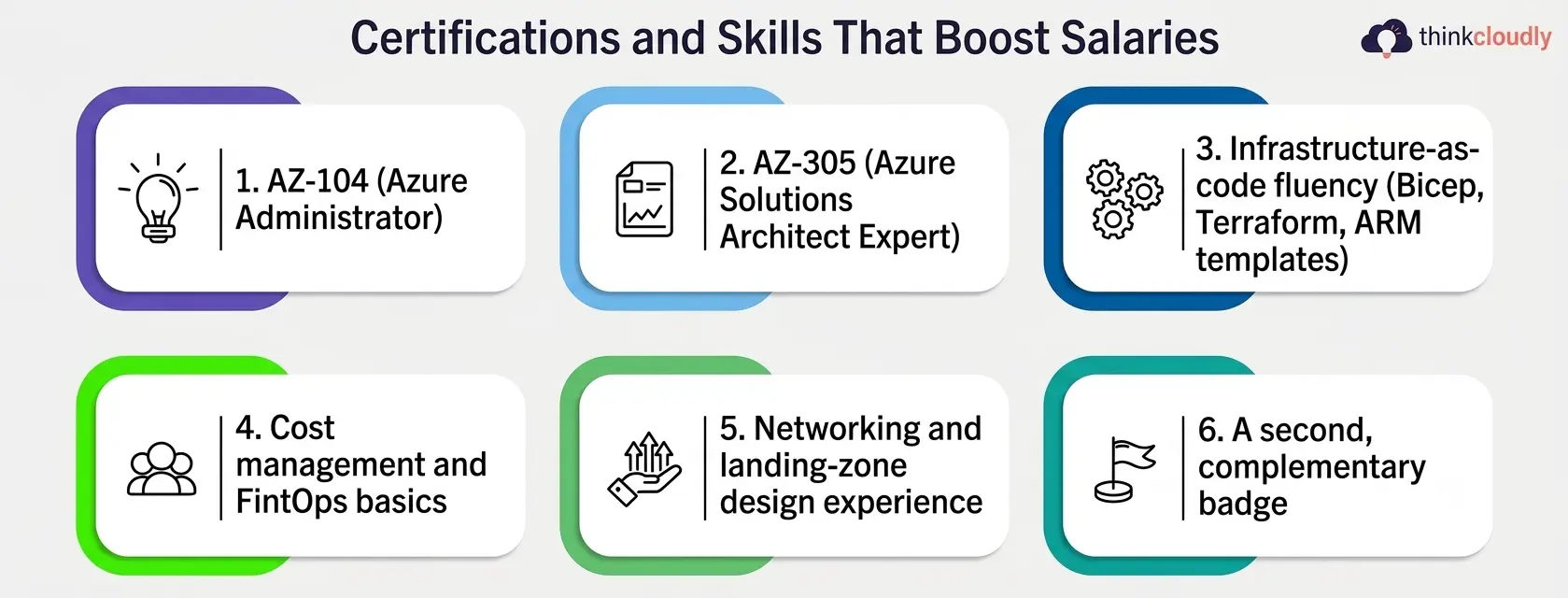
- AZ-104 (Azure Administrator) — the realistic starting point for most of the cloud administrator jobs and junior Azure jobs advertised in the UK right now.
- AZ-305 (Azure Solutions Architect Expert) — the single credential most strongly linked to the biggest salary jump in this entire dataset.
- Infrastructure-as-code fluency (Bicep, Terraform, ARM templates) — increasingly expected of engineering-track candidates applying for mid-to-senior cloud roles.
- Cost management and FinOps basics — a growing line item in Azure jobs postings, since employers now expect certified staff to control spend, not just provision resources.
- Networking and landing-zone design experience — the skill that most reliably separates administrator-level pay from architect-level pay.
- A second, complementary badge — pairing an administrator or architect certification with a security or DevOps credential tends to move candidates into a higher band faster than waiting on tenure alone.
How Pay Grows From Here?
None of these figures are a ceiling. Someone starting out as an Azure Administrator AZ-104 typically has a realistic three-to-five-year path toward solid engineering-level pay, and from there toward architect-level territory, provided the hands-on project work keeps pace with the certifications.
The jump isn’t automatic — it tracks directly with whether someone can point to specific systems they built, broke, and fixed, not just exams they passed. Recruiters and hiring panels in 2027 are notably more willing to ask scenario-based questions in interviews than they were a few years ago, which rewards candidates who’ve actually operated an environment under pressure over those who’ve only studied one.
It’s also worth tracking the regional picture if you’re weighing a relocation. The pay premium for roles based in London and the South East hasn’t disappeared, but hybrid and remote-first hiring has narrowed it in several of the titles above, particularly at engineering and administrator levels, where employers are more willing to advertise one national band regardless of location. Over a full career, that narrowing matters almost as much to lifetime earnings as the certifications themselves.
A Personal Note
I used to assume the certification was the finish line — pass the exam, update the CV headline, wait for recruiters to notice. It took one brutally honest hiring manager to correct that assumption during an interview, when he asked me to walk through a design decision I’d actually made rather than one I could recite from a textbook.
I didn’t have a good answer, and I didn’t get that role. What changed my own trajectory wasn’t a second certification; it was deliberately taking on the migration nobody else on the team wanted, documenting what went wrong, and being able to describe that mess clearly a year later.
If you’re studying toward any of the roles in this guide, don’t stop at the exam pass mark. Build something real with it, break it on purpose in a test environment, and keep a plain-language account of what you fixed — that story is worth more in a salary conversation than the certificate ever will be on its own.