

A reader wrote to me last month asking whether she should study for Microsoft’s newest data engineering badge or go after Google’s Professional Data Engineer credential instead. She’d already burned two weekends on DP-203 tutorials before realizing, halfway through a forum thread, that DP-203 doesn’t exist anymore—Microsoft retired it in March 2025 and folded its content into a Fabric-based exam.
That mix-up is exactly why the Azure data engineer certification vs Google Data Engineer question keeps resurfacing in study groups: the landscape shifted under everyone’s feet, and a lot of comparison posts online still describe an exam that isn’t even offered anymore.
This guide is current for 2027. We’ll look at what the current exam actually tests, how Google’s Professional Data Engineer credential stacks up against it, where the two diverge on schema conventions and tooling, what each vendor expects in terms of hands-on skill, and what career growth genuinely looks like once the badge is on your resume.
We’ll also walk through a plain comparison table so you can scan the differences in one place before committing months of study time to either path. No recycled exam codes, no guesswork—just where things stand right now.
The Numbers That Matter Before You Pick a Path
Before comparing study plans, it helps to see both certifications side by side in plain numbers:
- The Azure data engineer certification now means DP-700: Implementing Data Engineering Solutions Using Microsoft Fabric, which replaced the retired DP-203 credential, according to Microsoft’s own certification update.
- DP-700 runs 100 minutes, includes interactive question formats, and carries no formally listed prerequisite.
- Google’s Professional Data Engineer exam runs 2 hours with 40–50 multiple-choice and multiple-select questions, costs $200 USD, and stays valid for 2 years.
- Google recommends 3+ years of general experience, including at least one year on its own platform, before sitting that exam—a noticeably higher bar than Microsoft sets.
- US data engineers earn a median total pay around $135,000 a year, with cloud-specialized roles trending closer to $157,000.
- UK-based, Azure-focused data engineers typically land between £45,000 and £70,000 gross base salary.
None of this settles the debate outright, but it frames it honestly: this isn’t a story about one exam being objectively harder. It’s two vendors testing two different ways of thinking about the same job.
DP-700 vs Google Professional Data Engineer: Comparison Table
|
Factor |
DP-700 (Microsoft Fabric) |
Google Professional Data Engineer |
|
Issuing Vendor |
Microsoft |
Google Cloud |
|
Exam Length |
100 minutes |
2 hours |
|
Question Format |
Interactive, mixed item types |
40–50 multiple-choice/select |
|
Standard Cost |
Varies by country |
$200 USD |
|
Validity |
Ongoing, free renewal assessment |
2 years, paid renewal or skill badges |
|
Formal Prerequisite |
None listed |
None listed, 3+ years recommended |
|
Core Domains |
Implement/manage analytics solution, ingest and transform data, monitor and optimize |
Design systems, ingest/process data, store data, prepare data for analysis, and maintain workloads. |
|
Primary Toolset |
Microsoft Fabric, Synapse, Power BI |
BigQuery, Dataflow, Dataproc, Pub/Sub |
|
Best Suited For |
Microsoft-standardized, Power BI-heavy organizations | Cloud-native, analytics-first organizations |
A table like this is a fast scan, not the full picture—the real differences show up once you look at what each exam is actually testing.
What the Azure Data Engineer Certification Actually Tests Today
DP-700 is built around Microsoft Fabric rather than the standalone Synapse-and-Data-Factory stack the old exam used to test. Three domains make up the Azure data engineer certification: implementing and managing an analytics solution, ingesting and transforming data, and monitoring and optimizing that solution once it’s running. In practice, candidates need working comfort with SQL for querying, PySpark for transformation logic, and Kusto Query Language for real-time analytics—a broader toolkit than the retired exam expected.
What makes this credential different from its predecessor isn’t just the rebrand. Fabric unifies data engineering, warehousing, and business intelligence into one workspace, so the exam leans harder into orchestration and lakehouse design than the siloed, service-by-service questions candidates used to face. Renewal, at least, got simpler: it’s a free online assessment rather than a full retake, removing one of the biggest recurring frustrations with Microsoft’s older cycle.
Microsoft also publishes a free exam sandbox so candidates can see the exact interaction style before exam day, which is a genuinely useful step most older Microsoft exams never offered.
What Google’s Professional Data Engineer Exam Covers?
Google’s certification takes a broader, more platform-agnostic approach across five domains: designing data processing systems, ingesting and processing data, storing data, preparing data for analysis, and maintaining and automating workloads.
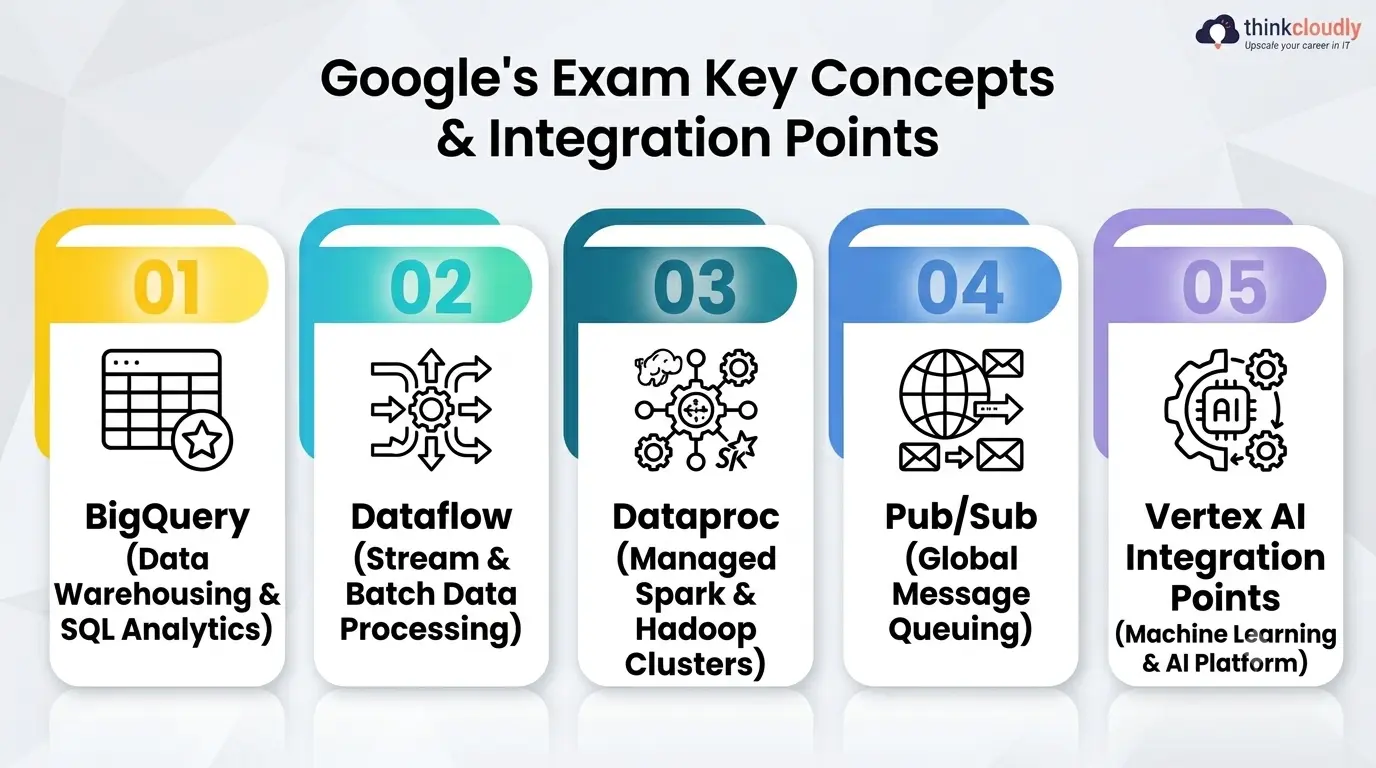
Rather than anchoring on one unified product the way the Azure data engineer certification now anchors on Fabric, Google’s exam spreads questions across BigQuery, Dataflow, Dataproc, Pub/Sub, and Vertex AI integration points, so candidates are expected to reason about trade-offs between services rather than master a single workspace end to end.
Scenario-based questions dominate the format, and Google explicitly recommends three-plus years of general industry experience, with at least one year specifically on its cloud platform, before attempting the exam.
That’s a meaningfully higher bar than Microsoft sets for DP-700, where no prerequisite is formally listed at all—though in practice, nobody passes either exam cold without real hands-on time first.
On renewal, Google gives certified professionals three routes: a full standard exam, a shorter one-hour renewal exam, or completing a set of designated skill-badge courses within the final year of the certification’s active window, which keeps the credential current without forcing a full retake every single cycle.
Data Modeling: Where Azure and Google Diverge
Data modeling looks different on each platform, and that difference shapes a lot of what candidates actually study. On the Azure side, schema design inside Fabric leans on OneLake’s unified storage layer and semantic models built for direct Power BI consumption, so this certification tests table and relationship structure with reporting already baked into the thinking. Google’s approach to data modeling is more warehouse-centric: BigQuery’s nested and repeated fields, partitioning, and clustering strategies dominate that side of the exam, built around querying at a massive scale rather than feeding one specific visualization layer.
Neither approach is wrong—Fabric optimizes for a predictable reporting layer downstream, while BigQuery optimizes for flexibility across whatever analytics tool eventually sits on top of it.
Data Engineering Tools: Fabric’s Workspace vs BigQuery’s Modular Stack
The data engineering tools each vendor expects you to know diverge just as sharply as the schema-design philosophy does. Azure’s data engineering tools center on Microsoft Fabric’s pipelines, Dataflow Gen2, notebooks, and Data Activator for event-driven triggers, with Power BI sitting directly downstream.
Google’s data engineering tools spread across Dataflow for stream and batch processing, Dataproc for Spark and Hadoop workloads, Cloud Composer for orchestration, and Pub/Sub for messaging—a more modular, assemble-it-yourself philosophy than Fabric’s single-workspace design.
If your organization already runs on Power BI and Microsoft 365, Microsoft’s toolset will feel like an extension of daily work; if you’re running open-source Spark pipelines or a multi-cloud setup, Google’s stack will map closer to what you already use day to day.
Cloud Data Platforms: Ecosystem and Everyday Workflow
Zooming out from individual tools, the two cloud data platforms behind these certifications reflect genuinely different philosophies. Microsoft’s cloud data platforms strategy increasingly funnels everything through Fabric—a single SaaS workspace meant to replace juggling Synapse, Data Factory, and Power BI as separate products.
Google’s cloud data platforms remain more service-oriented, with BigQuery, Dataflow, and Vertex AI operating as distinct, composable products rather than one unified workspace. That consolidation-versus-modularity split is exactly why the two exams feel so different to study for, even though both ultimately certify the same job title.
This split matters more in 2027 than it used to, because a growing share of mid-sized and enterprise employers in North America, the UK, and Australia now run genuinely multi-cloud setups rather than committing fully to one vendor.
A candidate who understands why Fabric consolidates and why BigQuery stays modular—not just which buttons to click in either one—tends to adapt faster when a new employer’s stack doesn’t match whichever ecosystem they originally trained on.
Practical Experience: What Each Vendor Actually Expects
Neither certification legally requires hands-on practical experience to sit the exam, but the honest prep timeline looks very different once you dig in. Microsoft lists no formal prerequisite for DP-700, but candidates without real practical experience building pipelines in Fabric consistently report struggling with the scenario-heavy questions on triggers and medallion-architecture design.
Google is more upfront about this: its official guidance recommends three-plus years of general practical experience, including at least one year specifically on Google Cloud, before attempting its exam. Someone a few months into a data role will likely find Microsoft’s associate-level exam more reachable right now than Google’s experience-weighted one.
Career Growth: Salary and Demand Heading Into 2027
Career growth is where most students actually make this decision, so it’s worth being specific. In the US, overall data engineer median total pay sits around $135,000, with cloud-specialized roles trending toward $157,000 and senior data engineers clearing $177,000.
UK-based Azure-focused data engineers commonly sit between £45,000 and £70,000 gross base, with senior roles pushing above that benchmark, while Canadian postings for either platform tend to land in a broadly comparable range once converted.
Neither certification alone guarantees those numbers — career growth tracks more closely with years of experience and the specific platform an employer already runs than with which logo sits on your resume.
Where the Azure data engineer certification tends to open doors fastest is inside large, Microsoft-standardized enterprises migrating on-premises SQL Server and Power BI workloads into Fabric; Google’s credential tends to perform just as well at cloud-native companies and analytics-heavy organizations already standardized on BigQuery. Both paths show real career growth potential once the certification is paired with actual project work.
Quick Decision Points: Azure vs Google, Side by Side
If you’re still undecided, these four questions tend to predict the right answer faster than any domain-by-domain comparison:
- What platform does your target employer already run? If it’s Microsoft 365, Power BI, and on-premises SQL Server migrating to the cloud, the Azure data engineer certification maps directly onto daily work. If it’s BigQuery, Looker, or a broader multi-cloud setup, Google’s certification is the closer match.
- How much hands-on time do you already have? Newer professionals with limited practical experience often find Microsoft’s associate-level exam more approachable, since it carries no formal prerequisite. Candidates with several years in the field, especially on Google Cloud specifically, are better positioned for the scenario depth Google’s exam demands.
- Do you want one unified workspace or modular, pick-your-own tooling? Fabric’s single-workspace design favors consolidation, while Google’s spread-out service model rewards teams who want to choose data engineering tools individually.
- Which ecosystem does your resume already lean toward? Certifying in the cloud data platforms you already have hands-on time in compounds faster than starting fresh on an unfamiliar one, regardless of which vendor’s market share looks stronger on paper.
Neither path locks you out of the other. Plenty of senior data engineers end up holding both within a few years, because employers increasingly want people who aren’t married to a single vendor.
A Personal Note
What struck me most while researching this comparison wasn’t the domain weightings or the salary figures — it was how many study guides online are still teaching a retired exam without flagging it. I went looking for a current, honest side-by-side on this topic before writing it myself and kept finding posts dated 2027 that still walked through DP-203 screenshots, which tells you how fast this corner of the industry moves and how little most writers bother to check.
If you’re picking between these two paths right now, don’t let an outdated blog post decide for you; check the vendor’s own exam page before you buy a single course. My honest advice: stop treating this like a once-and-done, permanent choice.
Pick whichever certification matches the platform your current job or target employer already runs, get genuinely hands-on instead of just watching tutorials, and treat a second certification — if you ever need one — as the informed choice, because by then you’ll actually know what you’re choosing between.