

I get asked some version of the same question almost every month: which Microsoft badge actually gets someone into an architect-level cloud role? There’s no single exam that does it. What gets people hired is a certification sequence followed in the right order, paired with enough hands-on practice that the exam content turns into judgment instead of memorized trivia.
I’ve watched candidates jump straight to the expert-level exam, pass it on the second attempt, and still struggle in their first architecture review because they skipped the fundamentals that make the advanced material click.
This guide lays out a realistic Microsoft cloud certification path for 2027—the exams in sequence, the skills each one is actually testing for, and the parts of the job description that no single certification covers on its own.
If the end goal is a cloud architect title with a salary to match, the path below is the one I’d walk a friend through, start to finish, without the detours that waste a year of study time. Microsoft’s own certification catalog is worth bookmarking alongside this guide, since exam codes and prerequisites do shift from year to year.
Why Does the Cloud Architect Role Demands More Than a Single Badge?
That role isn’t judged on how many exam codes sit on a resume. It sits at the intersection of cloud engineering discipline, business constraints, and long-term design decisions that are expensive to reverse once a workload is already in production.
Hiring managers expect someone who can translate a vague business request into a workable design—covering compute, data, identity management, and Azure networking—without needing six months to ramp up. They also expect that work to connect back to a broader cloud strategy, not just produce one well-built environment that nobody else on the team understands.
That’s precisely why Microsoft structured its credentials as a ladder rather than a single exam. Fundamentals build vocabulary, associate-level exams build operational muscle, and expert-level exams test whether a candidate can reason through trade-offs the way a working architect does every week.
Skipping rungs on that ladder is the single most common reason people stall out partway through a Microsoft cloud certification path, and it’s also the fastest way to burn a study budget on an exam attempt that doesn’t stick.
The Microsoft Cloud Certification Path, Step by Step
Here’s the sequence I recommend to anyone starting from scratch, broken into clear stages so it’s easy to see where you are and what comes next:
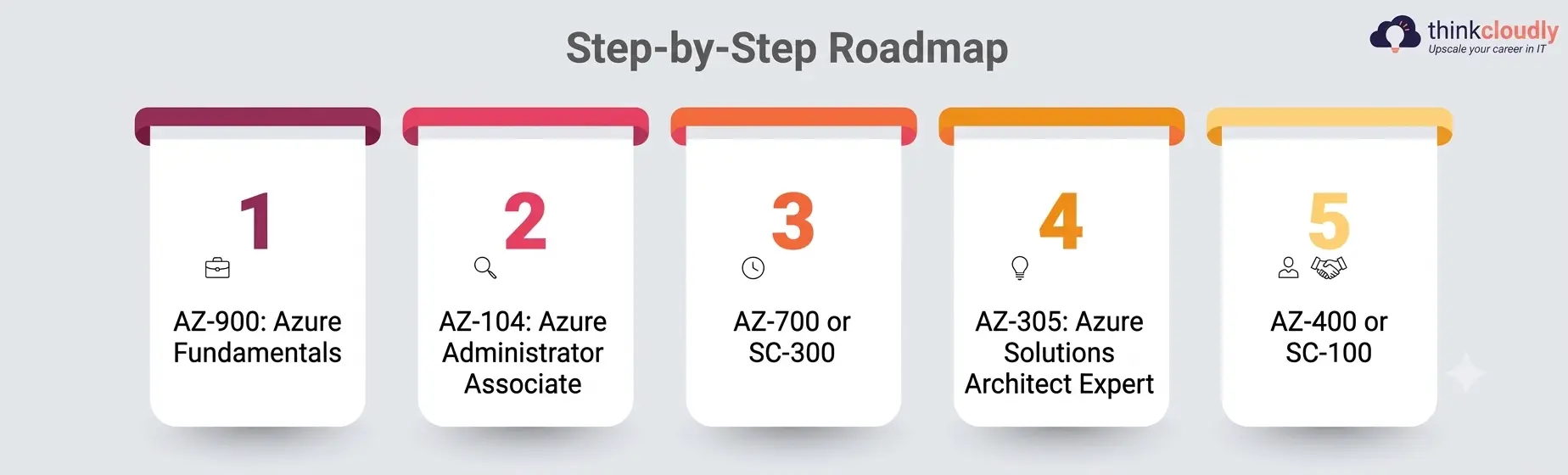
- AZ-900: Azure Fundamentals. No prerequisites, no coding, and it exists purely to build shared vocabulary around pricing models, service categories, and the shared-responsibility model. Skip this only if you already have hands-on Azure experience from a previous role.
- AZ-104: Azure Administrator Associate. This is where the path turns genuinely hands-on. Expect real work with storage accounts, virtual networks, and basic identity management tasks inside Microsoft Entra ID—the foundation every later exam quietly assumes you already understand, so don’t rush this stage.
- AZ-700 or SC-300 (pick based on specialization). AZ-700 goes deep on Azure networking—hybrid connectivity, routing, and traffic management—while SC-300 focuses on identity and access management at a specialist level, covering conditional access and governance. Most architects end up needing working knowledge of both eventually, even if they only sit one exam now.
- AZ-305: Azure Solutions Architect Expert. The centerpiece of the entire Microsoft cloud certification path. It stops asking “what does this service do” and starts asking “which service fits this specific constraint,” which is exactly the thinking that separates a certified admin from a true systems architect.
- AZ-400 or SC-100 (optional specialization). AZ-400 rounds out cloud engineering skills around CI/CD and release pipelines; SC-100 adds a Zero Trust security architecture lens on top of AZ-305. Neither is mandatory, but both make a resume stand out in a crowded applicant pool and signal a specific direction rather than a generalist profile.
Each stage builds on the one before it, which is why rushing straight to AZ-305 without AZ-104 under your belt tends to backfire later—the expert exam assumes operational fluency; it doesn’t re-teach from scratch, and candidates notice that gap halfway through their first scenario question.
None of this has to happen in a straight line either; plenty of people pause after stage two for a year to gain real workplace experience before sitting the expert-level exam, and that pause often produces a stronger result than studying straight through without a break.
Microsoft Cloud Certification Path at a Glance
|
Exam |
Level |
Core Focus |
|
AZ-900 |
Fundamentals |
Cloud concepts, pricing, shared responsibility |
|
AZ-104 |
Associate |
Administration, storage, virtual networks |
|
AZ-700 / SC-300 |
Associate/Specialty |
Networking depth or identity depth |
|
AZ-305 |
Expert |
End-to-end architecture and design trade-offs |
|
AZ-400 / SC-100 |
Expert |
DevOps pipelines or security architecture |
Keep this table nearby while planning a study schedule—it’s the fastest way to see how much ground is left before the expert-level exams and roughly how each rung of the ladder maps to the roles companies actually hire for. Most job postings for a senior design role expect at least stage four complete, with stage five treated as a meaningful bonus rather than a hard requirement.
Core Skills Every Cloud Architect Builds Along the Way
Passing exams is necessary but not sufficient on its own. These are the skills that actually separate a certified candidate from a hireable one, and the ones that come up repeatedly once someone is actually sitting in design reviews:
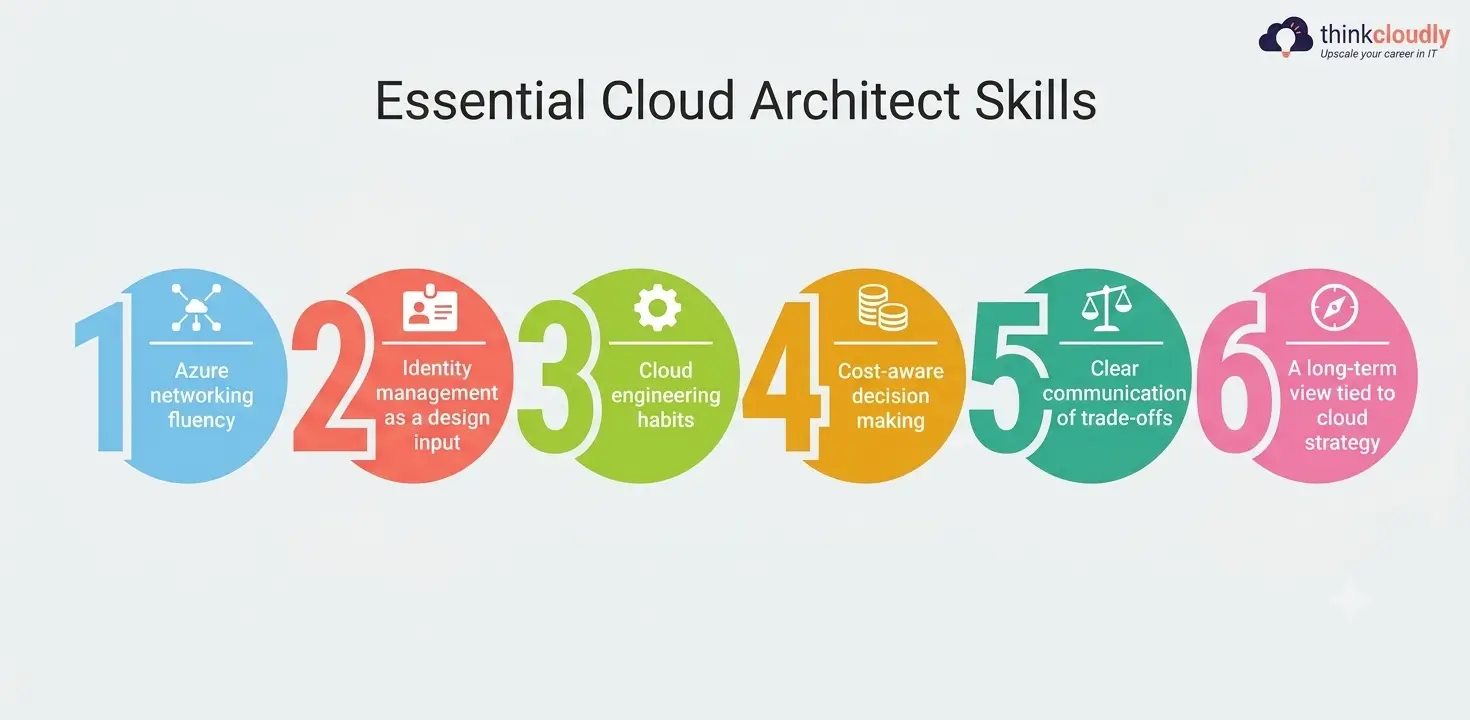
- Azure networking fluency—comfortably comparing hub-and-spoke topologies against Virtual WAN and knowing when ExpressRoute earns its cost over a simpler VPN gateway for a given latency requirement
- Identity management as a design input, not an afterthought—treating Microsoft Entra ID, conditional access, and least-privilege access as part of the architecture from day one, not a checkbox added at the end once something has already gone wrong
- Cloud engineering habits—infrastructure as code, repeatable deployments, and designs that a delivery team can actually build without guessing at undocumented assumptions
- Cost-aware decision-making—right-sizing compute, choosing reserved capacity where it genuinely makes sense, and treating spend as a design constraint rather than a line item someone else cleans up later
- Clear communication of trade-offs—explaining why a design was chosen over the alternatives, since that’s the exact skill AZ-305 and most interview panels are quietly testing for
- A long-term view tied to cloud strategy—connecting a single project’s architecture back to the organization’s broader direction instead of designing a solution that only makes sense in isolation
Azure networking and identity-and-access fundamentals show up on this list because they’re the two areas where exam-only candidates most often get caught out in real design reviews—theory without a sandbox to break things in doesn’t stick the same way hands-on practice does.
Salary and Career Outlook for 2027
Senior design roles in this field continue to pay a premium over generalist admin roles, and 2027 hasn’t changed that pattern. In the UK, research on Cloud Solutions Architect pay shows a wide band between early-career and experienced architects, with the gap driven mostly by how much independent design responsibility a person has actually carried—not just years in the industry.
UK salary data for architect-level cloud roles points in the same direction, with senior titles pulling well ahead of administrator-level pay once a candidate can show real production design work rather than lab exercises alone.
The pattern holds outside the UK too: US postings for the same seniority band consistently list compensation well above generalist infrastructure roles, and employers increasingly list remote-friendly openings for candidates who can prove design judgment rather than just operational familiarity.
On the demand side, worldwide IT spending forecast projects continued double-digit growth, with cloud infrastructure spending as one of the largest contributors—which translates directly into sustained hiring demand for people who can design and govern that spend responsibly rather than simply provision whatever a project team asks for.
What’s shifting is what employers expect alongside the badge. A certification proves baseline knowledge; what gets someone promoted into a senior architect seat is evidence they can connect technical decisions to business cloud strategy—cost forecasting, compliance posture, and resilience planning that a board actually cares about, not just a well-designed virtual network that only the engineering team ever sees.
How to Build a Study Plan Without Burning Out?
Trying to clear the whole Microsoft cloud certification path in one aggressive year is a reliable way to fail two exams and lose momentum on the rest of the sequence. A more sustainable approach looks like this:
- Give each exam four to six weeks of focused study, longer for AZ-305 and SC-100, since both reward scenario practice over flashcards and punish candidates who memorize instead of reason.
- Build a free sandbox subscription and actually deploy the services being studied—a hub-and-spoke Azure networking topology you built yourself teaches more practice questions about the same topic ever will.
- Pair theory with a study group or even one accountability partner; explaining a wrong answer out loud exposes gaps that solo review tends to hide until exam day.
- Revisit the official skills outline a week before exam day—Microsoft updates objectives several times a year, and the current Azure certification roadmap for 2027 is worth re-checking before committing to a sequence.
- Treat broader cloud strategy reading — case studies, post-incident write-ups, architecture blogs from teams outside your own company — as part of the curriculum, not optional extra credit for people with spare time.
None of this needs to be expensive. Microsoft Learn’s free modules cover most exam objectives on their own; the part people skip is the lab time, not the information.
Common Mistakes That Slow Down the Microsoft Cloud Certification Path
The biggest one is sequencing: attempting AZ-305 without AZ-104 experience behind it, then wondering why every scenario question feels harder than the practice tests suggested it would be. Close behind that is treating identity management as a single exam topic rather than a skill that touches every later certification — conditional access and least-privilege thinking show up again inside AZ-305, SC-100, and real job interviews alike, often in the very first question.
A third common trap is chasing every available badge instead of specializing; a resume with five associate-level certifications and no expert-level credential often reads as indecisive rather than well-rounded to a hiring manager scanning quickly.
A fourth, quieter trap is studying in total isolation from the job market — picking exam orders based on personal curiosity rather than the roles actually open in a given region, which can mean months spent on a specialty that nobody nearby is hiring for.
Finally, skipping the hands-on labs in favor of pure video content is the most common reason candidates pass an exam and then stall during their first real cloud engineering task at work, because the exam rewards recognition rather than genuine, repeatable practice.
A Personal Note
I didn’t take this path in the tidy order I just laid out — I jumped into networking content years before I properly understood identity management, and I paid for it later when a design review exposed the gap in front of people I wanted to impress. What I’d tell anyone starting today is simple: treat the Microsoft cloud certification path as a sequence of habits, not a checklist to clear as fast as possible.
The exams matter, but the sandbox hours, the failed deployments, and the moments you have to defend a design choice to someone skeptical are what actually turn a certified admin into a cloud architect worth hiring.
If your longer-term cloud strategy is to lead architecture decisions rather than just execute someone else’s, give the early exams the same respect you’d give the expert-level ones — they’re quietly doing more of the heavy lifting than people expect, and strong cloud engineering fundamentals rarely go out of style, no matter how many new services Microsoft ships next year.