

Every cloud forum eventually circles back to the same unresolved argument: which badge actually moves a career forward faster. The Azure vs. AWS certification question isn’t really about logos or brand loyalty—it’s about where job postings are concentrated, which skills employers pay a premium for, and how far each path can realistically take someone over the next five years.
This piece sets aside the vendor talking points and goes straight to what 2027 hiring data, salary surveys, and exam-market trends are actually showing, so the decision can be made with evidence instead of guesswork.
Job Market Demand — The Numbers You Need
Before comparing exam content or study hours, it helps to see where the actual postings are landing. Based on a dataset of roughly 850,000 US tech job postings spanning 2025 into early 2027, Compare the Cloud’s hiring analysis found the following:
- AWS was named in 30% of postings, the single most-requested cloud platform skill in the entire dataset
- Microsoft Azure followed at 24%, with Google Cloud trailing at 14%
- Infrastructure management and DevOps-tagged roles together made up 12% of all postings, while infrastructure tooling overall accounted for nearly half of every tool mention tracked
- Azure actually overtook AWS at the state level in a handful of US states tied to manufacturing and healthcare enterprise clusters, which means the national average hides real regional variation
- Postings explicitly naming either a cloud engineer or a cloud administrator title grew faster than the broader “cloud” category as a whole, suggesting employers are getting more specific about what they actually need
- 2026 alone accounted for 39% of the full dataset’s postings, nearly four times the volume of the same quarter a year earlier, signalling that cloud hiring accelerated sharply rather than settling into a plateau
None of that settles the AWS-versus-Azure debate outright, but it frames it honestly: AWS still commands a wider net of postings, while Azure holds disproportionate strength in specific industries and regions.
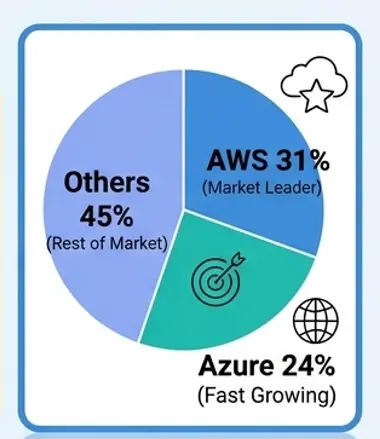
That lines up with the broader market picture too—Tech Insider’s cloud market tracker puts AWS at roughly 31% of global cloud infrastructure spend against Azure’s 24%, down from a 15-point gap back in 2020, which tells its own story about where enterprise budgets are slowly shifting even while AWS keeps the overall lead. A candidate chasing raw volume leans toward AWS; a candidate targeting a Microsoft-heavy employer or a regulated sector gets more mileage from Azure.
Azure vs AWS Certification: Comparing the Two Career Ladders
The actual structure of each certification path matters more than people expect once the ladders are compared side by side. AWS begins with the Cloud Practitioner exam, a foundational credential aimed at anyone entering the field, and moves into the Solutions Architect Associate, which remains the most-requested associate-level badge among hiring managers filling a cloud engineer opening.
From there, candidates branch into specialty tracks—DevOps Engineer Professional, Security Specialty, and Machine Learning Specialty—each aimed at a narrower slice of infrastructure management work.
Azure runs a parallel but differently shaped ladder. AZ-900 (Azure Fundamentals) is the entry point, followed by AZ-104 (Azure Administrator Associate), which is the credential most directly tied to day-to-day cloud administrator responsibilities: identity, storage, networking, and governance inside a live tenant. Above that sits AZ-305 (Solutions Architect Expert) and a growing set of specialty exams covering security, data, and AI workloads.
What separates the two tracks in practice isn’t difficulty—both are demanding at the professional and expert tiers—it’s orientation. AWS’s exam style rewards people who enjoy assembling a solution from a large, modular service catalog.
Azure’s exams lean more on scenario-based case studies tied to a single tenant or organization, which maps cleanly onto day-to-day operational work inside enterprises that are already standardized on Microsoft tooling. Neither ladder is objectively superior; they’re built for different daily realities, and the right Azure vs AWS certification choice depends on which reality a candidate is actually walking into.
Azure vs AWS Certification at a Glance: A Side-by-Side Snapshot
|
Factor |
AWS Path |
Azure Path |
|
Entry certification |
Cloud Practitioner (CLF-C02) |
Azure Fundamentals (AZ-900) |
|
Core associate credential |
Solutions Architect Associate (SAA-C03) |
Azure Administrator Associate (AZ-104) |
|
Reported salary uplift |
Roughly +$26,000/year on average |
Roughly +$24,000/year on average |
|
Job posting share (US, 2025–26) |
~30% of cloud-related postings |
~24% of cloud-related postings |
|
Strongest regional/industry fit |
Startups, product-led tech, cloud-native teams |
Government, finance, manufacturing, Microsoft-standardized enterprises |
|
Typical renewal cycle |
3 years (most associate/professional exams) | Annual free renewal for most associate exams |
A table like this compresses a lot, so treat it as a starting filter rather than a final verdict—the sections below unpack why these numbers shake out the way they do.
Salary and Career Growth: Which Path Pays and Scales Faster
Career growth is where the Azure vs. AWS certification conversation actually gets personal, because this is the number most people are really trying to answer. The US roles requiring AZ-305 or AZ-500 commonly pay between $130,000 and $180,000, while senior multi-cloud architect roles “regularly exceed” $160,000 regardless of which badge sits behind them.
On the AWS side, the same source notes that professional-level certifications can shorten the time to a first offer dramatically for active job seekers—sometimes to four or eight weeks, compared with three to five months for most associate-level credentials on either platform.
The earning trajectory doesn’t stop at the first certification, either. Professionals who stack a core associate badge with a specialty exam—security, DevOps, or machine learning—consistently out-earn peers who stop at one credential and wait for tenure to catch up.
That pattern holds on both platforms, which is a useful reminder that the platform choice itself matters less, long-term, than the decision to keep climbing whichever ladder was chosen first.
The earning curve here behaves less like a single fork in the road and more like compounding interest: the second and third credentials tend to matter more than which vendor issued the first one, and a candidate who stalls after one exam tends to plateau well before someone who keeps adding specialty badges on a steady cadence.
The broader trajectory also differs by starting role. Someone entering through an administrator-track credential on Azure typically has a clearer, more linear path toward governance and identity specialization, since that’s exactly what AZ-104 and its follow-on exams are built around.
Someone starting on AWS’s engineer-track exams, by contrast, often has a wider branching path available immediately, simply because AWS’s catalog spans more distinct service categories to specialize into. Neither route is slower in absolute terms—they just front-load the specialization decision at different points in the first few years of work.
Infrastructure Management and Security Engineering: Where Each Platform Pulls Ahead
Two specific disciplines deserve their own look, because this is where the gap between the two certification paths actually shows up in day-to-day work rather than just in exam names.
Infrastructure management on AWS tends to mean assembling and wiring together independent managed services—compute, networking, storage, and orchestration—each configured through its own console or API.
That rewards certified professionals who are comfortable thinking in modular, loosely coupled systems, and it’s a major reason the AWS path has such a steep early learning curve but strong long-term flexibility once mastered.
Azure’s take on the same discipline leans more on a unified resource-group model, where networking, compute, and storage for a given workload typically live together under one governance boundary—a structure many administrators find faster to reason about, especially early in a career.
Security engineering follows a similar split. AWS’s Identity and Access Management system is famously granular, which is a strength for teams that want precise control over every permission boundary, but it’s also a well-documented source of misconfiguration risk when that granularity isn’t managed carefully.
Azure folds security engineering into Microsoft Entra ID, giving teams a more guided, policy-driven approach that often feels safer by default for organizations without a dedicated security specialist on staff.
Candidates who pursue the AWS Security Specialty exam tend to be preparing for security engineering roles inside complex, service-sprawling environments, while AZ-500 candidates tend to be preparing for similar security-focused work inside organizations already standardized on Microsoft identity and compliance tooling.
Neither approach is strictly better—they’re optimized for different organizational shapes, and picking between an AWS or Azure specialty exam often comes down to which shape the target employer already has.
Cloud Engineer vs Cloud Administrator: Which Role Benefits More
A lot of the Azure vs AWS certification confusion comes from blending two genuinely different job families. A cloud engineer role typically spans automation, CI/CD pipelines, and application-adjacent infrastructure work, and it tends to reward the AWS associate and professional tracks because so much of that catalog is built around composable automation primitives.
A cloud administrator role, by contrast, centers on day-to-day operation of an existing environment—identities, subscriptions, storage policies, cost controls—which is close to a direct description of what AZ-104 was designed to validate.
This distinction matters for anyone choosing a first certification. If the job postings being targeted say “cloud engineer,” the AWS path generally has a shorter, more direct line from credential to day-one responsibilities. If the postings say “cloud administrator,” Azure’s AZ-104 track usually maps more precisely onto the actual first ninety days on the job.
That said, plenty of employers use these titles loosely, so it’s worth reading two or three real job descriptions before locking in either badge — a title like this at one company can mean full platform governance, while at another it means a narrower, entry-level scope.
Both paths ultimately feed into the same broader career growth story: an engineer-track hire who deepens platform skills eventually moves toward architect-level work, while an administrator-track hire who deepens identity and security specialization eventually moves toward lead or specialist roles. The titles diverge early in a career and often converge later.
Two Things to Check Before You Commit
If the sections above left two roughly equal options on the table, these are the two questions that tend to resolve the Azure vs AWS certification decision fastest:
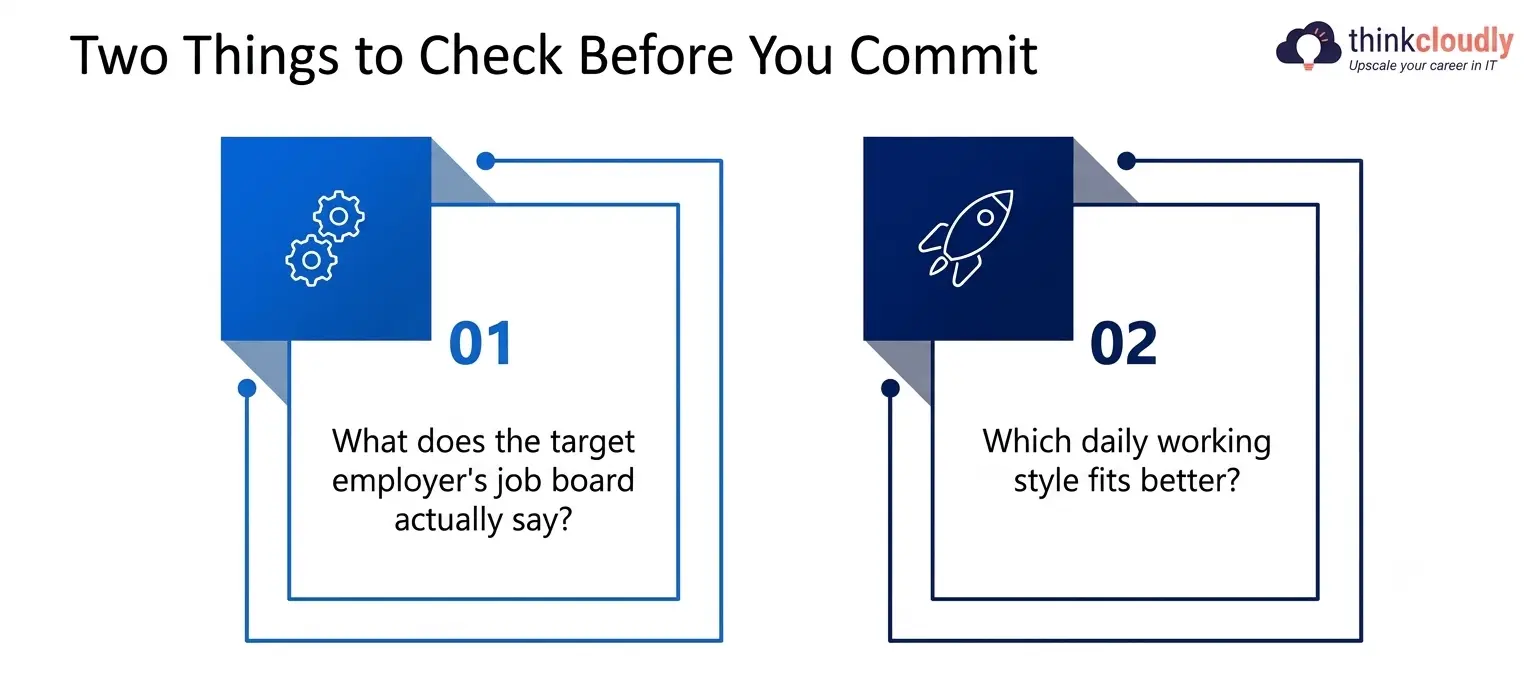
- What does the target employer’s job board actually say? Pull five to ten real postings for roles wanted in twelve months and count how often each platform shows up by name. That single exercise beats almost any generic market-share statistic for predicting what will actually get someone hired.
- Which daily working style fits better? Anyone who likes assembling solutions from a wide, modular toolbox and doesn’t mind a steeper early climb will probably prefer AWS and its broader infrastructure management catalog. Anyone who prefers a more guided, policy-driven environment with faster onboarding will likely find Azure’s administrator-first structure more natural from week one.
There’s no permanent commitment either way. Plenty of professionals end up certified on both platforms within a few years, because employers increasingly value people who aren’t locked into a single vendor’s worldview.
A Personal Note
I spent longer than I’d like to admit treating this like a once-and-done decision, as though picking wrong would somehow close a door permanently. It doesn’t. I started on the platform a former colleague happened to use, not because of some rigorous market analysis, but because the underlying concepts — identity, networking, cost control — turned out to transfer almost completely once I actually understood them rather than memorized them for an exam.
Anyone stuck on the Azure vs AWS certification question right now would do well to stop waiting for a perfect answer that doesn’t exist. Pick the one tied to real job postings visible today, get hands-on in a sandbox environment instead of just watching tutorials, and let the second certification be the genuinely informed choice — because by then, actual experience will be doing the deciding, not a market report.