
Every week I get some version of the same message from someone just starting out: “Should I pay for a DevOps certification, or can I learn this for free and still get hired?” It’s a fair question, and honestly, it doesn’t have a one-line answer.
I’ve spent enough time around hiring managers, bootcamp grads, and self-taught engineers to know that both paths work—but they work for different people, at different stages, for different reasons.
This piece is my honest attempt to lay out DevOps certification for beginners’ decisions the way I’d explain them to a friend over coffee, not the way a course-selling website would. I’ll walk through what free options actually give you, what paid options actually cost, where the real value sits, and which path makes sense depending on where you’re starting from. No recycled 2023 advice—this reflects how the market and the available programs actually look heading into 2027.
Why the Free vs. Paid Question Matters So Much Right Now?
A few years ago, “DevOps” was a niche title tucked inside a handful of Silicon Valley job boards. Today it’s one of the most commonly listed roles on cloud job postings across the US, UK, and Europe, and that popularity has created a flood of training options—some excellent, some barely worth the download.
Employers are no longer satisfied with candidates who can define continuous integration on a whiteboard; they want people who’ve actually broken a build, fixed it, and understood why it happened.
That shift is exactly why getting your DevOps certification for beginners strategy right matters: pick the wrong starting point and you either waste months on content too basic to help, or you burn a few hundred dollars on an exam you weren’t ready to pass.
The free vs. paid debate isn’t really about money alone. It’s about what you need at this exact moment—foundational understanding, verifiable proof for a resume, or hands-on practice with real DevOps tools. Each option on the market tends to deliver one of those three things well, rarely all three at once.
What a Beginner-Friendly DevOps Path Actually Needs to Teach?
Before comparing free and paid routes, it’s worth being clear about what any solid DevOps certification for beginners program should actually cover. If a course skips these basics, the price tag—free or paid—doesn’t matter much.
At minimum, a beginner path should build real DevOps skills around:
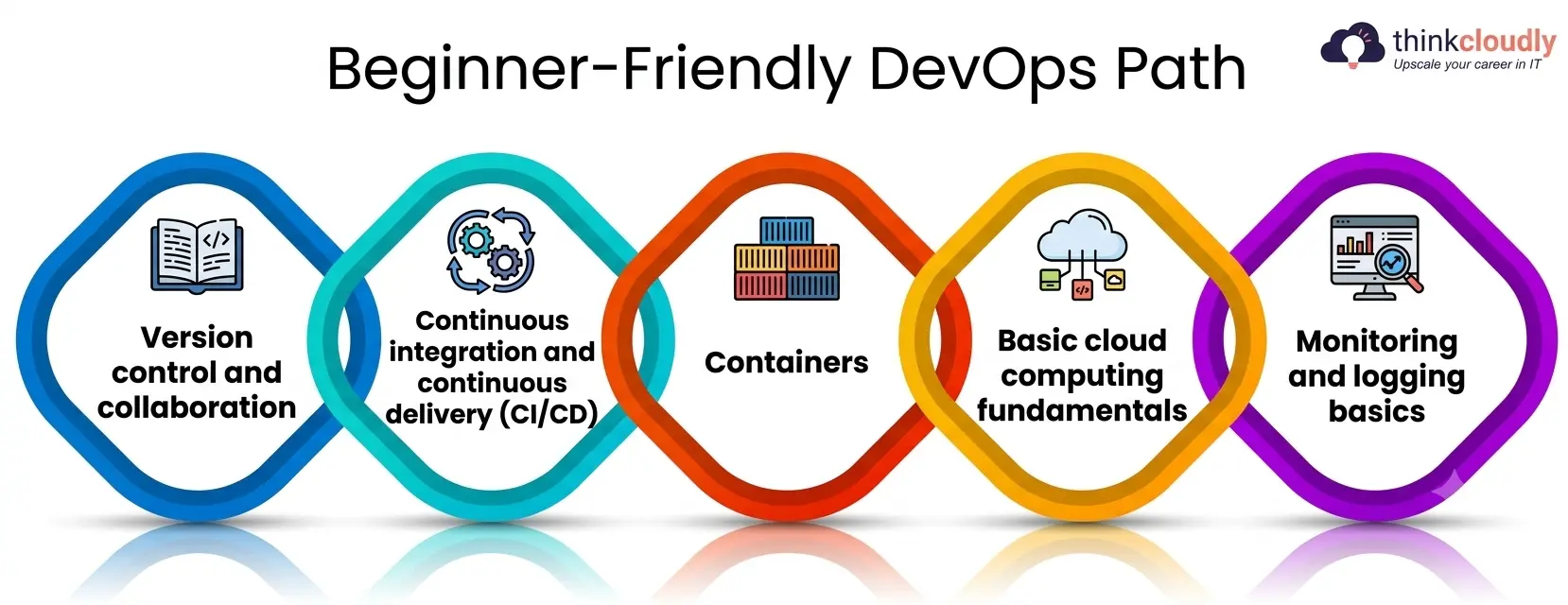
- Version control and collaboration, usually with Git, since almost every pipeline starts there
- Continuous integration and continuous delivery (CI/CD) concepts, even before touching a specific tool
- Containers, typically Docker, since most modern DevOps tools assume some container literacy
- Basic cloud computing fundamentals, because DevOps work rarely happens outside a cloud environment anymore
- Monitoring and logging basics, so you understand how teams catch problems before customers do
If a program—free or paid—glosses over these and jumps straight to “advanced orchestration,” it’s probably not built for someone starting from zero, regardless of how good its marketing looks. It’s worth sitting with that list for a moment, because most people who regret a certification purchase later didn’t pick a bad provider—they picked the right provider at the wrong stage of their own learning curve and ended up paying twice to fill the gaps a cheaper starting point would have covered.
Free DevOps Certification for Beginners Options Worth Your Time
Free training has gotten genuinely good, not just “good enough to skim.” According to a TechTarget roundup of free DevOps training, several reputable providers now offer no-cost introductory material that covers real ground rather than watered-down marketing content. Here’s where I’d point a true beginner first:
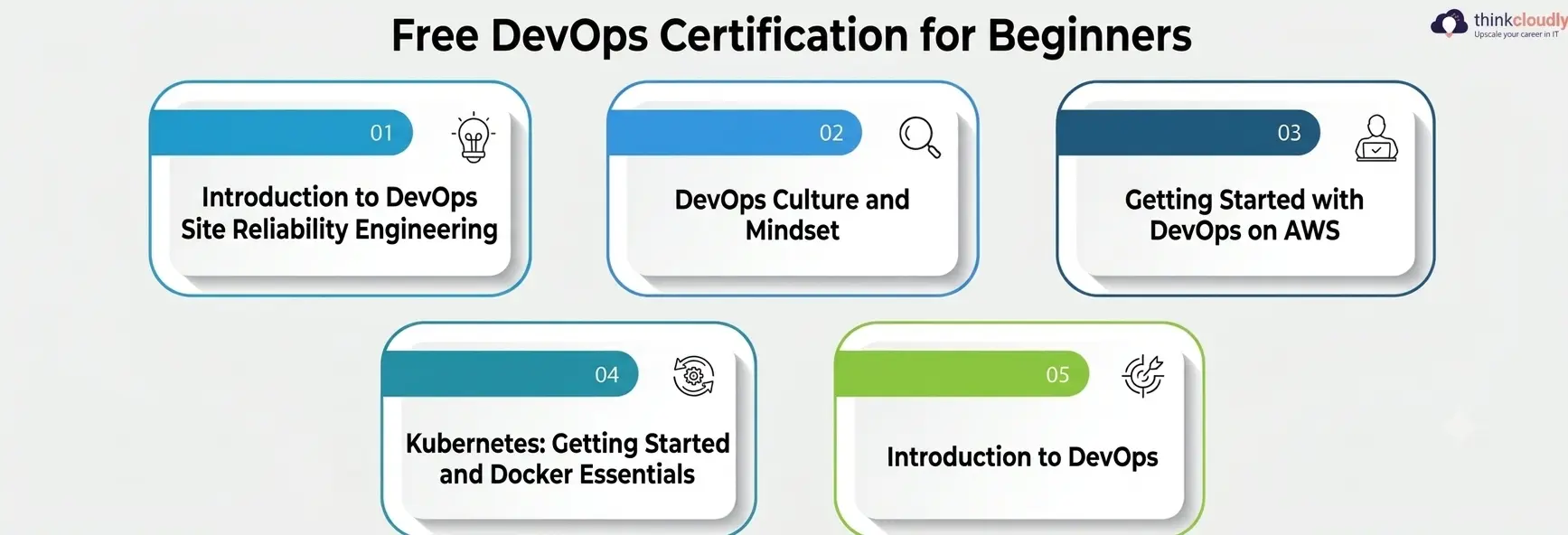
- Introduction to DevOps and Site Reliability Engineering—covers DevOps basics, infrastructure as code, and continuous integration with a practical Linux focus
- DevOps Culture and Mindset—free to audit, useful for understanding why DevOps exists before diving into DevOps tools
- Getting Started with DevOps on AWS—a solid first step if you already know you want to specialize in a specific cloud platform
- Kubernetes: Getting Started and Docker Essentials—hands-on introductions to two tools you’ll meet in almost every job description
- Introduction to DevOps—useful for understanding the historical “why” behind breaking down silos between development and operations
The honest limitation here: most free options teach concepts well but don’t hand you a verifiable, industry-recognized credential at the end. You’ll usually walk away with real understanding and, at best, a course completion certificate rather than a formally proctored certification exam result. That’s not nothing — it still shows initiative on a resume and signals that you followed through — but it’s not the same weight as a credential backed by a testing body.
Paid DevOps Certification for Beginners Options and What They Cost
Paid certifications exist for a specific reason: they’re proctored, standardized, and verifiable by anyone checking your credential ID. That verification is exactly what makes them industry-recognized credentials rather than just completed coursework.
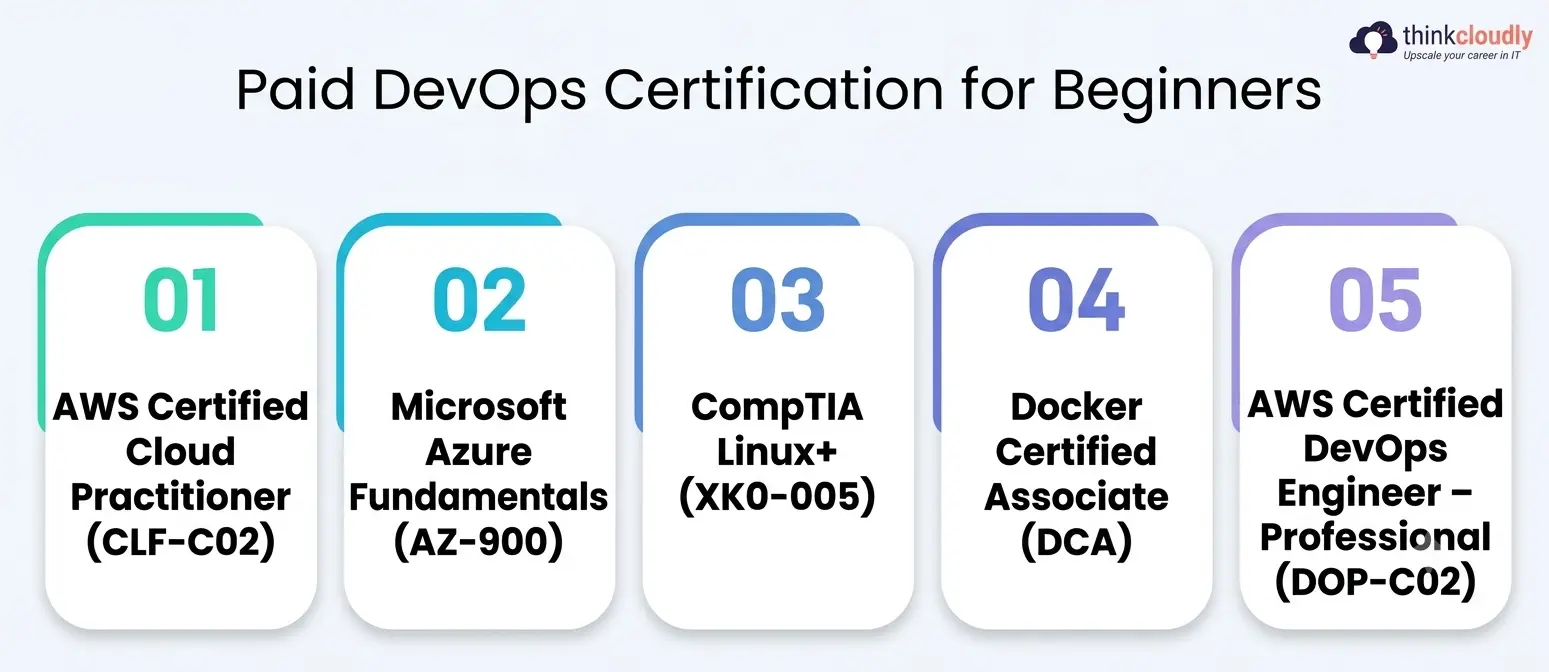
- AWS Certified Cloud Practitioner (CLF-C02) — around $100, a genuinely beginner-appropriate entry point into cloud computing before any DevOps-specific exam
- Microsoft Azure Fundamentals (AZ-900)—around $99, the Azure equivalent for anyone whose target employer runs on Microsoft’s stack
- CompTIA Linux+ (XK0-005)—around $369, recommended for anyone shaky on Linux, since nearly every DevOps pipeline ultimately runs on it
- Docker Certified Associate (DCA)—around $195, a reasonable next step once you’re comfortable packaging and shipping containers
- AWS Certified DevOps Engineer – Professional (DOP-C02)—officially priced at $300 by AWS itself, though this one is genuinely not for beginners; it assumes real production experience first
Notice the pattern: none of the beginner-appropriate paid options jump straight into advanced DevOps engineering exams. The sensible paid DevOps certification for beginners sequence starts with a cloud fundamentals exam, moves into containers, and only later reaches the professional-level DevOps certifications that employers associate most strongly with senior hires.
What Certified Professionals Actually Earn in 2027?
Money shouldn’t be the only reason to pursue a certification, but it’s a reasonable one to weigh honestly. The entry-level professionals in the US are earning a median of roughly $80,988, with mid-level professionals climbing to around $114,014 and senior-level engineers reaching approximately $131,642.
Certification alone won’t put you at the top of that range — experience does most of the heavy lifting — but it can be the difference between getting past a resume filter and never being considered at all for the roles that pay toward the higher end.
That earning potential sits inside a labor market that’s still expanding. The US Bureau of Labor Statistics projects computer and information technology occupations will keep growing faster than the average across all occupations through the mid-2030s, driven largely by companies continuing to shift infrastructure to the cloud and automating operations work that used to be done by hand. None of that growth is handed to any individual automatically, but it’s a genuinely favorable backdrop for anyone deciding whether this career path is worth the study hours right now.
Free vs Paid: A Side-by-Side Look
Here’s the comparison I wish someone had shown me when I was deciding where to start. Think of it as a quick-reference guide, not a ranking—the “better” column depends entirely on what you need right now.
|
Factor |
Free Options |
Paid Options |
|
Typical cost |
$0 |
99–450 depending on the exam |
|
Depth of DevOps skills taught |
Good for concepts, lighter on proctored assessment |
Deep, since exams force applied understanding. |
|
Proof you receive |
Usually a course completion certificate |
A formally issued, verifiable certification |
|
Recognition with employers |
Shows initiative, rarely a resume filter on its own |
Often used as an actual resume filter by recruiters |
|
Best for |
Testing interest, building foundational DevOps skills |
Proving competence once you’re ready to apply seriously |
|
Time investment |
Self-paced, often lighter |
Structured, with a fixed exam date forcing discipline |
|
Risk if you quit halfway |
None financially |
Lost exam fee if you don’t pass |
Do Employers Actually Care About Industry-Recognized Credentials?
Yes—but not blindly, and not equally across every hiring stage. Recruiters doing first-pass resume screening at larger companies often use industry-recognized credentials as a blunt filter before anyone reads your project history closely.
A verified AWS, Azure, or Linux Foundation credential clears that first gate in a way a free certificate of completion usually doesn’t, simply because anyone can list a free course on a resume with no way for a recruiter to verify it happened.
Once you’re past that first screen, though, the weight shifts. Hiring managers interviewing you directly tend to care far more about what you can actually demonstrate — a working pipeline, a documented project, real comfort with the DevOps tools the team already uses — than which certificate sits on your LinkedIn profile.
This is exactly where the free vs. paid decision stops being binary: smart beginners often use free resources to build real DevOps skills and a portfolio, then add one verified paid credential once they’re ready to apply, so the resume filter and the interview conversation both work in their favor.
Where Cloud Computing Fits Into the Decision?
It’s easy to treat “DevOps” and “cloud computing” as separate tracks, but in 2027 they’re barely separable in practice. Almost every DevOps tool you’ll touch—pipelines, container orchestration, infrastructure as code—runs on top of a cloud platform, usually AWS, Azure, or Google Cloud. That’s why most sensible beginner roadmaps, free or paid, start with a cloud fundamentals course before anything DevOps-specific.
If you’re choosing between a free cloud primer and jumping straight into a paid DevOps exam, take the primer first. Every paid DevOps certification for beginners path I’ve seen work well started with someone who already understood how compute, storage, and networking fit together in the cloud, rather than someone memorizing CI/CD terminology in isolation.
Course Completion Certificate vs Real Certification: Know the Difference
This distinction trips up a lot of beginners, so it’s worth saying plainly: a course completion certificate confirms you finished watching or reading material. A certification confirms, through a proctored exam, that you can apply that material under test conditions. Both have a place on a resume, but they are not interchangeable, and claiming the stronger label for the weaker credential is a mistake recruiters notice quickly.
If you’re early in your DevOps certification for beginners journey, collecting a few completion-certificate credits from free platforms is a smart, low-risk way to confirm you actually enjoy the work before spending money. Just don’t let a stack of completion certificates substitute for the one proctored credential that actually opens resume-screening doors later.
My Verdict: Which Path Should You Actually Take?
If you’re genuinely unsure whether DevOps is the right fit, start free. Build real DevOps skills with Git, Docker, and a cloud computing fundamentals course before spending a dollar. Once you know you want this as a career and you’re ready to prove it, invest in one cloud fundamentals exam first, then a containers-focused credential, saving the professional-level DevOps exams for after you have real hands-on experience.
That sequencing is, in my experience, the most reliable DevOps certification for beginners: free for exploration and skill-building, paid for verification once you’re serious. Skipping straight to an expensive professional exam without the free groundwork first is the single most common mistake I see beginners make, and it’s an expensive one to learn from directly.
A Personal Note
I didn’t start in tech with any certification at all — I started by breaking a staging environment at 1 a.m. and spending the rest of the night figuring out why. The free resources taught me the “why” behind DevOps long before I ever paid for an exam, and I still think that order matters more than people admit.
If you’re reading this because you’re not sure where to begin, start free, get your hands dirty, and only reach for your wallet once you already know, from experience, that you want to keep going. The certification should confirm what you’ve learned, not teach it to you from zero.