


I get asked some version of this question almost every month, usually by someone three weeks into learning Terraform and already anxious about whether a certificate will actually move the needle.
The honest answer isn’t a flat yes or no. It depends on where you are in your career, what your resume already says about you, and whether you’re treating the exam as a learning checkpoint or a magic ticket. Let’s actually work through it instead of giving you a motivational one-liner.
The Terraform Associate exam has become one of the more talked-about entry points into infrastructure-as-code work, and for good reason—hiring managers increasingly expect candidates to show they understand state, modules, and provisioning logic before they ever touch a production account.
But “popular” and “worth your time and money” aren’t the same thing, so this piece digs into what the exam actually covers, what it doesn’t, and whether sitting for it makes sense for your specific situation in 2027.
Why Is Everyone Suddenly Talking About the Terraform Associate Exam?
A few years back, infrastructure-as-code was something only a handful of specialists touched. That’s no longer true. Most mid-sized engineering teams now provision at least part of their cloud footprint through Terraform, and that shift has pushed the Terraform Associate exam from a “nice to have” line item into something recruiters actively screen for on job boards.
Part of this comes down to how teams are structured now. Instead of one dedicated platform engineer owning all the infrastructure, more companies expect generalist DevOps and backend engineers to write and review Terraform changes themselves.
That means more people need a working vocabulary around state files, variable scoping, and the handful of Terraform commands that make up daily work—and a certification exam is a fast, standardized way for a hiring manager to confirm that baseline without running their own technical screen for every applicant.
It also helps that HashiCorp keeps the exam itself fairly current. The official Terraform Associate certification page lays out the objectives plainly, and the exam gets refreshed periodically so it doesn’t drift too far from how teams actually use the tool day to day.
What the Terraform Associate Exam Actually Tests?
If you strip away the marketing language, the exam is built around a fairly narrow set of practical skills. Here’s the breakdown, organized the way most study plans should be structured:
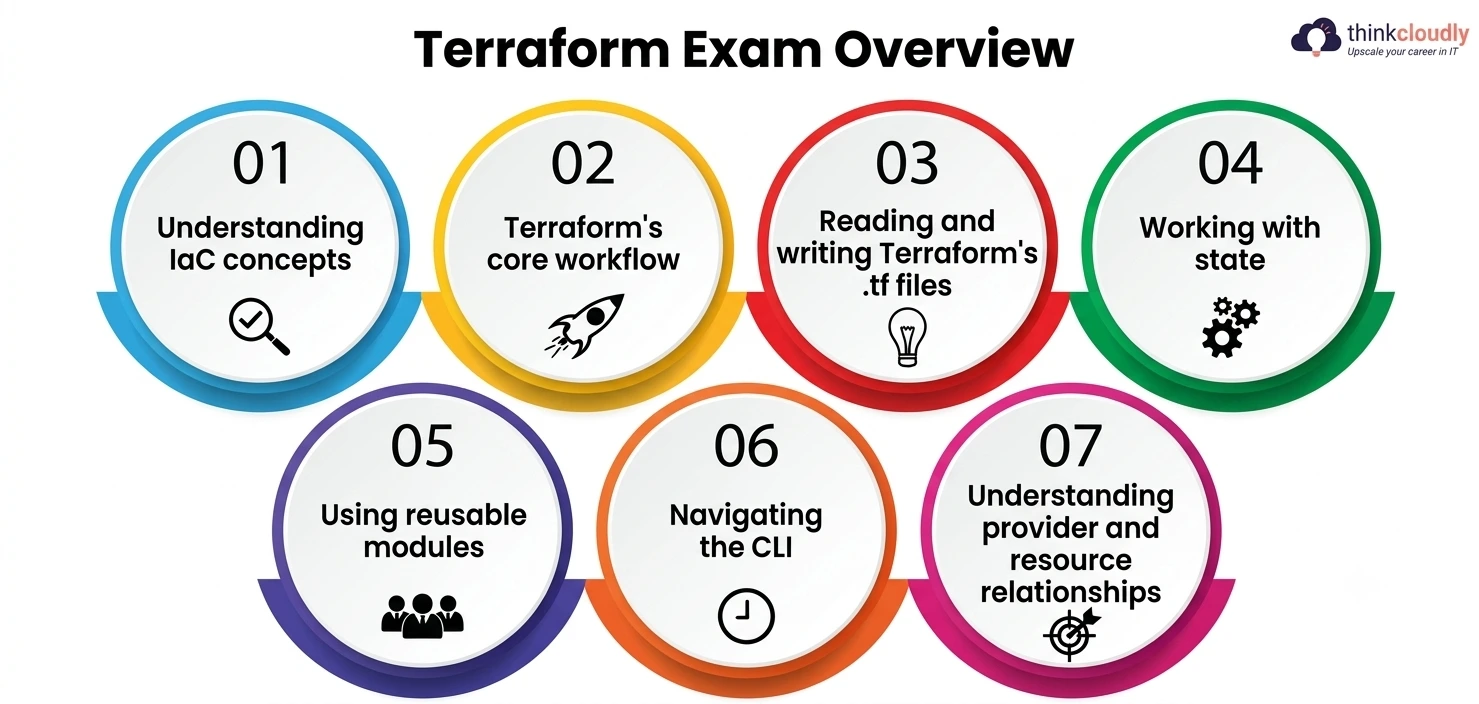
- Understanding IaC concepts—why declarative infrastructure beats manual console clicking, and what problems Terraform specifically solves versus other tools.
- Terraform’s core workflow—the init, plan, apply, and destroy cycle—and why each of those Terraform commands exists as a separate, deliberate step rather than one combined action.
- Reading and writing Terraform’s .tf files—correctly structuring resource blocks, variables, outputs, and data sources inside those same files so Terraform can parse and act on them.
- Working with state—what the state file tracks, why it shouldn’t be hand-edited, and how remote backends keep teams from stepping on each other.
- Using reusable modules—calling a module, passing inputs, reading outputs, and understanding why a shared, versioned setup reduces duplicated, inconsistent configurations across environments.
- Navigating the CLI—running the everyday commands candidates are expected to know well, including validate, fmt, and import.
- Understanding provider and resource relationships—including how Terraform determines build order internally to figure out what needs to be created, updated, or destroyed, and in what sequence.
None of this is exotic. It’s deliberately scoped to be a baseline, not a deep specialization—which is exactly why some senior engineers consider it a bit basic, and why some beginners find it genuinely challenging.
Certification Benefits That Go Beyond the Badge
Let’s get specific about what you actually gain, instead of waving at “it looks good on LinkedIn.” The clearest benefit is structural: studying for a defined exam forces you to cover gaps you’d otherwise skip while learning on the job. Most self-taught engineers get good at the parts of Terraform their current project needs and stay fuzzy on everything else. A structured exam syllabus doesn’t let you do that.
There’s also a measurable market signal behind this. Firefly’s State of IaC report found that 90 percent of teams admit their infrastructure-as-code practice falls short at scale, and a meaningful share have tied that gap directly to drift or misconfiguration incidents.
That’s the backdrop against which certification benefits actually matter to employers—they’re not hiring you because you own a certificate; they’re hiring you because the certificate suggests you understand the failure modes that keep showing up in that kind of research.
The second real certification benefit is less obvious: it gives you a shared vocabulary with the rest of the team on day one. New hires who’ve prepped properly tend to ask sharper questions in their first few weeks, because they already know what a backend configuration is supposed to do instead of nodding along while someone explains it from scratch.
Where the Terraform certification benefits taper off is seniority. If you’ve already shipped production Terraform for two or three years, the exam probably won’t change how a hiring manager reads your resume—your git history already says more than a badge can. It’s most valuable for people transitioning into DevOps from adjacent roles, or early-career engineers trying to get past an automated resume filter.
Terraform Modules and Configuration Files: What the Exam Expects You to Know
A huge chunk of exam prep time should go toward Terraform modules and configuration files, because that’s where most candidates lose points on practice tests. It’s not enough to know that modules exist—you need to understand input variables, output values, and how a root module calls a child module correctly.
Terraform modules are tested in a fairly practical way: expect scenario questions about passing variables into a module, referencing a module’s outputs elsewhere in your configuration, and understanding why versioning matters once more than one team depends on the same shared module. HashiCorp’s own documentation is the single best free resource here, and it matches the exam’s framing closely enough that working through it top to bottom covers a large share of this domain.
Configuration files get tested slightly differently — less about syntax memorization, more about structure. You’ll want to be comfortable reading a set of .tf files and identifying what resource depends on what, where a variable is declared versus referenced, and how terraform.tfvars interacts with variable defaults.
Candidates who’ve only ever copy-pasted boilerplate from tutorials without understanding why each block exists tend to stumble here, because the exam likes to present a slightly unfamiliar setup and ask what it will actually do.
Dependency Graphs and the Terraform Commands You’ll Use on the Job
This section is worth turning into a quick-reference sheet while you study, because it’s one of the more conceptually dense parts of the exam:
- What a dependency graph actually represents—Terraform builds dependency graphs internally to determine execution order; resources with no relationship to each other can be created in parallel, while anything referencing another resource’s output has to wait.
- Why dependency graphs matter for troubleshooting—a surprising plan output is often explained by an implicit dependency you didn’t realize existed, not a bug in Terraform itself.
- terraform graph—one of the lesser-used commands in the CLI, but genuinely useful for visualizing how resources connect before a risky change.
- terraform plan and terraform apply—the two Terraform commands you’ll run constantly, and the exam expects you to know exactly what each one does and doesn’t guarantee.
- terraform validate and terraform fmt—smaller, frequently run checks that catch syntax issues and formatting drift before a teammate has to deal with a messy diff in review.
If you want the primary source instead of secondhand summaries, HashiCorp’s also explains how the dependency graph works internally is short, technical, and genuinely clarifying way, and it explains why certain applications take the order they do.
Terraform Associate Exam vs Real-World DevOps Work
Here’s where I’ll be blunt: the Terraform Associate exam is a reasonable proxy for baseline competence, but it is not the same thing as day-to-day production work. The table below lays out where they overlap and where they diverge.
|
What the Exam Covers |
How It Plays Out on the Job |
|
Reading and writing basic configuration files |
Production setups are often inherited, messy, and spread across multiple repos. |
|
Calling and reusing Terraform modules |
You’ll spend more time debugging someone else’s module than writing your own. |
|
Memorizing the common Terraform commands |
Day-to-day work leans on the same handful of them repeatedly, plus CI/CD wrappers around them. |
|
Understanding how the dependency graph resolves order |
Real incidents usually involve dependency graphs colliding with manual console changes, not clean textbook scenarios. |
|
Certification benefits on a resume |
Benefits fade quickly once you have real production history to point to instead. |
This gap isn’t a knock against the exam—every certification simplifies reality to make it testable. The useful mindset is treating the Terraform Associate exam as a structured starting point, then immediately layering real project work on top of it, ideally something messier than a tutorial repo.
Who Should Sit for This Exam Right Now?
If you’re early in your DevOps career, switching from a sysadmin or developer background, or trying to clear an automated resume filter at a mid-sized company, the Terraform Associate exam is a reasonable use of a few weeks. The certification benefits are real at that stage, and the structured study pushes you through Terraform modules, state handling, and dependency graphs you might otherwise avoid.
If you’ve already got two-plus years of hands-on Terraform experience, your time is probably better spent on a harder problem — contributing to an internal module library, leading a migration between backends, or picking up a complementary skill like Kubernetes or a cloud-specific certification. At that point, the exam mostly confirms what your work history already demonstrates.
What Exam Day Actually Looks Like?
A detail a lot of first-timers overlook: the test itself is shorter and less dramatic than the weeks of prep make it feel. You’re looking at roughly 57 scored items, a one-hour window, and a proctored online option that lets you sit for it from a laptop at home instead of driving to a physical testing center. The proctoring software checks your ID, scans the room briefly through your webcam, and then mostly stays out of the way unless something unusual happens on screen.
Scoring comes back almost immediately after you submit, which is a relief compared to some other professional exams that make you wait days for a result. You won’t get a detailed breakdown of exactly which questions you missed, just a pass or fail and a rough sense of which domains were weaker, so it’s worth keeping your own notes on topics you felt shaky about during practice tests rather than relying on the official feedback to tell you where to focus a retake.
If you don’t pass on the first attempt, there’s a mandatory waiting period before you can register again — plan around that if you’re trying to hit a specific deadline, like a job application or an internal promotion cycle at work. Most people who fail on attempt one aren’t missing fundamental knowledge; they’re usually tripped up by time pressure or a handful of oddly worded scenario questions that don’t match how they’d phrase the same concept themselves.
Running through at least one full-length timed practice exam beforehand, under the same time constraints as the real thing, catches that problem before it costs you an actual attempt and another registration fee.
A Personal Note
I sat for this exam years ago, back when I was moving from a general sysadmin role into something closer to platform engineering, and I remember being almost embarrassed by how much the prep forced me to slow down and actually read the documentation instead of skimming Stack Overflow answers.
The exam itself was fine — a bit dry, exactly as advertised. What stuck with me was the habit it built: reading a module’s inputs and outputs before touching it, checking what a plan actually says instead of blindly applying, and treating the state file with the caution it deserves. If you’re on the fence, don’t overthink the decision itself.
Block out three or four focused weekends, work through real configuration files instead of just flashcards, and let the studying do more for you than the certificate ever will.