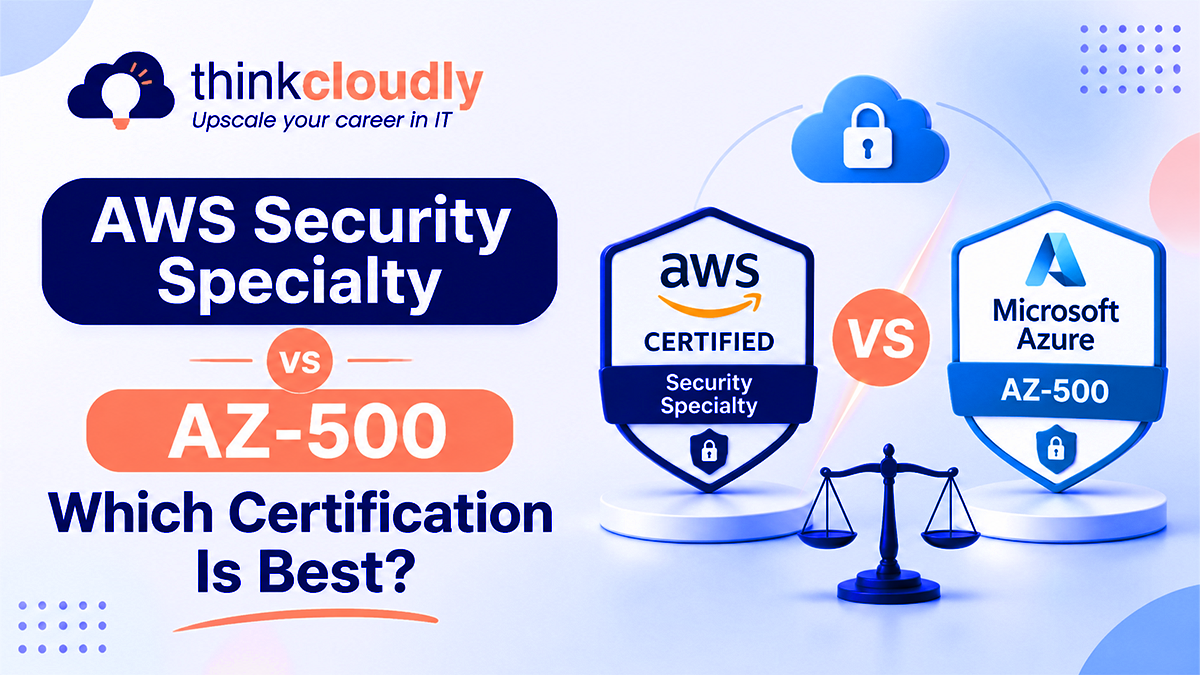





A few months ago I’d have told you AZ-500 was the obvious answer for anyone chasing a Microsoft security credential. I can’t tell you that anymore, because AZ-500 doesn’t exist as a bookable exam. Microsoft retired it on August 31, 2026, and the exam that took its place, SC-500, is built on a different premise entirely—one where AI workloads are treated as infrastructure you’re expected to defend, not an afterthought bolted onto a Defender module.
So the real AZ-500 vs SC-500 question in 2027 isn’t really a comparison anymore. It’s a one-way street. If you’re researching AZ-500 vs SC-500 because you saw both codes mentioned in a course catalog, study group, or old blog post, this piece sets the record straight on what the SC-500 certification actually tests, how it differs from the exam it replaced, what the SC-500 certification costs, and whether it’s worth your study hours right now.
If you’ve spent any time comparing a Microsoft security certification path against competing vendors, you already know how quickly exam codes and blueprints shift. The AZ-500-to-SC-500 shift is really a case study in how fast that churn can move—a credential that was considered the gold standard for Azure security work barely eighteen months ago is now a line item in a retirement table, not a bookable exam.
Why AZ-500 Got Retired in the First Place?
Microsoft didn’t quietly let AZ-500 fade out. It announced the retirement as part of a broader overhaul of its certification catalog, one explicitly framed around the idea that AI is reshaping job roles faster than the old exam blueprints could keep up.
According to Pearson VUE’s rundown of the certification changes, AZ-500 (Azure Security Engineer Associate) was retired on August 31, 2026, with SC-500 (Cloud and AI Security Engineer Associate) named as its direct replacement.
The Microsoft SC-500 rollout wasn’t framed as a minor refresh either—Microsoft positioned it as a fresh credential built around how cloud and AI security actually gets done in 2027, not a patched-up version of the old blueprint.
That’s an important detail for anyone still weighing AZ-500 vs SC-500 as if it were a live choice: there is no “pick whichever one suits you” option anymore. If you sat AZ-500 before it retired, your certification stays on your Microsoft Learn transcript until it naturally expires, then it quietly moves into historical status. You can’t renew it, and you can’t newly earn it. Every security engineer gearing up for a Microsoft credential in 2027 is, by default, studying for SC-500 whether they searched for it by name or not.
The “why” behind the retirement matters too, because it explains what the Microsoft SC-500 exam is actually testing. Microsoft’s stated rationale is that security engineering no longer stops at virtual networks, storage accounts, and identity—it now extends into protecting Copilot agents, AI Foundry deployments, and the data pipelines feeding generative AI tools. AZ-500 had no vocabulary for any of that. SC-500 online training program does, and it’s baked into one of its four core domains rather than treated as an add-on.
What Does SC-500 Actually Cover?
The full name of the exam is “Implementing End-to-End Security Controls for Cloud and AI Workloads,” and it leads to the credential Microsoft Certified: Cloud and AI Security Engineer Associate. Per the official Microsoft SC-500 study guide, the SC-500 certification exam is organized into four weighted domains:
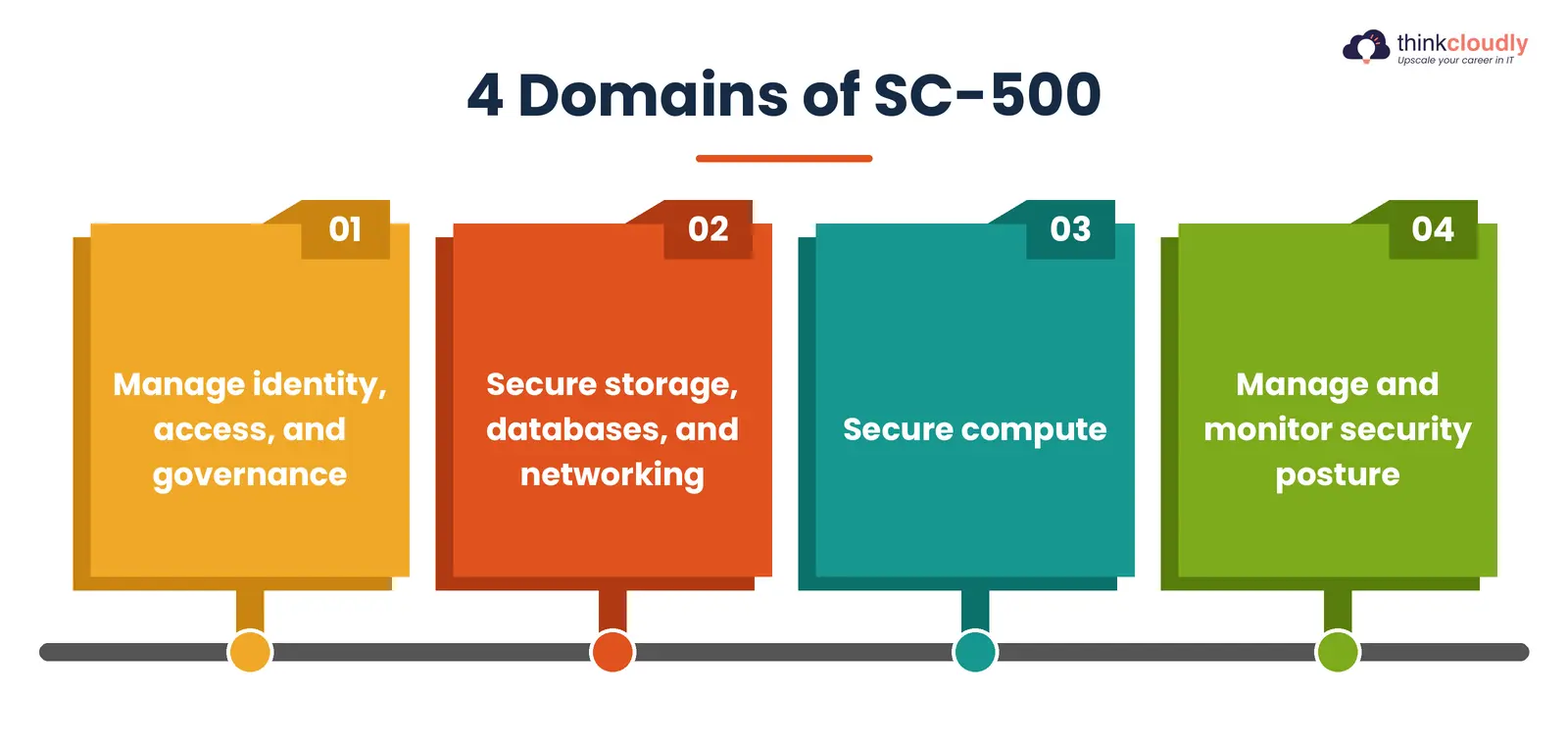
- Manage identity, access, and governance (20–25%)
- Secure storage, databases, and networking (25–30%)
- Secure compute (20–25%)
- Manage and monitor security posture (20–25%)
Anyone who sat on AZ-500 will recognize most of that structure. Entra ID, Key Vault, network security groups, Defender for Cloud, and Microsoft Sentinel are all still there, often tested at a similar depth.
The real shift sits inside “Secure compute,” which now folds in objectives on securing SharePoint data exposure, Microsoft Purview DSPM for AI, Copilot Studio agent protection, Entra Agent ID controls, and Defender for AI services. None of that existed in the AZ-500 blueprint because none of it existed as a mainstream enterprise concern when AZ-500 was written.
If you’re a working Azure security engineer who’s spent years hardening VMs, locking down storage accounts, and tuning conditional access policies, the good news is that roughly three of SC-500’s four domains will feel familiar. The fourth is the one you’ll need to budget real study time for, because it tests concepts—agent identity, AI gateway controls, and Copilot guardrails—that most security teams have only started operationalizing in the last year or two.
AZ-500 vs SC-500: The Side-by-Side Comparison
|
Factor |
AZ-500 (Azure Security Engineer Associate) |
SC-500 (Cloud and AI Security Engineer Associate) |
|
Status |
Retired August 31, 2026 |
Current, active exam |
|
Full exam name |
Microsoft Azure Security Technologies |
Implementing End-to-End Security Controls for Cloud and AI Workloads |
|
Core domains |
Identity/access, networking, compute, storage/databases, Defender for Cloud & Sentinel |
Identity/access/governance, storage/database/network security, compute security (incl. AI), security posture management |
|
AI security content |
None |
Explicit domain covering Copilot, Purview DSPM for AI, Entra Agent ID, Defender for AI |
|
Exam duration |
150 minutes |
120 minutes |
|
Passing score |
700 / 1000 |
700 / 1000 |
|
Cost (typical, US) |
Was $165 USD |
Roughly $165 USD, varies by country |
|
Delivery |
Pearson VUE, proctored |
Pearson VUE, proctored |
|
Prerequisites |
None formal; hands-on Azure experience is recommended. |
None formal; hands-on Azure and Microsoft 365 experience is recommended. |
|
Renewal |
No longer possible |
Standard one-year renewal cycle expected |
A table like this makes the overlap obvious, but don’t let it fool you into thinking the Microsoft SC-500 exam is just AZ-500 with a new label slapped on it. The weighting shift toward storage, database, and network security (now 25–30%, the single heaviest domain) combined with an entirely new AI security domain means SC-500 rewards a broader, more current skill set than a straight AZ-500 refresh would have asked for.
SC-500 Exam Logistics You’ll Actually Need
Before you register, here’s what matters for planning your study schedule:
- The exam runs 120 minutes, shorter than AZ-500’s 150-minute slot, so pacing matters more.
- Cost sits at roughly $165 USD in the United States, though Microsoft prices regionally, so check your local Pearson VUE listing before budgeting.
- A passing score of 700 out of 1000 is required, using Microsoft’s standard scaled scoring model.
- No official prerequisite certification is listed, but Microsoft explicitly recommends hands-on experience administering Azure and hybrid environments plus familiarity with Microsoft 365 administration before attempting it.
- Exams are proctored through Pearson VUE, either online or at a physical test center, with accommodations available on request for assistive devices or additional time.
If you’ve already got an AZ-500 study plan sitting in a folder somewhere, don’t throw it out—reuse what covers identity, networking, storage, and the Defender/Sentinel material, then layer the AI security objectives on top. Starting from zero wastes time; you don’t need to waste.
One more logistics note: Microsoft hasn’t published an exact question count for SC-500 yet, which is normal for a newly launched exam. Most of Microsoft’s associate-level exams run 40 to 60 questions, and there’s no reason to expect SC-500 to break that pattern—treat it as a planning range rather than a guarantee.
Who Should Actually Sit This Exam?
A Microsoft security certification is only useful if it maps to what you’re doing day to day, so it’s worth being honest about whether the SC-500 certification fits your current role before you commit weeks of study time to it.
SC-500 is a strong fit if:
- Your organization runs primarily on Azure and Microsoft 365, and you own or want to own Entra ID conditional access policies
- You already tune Defender for Cloud recommendations or write Sentinel detection rules as part of your job
- Your team has started piloting Copilot agents or Azure AI Foundry workloads, and nobody has clearly claimed the security side of that yet
- You hold AZ-500 and need the current, bookable Microsoft SC-500 credential that covers the same ground plus AI security
It’s a weaker fit if:
- You’re brand new to cloud security with no hands-on Azure exposure at all
- You haven’t yet configured conditional access, Key Vault, or NSGs in a real or sandbox environment
- Your organization is still entirely on-premises with no near-term Azure migration planned
- You’re hoping a single exam will substitute for actual hands-on practice before a job interview
If any of the second list describes you, working through Microsoft Learn’s free modules and spending real time in an Azure sandbox before registering will save you a failed attempt and a retake fee.
Studying for SC-500 Without Wasting Time
The single biggest mistake candidates make with any Microsoft security certification is studying a blueprint that’s already stale. Because SC-500 is new, a lot of third-party practice test vendors are still catching up, and some older AZ-500 dump sites have simply relabeled their old content under the new exam code without actually updating it. That’s a real problem if you’re trying to hit a specific pass date.
Stick to Microsoft’s own learning paths tied to the Cloud and AI Security Engineer Associate credential, cross-reference the official study guide’s domain list before trusting any third-party course outline, and build a lab environment where you can actually configure the things being tested—conditional access policies, Key Vault access policies, NSGs, and a basic Sentinel workspace with a data connector or two. Reading about Defender for Cloud’s Secure Score is not the same as watching it change after you remediate a recommendation yourself.
For the AI security domain specifically, spend time in the Microsoft Purview compliance portal if your organization has access to it, even in a trial tenant. DSPM for AI, Copilot Studio agent protections, and Entra Agent ID are genuinely new enough that most existing study material treats them as a single slide rather than giving them the hands-on depth the exam expects.
It also helps to treat this as studying for a Microsoft security certification rather than memorizing a single exam’s question bank. The underlying skills — least-privilege identity design, network segmentation, posture management through a central dashboard — show up across nearly every Microsoft certification Microsoft offers, from SC-200 to SC-300. Building that foundation properly means SC-500 won’t be the last credential you add, and the next one will take noticeably less effort.
What This Means for Your Career as an Azure Security Engineer?
Job titles haven’t caught up to exam codes yet, and honestly, they might never fully do so — that exact job title is still the search term most recruiters type into LinkedIn, even as the underlying skill set shifts toward what SC-500 actually tests. That’s good news if you’re job hunting: holding SC-500 signals you’re currently on both the Azure-native security stack and the AI governance layer employers are only just beginning to ask about explicitly in job descriptions.
Salary data lags certification changes by nature, since compensation surveys take time to catch up to a brand-new exam code. Current figures for Azure-focused security roles in the US cluster in a wide band — data on security engineers with Microsoft Azure skills puts the median base salary in the mid-$90,000s, with senior and architect-level roles running well above that once AI security responsibilities enter the job description. Treat that as a directional floor, not a ceiling — someone fluent in both Entra ID governance and Copilot agent protection will command more than someone who stopped learning at AZ-500’s old blueprint.
The practical takeaway: if your resume still lists AZ-500 as a current credential, update the framing. List it as held, note the exam’s retirement if asked in an interview, and get SC-500 scheduled if your role touches Azure security in any serious way. Hiring managers screening resumes for a Microsoft security certification in 2027 are looking for SC-500, not its retired predecessor, and recruiters who don’t yet know AZ-500 is gone will usually take your word for it once you explain the timeline.
None of this means the job title itself is disappearing. Postings will keep saying “Azure security engineer” for a while yet, because that’s the phrase candidates search for and the phrase hiring managers are used to typing. What’s changing underneath that familiar title is the expectation that an Azure-focused security engineer in 2027 can also speak to AI workload protection, not just the identity and network fundamentals that defined the role five years ago.
A Personal Note
I’ll be straight with you: when Microsoft first announced the AZ-500 retirement, my inbox filled up with people asking whether to rush and sit for AZ-500 before the deadline or just wait for SC-500. In hindsight, almost nobody who rushed got meaningful extra value out of it — the content overlap meant their study time would have counted either way, and the people who waited walked straight into an exam that’s actually more relevant to what they’re doing at work right now.
If you’re sitting on the fence about whether SC-500 is worth the time investment, my honest take is that the AI security domain alone justifies it, even if your org hasn’t fully adopted Copilot or Foundry yet. You’ll be the person in the room who already understands the controls when it does.
Note: Certification retirement dates, exam costs, and domain weightings are set by Microsoft and can change. Always confirm current details on Microsoft Learn’s SC-500 credential page before registering or scheduling an exam.