

You probably don’t even realize it, but if you’ve ever streamed a movie on Netflix, saved a photo on Google Drive, or turned in an assignment on Google Classroom, you’ve used the cloud. Today it all looks so normal, and it’s hard to imagine that none of this existed just a few decades ago. So how did we arrive here?
The history of cloud computing is actually a much longer and more interesting story than most people know—it doesn’t begin with Amazon or Google; it begins with giant, room-sized machines from the 1950s.
In this blog I’ll take you all the way through that whole journey in plain, simple language—where the idea came from, how it grew, and where it’s going next. Whether you’re a student doing research for a project or someone just curious about the tech you use every day, this guide is for you.
Introduction: The Age of Mainframes
To understand the history of cloud computing, you have to go back to a time when even the internet didn’t exist. In the 1950s, computers were large, costly machines that only large universities, governments, or corporations could afford to purchase. Of course a single computer could cost millions of dollars and no one could justify buying one for himself.
This is where a concept called “time-sharing” came in. Instead of a single user sitting at a computer at a time, multiple users could connect to a central mainframe via terminals—screens that had no real processing power of their own.
This idea was proposed by John McCarthy at MIT in 1955, and he later famously said that computing could be organized in the future as a public utility, just like the telephone system. And that one sentence foresaw the cloud as we know it today, decades before it happened. You can read more on this early theory on the ECPI University blog.
This was really the first instance of distributed computing. The idea of sharing computing resources across a number of users rather than each person owning their own hardware. This was the precursor to all that followed, and it remains the basis for the distributed computing systems that run today’s data centers.
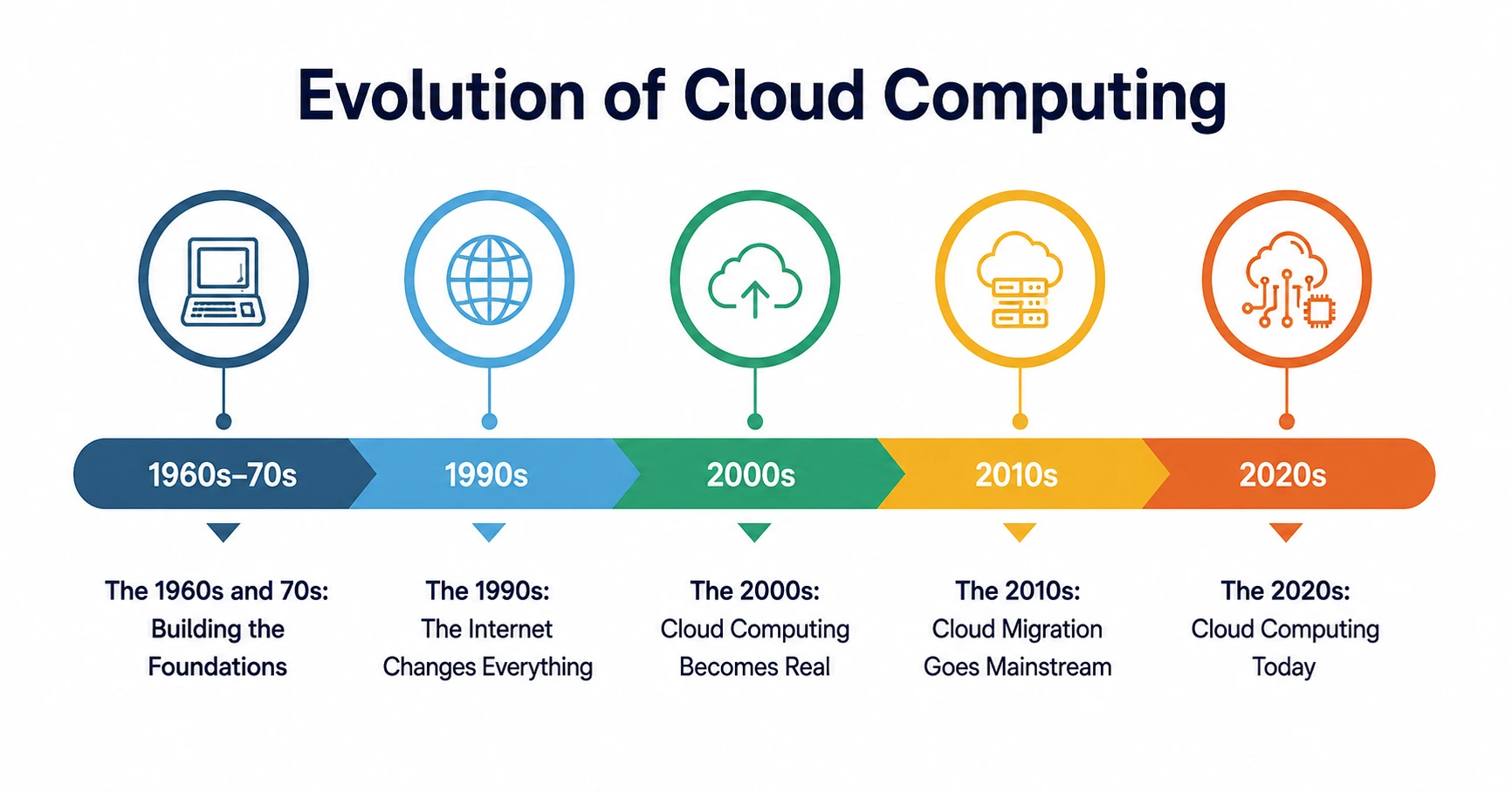
1960s and 70s: Building the Foundations
After that things started to happen fast. 1969 saw the launch of ARPANET, the first iteration of what would become the internet. It was originally developed to interconnect research institutions so that they could share data and resources remotely. No ARPANET, no internet, no cloud.
Meanwhile, IBM was working on its own innovations. In 1972 IBM announced its VM operating system, which enabled a single physical machine to support multiple virtual environments at the same time.
It was one of the first real instances of virtualization, a technology that would later become the foundation of modern digital infrastructure. If this timeline is of interest to you, Verdict’s Cloud Computing Timeline provides this in good detail.
The 1990s: Internet Changes Everything
Things really took off in the 1990s. In 1989 Tim Berners-Lee invented the World Wide Web and in the early 90s it became freely available Suddenly the internet wasn’t just for researchers anymore—everyday people and companies started getting online
In this decade, telecom companies also started to offer virtual private networks, or VPNs. In VPNs, multiple users share the same physical infrastructure, instead of paying for a dedicated line for each user. This was a big deal because it made shared, flexible networking inexpensive. And that’s the principle on which the cloud operates today.
Then in 1999 a company called Salesforce was introduced, and it changed the game completely. Salesforce was the first company to provide a complete business application over the Internet, rather than having to install software on their own computers.
This was the beginning of what we now know as Software-as-a-Service (SaaS) and is widely considered one of the most important milestones in the evolution of cloud computing. You can read the official website of salesforce .
The 2000s: Cloud Computing Matures
This is the decade that took “cloud computing” from theory to a real product that people could use.
Amazon launched Amazon Web Services (AWS) back in 2002, which was pretty limited back then. The real game changer, however, came in 2006 when AWS released two services that changed the tech world forever – Amazon S3 (Simple Storage Service) and Amazon EC2 (Elastic Compute Cloud).
For the first time, any developer, startup, or student could rent computing power and storage by the hour instead of purchasing physical servers. This was the true start of the Infrastructure-as-a-Service (IaaS) model. You can read about this journey in the official AWS blog, courtesy of Amazon.
Google wasn’t far behind. In 2008, it launched Google App Engine, which allowed developers to build and host applications on Google’s infrastructure. Microsoft was also working on what would become Azure the same year, officially released in 2010.
By the end of this decade, all three major players—Amazon, Google, and Microsoft—were competing in the same space, and the term “cloud computing” started becoming part of everyday business language. The entire period is one of the fastest growth phases in the evolution of cloud computing and is almost entirely driven by better internet bandwidth and an increasing appetite for flexible digital infrastructure.
2010s: Cloud Migration Enters Mainstream
Once companies realized what the cloud could really do—lower costs, faster deployment, and less hardware maintenance—the floodgates opened. Mass cloud migration has been the name of the game this decade, as companies of all sizes have started moving their operations off of physical, on-premises servers and onto cloud platforms.
During this time various deployment models also became clearer. Businesses now had to choose between the following:
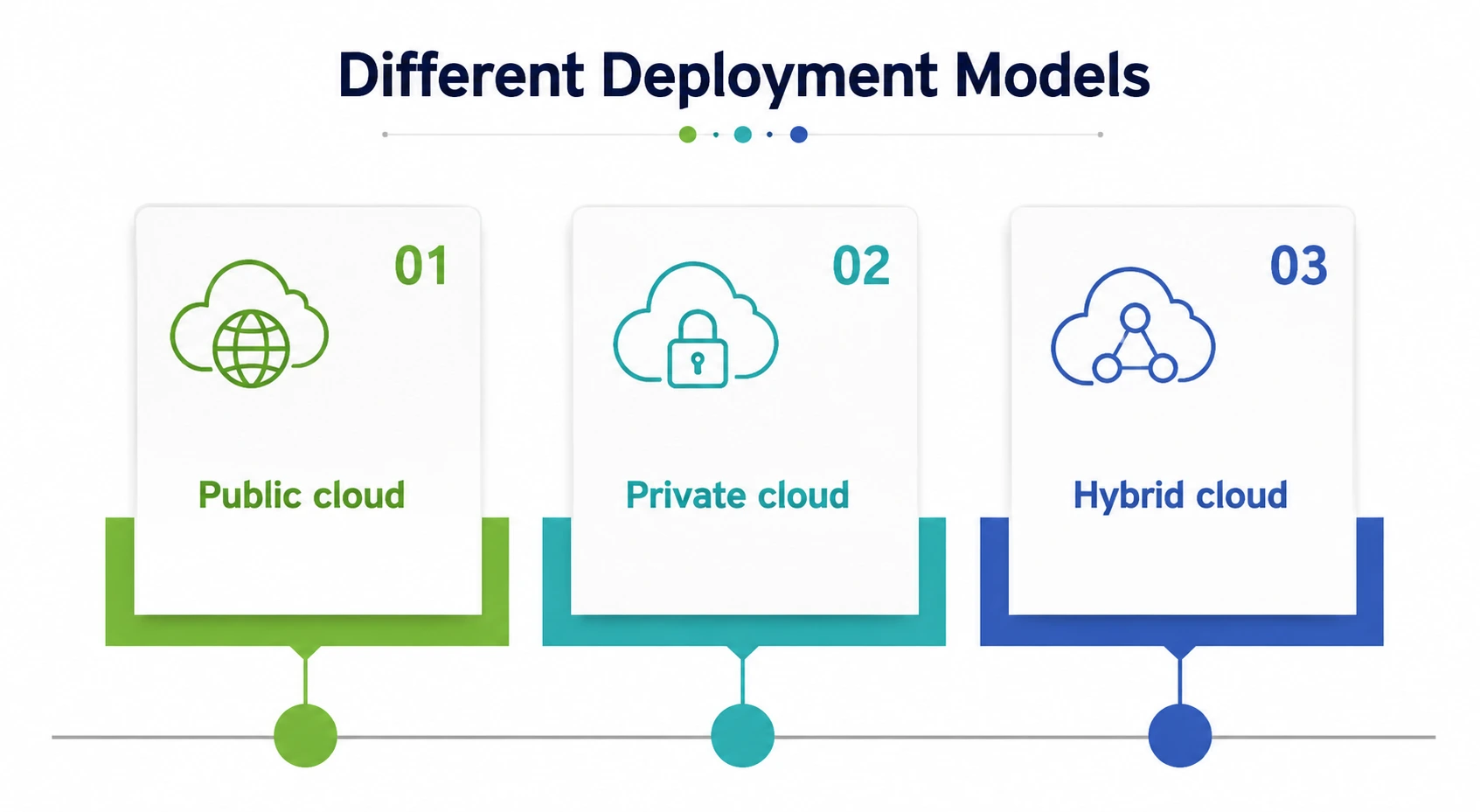
- Public cloud – Infrastructure owned by a third-party provider (e.g., AWS or Azure) and shared by multiple customers.
- Private cloud—it is a dedicated infrastructure for use by a single organization
- Hybrid cloud – a mix of public and private, offering businesses more flexibility and control
This flexibility meant that even heavily regulated industries like healthcare and banking were able to begin adopting cloud technology on their own terms. Choosing the right deployment model early on can save a business a lot of headaches down the road and is why it’s generally one of the first decisions made in any cloud strategy.
In the meantime, a huge technical change was taking place: containerization. Docker was released in 2013, and it revolutionized application packaging and deployment. Rather than needing full virtual machines, developers could now package up an application and all its dependencies in a lightweight “container” that would run reliably in any environment.
In 2014, Google released Kubernetes to help manage large numbers of these containers, and in 2015, it was donated to the Cloud Native Computing Foundation.
By 2017, support for Kubernetes was added by the major cloud vendors like AWS, Azure, and VMware, and containerization became the de facto standard for building and scaling modern applications.
This chapter is a pivotal moment in the evolution of cloud computing. It was the change not only in the location of where applications run but also in how they are built in the first place. Each step builds on the previous one.
In the 2020s, cloud computing is now
Fast forward to today, and cloud computing is no longer an emerging technology—it’s the status quo. All apps, websites, and digital services you use are built on some form of cloud infrastructure.
Modern digital infrastructure is multi-cloud (more than one cloud provider at the same time), edge computing (processing data closer to where it’s produced, such as on IoT devices), and serverless computing (where developers don’t even have to manage servers—the cloud provider does that for them automatically).
All of this is possible because of distributed computing happening quietly in the background, on thousands of servers located all around the world. AI has also become inextricably tied to cloud platforms. Training and deploying large AI models require vast amounts of computing power that most organizations cannot afford to own themselves.
The next phase of the history of cloud computing is being driven by providers rushing to offer specialized AI infrastructure.
Reference Fast: Key Dates in Cloud Computing History Year
|
Year |
Milestone |
Significance |
|
1955 |
John McCarthy proposes time-sharing |
Early foundation of shared, on-demand computing |
|
1969 |
ARPANET goes live |
Predecessor to the internet today |
|
1972 |
VM operating system announced by IBM |
Early virtualization technology |
|
1999 |
Salesforce launch |
Birth of the SaaS model |
|
2006 |
AWS launches S3 and EC2 |
Birth of modern IaaS and public cloud |
|
2008 |
Google App Engine release |
Cloud application hosting becomes available |
|
2010 |
Microsoft Azure launch |
Big Business player into the cloud market |
|
2013–2014 |
Docker and Kubernetes launch |
Containerization becoming the new deployment standard |
|
2020s |
Adoption of AI, edge, and multi-cloud |
Nearly all digital infrastructure is in the cloud |
Why should you know this history?
Learning about the history of cloud computing isn’t just trivia for students; it helps explain how the technology works today. Distributed computing, virtualization, container technology, etc. did not spring out of nowhere; they were ways to solve real, concrete problems that engineers had over the decades.
Once you see the timeline, buzzwords like AWS, Kubernetes, or hybrid deployment models start to make a lot more sense. Setting out the progression of cloud computing step-by-step also makes it much easier to work out where cloud platforms are likely to head next.
It also helps to know that the cloud is not a finished product; it’s still evolving. Just as mainframes were replaced by virtual machines, and virtual machines were replaced by containers, so too will cloud services keep evolving today. Keeping up to date with what is going on in cloud computing is a great way to get a sense of what is coming next in technology.
A Personal Note
To be honest, when I started reading about the history of cloud computing, I thought it was a 2000s invention, related only to Amazon and Google. But that all changed when I started digging into the real timeline.
It’s a good reminder that most of the “new” tech is just an old idea finally having the infrastructure to work. If you are a student working on this topic, don’t just memorize the dates—try to understand why each shift occurred. That’s the real education.