
A classmate once asked me why a five-minute college survey needed a data handling clause before anyone could fill it in. I didn’t have a good answer at the time. That gap stuck with me, and it’s the reason I wanted to write this guide the way I wish someone had written it for me.
If you’re a student, someone new to the workforce, or just tired of half-explained news stories about leaked databases, this is a plain-language walkthrough of data privacy and compliance—no legal jargon, no filler.
By the end you’ll know what data privacy and compliance actually looks like day to day, which rules organizations answer to, and what you can start doing this week, whether that’s a class project’s dataset or your first job’s customer records.
What Is Data Privacy and Compliance, Really?
Strip away the terminology, and data privacy and compliance are really two questions stacked on top of each other. Privacy asks, should we—should this information even be collected, and does the person it belongs to know about it? Compliance asks, “How do we meet the specific legal requirements a regulator has written down?”
Good intentions alone don’t answer either question. A company can genuinely care about its users and still fall short if its practices were never checked against real compliance standards. That’s the whole point of formal frameworks: they turn vague good intentions into something you can actually audit against recognized compliance standards.
Read enough of these frameworks, and a pattern emerges—be transparent about what’s collected, have a lawful reason for collecting it, don’t keep it forever, and let people access or delete their own records. Once you spot that pattern, a brand-new regulation stops looking intimidating and starts looking familiar.
Why Does This Actually Matter?
It’s easy to file this under “things I memorize for a business law course and then forget.” I’d push back on that instinct. Every app on your phone, every university portal, every part-time job application is quietly deciding something about your personal data right now, whether you notice or not.
Understanding data privacy and compliance has more in common with financial literacy than with trivia—it’s something you’ll use long after the final exam. For organizations, the numbers back this up.
IBM’s Cost of a Data Breach Report put the global average cost of a single breach at $4.44 million in 2025, and that’s before counting the customers who quietly stop trusting the brand and never come back. Regulators under GDPR alone have issued fines in the hundreds of millions of euros. Getting your compliance standards right isn’t overhead—it’s closer to insurance you hope you never have to cash in.
A Quick Comparison of Major Regulations
Different industries and countries answer to different rulebooks, so here’s a simple anchor table before we go further.
|
Regulation |
Region / Scope | Core Focus |
Who Must Follow It |
| European Union & EEA | Consent, data subject rights, breach notification |
Any organization processing EU residents’ data |
|
| United States | Protection of health information |
Healthcare providers, insurers, and their partners |
|
|
CCPA/CPRA |
California, USA | Consumer rights over personal data sale/use |
Businesses meeting revenue or data-volume thresholds |
| Global (voluntary standard) | Information security management systems |
Any organization seeking certified security practices |
|
| United States (widely adopted globally) | Risk-based cybersecurity guidance |
Businesses and agencies of any size |
None of these frameworks sit in isolation. A company operating across three continents might have to satisfy four or five of them simultaneously, which is exactly why a structured approach beats memorizing individual rules one at a time.
Building a Data Protection Strategy That Actually Works
A data protection strategy is the bridge between “we care about privacy” and “we can prove it under audit.” Skip the bridge, and even well-meaning teams end up reacting to problems instead of preventing them.
In practice, a workable data protection strategy starts with knowing exactly what personal data you hold and where it physically lives—you’d be surprised how many organizations can’t answer that honestly.
From there it moves into ranking which datasets would cause real harm if exposed; applying encryption or anonymization so stolen data loses its value to an attacker; rehearsing an incident response plan rather than just writing one; and auditing regularly so policy and practice don’t quietly drift apart.
A strong data protection strategy isn’t a document that sits in a drawer; it gets revisited every time a company adopts a new tool, signs a new vendor, or expands into a region with different laws.
Privacy Management: Turning Policy Into Daily Habit
Privacy management is where strategy meets Monday morning. It’s the ongoing, unglamorous work of making sure privacy commitments hold up in day-to-day operations rather than living only in a policy PDF nobody reads.
That usually means a designated owner—sometimes a data protection officer—clear internal steps for handling requests like “delete my data,” and training so that every employee, not just the legal team, understands their role in it.
For students building a first app or research project, this can start small. Label what data your project collects. Get explicit permission before gathering it. Never keep more than you actually need. Those habits scale directly into professional privacy management later on, and honestly, they’re the same habits either way—the stakes just get bigger.
Strengthening Data Access Control
If privacy management is the “who’s responsible” layer, data access control is the technical gatekeeper underneath it. Good data access control answers one blunt question: who is allowed to see or touch this specific piece of information, and under what conditions?
A few principles carry most of the weight here. Give people access only to what their role genuinely requires—nothing more, however senior they are. Tie permissions to a job function rather than an individual’s personal request.
Add multi-factor authentication, because a password alone rarely holds up anymore. Log every access attempt so unusual activity gets caught early instead of six months later. And review permissions regularly, revoking them the moment someone changes roles or leaves.
Weak data access control is one of the most common causes of internal data leaks — not because anyone was malicious, but because access stayed open long after it was needed. Tightening this single area often delivers the biggest security improvement for the least effort of anything on this list.
Information Governance: The Framework Holding Everything Together
Information governance is the umbrella connecting strategy, daily practice, and access control into one coherent system — the rulebook for how information flows through an organization from the moment it’s created to the moment it’s deleted.
A mature information governance program defines who owns which data, sets retention schedules, classifies information by sensitivity, and makes sure every department, not just IT, treats data responsibly.
Skip it, and organizations end up with data scattered across forgotten spreadsheets, shadow drives, and tools nobody officially tracks—precisely the kind of mess that leads to breaches.
For students entering the workforce, understanding this area is a genuine career advantage; employers increasingly value people who think about data responsibly, not just technically.
7 Practical Steps for Better Data Privacy and Compliance
Theory is fine, but here’s where it turns into action. These steps for better data privacy and compliance apply whether you’re securing a student project or advising a small business:
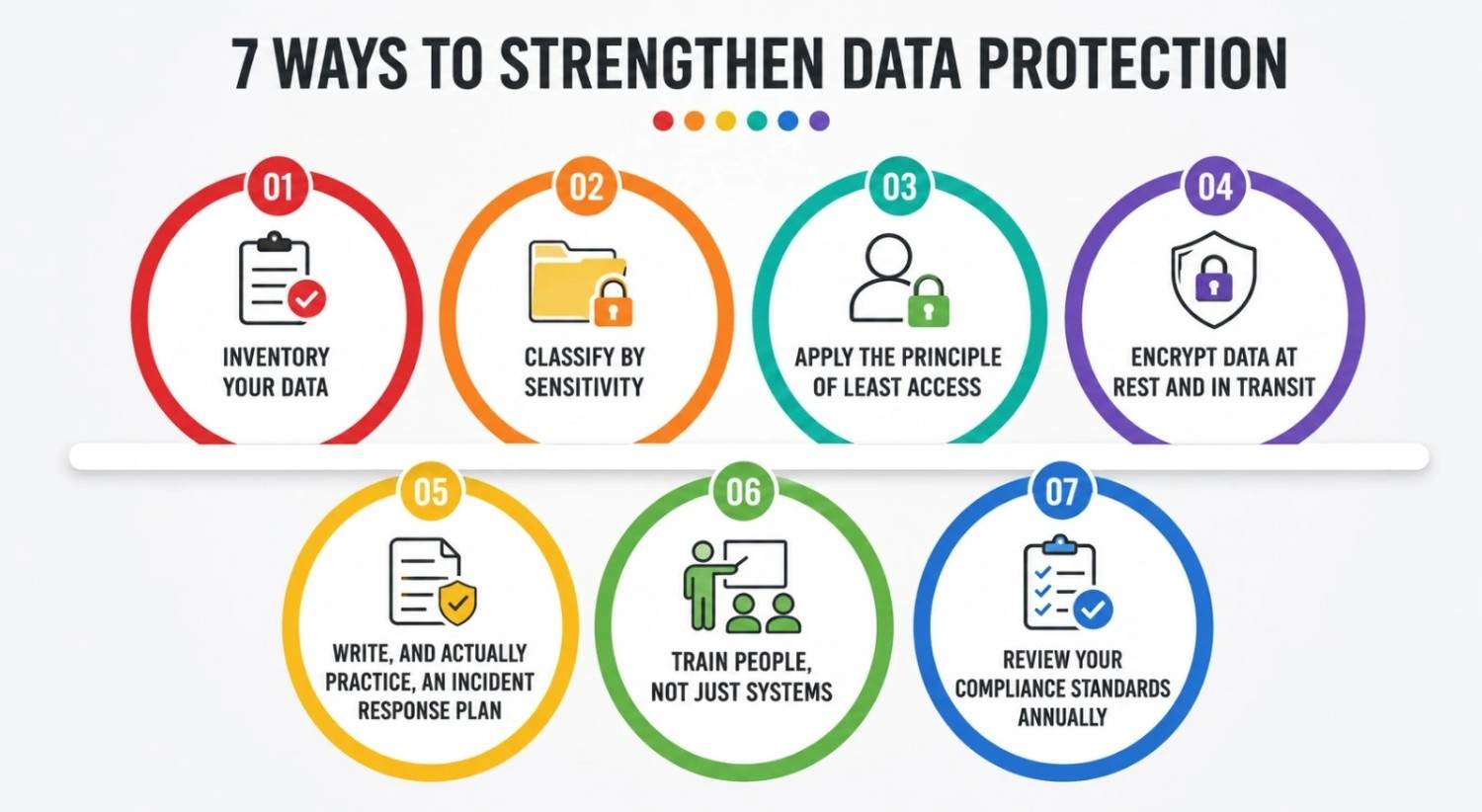
- Inventory your data. You can’t protect what you haven’t identified.
- Classify by sensitivity. Not everything deserves the same level of protection.
- Apply the principle of least access. Strong data access control means fewer eyes on sensitive data, which lowers the odds of a costly mistake.
- Encrypt data at rest and in transit. This one habit blunts the impact of most breaches.
- Write, and actually practice, an incident response plan. A plan you’ve never rehearsed is just a hope.
- Train people, not just systems. Most breaches start with human error, not a sophisticated hack.
- Review your compliance standards annually. Regulations change, and your practices should too.
None of this requires a massive budget. It requires consistency, which is honestly the harder part to sustain.
Common Mistakes Beginners Make
A handful of patterns show up again and again among students and early-career professionals meeting this space for the first time. Treating privacy as a one-time checklist rather than an ongoing practice is probably the biggest one.
Close behind it is the assumption “we’re too small to be a target”—smaller organizations are frequently targeted precisely because their defenses are weaker. People also tend to confuse security with privacy: encrypting data is a security measure, but it doesn’t automatically make the original decision to collect that data lawful or ethical.
And third-party vendors get overlooked constantly, even though they often hold the same sensitive data with far less oversight than the primary organization has.
Spot these patterns now, as a student, and you’ll skip re-learning them the hard way in your first job.
Career Paths Built Around This Skill Set
If any of this has sparked your interest, know that data privacy and compliance have grown into a real career track, not just a checkbox tucked inside legal or IT. A Data Protection Officer oversees how an organization meets its legal obligations and often reports straight to leadership.
Privacy analysts audit systems and processes for gaps. Compliance officers track regulatory change across every region a company operates in. Security engineers build the technical controls—encryption, access logging, and network segmentation—that make written policy actually enforceable.
None of these roles demand a law degree, though legal literacy helps. People land in this field from computer science, business administration, and even journalism and public policy because it rewards clear thinking as much as technical depth.
Organizations like the IAPP run training and certifications built specifically for this career path, and it’s worth a look if you’re weighing electives or a first job. Demand keeps climbing as more of daily life moves online, across healthcare, finance, education technology, and government alike.
Where Is This Heading?
Regulations are only getting more specific, not less. More countries are drafting their own versions of GDPR-style law, and artificial intelligence systems are pushing regulators to ask new questions about how personal data trains automated decisions.
Staying current with data privacy and compliance isn’t a one-semester topic. It’s a habit you’ll carry across your entire career, in nearly any field that touches technology, healthcare, finance, or education.
A Personal Note
I’ll admit this topic felt dry to me at first—a subject made of acronyms and fine print. What changed my mind was realizing how personal it actually is. Every regulation in this guide exists because real people were harmed by careless data handling before the rule existed to stop it.
Once you see it that way, compliance stops feeling like a burden and starts feeling like basic respect for the people whose information you’ve been trusted with. If you’re a student reading this before your first internship, that mindset will outlast any single fact in this article.