
If you’re new to internal audit or compliance work, “control testing” can feel like a vague phrase thrown around in textbooks without a clear roadmap for how to actually do it. This guide breaks the process down into steps you can apply on a real engagement—whether you’re a student prepping for your first internship, a junior auditor building a workpaper, or someone studying for a certification exam.
By the end, you’ll have a working framework for planning, executing, and documenting a test that actually holds up under review, not just one that looks tidy in a spreadsheet.
What Is Control Testing, Really?
At its core, control testing is the process of evaluating whether a control — a policy, procedure, or automated check meant to reduce a risk — is both properly designed and actually operating the way it’s supposed to.
It sits at the center of nearly every audit engagement, financial statement review, and regulatory examination, because a control that only exists on paper protects nobody. There are two questions every control test tries to answer:
- Is the control designed to address the risk it’s meant to mitigate? (design effectiveness)
- Is the control actually being performed, consistently, the way it’s documented? (operating effectiveness)
A thorough control review looks at both of these, in that order. Skipping straight to operating effectiveness without first confirming design is one of the most common shortcuts in student and junior-auditor work, and it’s exactly the kind of gap that turns into an embarrassing finding six months later.
Good testing practice doesn’t assume a policy document equals a working process—it verifies the gap between the two doesn’t exist.
Why Does This Discipline Sit at the Heart of IT Audit and Compliance Assessment?
In an IT audit, testing is how you move from “the company says it has access controls” to “here is the evidence that access controls actually restrict who can change payroll records.”
According to ISACA’s resources for audit and assurance professionals, practitioners in this field are expected to independently verify that information systems and business processes are properly controlled, monitored, and assessed—and testing is the mechanism that produces that verification rather than just asserting it.
The same logic carries over into a broader compliance assessment. Regulators, external auditors, and boards don’t want to hear that a control “should” work — they want tested evidence tied to a specific requirement.
That’s why this discipline shows up across SOX work, HIPAA reviews, SOC 2 engagements, and ISO 27001 certifications alike. NIST makes a related point in its guidance on assessing security and privacy controls, which frames assessment as the way organizations confirm that controls are implemented correctly and actually achieve their intended outcome, not merely documented on paper.
Students sometimes assume IT audits and financial audits run on separate logic. They don’t. Whether you’re testing a firewall rule change process or a journal-entry approval workflow, the underlying question is identical: does the evidence prove the control worked, or does it only prove someone wrote a policy about it?
Risk Identification Comes First — Always
Before you write a single test step, you need risk identification. Testing a control without first understanding what risk it’s supposed to reduce is like writing an answer before reading the question. Effective risk analysis at this stage asks:
- What could realistically go wrong in this process — fraud, error, downtime, or non-compliance?
- Which of those outcomes would actually matter to the business or to regulators if they happened?
- Which controls, if any, are supposed to catch or prevent that specific risk?
The COSO Internal Control–Integrated Framework treats risk assessment as one of its five foundational components, alongside control environment, control activities, information and communication, and monitoring—precisely because a meaningful test cannot be designed without this groundwork first.
As Cherry Bekaert’s guide to the COSO framework explains, folding risk assessment into the control structure is what allows an organization to identify, assess, and respond to risk before it becomes an incident.
Weak groundwork here is how audit teams end up spending days on testing efforts that don’t matter while missing the one gap that actually causes a breach or a restatement. If you only remember one habit from this article, make it this: never let a test plan get written before the risk it addresses is written down first, in plain language, and agreed on by the team.
The Standard Audit Procedures Behind Every Control Test
Once risk identification is complete and you know which controls need attention, you draw from a small, well-established set of audit procedures. ISACA’s guidance on building audit programs — summarized in this overview of ISACA’s five-step audit planning process — describes developing methodology and test scripts to verify controls as a core planning step, well before fieldwork even starts.
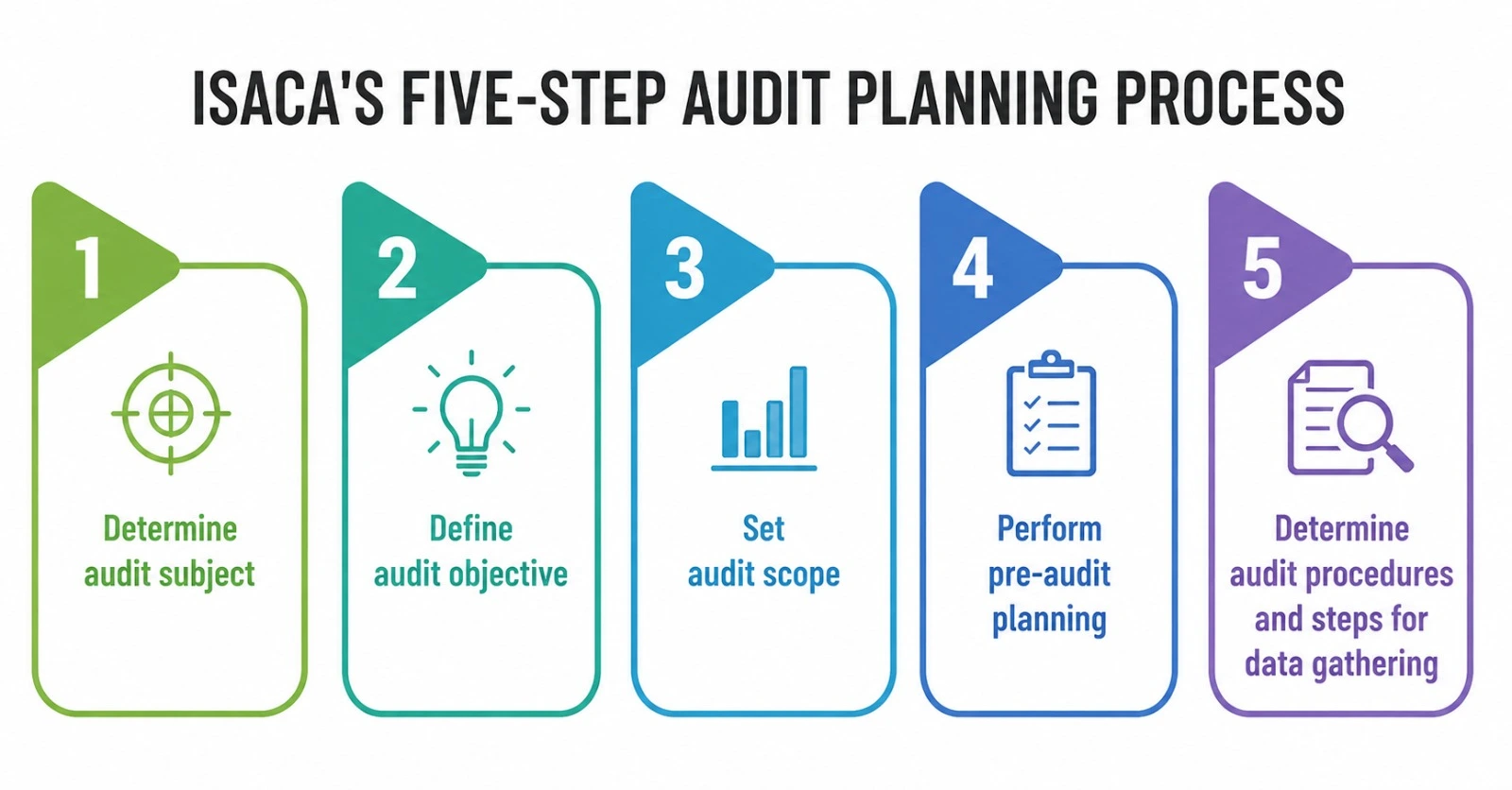
Here’s a simple breakdown of the procedures you’ll use in almost every engagement:
|
Procedure |
What You’re Doing |
Best For |
|
Inquiry |
Asking the control owner to explain how the control works |
Building initial understanding, not standalone evidence |
|
Observation |
Watching the control being performed in real time |
Manual controls performed infrequently |
|
Inspection |
Reviewing documents, logs, tickets, or system configurations |
Most controls leave a clear evidence trail |
|
Reperformance |
Independently redoing the control yourself |
High-risk or automated controls needing strong evidence |
|
Walkthrough |
Tracing one transaction end-to-end through the process | Understanding design before testing operating effectiveness |
Inquiry alone is never enough on its own. NIST’s assessment methodology for federal systems similarly distinguishes between examining documentation, interviewing staff, and testing the control directly, treating direct testing as the strongest form of evidence precisely because it doesn’t rely on someone’s word alone.
A Quick Note on the Frameworks Behind the Terminology
Students often meet these ideas for the first time through three different frameworks, and it helps to know how they relate. COSO’s Internal Control–Integrated Framework is where most of the vocabulary around risk assessment, control environment, and monitoring originates, and it’s the reference point most financial and operational reviews are built on.
COBIT, maintained by ISACA, translates that same thinking into an IT governance context, giving practitioners a structured way to map business objectives to specific technology controls. NIST’s SP 800-53 and SP 800-53 A family does something similar for federal and government-adjacent systems, pairing a catalog of security and privacy controls with a matching set of assessment methods.
None of these frameworks is “the” correct one—most organizations blend elements of all three depending on industry, regulator, and the kind of system involved—but recognizing which framework a client or textbook is drawing from will save you a lot of confusion when the terminology shifts slightly between sources.
Design Testing vs. Operating Effectiveness: Two Different Jobs
Students often collapse control testing into a single step, but it genuinely splits into two separate exercises with different goals. Design testing asks whether the control, as built, could actually stop or catch the risk it targets — this usually happens through a walkthrough, where you trace one transaction from start to finish and check whether the control point makes logical sense.
Operating effectiveness testing asks whether that same control was consistently performed over a period, usually through a sample of transactions pulled across weeks or months.
Treating these as one step is a common reason this whole exercise produces false comfort: a control can be beautifully designed and still fail in practice because someone skipped it under deadline pressure, or it can be performed diligently every single time and still fail to catch the risk it was built for because it was never designed correctly in the first place.
Confirming both halves separately is what turns a checklist exercise into real assurance.
8 Control Testing Tips You Can Use Today
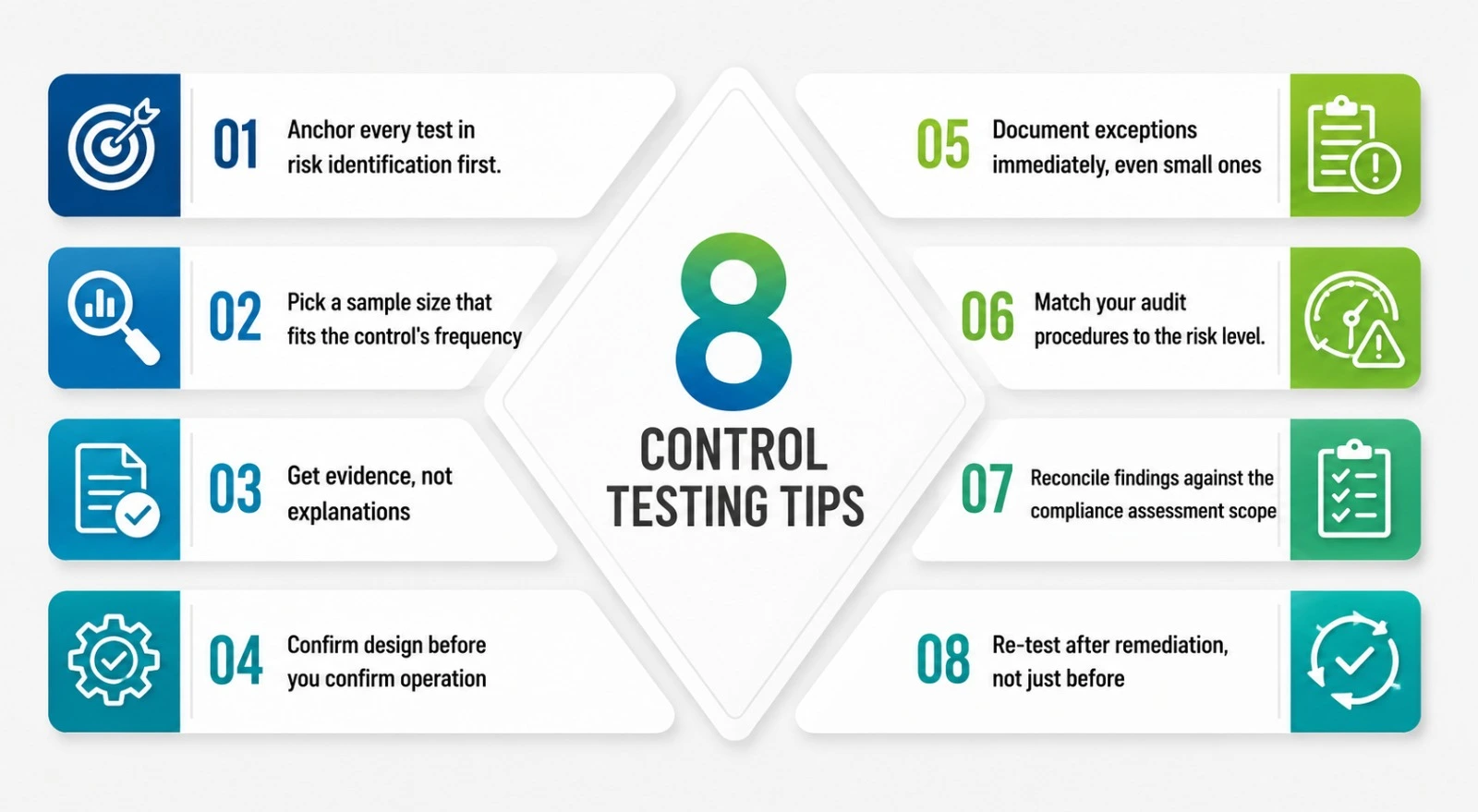
- Anchor every test in risk identification first. Don’t test a control because it’s on a checklist—test it because your earlier risk mapping showed it addresses something that actually matters to the business.
- Pick a sample size that fits the control’s frequency. A control that runs once a year needs a different sampling approach than one that runs a thousand times a day. Testing one instance of a monthly reconciliation and calling the job done is a common rookie mistake.
- Get evidence, not explanations. A screenshot, a signed approval, a system log — these hold up under review. A verbal description from the control owner doesn’t, no matter how confident they sound.
- Confirm design before you confirm operation. A control review that jumps straight to “did it happen” without first checking “was it built to work” will miss controls that are well-executed but poorly designed from the start.
- Document exceptions immediately, even small ones. One missed approval in a sample of twenty-five isn’t automatically a failed control, but it needs to be recorded and evaluated, not quietly dropped from the workpaper.
- Match your audit procedures to the risk level. High-risk controls deserve re-performance or detailed inspection; low-risk controls may only need observation or a lighter inspection pass.
- Reconcile findings against the compliance assessment scope. A control can pass your test and still leave a gap against a specific regulatory clause, so always check both separately rather than assuming one covers the other.
- Re-test after remediation, not just before. Control testing isn’t a one-time event. If a control failed and management fixed it, go back and confirm the fix actually holds before you close the finding.
Where Does Control Review Work Go Wrong?
Most weak reviews of this kind share the same three problems: shallow risk analysis, over-reliance on inquiry instead of inspection or re-performance, and samples too small to support a real conclusion.
A review that exists only to check a compliance box, rather than to genuinely evaluate whether a risk is covered, tends to miss exactly the issues that later surface as audit findings or, worse, actual incidents.
NIST’s guidance on security and privacy control assessment procedures makes the point that assessment should verify that controls meet their stated objectives and achieve the intended outcome, not just that a checklist item was ticked off.
For technology-specific work, the ISCA CA Lab’s guide to auditing general IT controls is a useful companion resource, since general IT controls—access management, change management, and backup and recovery—tend to need more technical audit procedures than a typical business-process review, and students moving from financial audit into technology work often underestimate that gap.
A Personal Note
I’ve sat through reviews where the work papers were technically complete but told you nothing useful because the sampling was built around what was easy to check rather than what was actually risky.
The best control testing I’ve seen always starts with a blunt question: if this control failed silently for six months, would anyone notice? If the honest answer is no, that’s exactly the control worth spending your time on—not the one that happens to be easiest to sample.
If you’re a student heading into your first audit engagement, hold onto that question. It will serve you longer than any checklist.