

If you’re a computer science student or an early-career IT professional scrolling through job boards right now, you’ve probably noticed two titles showing up in almost every listing: DevOps Engineer and Site Reliability Engineer.
They sound similar, they often report into the same infrastructure teams, and recruiters sometimes use the terms as if they’re interchangeable. They aren’t. The DevOps Engineer vs SRE question is one of the most common career decisions students ask me about, and it deserves a clearer answer than “pick whichever pays more.”
This guide breaks down what each role actually does day to day, how their responsibilities diverge once you look past the job title, and how to decide which path fits your strengths. I’ve written it the way I wish someone had explained it to me when I was choosing between the two—plainly, with real examples, and without the jargon overload most explainers lean on.
Why the DevOps Engineer vs SRE Question Keep Coming Up?
Both roles grew out of the same frustration: developers writing code and operations teams running it in production used to work in silos, and things broke at the handoff. DevOps emerged around 2009 as a cultural movement to close that gap.
Site Reliability Engineering, a term coined at Google, took a more engineering-first approach to the same problem—treat operations as a software problem and solve it with code. According to the Google SRE book, SRE is essentially “what happens when you ask a software engineer to design an operations function.”
That shared origin is exactly why the DevOps Engineer vs SRE comparison confuses so many students. The two disciplines overlap on tools, overlap on goals, and often overlap on the teams they sit in.
Job postings don’t help either—a listing titled “DevOps Engineer” at one company might describe exactly what a “Site Reliability Engineer” does at another, because titles vary far more than the underlying work does.
But once you look past naming conventions, the day-to-day tasks, the metrics each role is judged on, and the mindset required, they are genuinely different, and that difference should shape which one you train for.
What Does a DevOps Engineer Actually Do?
A DevOps engineer sits at the intersection of development and operations, and the job is largely about building the pipeline that takes code from a developer’s laptop to a live production environment safely and quickly. That means:
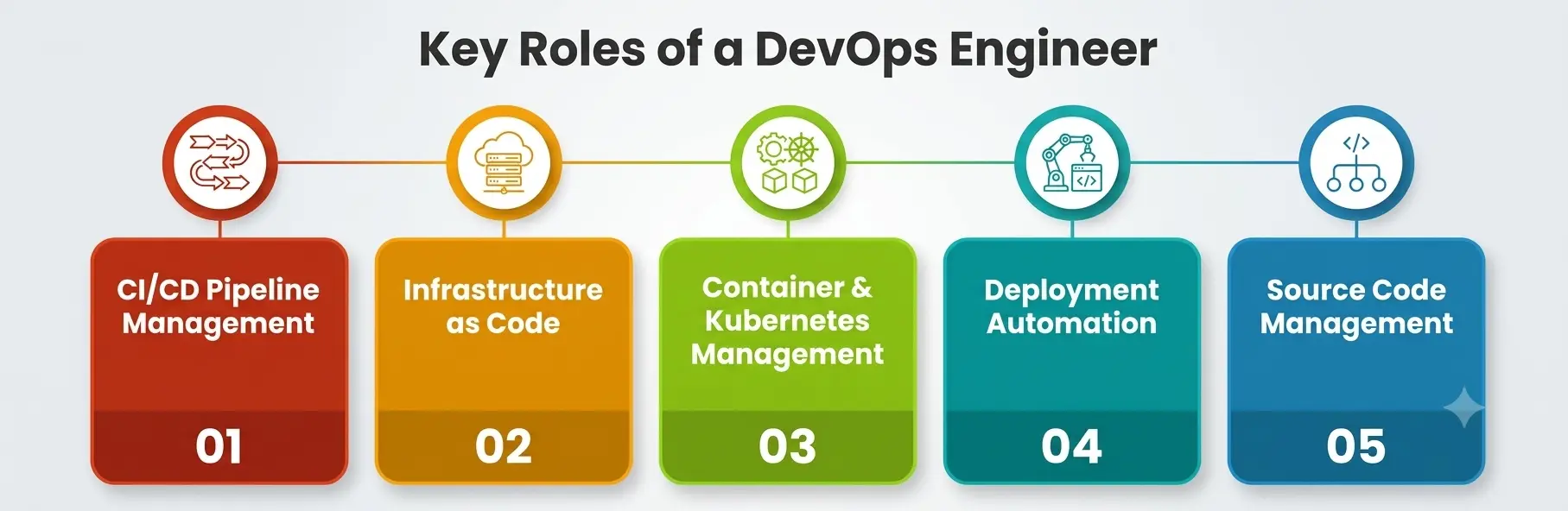
- Building and maintaining CI/CD pipelines
- Writing infrastructure as code (Terraform, CloudFormation, Pulumi)
- Managing containers and orchestration (Docker, Kubernetes)
- Owning deployment automation so releases don’t depend on a person clicking buttons at 2 a.m.
- Working closely with developers on source code management practices—branching strategy, code review gates, merge policies
Deployment automation is arguably the single biggest chunk of a DevOps engineer’s calendar. Every pipeline failure, every flaky test gate, and every manual approval step that slows a release down is something a DevOps engineer is expected to fix or automate away. If your team ships software several times a day, that’s usually a sign a strong deployment automation culture is already in place and a DevOps engineer built it.
Source code management is the other pillar. A DevOps engineer doesn’t just write application code—they design how an entire engineering org stores, branches, reviews, and merges code.
Getting source code management wrong (messy branching models, no automated checks before merge) is one of the fastest ways to slow an engineering team down, and fixing it is squarely a DevOps engineer’s job.
The end goal of all of this is faster, more reliable software delivery. A DevOps engineer is judged less on “is the system up right now?” and more on “how quickly and safely can we ship the next change?”
Reference Blog: The Roles and Responsibilities of DevOps Engineer
What Does a Site Reliability Engineer (SRE) Actually Do?
An SRE’s job starts where the DevOps Engineer’s mostly ends: once code is live, who keeps it running? SRE work is anchored in measurable reliability—Service Level Objectives (SLOs), error budgets, and incident response.
Typical duties of an SRE include:
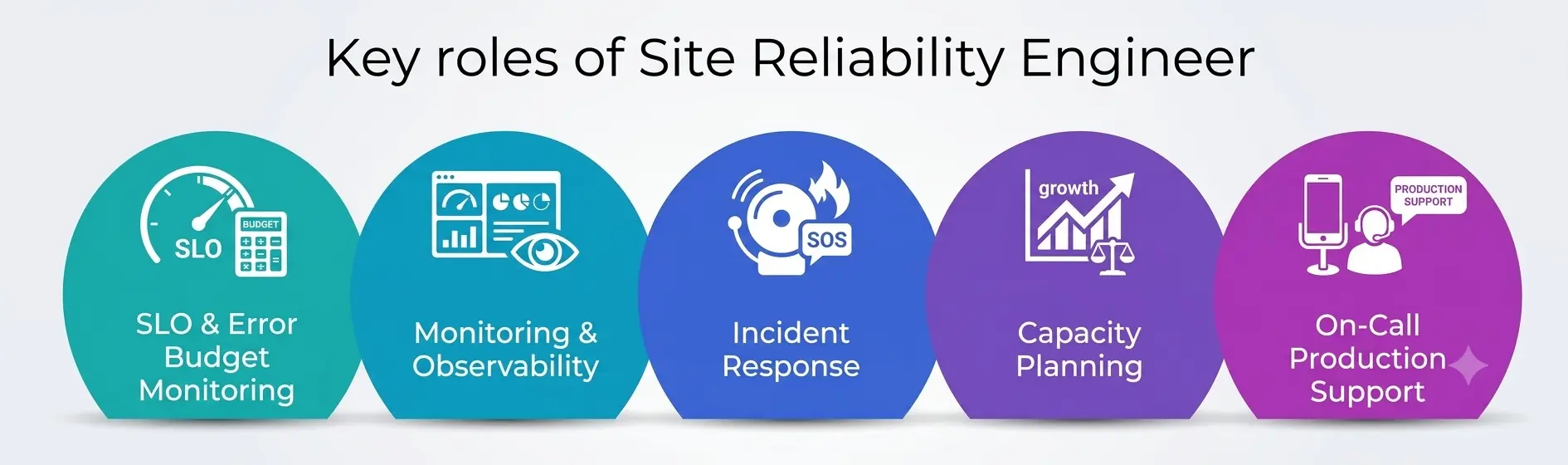
- Define and monitor SLOs and error budgets
- monitoring alerting and observability systems in building monitoring
- Enabling incident response and blameless postmortems
- Capacity planning and utilization of resources forecast
- Production support during outages, rotation on-call
SREs spend the lion’s share of their attention on production support, yet it’s not the majority of their week. When a service goes down at 3 a.m., it’s usually the SRE getting paged, diagnosing the root cause, and deciding whether the incident burns through the team’s error budget. Strong production support isn’t about heroics during an outage—it’s about the monitoring and automation built beforehand so outages are rare and short.
Resource utilization is the quieter half of the job. SREs constantly look at how efficiently compute, storage, and network resources are being used against actual demand. Over-provisioned infrastructure wastes money; under-provisioned infrastructure causes outages. Getting that balance right—through autoscaling policies, load testing, and capacity forecasting—is a core, ongoing SRE responsibility, not a one-time project.
DevOps Engineer vs SRE: A Side-by-Side Comparison
Here’s a table format explanation to make the DevOps Engineer vs SRE distinction easier to hold in your head:
|
Dimension |
DevOps Engineer |
Site Reliability Engineer (SRE) |
|
Primary focus |
Deployment automation and software delivery speed |
System reliability and production support |
|
Core metric |
Lead time to deploy, deployment frequency |
SLOs, error budgets, uptime |
|
Key tools |
CI/CD pipelines, IaC, containers |
Monitoring/observability stacks, incident tooling |
|
Ownership |
Source code management and release pipelines |
Resource utilization, capacity planning, on-call |
|
Mindset |
“How fast can we ship this safely?” |
“How much risk can this service absorb before it breaks?” |
|
Origin |
Cultural movement (Dev + Ops collaboration) |
Engineering discipline (born at Google, 2003) |
|
Typical background |
Software engineering, systems administration |
Software engineering, applied mathematics, distributed systems |
That table format explanation isn’t exhaustive, but it captures the core split: DevOps engineers optimize the path code that takes to production, and SREs own what happens to it once it gets there.
A Day in the Life: DevOps Engineer vs SRE
Numbers on a page rarely capture what a role actually feels like day to day, so picture a normal Tuesday for each.
A DevOps engineer might start the morning reviewing a failed pipeline build, spend an hour writing a Terraform module to spin up a new staging environment, sit in a code review to unblock a teammate’s pull request, and then spend the afternoon tuning a Kubernetes autoscaling policy ahead of a big feature launch. The common thread is momentum—moving code closer to release, faster, and with fewer manual steps in between.
An SRE’s Tuesday tends to look different. The morning might start with triaging overnight alerts from a monitoring dashboard, followed by an hour digging into why p99 latency crept up on one particular service.
After lunch, there’s a postmortem review for last week’s incident, then a capacity-planning session ahead of a traffic spike expected around an upcoming product launch. The common thread here is protection—keeping what’s already live stable, predictable, and fast enough for users who never see the work behind it.
This day-in-the-life comparison is often the clearest way to answer the DevOps Engineer vs SRE question for yourself, more so than any list of responsibilities on a job posting. If the first day sounds energizing, learn DevOps. If the second one does, learn SRE.
Skills That Matter for Each Path
If you’re a student mapping out what to learn, the overlap is real, but the emphasis differs.
For a DevOps Engineer track, prioritize:
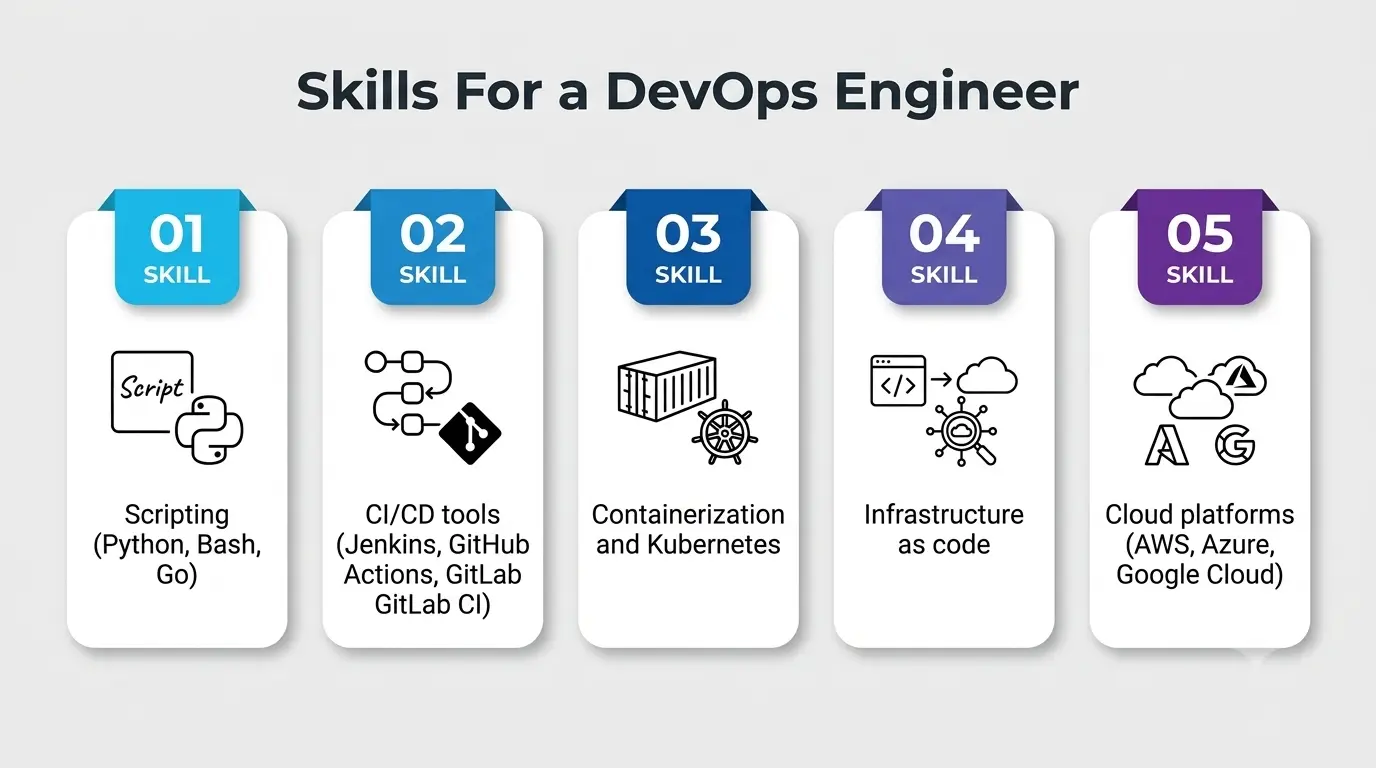
- Scripting (Python, Bash, Go)
- CI/CD tools (Jenkins, GitHub Actions, GitLab CI)
- Containerization and Kubernetes
- Infrastructure as code
- Cloud platforms (AWS, Azure, Google Cloud)—cloud fundamentals certifications carry real weight with hiring managers in 2026
For an SRE track, prioritize:
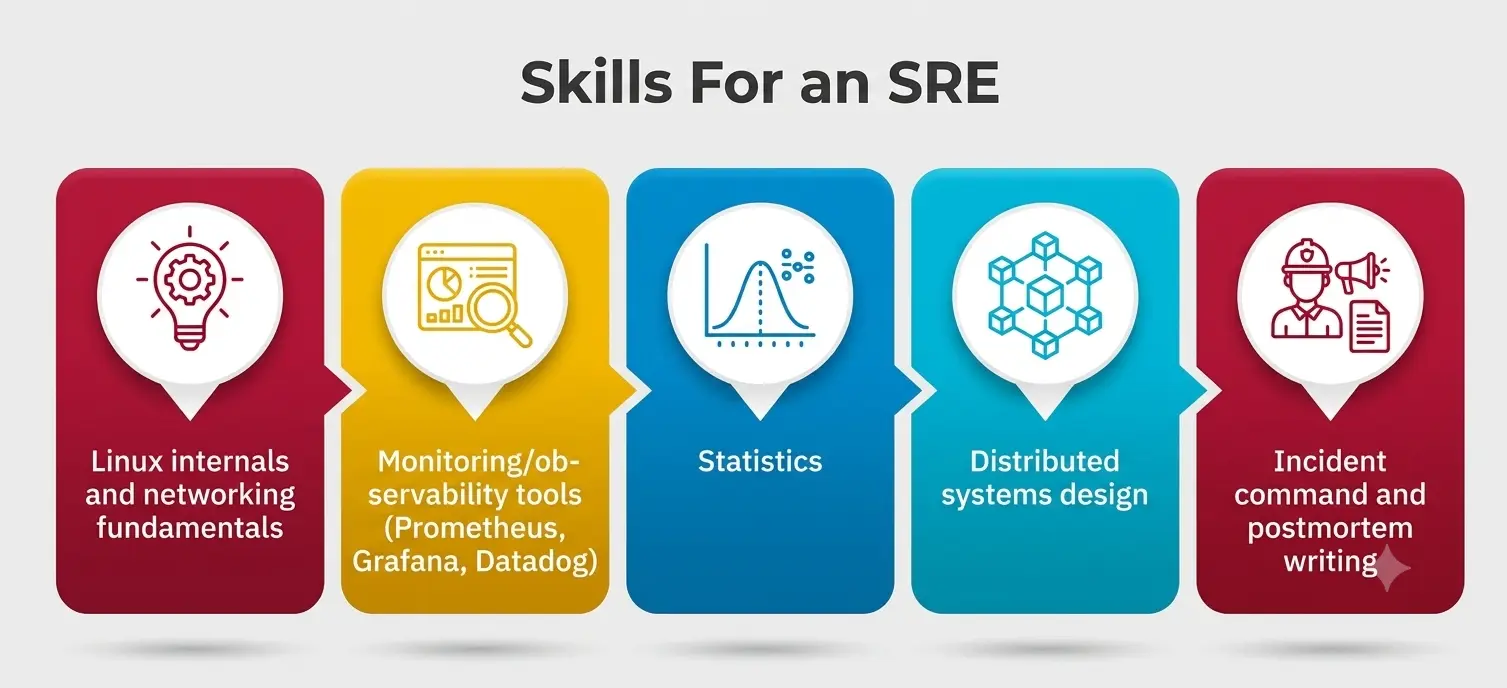
- Linux internals and networking fundamentals
- Monitoring/observability tools (Prometheus, Grafana, Datadog)
- Statistics—SLOs and error budgets are a math problem before they’re a tooling problem
- Distributed systems design
- Incident command and postmortem writing
Both paths reward strong scripting ability and cloud literacy, so don’t treat this as an either/or when it comes to fundamentals—the split shows up more in what you specialize toward after year one or two. If you’re unsure which track to specialize in first, ask which skill list excites you more: pipelines and release tooling or monitoring, load testing, and resource utilization analysis.
Career Outlook and Salary Trends for 2026
Demand for both roles has stayed strong through 2026, driven by the same forces: companies running more services, more cloud spend to manage, and more pressure to ship software delivery faster without sacrificing stability.
The data projects employment for software developers and related infrastructure roles to grow much faster than the average for all occupations through the rest of this decade, and DevOps and SRE roles sit squarely inside that growth.
Compensation tends to run close between the two roles at comparable seniority, though SREs at large-scale companies (think services handling millions of concurrent users) often command a premium because the reliability bar is so much higher.
Staffing firm data puts U.S. site reliability engineer pay in a roughly $114,000 to $170,000 range depending on seniority and location, with mid-level candidates landing near the middle of that band.
DevOps Engineers, meanwhile, see strong and steady demand at mid-sized companies and startups that are still building out their software delivery pipeline from scratch, where the cost of slow or unreliable releases is felt immediately.
The DORA State of DevOps research has tracked this space for over a decade and consistently finds that organizations with elite deployment automation and delivery practices significantly outperform their peers on both speed and stability — which is exactly why companies keep hiring for both roles rather than picking one.
So, Which One Should You Choose?
Here’s the honest answer: it depends on what energizes you, not on which title looks better on LinkedIn.
Choose the DevOps Engineer path if you enjoy building things — pipelines, automation scripts, developer tooling — and you get satisfaction from shaving minutes off a deployment process or removing a manual step from a release. You’ll spend your day thinking about software delivery speed, developer experience, and source code management workflows.
Choose the SRE path if you’re drawn to systems thinking, you like the challenge of a live incident, and you find satisfaction in analyzing why something broke rather than just fixing it and moving on. You’ll spend your day thinking about production support, resource utilization, and the math behind reliability targets.
Plenty of engineers move between the two over a career — starting in DevOps to learn the delivery pipeline, then moving into SRE once they want to own reliability at scale, or the reverse.
Neither path locks you out of the other; as the two disciplines work from shared data and shared goals, which is exactly why a switch two or three years in is so common and realistic.
A Personal Note
I’ve mentored a handful of students through exactly this decision, and the ones who end up happiest aren’t the ones who picked based on salary surveys — they’re the ones who spent a weekend actually building something small: a CI/CD pipeline for a toy project, or a basic monitoring dashboard for a personal server.
That hands-on test tells you more about which side of the DevOps Engineer vs SRE divide fits you than any comparison article, including this one. Go build something small before you commit to either path. You’ll know within a weekend which one feels like play and which one feels like a chore.