
Every organization, from a five-person startup to a multinational bank, runs into the same problem sooner or later: things go wrong. Systems fail, vendors miss deadlines, employees click on phishing emails, and regulators rewrite the rules mid-year. None of that is fully avoidable.
What separates organizations that survive these moments from the ones that don’t isn’t luck—it’s preparation, tested processes, and a clear-eyed plan for handling what could go wrong before it actually does.
That planning process is what this article is about, and it will walk you through risk mitigation from the ground up. If you’re a student studying business, cybersecurity, finance, or management, you’ll run into this idea constantly—in a case study, an internship, or your first real job.
This guide breaks down what risk mitigation actually means, how it grows out of proper risk assessment, and how organizations turn plans on paper into working controls, sound policies, and genuine business resilience. By the end, you should be able to explain the whole cycle in your own words, not just repeat definitions from a textbook.
What Is Risk Mitigation?
In plain terms, risk mitigation is the set of actions an organization takes to lower the chances that a risk will occur or to reduce the damage if it does happen anyway. It isn’t about eliminating every possible threat—that goal is unrealistic for any organization of meaningful size. It’s about deciding which risks matter most and putting practical, proportionate measures in place to handle them.
Students often confuse this term with risk assessment, but the two aren’t interchangeable. Risk assessment tells you what could go wrong and roughly how bad it would be. The response that follows is the treatment step. One is diagnosis; the other is action.
A doctor who only diagnoses illness without ever prescribing treatment isn’t doing their whole job, and an organization that only assesses exposure without acting on the findings is in the same position—aware of the problem but doing nothing meaningful about it.
Risk Assessment: The Groundwork Before Any Response
You can’t fix what you haven’t measured. Risk assessment is the groundwork stage, and it usually follows a fairly simple sequence, even in large and complicated organizations:
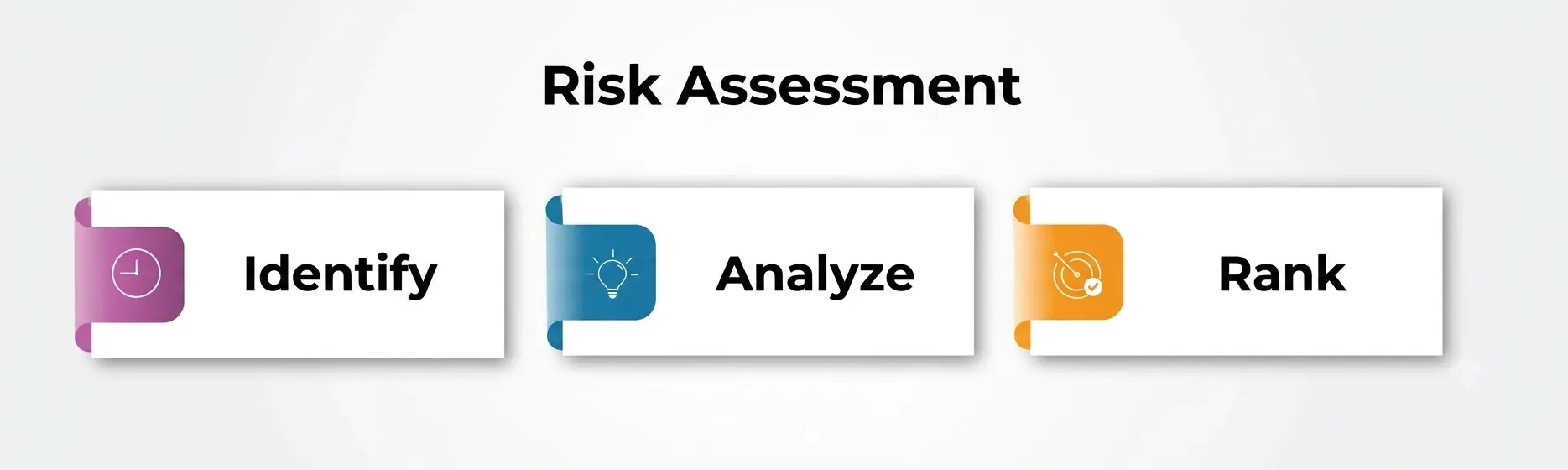
- Identify the risks facing the organization—operational, financial, legal, cyber, reputational, or environmental.
- Analyze how likely each one is and how severe the impact would be if it happened.
- Rank the risks so leadership knows where to spend limited time, budget, and attention first.
Frameworks like ISO 31000 give organizations a shared vocabulary and a repeatable process for this stage, which matters enormously when teams across different countries, business units, or departments need to agree on what “high risk” actually means for their organization.
Some teams lean on qualitative methods here—workshops, interviews, and expert judgment sorted into simple low/medium/high buckets—while others prefer quantitative scoring, assigning rough dollar values and probabilities to each scenario so risks can be compared on a single scale.
Neither approach is universally better; smaller teams often start qualitative and add quantitative rigor as the stakes and the data available to them grow. Once that assessment work is finished, it feeds directly into the next and more action-oriented stage: deciding how to respond to what’s been found, which is where risk mitigation formally begins.
Four Ways to Respond: Core Strategies
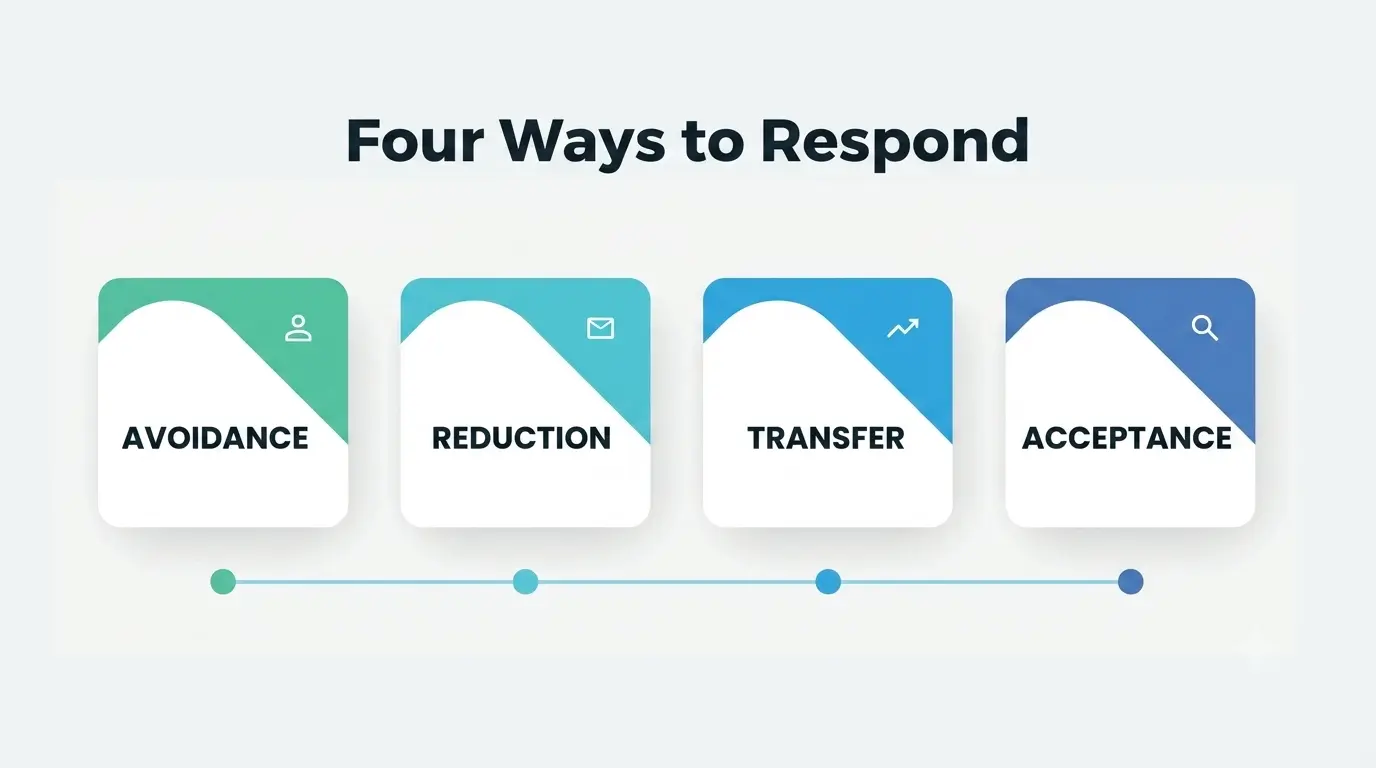
Most risk professionals sort their response options into four broad categories. Knowing these by name is genuinely useful—they show up in exams, job interviews, and audit reports alike, and interviewers love asking candidates to explain the difference between them on the spot.
|
Strategy |
What It Means |
Typical Example |
|
Avoidance |
Stop the activity that creates the risk entirely. |
Discontinuing a product line with unresolved safety issues |
|
Reduction |
Lower the likelihood or impact through preventive action. |
Adding multi-factor authentication to cut down account takeovers |
|
Transfer |
Shift the financial burden of the risk to another party. |
Buying cyber insurance or outsourcing a risky process to a specialist vendor |
|
Acceptance |
Acknowledge the risk and monitor it without heavy investment. |
Accepting minor currency fluctuation on a small international contract |
There’s no single “correct” choice here—the right one depends on cost, appetite for uncertainty, and how critical the affected process is to daily operations. A student learning this for the first time should remember that these four options aren’t ranked by preference; each one is chosen based on context, and mature organizations often use all four at once across different parts of the business as part of one coordinated risk mitigation program.
Picture a mid-sized retailer weighing whether to keep processing customer payments in-house. Building a fully custom, in-house system might mean reduction—hardening it with encryption and tighter access rules. Handing the whole function to a licensed payment processor is a transfer—someone else now carries most of that exposure.
Shutting down a risky checkout feature entirely, rather than patching it repeatedly, is avoidance. And quietly monitoring a low-value edge case that would cost more to fix than it could ever lose is acceptance. Four different answers, same underlying risk, and each one defensible depending on the numbers behind it.
Internal Controls: Turning Strategy into Daily Practice
Strategy written on paper doesn’t protect anyone by itself. Internal controls are what convert a decision into a repeatable, checkable action that actually happens on a Tuesday afternoon, not just in a planning document.
Think of these safeguards as the guardrails built into everyday operations—approval limits before a payment goes out, segregation of duties so one person can’t both authorize and execute a transaction, and reconciliation checks that catch errors before they compound into something larger, long before a small mistake turns into a headline.
Well-designed controls do double duty: they lower the chance of fraud or error, and they give auditors and regulators evidence that the organization is genuinely managing exposure, not just describing good intentions in a slide deck.
The COSO framework is one of the most widely referenced models here, and it’s worth knowing if you’re headed into accounting, audit, or corporate finance. These safeguards work best when reviewed on a set schedule—a control that made perfect sense three years ago can quietly become outdated as the business changes around it.
Security Controls: Protecting Systems, Data, and People
For anything touching technology, security controls form a specific and critical part of the broader protective environment. These include technical measures such as firewalls, encryption, and access management, along with administrative measures like background checks and staff awareness training.
The CIS Controls are a solid starting reference for students moving into cybersecurity, since they prioritize a manageable list of actions instead of handing beginners an overwhelming checklist.
Good defenses in this category aren’t only about stopping attackers outright—they also limit the blast radius once something does slip through, which is often the more realistic and honest goal for any team. No system is unbreakable, but a well-layered, well-tested set of safeguards buys valuable time and shrinks the scale of eventual damage.
Compliance Management: Aligning Risk Work With Law and Regulation
Compliance management is where risk work meets legal obligation. Every industry carries its own rules—data privacy laws, financial reporting requirements, workplace safety standards—and this discipline is about tracking those rules, mapping them to internal processes, and proving adherence whenever a regulator or client asks for evidence.
Done well, this function isn’t a separate box-ticking exercise sitting apart from the rest of the program—the two should reinforce each other constantly. A control built to satisfy an auditor should also be a control that genuinely reduces exposure in practice.
Organizations that treat this work as paperwork alone tend to build controls that look convincing on a checklist but do very little in the real world. Students entering regulated industries like healthcare, banking, or energy will quickly find that this discipline shapes almost every process decision made above their pay grade, whether they notice it directly or not.
Policy Management: Writing Rules People Actually Follow
A policy is only useful if people know it exists and can follow it without confusion. Policy management covers how an organization writes, approves, distributes, updates, and eventually retires its internal rules—everything from a password policy to a full code of conduct.
Weak execution here tends to look the same everywhere: outdated documents nobody has opened in years, contradictory rules across departments, or policies written in language no employee could realistically apply on a busy day.
Strong policy management ties each rule back to a specific, named risk it’s meant to address, gets reviewed on a set schedule, and gets communicated in language people actually understand rather than legal jargon.
When this process and compliance management run through the same coordinated workflow, organizations avoid the common trap of having rules on paper that nobody in the building actually follows in practice.
Business Resilience: What Happens After the Controls Are in Place
Here’s something worth sitting with: even the best-designed program reduces the odds of bad things happening, but it can’t promise they’ll never happen. That’s where business resilience comes in. It’s an organization’s capacity to keep functioning or recover quickly when a disruption gets through anyway—a cyberattack, a supply chain failure, a natural disaster, or a key employee leaving without warning.
Standards like ISO 22301 focus specifically on building this kind of staying power through documented continuity plans, tested backup systems, and rehearsed recovery procedures.
Risk mitigation and this recovery capacity work as a pair rather than substitutes for one another: one lowers the odds of disruption, the other determines how fast the organization gets back on its feet when prevention wasn’t enough.
Neither one can replace the other, and organizations that only invest in one tend to be surprised by the gap the other was supposed to cover.
A Practical Workflow for Students and Early-Career Professionals
If you’re trying to apply this in a class project, an internship, or your first risk-related role, a workable sequence looks roughly like this:
- Identify and assess risks using a structured method, not guesswork or gut feeling.
- Choose a response—avoid, reduce, transfer, or accept—for each significant risk you’ve found.
- Translate that choice into specific internal controls and, where relevant, dedicated security controls.
- Document the rule clearly and route it through proper policy management before it goes live.
- Check the finished policy against applicable laws and confirm it satisfies current regulatory obligations before it ever goes live.
- Test whether the organization could keep operating if the risk materialized anyway—this is your recovery and continuity check.
- Revisit the whole cycle on a set schedule, because risks shift constantly and static plans age badly within a year or two.
Common Mistakes That Undermine a Risk Program
A handful of patterns show up again and again in real organizations, regardless of size or industry:
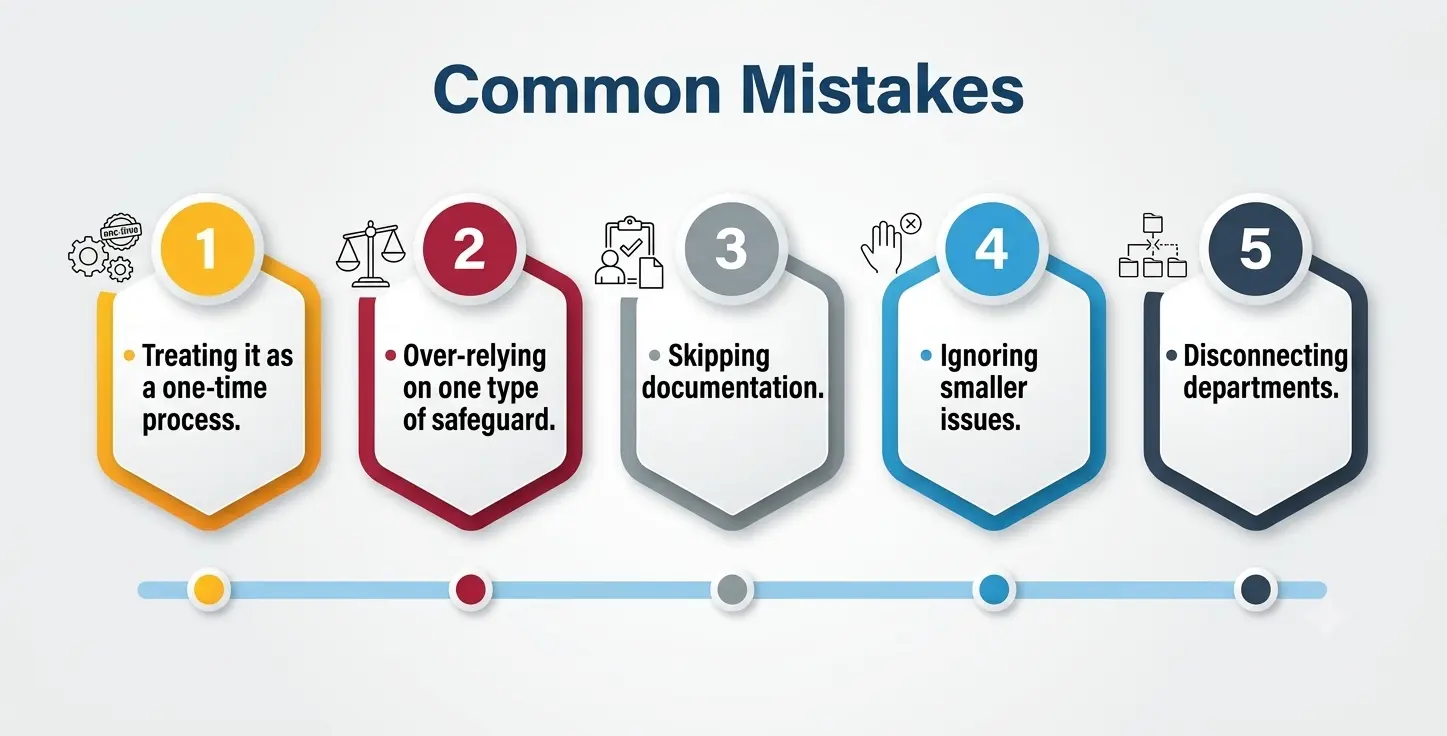
- Treating it as a one-time project. Risks shift as the business, technology, and regulatory environment change, so response plans need regular revisits rather than a single annual sign-off.
- Over-relying on one type of safeguard. A firewall alone isn’t a full security program, and one signed policy isn’t a compliance program either.
- Skipping documentation. If a control isn’t written down and tested, it’s hard to prove it exists at all once an audit begins.
- Ignoring smaller issues. Minor problems left unmanaged tend to compound into the bigger failures that damage long-term stability.
- Disconnecting departments. When IT, legal, finance, and operations manage exposure separately instead of through one shared control framework, gaps tend to form exactly where teams don’t talk to each other, and nobody notices until something breaks.
Conclusion
Risk mitigation isn’t a single tool or a one-time checklist—it’s an ongoing discipline that starts with honest risk assessment and ends with tested, working safeguards.
Get the assessment right, choose a sensible response strategy, back it with solid internal controls and security controls, keep policy management and compliance management aligned with each other, and build enough business resilience to absorb the risks you couldn’t fully prevent in the first place.
That combination is what separates organizations that merely talk about managing risk from the ones that actually do it when it counts.
A Personal Note
I’ve reviewed enough control failures and near-misses over the years to notice a pattern: the organizations that struggle most rarely lack rules on paper. What they lack is the habit of actually testing whether those rules hold up under real pressure, on a bad day, with a distracted team.
If you’re a student reading this before your first internship, that’s the one thing worth carrying with you—a control nobody has stress-tested is just a hopeful sentence sitting in a document. Go find out whether it actually works before something forces you to find out the hard way.