
Every time you fill out a college admission form, sign up for an app, or swipe a card at a campus store, a piece of your personal information leaves your hands and enters someone else’s database.
What happens to it next—who can see it, how long it’s kept, whether it’s sold, or whether it’s protected from hackers—is the entire subject of data compliance. If that sentence made you pause and think, “Wait, I’ve never actually looked into this,” you’re not alone, and that’s exactly why this guide exists.
This is a practical, no-jargon walkthrough of what data compliance actually means, why it has become one of the most in-demand skills for students entering tech, law, and business careers, and how real organizations build it from the ground up.
What Is Data Compliance?
Data compliance is the practice of collecting, storing, processing, and sharing information in a way that follows the laws, industry standards, and internal policies that apply to an organization. It is not a single checklist you complete once. It is an ongoing discipline that blends legal knowledge, technical controls, and everyday employee behavior into one working system.
At its core, data compliance answers three questions for any organization: what personal or sensitive data do we hold, what are we legally allowed to do with it, and can we prove—with evidence—that we’re following the rules? An organization that can’t answer all three isn’t practicing real data compliance, even if it has a privacy policy posted on its website.
Depending on where a business operates, data compliance might mean following the General Data Protection Regulation in Europe, the Digital Personal Data Protection Act in India, the California Consumer Privacy Act in the United States, or sector rules like HIPAA for healthcare records. Most global companies end up following several of these at once, which is exactly why this has become a career field of its own.
Data Compliance vs. Data Privacy vs. Data Security
Students often use these three terms interchangeably, but they describe different pieces of the same puzzle. Data privacy is about the rights individuals have over their own information—the right to know what’s collected, correct it, or ask for it to be deleted.
Data security is the technical shield around that data: encryption, firewalls, and secure infrastructure. Data compliance sits above both of them. It is the umbrella discipline that makes sure an organization’s privacy commitments and security controls actually line up with the laws and standards it’s legally required to follow.
You can have strong security without full compliance, and you can have a compliant-looking policy without real privacy protection—the goal is to have all three working together.
Why Does This Matter More Than Ever?
A decade ago, this practice was mostly a legal department’s problem. Today, it touches product design, software engineering, marketing, HR, and customer support—because almost every function inside a modern organization now handles personal data in some form.
There are three forces pushing this topic to the top of the priority list:
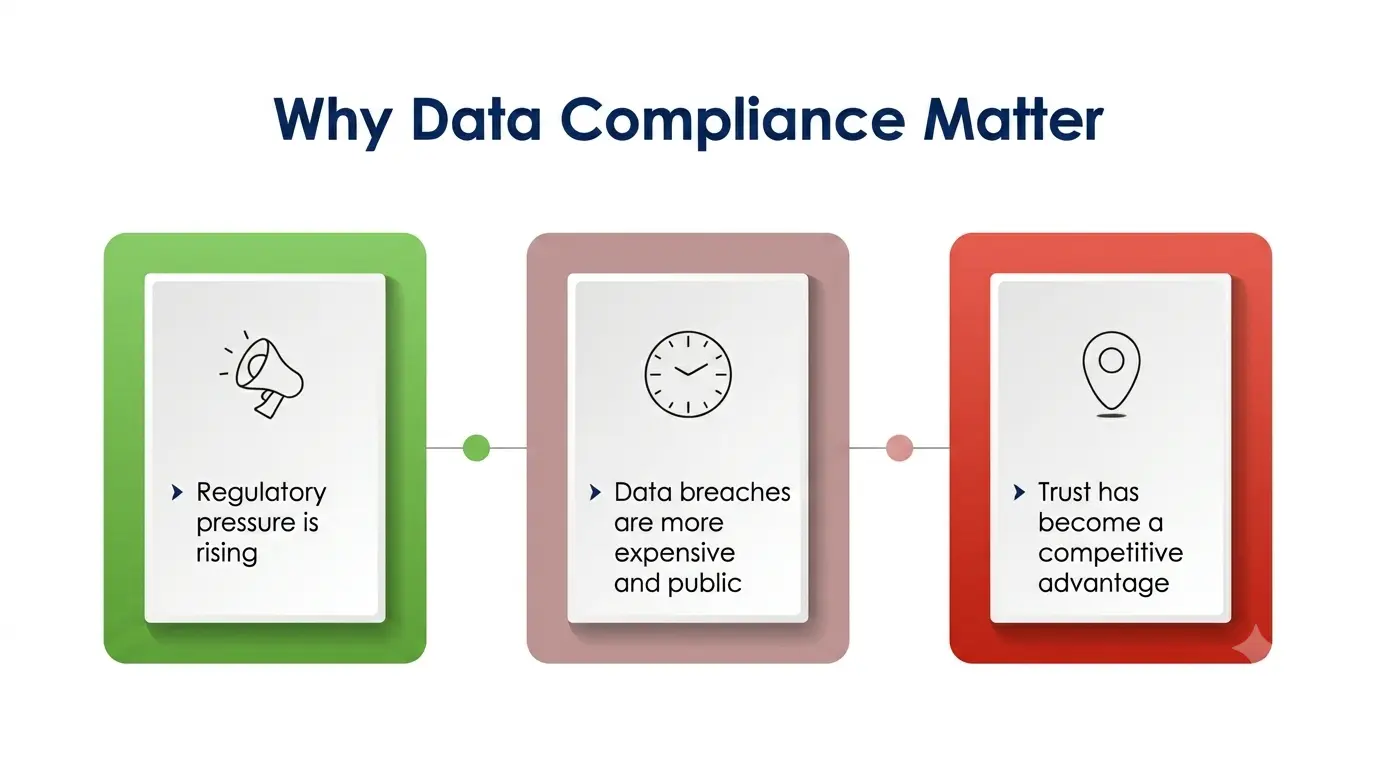
- Regulatory pressure is rising. Fines for mishandling personal data can reach into the tens of millions of dollars under laws like the GDPR, and newer laws such as India’s DPDP Act carry penalties that scale with the severity of the violation.
- Data breaches are more expensive and more public than ever. A single leaked database can end up on the news within hours, and customers rarely forgive a company that loses their information.
- Trust has become a competitive advantage. Businesses that can demonstrate strong compliance discipline often win contracts and customers that competitors lose simply because they cannot prove the same level of care.
For students, this means it is no longer a niche legal topic—it’s a skill set that spans cybersecurity, data science, business administration, and law, and it’s increasingly asked about in interviews across all of these fields. This is precisely why regulatory compliance has moved from a back-office concern to a boardroom priority in almost every industry.
The Five Building Blocks Behind Every Compliance Program
Real-world compliance programs are built on five interconnected pillars. Understanding each one individually makes the bigger picture much easier to grasp.
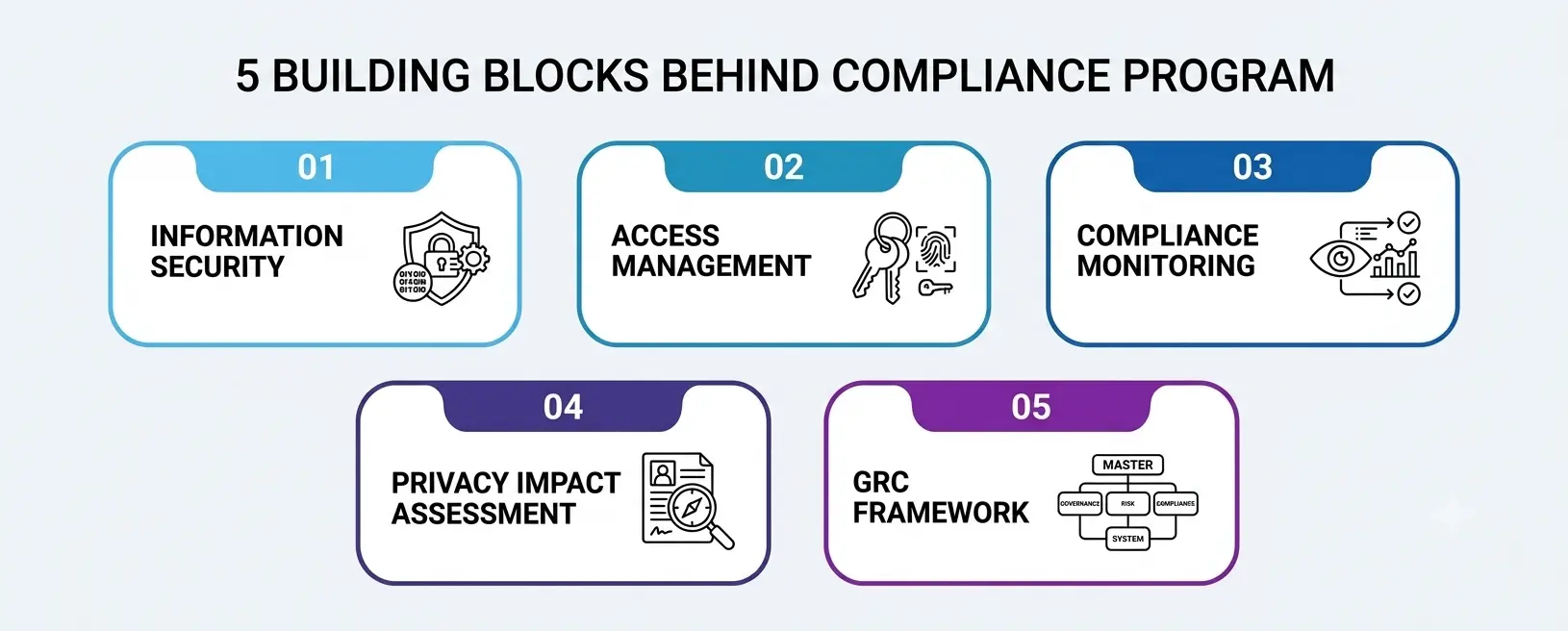
1. Information Security
Information security is the technical backbone of any compliance program. Without strong information security, no policy or legal framework can actually protect data in practice. This pillar covers encryption, secure servers, firewalls, patch management, and incident response—the tools and practices that keep data safe from unauthorized access, theft, or destruction.
Good information security isn’t only about stopping outside attackers. It also protects against accidental data loss, misconfigured cloud storage, and insider mistakes, which cause a surprising share of real-world data breaches. A compliance program that ignores information security is really just a stack of paperwork.
2. Access Management
Access management determines who is allowed to view, modify, or distribute particular data—and equally important, who is not. The guiding principle here is the principle of least privilege, supported by frameworks such as the NIST Cybersecurity Framework: give every person and system only the access they need to do their job, and no more.
Strong access management typically includes role-based permissions, multi-factor authentication, regular access reviews, and immediate removal of access when someone changes roles or leaves the organization.
When access management is weak, a single stolen password can expose an entire customer database, which is why regulators treat it as a core test of whether a company takes compliance seriously.
3. Compliance Monitoring
Compliance monitoring is a regular review that your controls are actually working, not just assuming they are. This includes automated reviews of logs, periodic audits, vulnerability scans, and day-to-day tracking of adherence to policies.
Programs can look good on paper and quietly fail in practice if there is no active monitoring for compliance. Many of the big breaches happen not because there was no rule, but because no one was watching to make sure the rule was followed. Continuous compliance monitoring makes the whole project a living system that evolves as risks change, instead of a one-off exercise.
4. Privacy Impact Assessment
A privacy impact assessment, often called a PIA or DPIA, is a structured review conducted before launching a new product, system, or data-processing activity. Its purpose is to identify privacy risks early, before they become expensive problems.
The UK Information Commissioner’s Office requires a privacy impact assessment whenever a new project is likely to result in high risk to individuals, such as large-scale profiling or processing of sensitive categories of data.
A well-run privacy impact assessment maps exactly what data will be collected, why it’s needed, who will access it, and what could go wrong. Skipping this step is one of the most common reasons organizations end up building a product that violates privacy or security requirements after it’s already been launched—a far more expensive mistake to fix.
5. GRC Framework
The framework that ties everything else together is a GRC (short for Governance, Risk, and Compliance) framework. Instead of each function managing its own compliance in isolation, it consolidates an organization’s policies, risk appetite, and regulatory requirements into one integrated system.
For example, organizations most often build their GRC framework using well-accepted models such as COSO, COBIT, or ISO 31000, or a purpose-built approach tailored for their industry. A mature GRC framework gives leadership a real-time view of where compliance gaps exist, instead of relying on scattered spreadsheets and year-end reports.
Without a GRC framework holding the pillars together, technical security, access management, compliance monitoring, and privacy impact assessment activities tend to operate in silos—which is exactly where compliance failures slip through.
Major Data Protection Laws and Frameworks You Should Know
|
Law / Framework |
Region |
What It Primarily Covers |
|
GDPR |
European Union |
Broad protection of personal data for anyone in the EU, with strict consent and breach-notification rules |
|
CCPA / CPRA |
California, USA |
Consumer rights to know, delete, and opt out of the sale of personal information |
|
HIPAA |
United States |
Protection of health-related personal data held by healthcare providers and insurers |
|
ISO/IEC 27001 |
Global |
Certifiable global standard for building a formal ISMS to protect organizational data |
This table is not exhaustive—dozens of national and state-level laws now exist—but these five give students and professionals a solid starting map of the global landscape.
A Step-by-Step Implementation Approach
Turning these principles into a working program usually follows a similar sequence, regardless of company size.
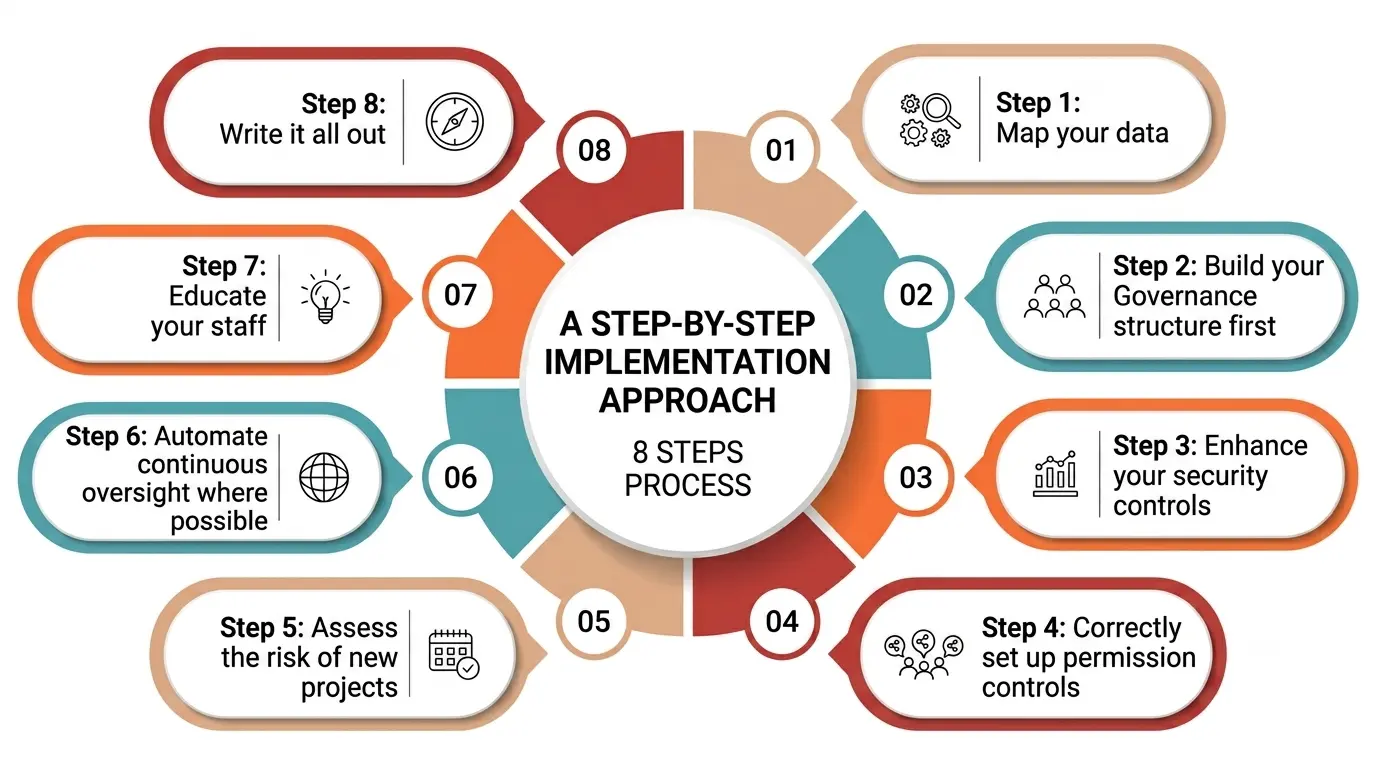
- Step 1: Map your data. You cannot protect what you haven’t inventoried. List every place personal data enters, moves through, and leaves your organization.
- Step 2: Build your governance structure first. Decide who owns the program, how risks will be scored, and which regulations actually apply to your organization before writing a single policy.
- Step 3: Enhance your security controls. Encrypt sensitive data at rest and in transit. Patch systems regularly. Set up monitoring for anomalous activity.
- Step 4: Correctly set up the permission controls. Use the least privilege permissions, require multi-factor authentication, and conduct regular access reviews.
- Step 5: Assess the risk of new projects. Assess the risks of deploying any system that processes personal data and specify the steps that will be taken to mitigate those risks before the system is deployed.
- Step 6: Automate continuous oversight where possible. Automated tools should be the basis for identifying policy violations, unusual access patterns, or expired consent, not annual audits alone.
- Step 7: Educate your staff. Most breaches are not sophisticated hacking but human error. Regular practice training fills the gap.
- Step 8: Write it all out. Compliance is not just something that regulators and auditors want to see; they want proof of compliance. Training and Incidents, and Document Assessment and Remediation Steps.
Following this sequence turns the program from an abstract legal obligation into a concrete operational habit.
Common Mistakes Organizations Make
Even well-intentioned teams get the fundamentals wrong in predictable ways. Treating it as a one-time project rather than a continuous process is probably the most common error—regulations change, and so does the data an organization collects.
Others underinvest in day-to-day permission controls, leaving old employee accounts active for months after departure, which quietly widens the attack surface. Some skip an early risk review entirely because a project feels “too small to matter,” only to discover the problem later, once real users are affected and the fix costs far more than prevention would have.
And plenty of programs collapse because there was never a proper governance structure connecting legal, IT, and business teams in the first place, so nobody actually owns the outcome when something goes wrong.
A smaller but equally damaging mistake is treating training as a once-a-year checkbox. Rules change, new tools get adopted, and employees forget details within months—refresher training tied to real incidents tends to stick far better than an annual slideshow nobody remembers by March.
What Does This Mean for Students Building a Career?
If you’re studying computer science, law, business, or information systems, this subject sits at a genuinely useful intersection of all four. Understanding security basics, how access controls work, what a privacy risk review involves, and how a governance and risk structure ties a company together will make you a stronger candidate for roles in cybersecurity, data protection, IT audit, and compliance consulting—fields that are actively hiring and unlikely to slow down anytime soon.
A Personal Note
I’ve spent enough time reading breach reports and regulatory fines to notice a pattern: the companies that get hurt the worst are rarely the ones with no rules at all. They’re the ones with rules nobody actually followed.
If there’s one thing I’d want a student reading this to take away, it’s that doing this well isn’t really about memorizing legal clauses—it’s about building habits, in yourself and in the systems you’ll one day design, that treat other people’s information with the same care you’d want for your own.
Final Thoughts
This will keep evolving as new laws emerge and new technologies create new categories of risk. But the fundamentals covered here—strong technical security, disciplined identity and access controls, active continuous auditing, a thorough risk review habit, and a governance structure tying it all together—are unlikely to go out of date anytime soon. Understanding them now puts students and early-career professionals well ahead of where most people start.