
Every enterprise breach story in 2026 seems to end the same way: a setting nobody double-checked, a default nobody changed, and a rule nobody enforced. That quiet gap is exactly what Secure Configuration Management is built to close.
It isn’t a single tool or a once-a-year audit. It’s the ongoing discipline of defining, applying, and monitoring secure settings across every server, application, and cloud service an organization runs. For students stepping into IT security for the first time, this guide breaks the idea down piece by piece, using the same frameworks enterprises actually rely on today.
Think of it this way: a lock on a door is only useful if someone remembers to keep it locked. A server can ship with strong security features and still be wide open in practice, simply because a default was never changed or a setting quietly reverted after an update.
That gap between “capable of being secure” and “actually configured securely” is where most real-world incidents happen—and it’s the gap this entire discipline exists to close.
What Is Secure Configuration Management?
Secure configuration management is the process of establishing a known-good, hardened baseline for every system in an environment and then tracking and correcting any change that drifts away from that baseline. Instead of assuming a server is safe because it passed a scan once, it treats security as a living state that has to be re-verified continuously, not a one-time achievement.
The idea has deep roots in federal guidance. NIST’s Special Publication 800-128 describes this discipline as security-focused configuration management, built on the principle that a system’s configuration is itself a security control, not an afterthought bolted on once the system is already running. That framing matters because it shifts configuration work from an IT chore into a genuine risk-reduction activity.
At its core, this practice covers operating systems, network devices, databases, containers, and cloud services alike. If it has a configuration file or an admin panel, it needs a baseline.
Why Does It Matter for Enterprises in 2026?
The numbers make the case better than theory can. According to IBM’s 2026 Cost of a Data Breach Report, the global average cost of a breach climbed to a record $4.99 million this year, with compromised APIs, applications, and cloud misconfigurations named among the most common root causes behind incidents involving connected systems. That single statistic explains why boards that once treated configuration reviews as a checkbox now treat them as a line item.
Two forces are driving the shift. First, IT compliance obligations have multiplied—GDPR, HIPAA, PCI DSS, and sector-specific mandates all expect documented, provable control over system settings. Second, environments have grown too large and too dynamic for manual review.
A missed patch, a port left open after a test deployment, or a permission never revoked once a project ended—all of it counts as configuration drift, and drift is exactly what attackers go looking for first, because it’s the path of least resistance into a network.
The Core Pillars of Secure Configuration Management
Secure Configuration Management rests on four connected pillars, and skipping any one of them weakens the rest:
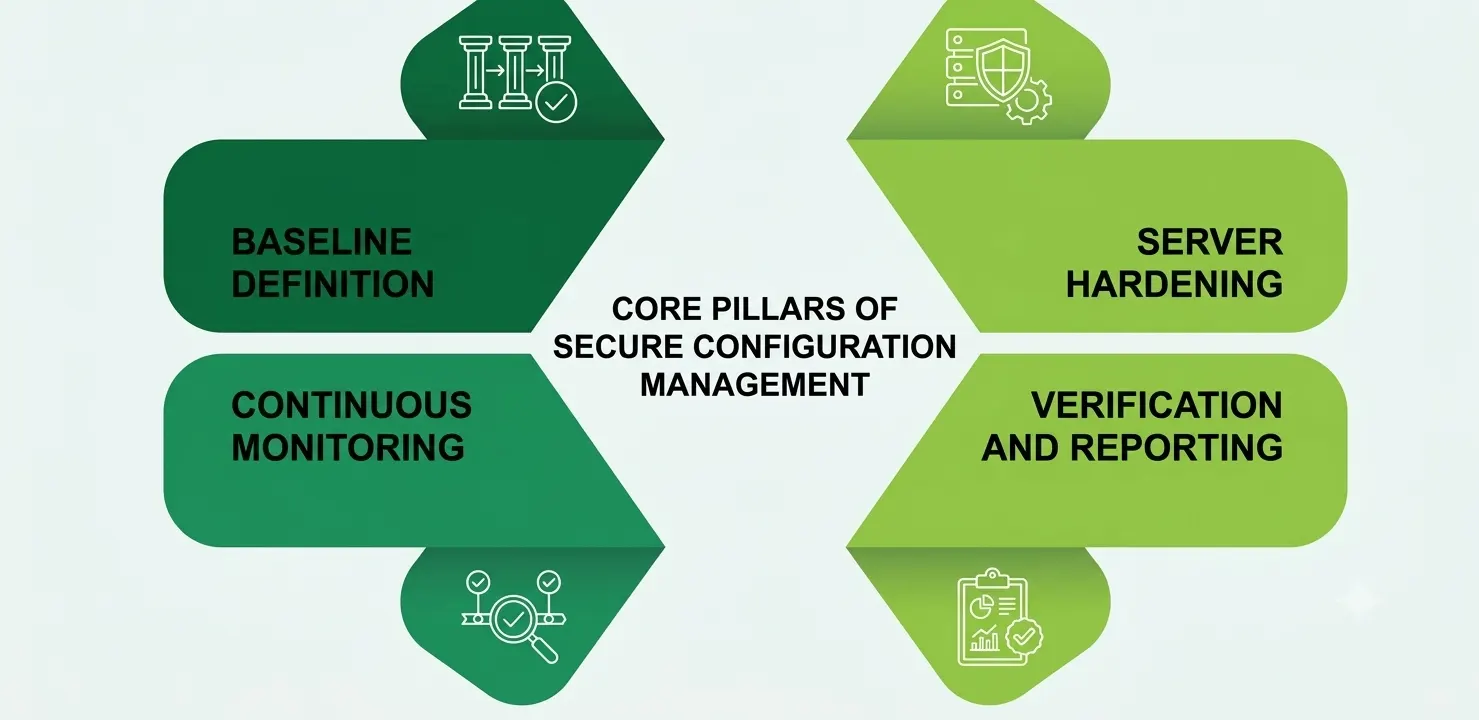
- Baseline definition—agreeing on what “secure” looks like for each type of asset.
- Server hardening—removing unnecessary services, tightening permissions, and disabling insecure defaults.
- Continuous monitoring—watching for unauthorized changes in real time.
- Verification and reporting—proving, with evidence, that the baseline is still being followed.
Enterprises that treat these as one connected workflow, rather than four separate projects owned by four separate teams, see far fewer surprises during audits.
Configuration Approaches Compared
|
Approach |
How It Works | Drift Risk | Audit Readiness | Typical Use |
|
Manual / spreadsheet-based |
Admins apply settings by hand and log them in documents. | High | Low—evidence is scattered and often outdated. |
Very small environments |
|
Semi-automated |
Scripts apply baselines; periodic scans check for changes. | Medium | Moderate—reports exist but lag behind reality |
Mid-sized IT teams |
| Fully automated (Infrastructure as Code) |
Configuration is defined in code and enforced continuously. |
Low | High—every change is logged and reversible |
Enterprises with distributed or cloud infrastructure |
Tools Enterprises Actually Use
Theory only goes so far—most of this work is carried out through a fairly small, well-established toolset. Configuration-as-code platforms such as Ansible, Puppet, and Chef let teams define a baseline once and apply it identically across thousands of machines, instead of repeating manual steps that inevitably drift over time.
For checking systems against a published benchmark, open-source scanners like OpenSCAP and Lynis are common starting points, while larger organizations often pair them with commercial benchmark-assessment tools for broader coverage and reporting.
Cloud-native services—think built-in policy engines from major cloud providers—extend the same idea to virtual infrastructure, flagging a misconfigured storage bucket or an overly permissive access rule the moment it appears rather than weeks later during a review.
None of these tools replace judgment; they simply make it possible to apply that judgment consistently at a scale no human team could manage by hand.
A Quick Illustration: How Drift Turns Into a Breach
Picture a mid-sized enterprise that hardens a fleet of cloud servers before launch, passes its first audit, and moves on to other priorities. Six months later, an engineer temporarily disables a firewall rule to debug a connectivity issue during an on-call incident, intending to re-enable it before the shift ends.
The fix works, the incident closes, and in the rush to document the resolution, the rule is never restored. Nothing about that moment looks like a security failure—it looks like a normal Tuesday. Weeks later, automated scanning tools sweep the internet for exactly that kind of opening, and the server that was compliant at launch becomes the entry point for an attacker who never had to break anything, because the door was simply left ajar.
This is the ordinary, unglamorous way most breaches actually start, and it’s precisely the scenario that continuous baseline monitoring is designed to catch within hours instead of months.
Server Hardening: Turning Defaults Into Defenses
Server hardening is where secure configuration work becomes tangible. Out of the box, most operating systems are tuned for compatibility, not security—unused services run quietly in the background, default accounts stay active, and ports sit open that nobody actually needs.
Server hardening means working through that list deliberately: disabling what isn’t used, enforcing least-privilege access, encrypting data at rest and in transit, and applying vendor patches on a fixed schedule instead of whenever someone remembers.
Most enterprises don’t build hardening standards from a blank page. They start from the CIS Benchmarks, a set of consensus-driven configuration baselines covering operating systems, cloud platforms, and common enterprise software.
Mapping internal policy to a widely recognized external standard also makes server hardening far easier to defend during a client or regulator review, since the reasoning behind every setting is already documented by a neutral third party.
Configuration Drift: The Silent Risk
Configuration drift describes what happens after a system is hardened and then, quietly, stops matching its own baseline. A developer opens a port to debug an issue and forgets to close it.
A patch resets a setting back to its default. A contractor’s temporary access never gets revoked. None of these changes looks alarming on its own, but together they erode the protection that careful hardening was supposed to lock in.
Configuration drift is dangerous precisely because it’s incremental—no single change trips an alarm, yet the cumulative effect can quietly reopen gaps a hardening project just closed months earlier.
Catching drift early requires automated, continuous comparison against the approved baseline, not a manual review that happens once a quarter, by which time dozens of small changes may already have accumulated.
Security Assessment and Continuous Monitoring
A security assessment is the formal process of checking whether real-world systems actually match their intended secure state. This differs from a general vulnerability scan: it specifically measures configuration health—password policies, firewall rules, encryption settings, and logging coverage—against a defined benchmark, rather than just hunting for known software flaws.
Modern enterprises run a security assessment far more often than the annual cycle that used to be standard practice. Continuous or near-continuous assessment, supported by automated scanning tools, catches problems while they’re still small and cheap to fix, instead of after an attacker has already found them.
Pair a strong security assessment program with clear ownership—someone accountable for closing each finding within a set window—and the whole discipline stops feeling like paperwork and starts functioning as real protection.
IT Compliance and Compliance Auditing: Proving It, Not Just Doing It
IT compliance and compliance auditing are often treated as the finish line of a security program, but they work better as its scoreboard. Those frameworks—including ISO/IEC 27001, SOC 2, and PCI DSS—all expect organizations to demonstrate, with evidence, that configuration controls are both defined and enforced, not simply written down in a policy binder somewhere.
Compliance auditing is where that evidence actually gets tested. An auditor doesn’t want to hear that servers are hardened; they want logs, timestamps, and change records that prove it happened and keeps happening.
Enterprises that treat compliance auditing as a continuous by-product of their daily configuration workflow—rather than a scramble that starts six weeks before the audit date—consistently pass faster and with fewer findings.
Building that evidence trail is, in practice, one of the most concrete returns an organization gets from investing in disciplined configuration work in the first place. Done well, compliance auditing also feeds straight back into next year’s IT compliance planning, closing the loop instead of resetting it every twelve months.
Best Practices Checklist for Enterprises
- Define a written baseline for every asset class before anything new is deployed.
- Automate baseline enforcement with configuration-as-code tools so changes are applied consistently everywhere, not just on the systems someone remembers to check.
- Schedule recurring assessments—monthly at minimum for internet-facing systems, with continuous scanning layered on top.
- Maintain an exceptions register for every approved deviation, complete with an owner and an expiry date.
- Centralize logs so unauthorized changes are visible within hours, not months.
- Keep Secure Configuration Management documentation current so audits never have to start from zero.
Common Mistakes Enterprises Still Make
Even mature IT teams fall into predictable traps. Treating hardening as a one-time project rather than an ongoing cycle is probably the most common one—a server hardened at launch and never rechecked is really just a server that used to be secure.
Applying an identical baseline to every system regardless of its role is another frequent mistake; it either over-restricts business-critical servers or under-protects the ones holding sensitive data. Finally, many teams underinvest in documentation, which turns every audit into a fire drill instead of a routine formality.
Getting Started: A Realistic Roadmap
Enterprises new to this discipline don’t need to solve everything in month one. A workable rollout looks something like this: inventory every system and classify it by sensitivity; adopt an established benchmark rather than writing one from scratch; automate deployment of that baseline into golden images; schedule recurring checks; and only then layer on formal reporting for auditors and regulators.
This sequencing matters because programs that try to automate everything before the basic inventory is complete usually stall—it’s difficult to harden or monitor systems nobody has fully mapped yet. Secure Configuration Management works best when it grows in that order: know what you have, define what “secure” means for it, then automate and verify.
It also helps to assign clear ownership at every stage rather than leaving the whole program under one overworked security lead. Infrastructure teams typically own baseline deployment, security teams own the standards and exception approvals, and application owners are accountable for keeping their own systems within policy.
Splitting responsibility this way turns a single point of failure into a shared habit, which is usually the difference between a program that survives staff turnover and one that quietly falls apart the moment its original champion leaves.
2026 and Beyond: Where This Discipline Is Heading
Configuration tooling is increasingly shifting left, into the same pipelines developers already use to ship code, so insecure settings get caught before deployment rather than after. Cloud providers are also expanding native compliance dashboards that map live settings directly against frameworks like ISO/IEC 27001 in near real time.
The organizations gaining the most from this shift are the ones that already treat their infrastructure as version-controlled, auditable code, rather than as a collection of machines someone configured by hand years ago and never revisited.
A Personal Note
I’ve read enough post-incident reports to notice the pattern: it’s rarely the exotic attack that gets an organization into trouble. It’s the setting nobody revisited, the account nobody closed, the exception nobody tracked.
If you’re a student reading this before your first security role, learn secure configuration management early. It’s unglamorous work, but it’s the discipline that quietly prevents most of the headlines you’ll read about later.
Conclusion
None of this requires exotic technology. It requires discipline: a defined baseline, deliberate hardening, honest monitoring, and evidence that holds up when someone asks for it. Enterprises that build that habit early spend far less time explaining breaches after the fact, and far more time simply not having them.