
Most businesses know they need to be on the cloud. Far fewer know how to make it actually work. Gartner reported that over 85% of organizations will embrace a cloud-first principle by 2026, yet 75% of enterprise workloads still sit on-premises today. That gap is not a technology problem. It is a strategy problem. This guide cuts through the noise and gives you a clear, honest picture of what AWS integration actually involves, what it takes to get it right, and where most organizations quietly go wrong.
What AWS Integration Actually Means for Your Business
AWS integration is the process of connecting your business tools, data, applications, and workflows through Amazon’s cloud platform so they work together as one coordinated system rather than a collection of separate parts that do not communicate.
That sounds straightforward. In practice, it rarely is.
Your customer database speaks one language. Your sales platform speaks another language. Your finance system was built a decade ago and was never designed to share data with anything that came after it. AWS does not automatically fix that. What it does is give you the infrastructure, the tools, and the architecture to fix it systematically if you approach the work with genuine intention.
For context on where the opportunity sits: 70% of Fortune 500 companies still run on software written over two decades ago. That is not a statistic about technology falling behind. It is a statistic about competitive exposure. Companies that connect their systems intelligently through cloud infrastructure are operating at a pace and cost structure that aging on-premises environments simply cannot match.
Why 2026 Is the Turning Point for Enterprise AWS Integration
McKinsey data from 2025 puts the potential EBITDA improvement from full cloud value capture at 20 to 30%. For businesses operating on thin margins or facing pressure from digital-first competitors, that number is worth taking seriously.
Amazon Web Services holds approximately 30% global cloud market share, ahead of Microsoft Azure at 20% and Google Cloud at 13%. That dominance reflects the depth and reliability of what AWS has built over two decades. But market leadership does not mean AWS is the right choice for every organization in every situation, and it certainly does not mean that moving to AWS automatically produces results.
The organizations getting real returns from AWS in 2026 are the ones treating cloud integration as a strategic initiative with executive ownership, clear business metrics, and a realistic assessment of the internal capability required to execute it. The ones still struggling are the ones who handed it to IT, set a deadline, and waited.
The Core Pillars of Seamless AWS Integration
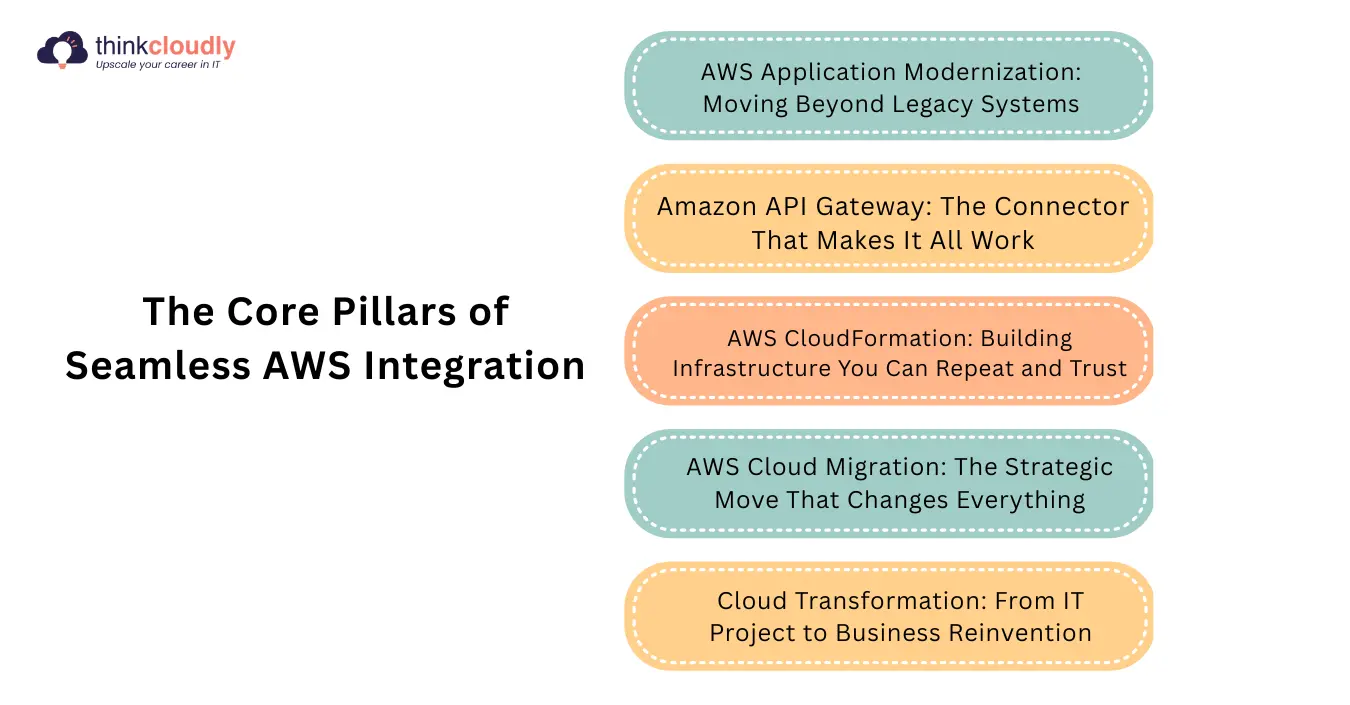
AWS Application Modernization: Moving Beyond Legacy Systems
Legacy applications are the most common reason AWS integration stalls. Old software creates data silos, slows development cycles, and introduces security vulnerabilities that newer architectures have already solved. AWS Application Modernization addresses this by updating or rebuilding older systems for the cloud, not necessarily all at once but layer by layer, keeping what works while systematically replacing what does not.
With 42% of strategic workloads still on-premises, the reality is that lift-and-shift migration alone is not enough. Moving an outdated application to the cloud without modernizing it simply gives you the same problems in a different location, now with a monthly cloud bill attached.
AWS Transform, which became generally available in 2025, uses AI agents to automate migration planning and code translation. Projects that historically took 18 months are being compressed to weeks. That is a genuine shift in what is practically achievable, but it requires clean data governance and clear organizational alignment to deliver on that promise.
Amazon API Gateway: The Connector That Makes It All Work
If modernization is the foundation, API connectivity is the plumbing. Amazon API Gateway is the service that allows your different applications and systems to talk to each other, securely and in real time, without requiring you to rebuild the underlying systems those connections run between.
It handles authorization, request throttling, and lifecycle management in the background. For business leaders who do not want to get deep into the technical details, the practical outcome is this: your systems share information when they need to, nothing unnecessary gets exposed, and you maintain visibility into what is happening across your integrations.
By 2026, over 30% of new API demand is coming from AI and large language model tools. Organizations building their API infrastructure now are not just solving a current connectivity problem. They are building the layer that AI-powered operations will run on top of.
AWS CloudFormation: Building Infrastructure You Can Repeat and Trust
One of the less glamorous but genuinely valuable capabilities AWS offers is infrastructure consistency. CloudFormation allows you to define your infrastructure once, as code, and deploy it identically every time, whether you are expanding into a new region, standing up a new team environment, or recovering from a failure.
The business case is straightforward. Inconsistent infrastructure creates inconsistent behavior. Teams interpret setup instructions differently, steps get missed under pressure, and environments that should be identical end up diverging in ways that cause hard-to-diagnose problems months later. CloudFormation removes that variable by making the infrastructure definition the authoritative source of truth.
It does require someone who understands infrastructure-as-code to set up properly. Organizations without that capability in-house often find this is where an experienced AWS partner earns their fee.
AWS Cloud Migration: The Strategic Move That Changes Everything
Migrated workloads as a tracked performance metric jumped from 36% to 78% between 2024 and 2025 alone. Organizations doing this well are seeing infrastructure cost reductions of 20 to 40%, faster deployment cycles, and the ability to reach new markets in weeks rather than quarters.
The AWS Migration Acceleration Program contributed to 41% faster first milestones and 37% faster overall migrations in 2025. But speed metrics only matter if the migration is moving toward the right destination. Organizations that rush migration without a clear picture of what they are migrating to often find themselves with a cloud bill that keeps growing and outcomes that never quite materialize.
Migration is not the hard part. Knowing what you want on the other side of it is.
Cloud Transformation: From IT Project to Business Reinvention
Cloud transformation is a broader and more consequential thing than cloud migration. Migration moves your workloads. Transformation changes how your business operates, how it serves customers, and how it competes.
In 2026, AI workloads are dominating cloud consumption alongside hybrid architectures, multi-cloud environments, and edge computing that reduces latency by processing data closer to where it is generated. More than 57% of organizations have or plan a sustainability initiative and 36% already track their cloud carbon footprint, which means cloud infrastructure is now a corporate responsibility decision alongside being a technical one.
Zero-trust security, where no user or system is automatically trusted regardless of location, is the defining architecture standard of 2026. For businesses handling sensitive customer or financial data, this is not a preference. It is an operational baseline.
AWS Integration Tools at a Glance (2025 to 2026)
|
AWS Tool / Concept |
What It Does | Business Benefit |
2025 to 2026 Relevance |
|
Amazon API Gateway |
Connects applications via managed APIs | Secure real-time data sharing |
30% of API demand from AI tools by 2026 |
|
AWS CloudFormation |
Defines infrastructure as reusable templates | Consistent deployments across regions |
Enables regional expansion and CI/CD |
|
AWS Cloud Migration |
Moves workloads from on-premises to cloud | 20 to 40% infrastructure cost reduction |
78% of tracked workloads migrated by 2025 |
|
AWS Application Modernization |
Rebuilds legacy software for cloud | Eliminates bottlenecks, improves agility |
42% of strategic workloads still on-premises |
|
AWS Transform |
AI-powered migration automation | Compresses 18-month projects to weeks |
Generally available 2025, expanded 2026 |
|
Cloud Transformation |
Business model evolution via cloud | Competitive advantage, operational resilience |
21.3% public cloud growth forecast for 2026 |
|
Zero Trust Security |
No implicit trust for any user or system | Protects sensitive data end to end |
Core architecture standard in 2026 |
|
AWS FinOps Tools |
Governs and optimizes cloud spending | Prevents budget overruns |
Cloud budgets exceeded limits by 17% in 2025 |
Common Mistakes That Derail AWS Integration
Nearly 60% of cloud migration projects exceed their budgets or timelines. Most of the time it is not because the technology failed. It is because the approach was flawed from the start. Here are the patterns that most consistently get in the way:
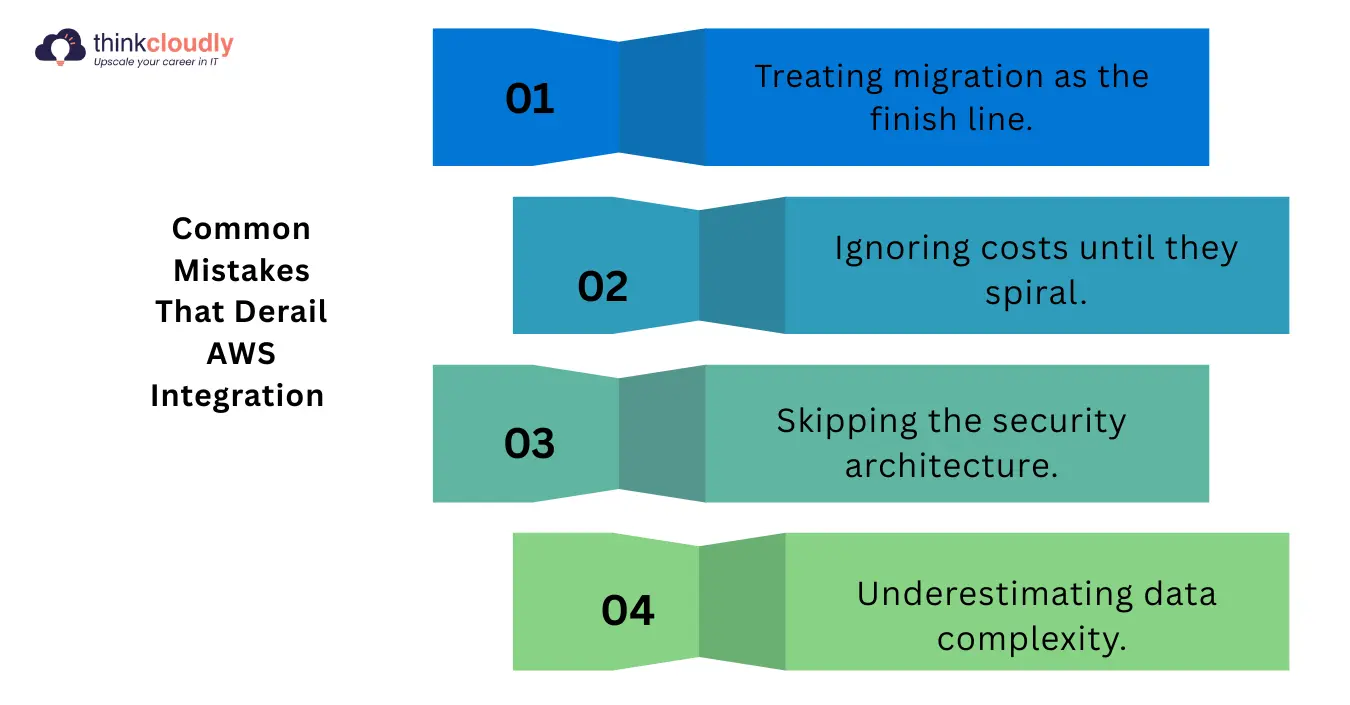
Treating migration as the finish line
Moving to the cloud without rethinking how your applications work is the single most common and most expensive mistake organizations make. If you simply lift your existing systems into AWS without modernizing them, you have reproduced your old problems in a new environment and added a cloud bill on top. The organizations that genuinely benefit treat migration as the beginning of a transformation, not the completion of one.
Ignoring costs until they spiral
Cloud budgets exceeded their limits by 17% in 2025. That figure reflects how frequently cost governance is treated as something to address after deployment rather than something built into migration strategy from the start. AWS gives you the tools to manage spending precisely, but those tools only work if someone is actively using them with clear accountability.
Skipping security architecture under time pressure
In a rush to hit deployment deadlines, security often gets deferred to a later phase. In 2026, that approach creates real exposure. Zero-trust principles need to be embedded from the beginning of your architecture decisions, not retrofitted after the fact when the cost and complexity of doing so are significantly higher.
Underestimating how fragmented your data actually is
Many enterprises have data scattered across business units, legacy databases, file systems, and older data centres built over decades. Migration is the opportunity to redesign how data is stored, governed, accessed, and analyzed. Organizations that skip this step find their AI adoption efforts failing at the data layer because enterprise data is too scattered or inaccessible to be useful.
What Successful Enterprise AWS Integration Looks Like in Practice
Organizations implementing generative AI solutions on AWS with partner support are achieving 240% ROI and $16.5 million in benefits over three years, according to a 2025 Forrester study. Those are not exclusively large enterprise outcomes. Mid-size and growing organizations are achieving comparable results when they approach integration with the right strategic foundation.
The common characteristics of organizations getting the best results are worth being specific about. They treat cloud transformation as a leadership priority with executive sponsorship, not an IT project with a technical owner. They measure outcomes in business terms, revenue impact, cost reduction, and speed to market, rather than just technical completion metrics. They invest in internal capability alongside deploying new tools. And they are honest about where they need external expertise rather than trying to figure everything out themselves.
Building your own AI infrastructure from scratch carries prohibitive cost and time implications for most organizations. Cloud gives you immediate access to enterprise-scale AI capabilities. That reality is pushing cloud migration from a competitive advantage to a strategic necessity for organizations that intend to compete seriously over the next five years.
Conclusion
AWS integration in 2026 is one of the clearest paths available to organizations that want to operate with more agility, reduce infrastructure costs, and build on a platform that can support AI-powered operations as that capability becomes table stakes rather than a competitive advantage.
Through AWS Application Modernization, businesses break free from legacy limitations. Through Amazon API Gateway, they connect tools and data in real time. Through AWS CloudFormation, they build infrastructure that scales consistently. Through AWS Cloud Migration and cloud transformation, they step into an operating model built for the next decade rather than the last one.
None of this happens automatically. AWS is a powerful platform, not a self-executing strategy. The organizations that get the most from it are the ones that bring genuine strategic clarity to the work, invest in the right internal and external capability, and measure their progress against business outcomes rather than just technical milestones.
The question in 2026 is no longer whether cloud integration makes sense. It is whether your organization is approaching it with the seriousness and intention it deserves.
Sources
- Gartner. Cloud-First Adoption Forecast 2026. (2024)
- AWS Migration and Modernization Blog. AWS Transform Generally Available. (2025)
- McKinsey and Company. Cloud ROI and EBITDA Impact. (2025)
- Holori. Cloud Market Share Report: Top Cloud Vendors in 2026. (2025)
- AWS Partner Network Blog. MAP Enhancements and Migration ROI. (2026)
- Successive Digital. AWS Cloud Migration Trends for Enterprises. (2026)
- AWS Architecture Blog. Building an AI Gateway with Amazon API Gateway. (2025)
- AWS Documentation. Amazon API Gateway Features.
- Systango. AWS Cloud Trends: Key Business and Tech Insights. (2026)
- Appverticals. 7 Rs of AWS Cloud Migration Strategy. (2026)
- GitNexa. Ultimate AWS Cloud Migration Guide. (2026)
- Minfy Technologies. Top 3 AWS Cloud Computing Trends. (2025)