





Here’s a date that stopped me mid-scroll the first time I saw it: Microsoft refreshed the official AZ-104 study guide on April 17, 2027, and almost nobody outside a small circle of IT forums noticed. If you’re planning to sit for the AZ-104 certification this year, that date matters more than any older study guide, because the exam you’ll take isn’t word-for-word the one your colleague passed back in 2023.
The five domain weights stayed the same, but Microsoft adjusted the objectives inside storage, compute, networking, and monitoring, and Microsoft Entra ID terminology has fully replaced the old Azure Active Directory naming. In this AZ-104 exam guide, I’ll cover the current syllabus, the AZ 104 certification exam cost (including India), how it’s scored, how renewal works, and—based on my own experience preparing for it earlier this year—what actually helped me pass on the first attempt.
What Is the AZ-104 Certification?
The AZ-104 certification is Microsoft’s Azure Administrator Associate credential, officially called Microsoft Certified: Azure Administrator Associate. It confirms you can implement, manage, and monitor an organization’s Azure environment—identity, governance, storage, compute, networking, and monitoring—in production, not just theory. Microsoft describes the ideal candidate as someone with subject-matter expertise in these areas, working within a larger team that also touches security, DevOps, and application development.
Unlike Azure Fundamentals (AZ-900), an introductory credential for anyone wanting a broad overview of cloud concepts, this Azure administrator certification assumes hands-on comfort with the Azure portal, PowerShell, the Azure CLI, and ARM templates or Bicep files. If you’ve only completed Azure fundamentals training and never deployed a resource group, close that gap before booking your exam date.
According to the course outline, a typical Azure administrator implements, manages, and monitors identity, governance, storage, compute, and virtual networks in a cloud environment and can also provision, size, and adjust resources as business needs change.
What Changed in April 2027? AZ-104 Update?
This is the part most outdated study guides get wrong. Microsoft last updated the AZ-104 skills-measured outline on April 17, 2027. The official AZ-104 study guide shows the domain weights unchanged, with minor edits to objectives in four of the five domains. Here are the current weights:
|
AZ-104 Skill Domain |
2027 Weight |
|---|---|
|
Manage Azure identities and governance. |
20–25% |
|
Implement and manage storage |
15–20% |
|
Deploy and manage Azure compute resources. |
20–25% |
|
Implement and manage virtual networking. |
15–20% |
|
Monitor and maintain Azure resources |
10–15% |
The minor changes touched Azure Files and Blob Storage, virtual machines, containers, virtual networks, and Azure Monitor objectives. The current outline also tests ARM templates and Bicep files, Azure Container Apps, Azure Bastion, and Network Watcher, and it uses Microsoft Entra ID naming throughout. Treat any older material still saying “Azure Active Directory” as a warning sign.
AZ-104 Exam Format, Cost, and Passing Score
Before you build a study plan, get the logistics straight. The AZ-104 exam gives candidates 100 minutes and typically contains 40 to 60 questions, mixing multiple choice, drag-and-drop, and scenario-based case studies. The AZ-104 passing score is 700 out of 1000, and that is a scaled score, not simply 70 percent of questions answered correctly. Microsoft weighs the difficulty of your question set, so two candidates who both feel like they “did fine” can walk away with different scores.
The AZ-104 exam fee is $165 USD in the United States, scheduled through Pearson VUE. The AZ-104 exam fee in India is about ₹4,800 (Microsoft’s exam page shows the live local price once you select your country). There’s no mandatory prerequisite, though Microsoft recommends hands-on Azure experience beforehand. If you fail, you wait 24 hours before the second attempt and 14 days before each later one, with a maximum of five attempts in twelve months.
One detail many candidates miss: during the exam you can open Microsoft Learn documentation. It is not a true open-book exam, though. The timer keeps running, and you can only browse learn.microsoft.com, so it helps you confirm one fact, not learn a topic. You can try the interface first in Microsoft’s free exam sandbox.
AZ-104 Certification Validity and Renewal
The Azure Administrator Associate certification is valid for one year. To keep it, you pass a free online renewal assessment on Microsoft Learn, which opens six months before your expiry date. It is shorter than the original exam, unproctored, and focuses on what changed in Azure since you certified. If you let the certification lapse, you have to pay for and pass the full AZ-104 exam again.
AZ-900 vs AZ-104: Which Should You Take First?
AZ-900 is not required before AZ-104. AZ-900 tests whether you understand cloud concepts and Azure services; AZ-104 tests whether you can configure and troubleshoot them. If you’re new to the cloud, start with AZ-900 Azure Fundamentals. If you already manage servers, networks, or Microsoft 365, go straight to AZ-104 and use the free Microsoft Learn modules to fill any gaps.
Is the AZ-104 Exam Hard?
AZ-104 is an intermediate exam, and most candidates find it noticeably harder than AZ-900. The difficulty doesn’t come from memorizing services. It comes from scenario questions that ask you to pick the least-privilege, lowest-cost, or most resilient option under specific constraints. Candidates with daily Azure portal or CLI work usually need four to eight weeks; those without hands-on time usually need longer.
Why Employers Still Value This Azure Administrator Certification in 2027
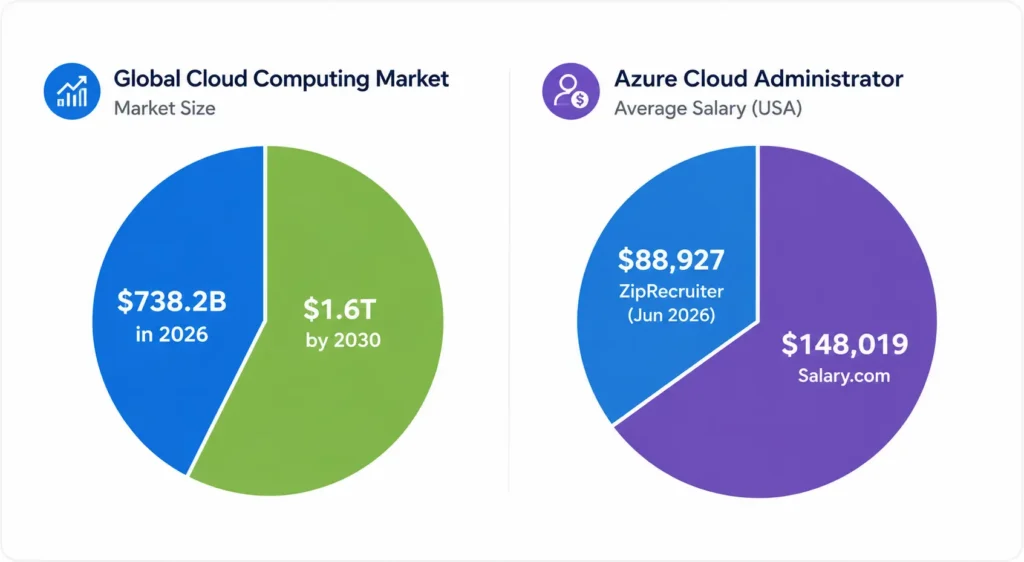
Cloud budgets haven’t slowed down, and neither has hiring for the people who keep those environments running. If you’re weighing whether the AZ-104 certification is worth the study hours, compensation data is a good place to start. The global cloud computing market is expected to grow from $738.2 billion in 2027 to $1.6 trillion by 2030, and that growth translates directly into demand for administrators who run these environments day to day, not just design them on a whiteboard.
On pay specifically, the numbers vary by source but tell a consistent story. The average salary for an Azure cloud administrator in the United States sits around $148,019 per year, while other figures put the average Microsoft Azure administrator salary closer to $88,927 annually, with top earners reaching well above six figures. That spread tells you something: a few years of production experience can move you from the lower end of that range to the upper end fairly quickly.
For long-term career growth, this credential tends to work as a launchpad rather than a ceiling. Employers increasingly list AZ-104 among preferred qualifications for mid-level cloud roles because it signals verified, current experience instead of a self-reported skill on a resume. Common job titles include Azure administrator, cloud administrator, cloud support engineer, and cloud operations engineer.
Building Your Azure Learning Path Beyond AZ-104
Passing one exam rarely happens in isolation. A well-planned Azure learning path usually starts with fundamentals, moves through the associate-level AZ-104, and then branches into specialty tracks.
If you already work as a cloud administrator or are trying to break into that title, map your next step in advance. The common sequences are:
- Architecture: AZ-104, then AZ-305 for Azure Solutions Architect Expert (AZ-104 is required for that expert title)
- Security: AZ-104, then AZ-500 Azure Security Engineer
- DevOps: AZ-104, then AZ-400 for Azure DevOps Engineer Expert
Recruiters in cloud-heavy industries repeat the same advice: certifications open the interview door, but hands-on lab time gets you hired and promoted. Treat each Azure certification as proof of skills already built, not a substitute for building them.
AZ-104 Syllabus: Skills You’ll Actually Be Tested On
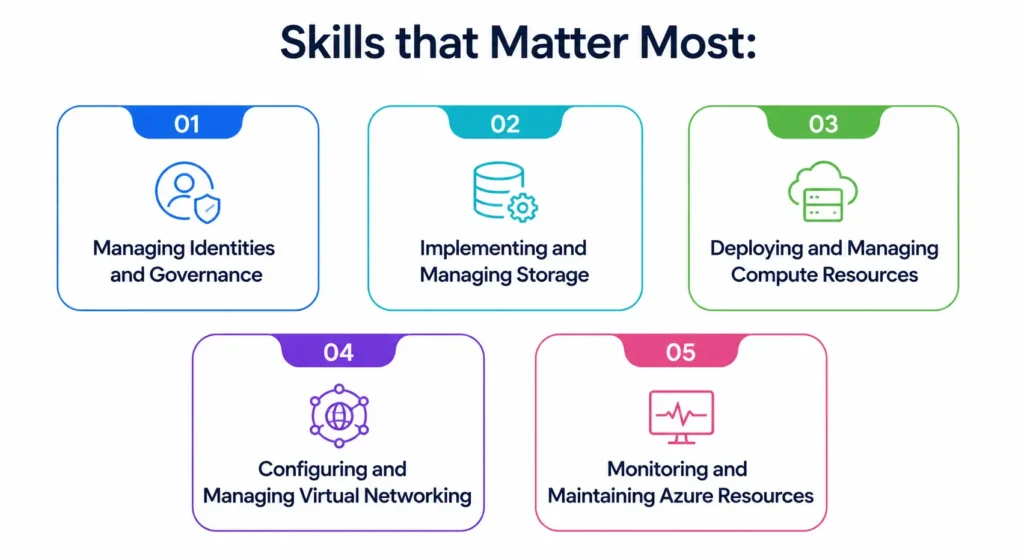
Rather than listing every bullet from Microsoft’s official AZ-104 exam topics, here’s the practical breakdown organized the way I wish someone had organized it for me.
1. Managing Identities and Governance (20–25%)
This is one of the two heaviest domains, so don’t treat it as an afterthought. Expect scenario questions on Microsoft Entra ID user and group management, self-service password reset, role-based access control (RBAC), Azure Policy, resource locks, tags, management groups, and cost budgets. The exam wants to see that you understand who can act on a resource and where that permission is enforced.
2. Implementing and Managing Storage (15–20%)
Storage accounts, redundancy options (LRS, ZRS, GRS), blob lifecycle management, and access tiers show up repeatedly. Be comfortable explaining when soft delete and versioning matter and how shared access signatures differ from account keys.
3. Deploying and Managing Compute Resources (20–25%)
Virtual machines, availability sets, scale sets, App Service, and containers (Azure Container Instances and Azure Container Apps) sit here. You’ll also need to read and modify ARM templates and Bicep files and convert an ARM template to Bicep.
4. Configuring and Managing Virtual Networking (15–20%)
Networking touches nearly everything else. VNets, subnets, peering, NSGs, user-defined routes, Azure DNS, load balancers, Azure Bastion, and private endpoints are all fair game, usually wrapped inside troubleshooting scenarios.
5. Monitoring and Maintaining Azure Resources (10–15%)
The smallest domain by weight but not by importance. Azure Monitor, alerts, Network Watcher, backup configuration, and Site Recovery failover scenarios all live here, usually inside case studies rather than single questions.
A 10-Week AZ-104 Study Plan That Respects Your Time
You don’t need six months of study time if you already work with IT infrastructure—you need structure. Here’s a realistic AZ-104 study plan:
- Weeks 1–2: Build or refresh your Azure fundamentals knowledge, then set up a free-tier Azure subscription for hands-on labs.
- Weeks 3–4: Work through identity and governance labs — create users, groups, custom RBAC roles, and Azure Policy assignments.
- Weeks 5–6: Move into storage and compute, deploying VMs, scale sets, and at least one ARM-to-Bicep conversion by hand.
- Weeks 7–8: Networking deep dive — build a VNet with subnets, NSGs, and a Bastion host from scratch, then break it on purpose and fix it.
- Weeks 9–10: Monitoring, backup, and full-length AZ-104 practice tests, reviewing every wrong answer until the reasoning is second nature.
Free AZ-104 Study Resources (NEW)
- Microsoft’s official AZ-104 study guide — the source of truth for the syllabus
- Free Microsoft AZ-104 practice assessment — check your readiness
- Microsoft Learn AZ-104 learning paths — free modules for every domain
- ThinkCloudly’s free question bank and free assessment — extra AZ-104 exam questions with explanations
My Own Experience Preparing for the AZ-104 Exam
I’ll be honest about something most guides skip: I underestimated the identity and governance section the first time through my practice tests, assuming it was “the easy part” left over from years of general IT experience. It wasn’t. The scenario questions expect you to reason through least-privilege access under specific business constraints, not just recall what RBAC stands for.
What actually moved my practice scores was forcing myself to build and tear down a small resource group with custom roles every single day for two weeks rather than passively rewatching video lectures. By the time I sat for the real AZ-104 certification exam, the case studies felt familiar, and that hands-on repetition — not the reading — is what got me across the 700 line.
Conclusion
The AZ-104 certification in 2027 has refreshed objectives, and treating it that way is the single biggest advantage you can give yourself. Study from the April 2027 outline, put real hours into a live Azure subscription, and don’t skip governance just because it sounds administrative rather than technical.
Whether you’re switching careers, formalizing skills you use daily as a cloud administrator, or aiming for architecture or DevOps, the Azure Administrator Associate credential still opens doors. Build your Azure learning path around the current outline, not an outdated one, and the AZ-104 exam becomes far less intimidating than the forums make it sound.