Did you know a Scrum Master in the United States now earns a median total pay of roughly $126,000 a year?
That single number explains why so many professionals, from project coordinators to former teachers, are quietly switching careers into Agile delivery. I still remember staring at a similar figure five years ago, right before I signed up for my own first course, wondering if a two-day class could really change my career trajectory.
It did, and the data below shows I wasn’t the only one. If you are weighing whether to invest your time and money into Scrum Master certifications this year, this guide walks you through what actually moves the needle in 2026, using only current numbers and honest comparisons.
Why Scrum Master Certifications Still Matter in 2026
Agile is no longer a “tech company thing.” By 2026, Scrum has settled into finance teams, hospital IT departments, marketing squads, and even government projects. Industry researchers at Refonte Learning note that job opportunities for this role are projected to climb by roughly 24 to 26 percent this year, a pace that outstrips most other office-based careers.
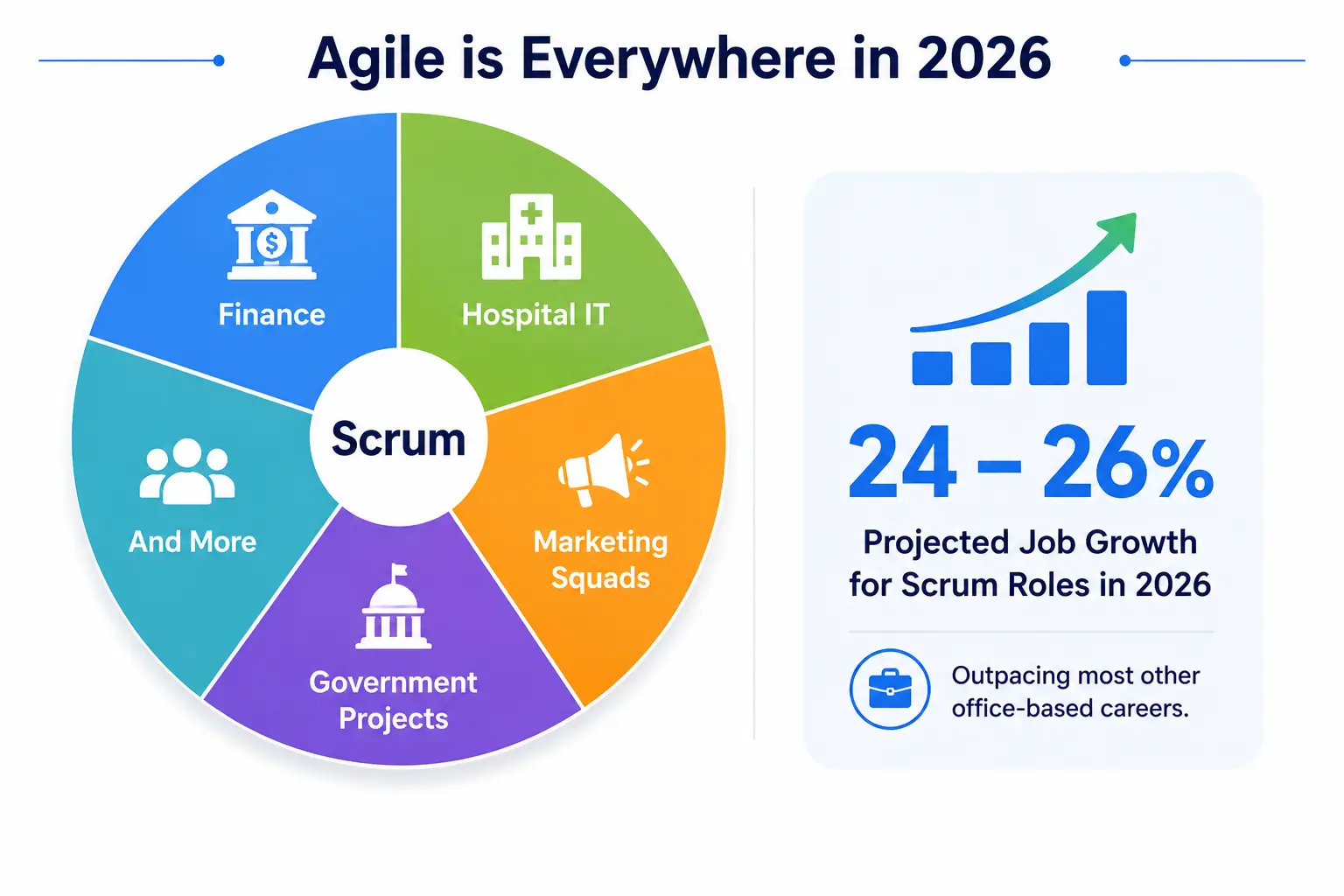
That kind of growth doesn’t happen because companies love job titles; it happens because organizations genuinely struggle to find people who can run a sprint, coach a team, and remove blockers without hand-holding.
This is exactly where Scrum Master certifications earn their keep. A certification will not magically hand you a leadership title, but it does two very practical things: it gets your resume past automated filters that scan for keywords, and it gives you a shared vocabulary with hiring managers who themselves came up through certified scrum master programs.
Recruiters at staffing firms such as Robert Half specifically list the Certified Scrum Master credential as a preferred qualification for mid-level roles, alongside three to four years of hands-on Agile experience. Many professionals treat their first agile certification as a springboard into broader scrum roles across product, delivery, and coaching tracks, rather than a one-time box to tick.
The Certifications Worth Knowing About
There isn’t one single Scrum Master certification. There is a small family of them, run by different organizations, with different philosophies about how you prove you know Scrum because not every certified Scrum Master wants the same career path. Here is a quick breakdown of the ones that actually show up in job postings.
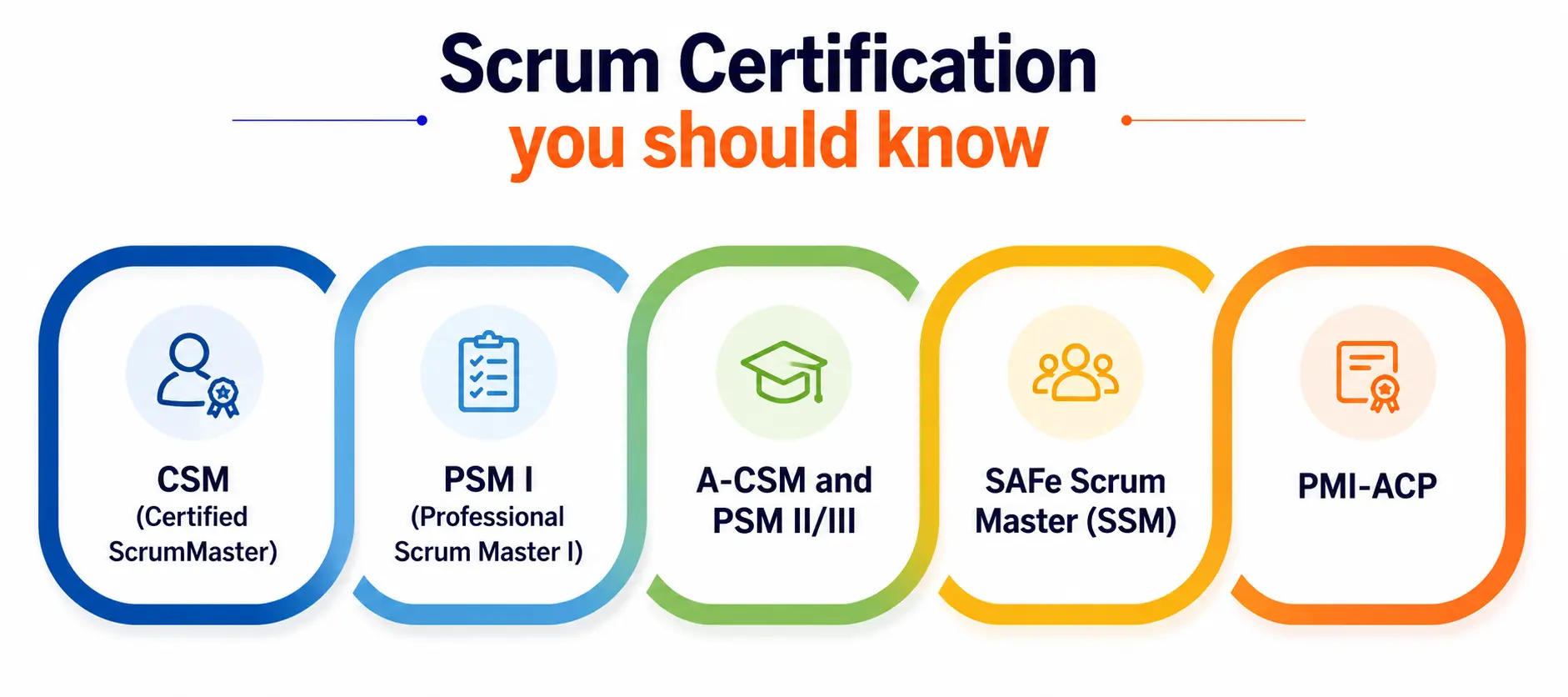
- CSM (Certified ScrumMaster) – Issued by Scrum Alliance, this requires a mandatory two-day, trainer-led course before you can sit the exam. It is widely treated as the entry point for beginners and is one of the most requested credentials by recruiters.
- PSM I (Professional Scrum Master I) – Issued by Scrum.org, founded by Scrum co-creator Ken Schwaber. No mandatory training is required, but the exam has a stricter passing threshold, which employers respect for its rigor.
- A-CSM and PSM II/III – Advanced tiers for professionals who already hold a foundational badge and want to prove they can coach multiple teams or drive organizational change.
- SAFe Scrum Master (SSM) – Useful if you are targeting large enterprises that run Scaled Agile Framework programs across dozens of teams. Several employers now list this alongside other Scrum Master certifications for enterprise-scale postings.
- PMI-ACP – A broader agile certification from the Project Management Institute, often paired with a Scrum-specific badge for professionals who want to move toward program-level roles.
Each of these plays a slightly different role in a resume, but the common thread is simple: certified professionals are treated as a known quantity by hiring managers, while self-taught candidates often have to prove themselves interview by interview. Deciding among them usually comes down to budget, timeline, and how much structure you personally need while studying.
CSM Certification vs PSM Certification: Which One Pays Off Faster
This is the question I get asked most often, so let’s be direct about it. A CSM certification course typically costs between $800 and $1,500 in 2026, which covers the two-day class, two exam attempts, and two years of Scrum Alliance membership.
A PSM certification, on the other hand, can cost under $300 if you self-study and simply pay for the exam voucher, since Scrum.org does not require a class and the credential never expires. Cost aside, both of these Scrum Master certifications are respected internationally, so the decision usually comes down to learning style rather than prestige.
Neither path is objectively “better.” A CSM certification suits people who want structured, instructor-led learning and direct scrum training with feedback from a live coach. A PSM certification suits self-driven learners who are comfortable studying the Scrum Guide independently and want a credential with no renewal fees.
Either route counts as a legitimate agile certification in the eyes of most hiring managers, and both are supported by scrum training material that gets refreshed yearly to match the latest edition of the Scrum Guide.
In short, both belong on the shortlist worth your time in 2026. Public salary aggregators consistently show that certified scrum master professionals, regardless of which badge they hold, earn somewhere between 15 and 24 percent more than uncertified peers doing similar work.
Use the table below as a quick side-by-side view before you commit to either option.
Table: Comparing the Two Leading Certifications in 2026
|
Feature |
CSM (Scrum Alliance) |
PSM I (Scrum.org) |
|
Training required |
Mandatory 2-day live course |
Optional, self-study allowed |
|
Typical total cost (2026) |
$800 – $1,500 |
Under $300 (self-study) |
|
Exam passing score |
Around 74% |
Around 85% |
|
Renewal |
Every 2 years, with SEUs |
Lifetime, no renewal |
|
Best suited for |
Beginners who want guided learning |
Independent learners who like rigor |
|
Global recognition |
Very high |
Very high |
How Much Do Scrum Master Certifications Actually Change Your Salary?
Numbers help more than opinions here, so let’s look at what 2026 data actually shows. July 2026 figures, based on more than 10,000 submitted salaries, put the typical pay range for a Scrum Master between $100,006 and $162,648 annually in the United States, with top earners crossing $200,000. The mid-2026 snapshot lands close by, with a national average of about $120,688 and a top decile above $158,000.
What is more telling is the certification premium itself. A 2026 Agile salary report found that professionals holding an agile certification earn 15 to 20 percent more on average than uncertified peers, and PMI-ACP holders specifically report premiums closer to 28 percent over comparable uncertified roles.
That gap does not appear out of nowhere; certified candidates tend to pass technical screening faster, negotiate with more confidence, and are shortlisted for senior scrum roles sooner than peers without a formal badge. This premium tends to compound as certified professionals move from single-team scrum roles into coaching or program-level positions that call for a second or third agile certification.
It’s one more reason so many mid-career professionals keep adding to their stack of Scrum Master certifications rather than stopping at one. I have watched this play out with people I trained personally. Two candidates with nearly identical experience applied for the same internal transfer at a mid-size logistics company.
The one holding a current CSM certification was interviewed within a week. The other, equally capable but uncertified, waited almost two months and eventually had to prove her knowledge through a longer technical panel. The certification did not make her smarter. It simply removed friction from the hiring process.
What Employers Actually Look for Beyond the Certificate?
A badge alone rarely closes a deal. Employers pair the paper credential with evidence of real scrum roles on an actual team, however small. If you are certified but have never run a retrospective, lean on any volunteer, academic, or cross-functional project where you organized work in sprints.
Hiring managers can tell the difference between someone who memorized definitions for an exam and someone who has sat through a messy sprint planning session and helped a team recover from it. It also helps to understand how the role itself has shifted.
The 15th Annual State of Agile Report found that 76 percent of companies now have dedicated Scrum Masters on staff, up from 68 percent just three years earlier, and also recorded a 32 percent jump in Scrum Master job postings between 2021 and 2024.
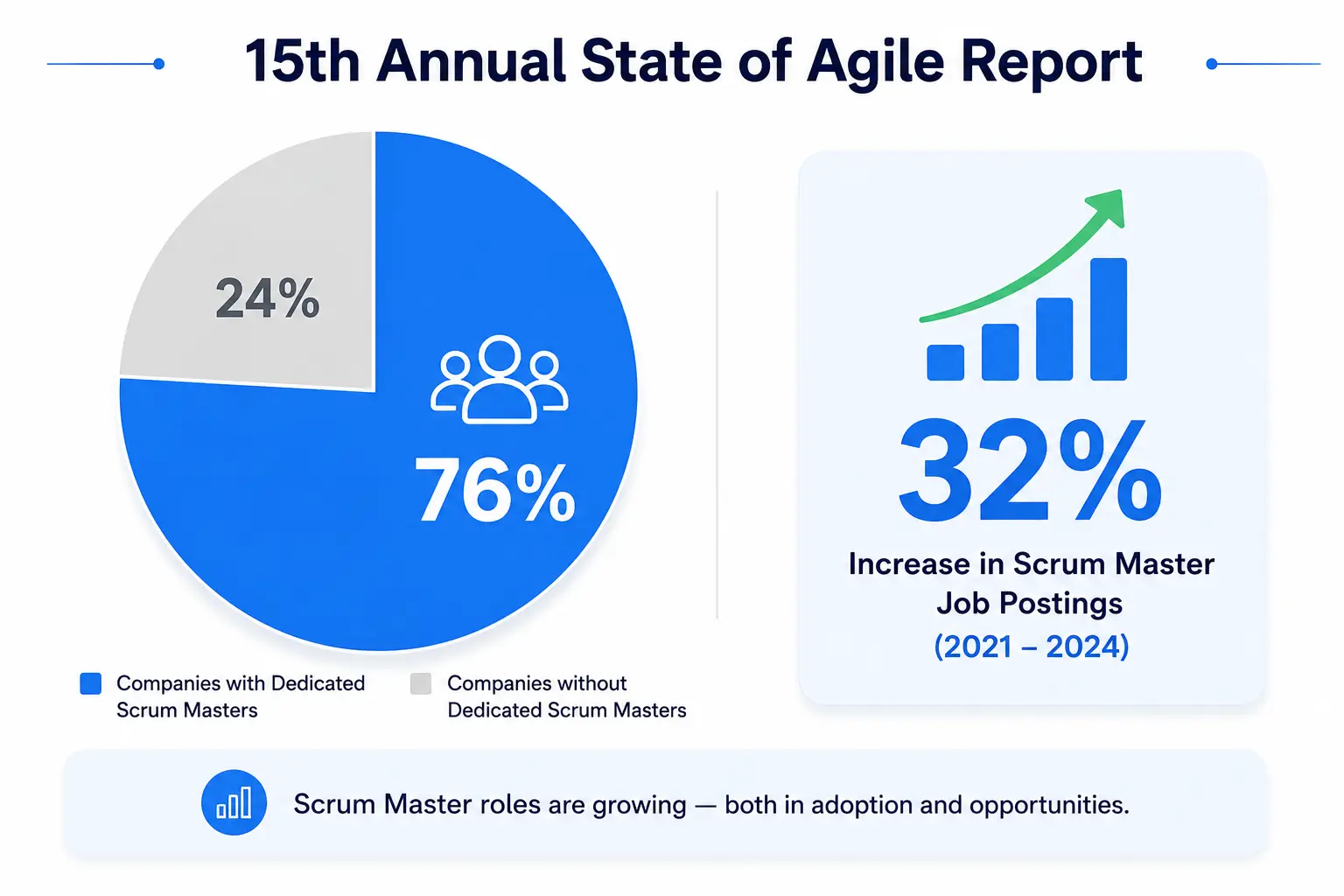
Employers today expect Scrum Masters to influence delivery outcomes, not just schedule meetings, so among the many Scrum Master certifications available, the ones that include practical case studies tend to carry more weight in interviews than pure theory-based prep courses. Even a well-established certified scrum master benefits from refresher scrum training every couple of years, since Agile tooling and team dynamics keep shifting.
A Quick Word From My Own Experience
When I first sat for my Scrum Master exam, I assumed the certificate itself would be the finish line. It wasn’t. The real shift happened once I started applying what I learned in actual sprint reviews, sitting through awkward silences during retrospectives, and learning to ask better questions instead of giving quick answers.
What the certification did give me was a vocabulary and a framework that made those early mistakes less costly, and it’s the same pattern I now see repeated across most certified professionals. If you are considering this path this year, treat the exam as the starting line, not the trophy, and you’ll get far more out of the investment.
Final Thoughts
The evidence from 2026 is fairly consistent across every major source: agile adoption keeps expanding, salaries keep climbing, and Scrum Master certifications remain one of the more reliable ways to move into that growth. Whether you choose a CSM certification for its structured classroom format or a PSM certification for its lighter cost and lifetime validity, the credential works best when it’s paired with genuine practice in real scrum roles.
Treat the certificate as a door opener, not a substitute for experience, and the return on investment tends to speak for itself. Whether you’re chasing your first agile certification or your third, the fastest growth still comes from pairing the credential with real scrum roles inside an actual team.
If you’re looking for guided scrum training rather than figuring it all out alone, Thinkcloudly runs live cohort-based courses that walk you through real sprint simulations, mock interviews, and exam prep material alongside the certification itself. Their sessions also include post-training mentorship, so you’re not left studying in isolation once the course ends.