
I still remember the first time someone asked me to explain what “GRC” even stood for. I fumbled through governance, risk, and compliance like I was reciting a spelling bee word I’d only half-memorized.
A few years and a lot of trial and error later, I’ve watched dozens of career switchers—some fresh out of college, some coming from customer service or accounting—land their first GRC analyst jobs without a single line of “risk analyst” on their resume.
If you’re reading this wondering whether it’s actually possible to break into this field from zero, I want to walk you through exactly how people do it, because I’ve seen the pattern repeat often enough to trust it.
This isn’t going to be a fluffy “just believe in yourself” post. It’s a practical map: what the field actually pays, what skills matter, which certifications are worth your money, and how to position yourself so a hiring manager stops seeing “no experience” and starts seeing “someone I can train fast.”
Whether you’re weighing this against other compliance careers or you’ve already decided this is the path for you, the steps below apply either way.
What Does a GRC Analyst Actually Do?
Before chasing GRC analyst jobs, it helps to know what you’re signing up for. A GRC analyst sits at the intersection of three things:
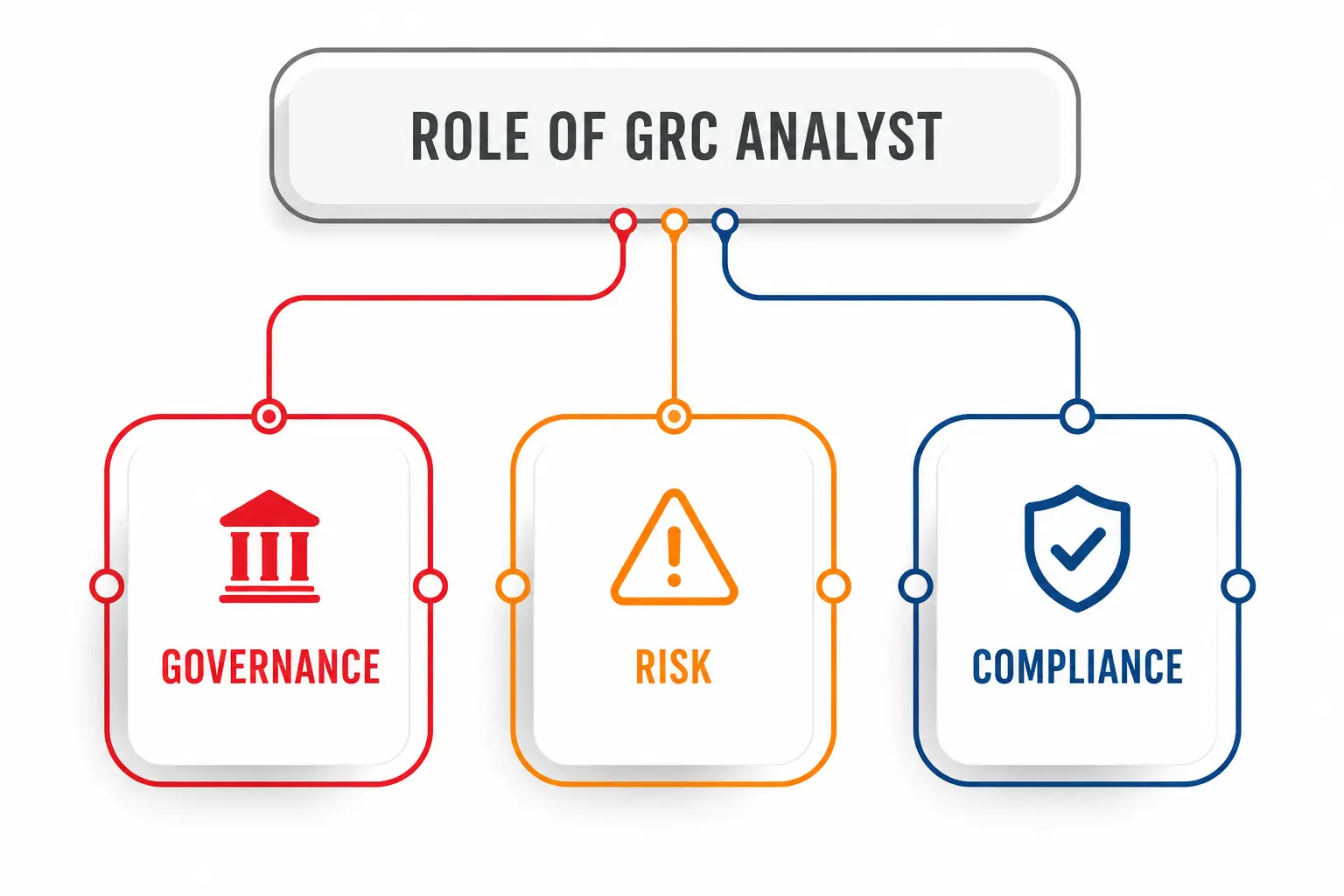
- Governance — making sure the organization has policies and decision-making structures that actually work
- Risk — identifying what could go wrong and how badly
- Compliance — proving the company follows the laws and standards it’s supposed to
In practice, that means writing policy documents, running risk assessments, tracking audit findings, and translating dense regulatory language into something a business team can act on. It’s less “hacker in a hoodie” and more “detective with a spreadsheet. “If you like structure, documentation, and asking, “But how do we know that’s actually true?”—you’ll probably enjoy this work.
Is the Pay Actually Good for Beginners?
Yes, and this is where most people’s eyes widen. According to sources, the average GRC analyst job salary in the United States sits around $77,403 per year as of July 2026, which breaks down to an hourly rate of about that, with entry-level pay (10th percentile) starting near $50,802.
Some data paints an even more encouraging picture for newcomers. As of mid-2026, the average annual pay for an entry-level GRC analyst in the United States is $80,350 a year, or roughly $38.63 an hour, with the middle 50% of earners falling between $54,000 and $100,500 a year.
ERI SalaryExpert offers a slightly more conservative but still solid number: an entry-level GRC analyst with one to three years of experience earns an average of $63,297, while senior-level professionals with eight or more years bring home around $100,606, based on SalaryExpert’s 2026 compensation data.
What all three sources agree on is this: the range is wide, and where you land in it depends heavily on your certifications, your specialization, and how well you can talk about risk in business terms rather than jargon.
One career blog put it well—a compliance analyst focused only on paperwork tends to sit at the lower end, while someone who blends risk management skills with a technical understanding of cybersecurity controls can push their pay meaningfully higher, sometimes by $20,000 to $30,000 a year, per ThinkCloudly’s GRC analyst salary trends.
Why Does “No Experience” Not Mean “No Chance”?
Here’s the part that surprises people: GRC is one of the few corporate career paths where a strong foundation in frameworks and a genuine understanding of a governance framework can outweigh years of unrelated job titles. Employers are less interested in your past job title and more interested in whether you can read a policy, spot a gap, and document it clearly.
That said, I won’t sugarcoat it—plenty of postings for GRC analyst jobs still ask for “2-3 years experience” out of habit, even for junior roles. The trick isn’t to argue with that line item. It’s to build a resume and portfolio that makes the requirement feel irrelevant.
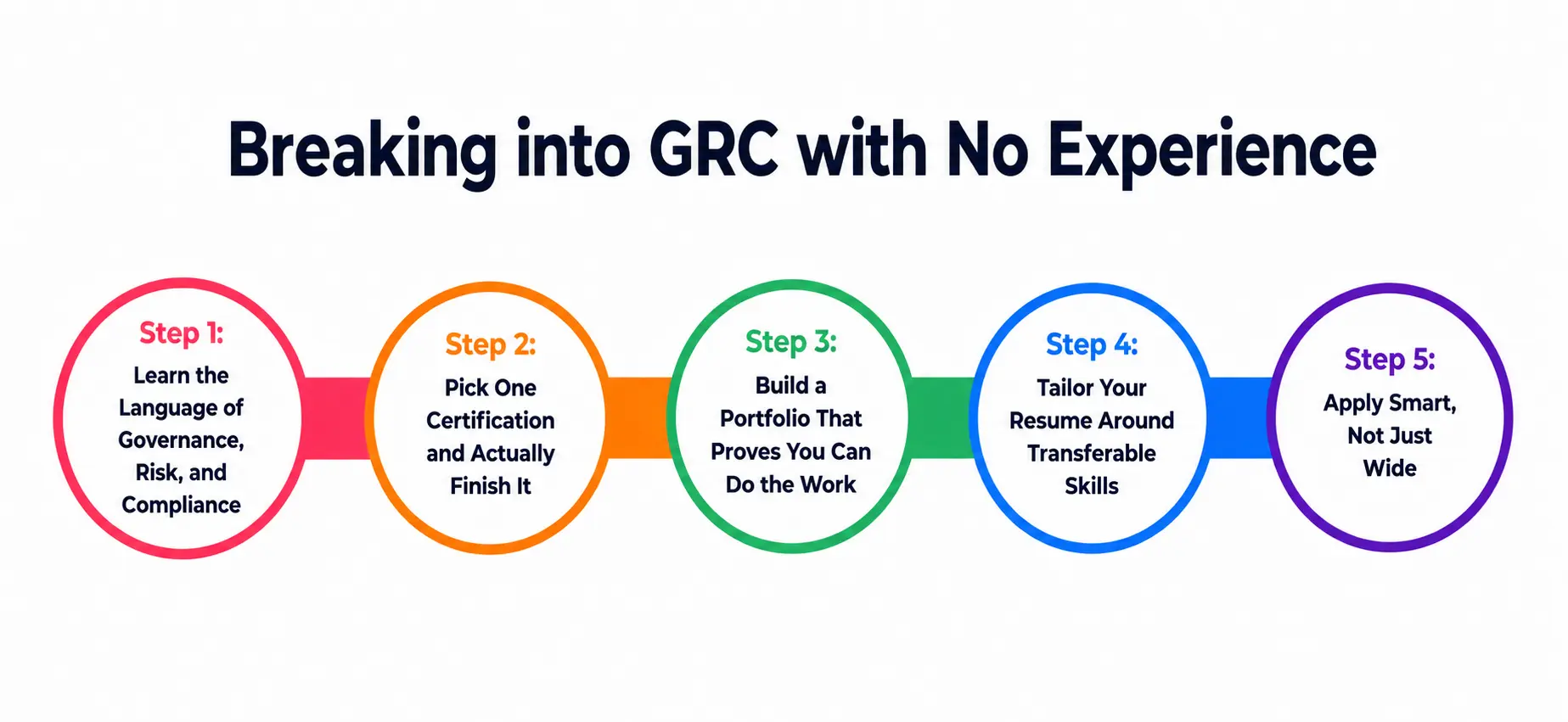
Step 1: Learn the Language of Governance, Risk, and Compliance
You don’t need a degree in cybersecurity to start. You need fluency in the vocabulary that recruiters scan for. Spend real time understanding:
- How a governance framework is structured — policies, standards, procedures, and how they cascade down from leadership
- Core risk management concepts like likelihood, impact, risk appetite, and risk registers
- The basics of regulatory compliance — why laws like GDPR, HIPAA, or SOX exist and what they actually require companies to do
- What a compliance audit looks like from start to finish, including evidence collection and remediation tracking
You can learn most of this for free, through NIST publications, ISO summaries, and YouTube breakdowns of frameworks like NIST CSF or ISO 27001. Reading a couple of real regulatory compliance documents end to end — even a short summary of GDPR or an SEC filing requirement — will teach you more than a week of general theory. The goal isn’t mastery — it’s being able to hold an intelligent conversation about compliance management in an interview.
Step 2: Pick One Certification and Actually Finish It
Certifications are the single fastest way to signal credibility when you have no work history to lean on. But don’t try to collect all of them at once—pick the one that matches the door you’re trying to walk through.
According to Training Camp’s 2026 certification guide, the advice is refreshingly simple: if you’re leaning toward IT audits, go for CISA; if you’re focused on risk management, go CRISC; if you’re managing security programs with governance responsibilities, pursue CISM, and you shouldn’t try to earn all three at once—pass one, let the momentum build, then add the next, per Training Camp’s certification roadmap.
For true beginners with zero background, CyberArrow’s certification guide notes that ISO 27001 Foundation-level training and NIST Cybersecurity Framework courses are considered beginner to intermediate difficulty and useful for GRC teams working with U.S. federal or commercial clients.
Another useful entry point, per ThinkCloudly’s certification primer, is that CRISC, CISA, ISO 31000, CompTIA Security+, and GRC Professional certifications are considered the most beginner-friendly ways to build a foundation in governance, risk, and compliance, and the source notes that people from non-IT backgrounds regularly break in this way, according to ThinkCloudly’s guide to entry-level GRC certifications.
My honest take: if you’re brand new, start with CompTIA Security+ or an ISO 27001 Foundation course. They’re cheaper, faster to complete, and still respected. Save CRISC or CISA for once you have a job and can meet their experience requirements for full certification status.
Step 3: Build a Portfolio That Proves You Can Do the Work
This is the step most beginners skip, and it’s the one that actually gets interviews. Recruiters scanning resumes for GRC analyst jobs want evidence, not adjectives. Build two or three small projects:
- A mock governance framework for a fictional small business, mapped to a real standard like ISO 27001 or NIST CSF
- A sample risk register showing how you’d score and prioritize five hypothetical risks
- A one-page compliance audit checklist for something relatable, like handling customer data under GDPR
Put these in a simple portfolio site or a shared PDF. It costs you a weekend and instantly separates you from candidates who only have a certificate and a hope.
Step 4: Tailor Your Resume Around Transferable Skills
If you’re coming from customer service, you’ve handled documentation and process adherence. If you’re coming from accounting, you already understand controls and audits. If you were in IT support, you’d deal with access management and system logs. Reframe these honestly—don’t invent experience, just translate what you did into the language of risk management and compliance careers.
Step 5: Apply Smart, Not Just Wide
Target smaller companies, MSPs, consulting firms, and GRC platform vendors (like ServiceNow or Vanta partners) before aiming for Fortune 500 in-house teams. These smaller employers are often more willing to train someone with the right foundation and attitude.
Also look for titles like “Compliance Coordinator,” “Junior Risk Analyst,” or “Security Compliance Associate”—these are frequently the same job with a different label and often have lower experience bars than roles explicitly titled “GRC Analyst.” Many of the best GRC analyst jobs for beginners aren’t even labeled that way in the posting.
What a Typical Week Looks Like Once You’re Hired?
It helps to know what you’re walking into. A junior analyst’s week usually involves updating a compliance management tracker, following up with system owners on overdue evidence requests, and preparing documentation ahead of an upcoming compliance audit. It’s steady, detail-oriented work, and the people who thrive in it tend to enjoy checklists and clear processes rather than constant firefighting.
A Quick Snapshot: Salary and Requirements by Experience Level
|
Experience Level |
Typical Annual Salary (US) | Common Certifications Expected |
Typical Responsibilities |
|
Entry-level (0-1 yr) |
$50,800 – $80,350 | Security+, ISO 27001 Foundation |
Documentation, evidence collection, basic risk tracking |
|
Early-career (1-3 yrs) |
$63,300 – $88,600 | CRISC or CISA (in progress) |
Risk assessments, audit support, policy drafting |
|
Mid-level (3-5 yrs) |
$77,400 – $100,500 | CRISC, CISA (completed) |
Framework implementation, vendor risk reviews |
|
Senior-level (8+ yrs) |
$100,600 – $130,000+ | CISM, CGEIT, CISSP |
Program ownership, leadership reporting, strategy |
Common Mistakes Beginners Make
- Chasing every certification at once instead of finishing one and applying for it.
- Waiting to feel “ready” before applying — most people who land GRC analyst jobs with no experience apply before they feel fully qualified.
- Ignoring soft skills — this field is full of stakeholder conversations, and communication matters as much as technical knowledge.
- Applying only to titles with “GRC” in them, missing adjacent roles that lead to the same career.
- Not asking about growth paths in interviews — a strong compliance management program will usually have a clear path from analyst to senior analyst to manager.
A Personal Note
If there’s one thing I wish someone had told me earlier, it’s this: nobody starts a GRC analyst job search feeling fully qualified. Every person I’ve watched succeed in this field started by feeling slightly like an impostor, filling gaps with one certification, one mock project, one honest conversation at a time.
The field rewards patience and clarity far more than it rewards perfection. If you’re a student reading this and wondering whether you belong here—you do. Start with one framework, one certification, and one small project this month. That’s genuinely how it begins for almost everyone.