
Every business, from a two-person startup to a multinational bank, runs into the same problem eventually: something unexpected happens, and nobody saw it coming because nobody was writing it down.
That’s the entire reason a risk register template exists. It’s not a fancy tool. It’s a simple habit turned into a document—and it’s one of the first things students of risk management, audit, or operations should learn to build properly, long before they ever sit in front of a real audit committee.
If you’re studying business, compliance, or project management, you’ve probably heard the phrase thrown around in lectures without much explanation of how to actually use one. This guide fixes that.
We’ll walk through how it connects to a wider risk management template, how it supports a business risk assessment, and how it ties into a business impact analysis template, compliance tracking, and control testing. By the end, you’ll know enough to build your own from scratch and explain, clearly, why each piece exists.
What Is a Risk Register Template?
A risk register template is a structured document—usually a spreadsheet or a table inside compliance software—that lists every identified risk facing a business, along with how likely it is, how bad it would be, who owns it, and what’s being done about it. Think of it as a business’s early-warning system in written form.
Emergency management specialists point out that risks rarely wait for a convenient moment—supply chains get disrupted by regional conflicts, infrastructure fails without notice, and vendors quietly go out of business. A structured register doesn’t stop any of that from happening. What it does is make sure someone already thought about it, assigned an owner, and had a plan before the news broke.
Without one, risk management lives in people’s heads, scattered emails, and meeting notes that nobody reopens. With one, it lives in a single place everyone can check, and nobody has to rely on memory during a crisis.
Why Every Business Needs a Risk Management Template
A risk management template is the broader framework a risk register sits inside. The register is where individual risks get logged; the wider template is the process around it—how risks get identified, scored, reviewed, and closed out over time.
Skipping this structure has a predictable pattern. A risk gets mentioned once in a meeting, someone jots it on a sticky note, and three weeks later it’s caused a real problem that could have been flagged early.
A proper risk management template forces a rhythm: identify, log, score, assign, review, repeat. Students entering compliance or operations roles will find this rhythm is the backbone of almost every audit and governance framework they’ll encounter later in their careers.
The document itself is only useful if it’s reviewed regularly. A register that gets filled out once and forgotten is not a living tool—it’s a historical record of what someone was worried about six months ago, and it will mislead anyone who trusts it.
Assigning Ownership: Who Keeps It Updated?
A document with no owner drifts. Someone in the organization—usually a risk manager, a compliance officer, or a project lead, depending on the size of the business—needs to be responsible for chasing updates, closing stale entries, and flagging when a risk’s score has changed.
In smaller companies this can be one person wearing several hats; in larger ones it’s often split by department, with each owner responsible for their own section and a central coordinator pulling everything into one view for leadership.
This matters more than it sounds. A register with fifty entries and no single accountable owner tends to decay within a few months—some rows go stale, others get duplicated, and nobody notices until an auditor asks a question nobody can answer confidently.
Key Components of a Risk Register Template
Every solid one shares a common skeleton, even if the formatting differs between industries. Here’s a breakdown of what should be in each row:
|
Column |
Purpose |
|
Risk ID |
A unique reference number so the risk can be tracked and cross-referenced |
|
Description |
A short, clear statement of what the risk actually is |
|
Category |
Financial, operational, regulatory, reputational, technological, etc. |
|
Likelihood |
How probable the risk is, usually scored on a simple scale (e.g., 1–5) |
|
Impact |
How severe the consequences would be if the risk occurred |
|
Risk Score |
Likelihood × Impact, used to prioritize which risks need attention first |
|
Owner |
The specific person or team responsible for monitoring and response |
|
Mitigation Plan |
The action being taken to reduce likelihood or impact |
|
Status |
Open, in progress, closed, or escalated |
Keeping the scoring scale consistent across every entry matters more than people expect. If “likely” means something different to each person filling out the document, the whole thing loses credibility the first time two assessors disagree in front of a manager. Write the scale down in plain language and share it before anyone starts scoring.
Business Risk Assessment: The Foundation Beneath the Register
You can’t fill out a register without first doing a proper business risk assessment. This is the analytical step—walking through each part of the business, asking what could realistically go wrong, and estimating how serious it would be.
A thorough assessment typically covers financial exposure, operational bottlenecks, regulatory obligations, cybersecurity gaps, and reputational threats. It’s not a one-time exercise.
New risks appear as a business grows, hires, expands into new markets, or adopts new technology, so this analysis needs to be revisited on a set schedule, not just when something already went wrong.
Students often assume this kind of assessment is a purely financial exercise. It isn’t. A poorly worded contract, a single point of failure in a supply chain, or a compliance gap can all cause more damage than a bad quarter of revenue, and none of those show up if the review only looks at the balance sheet.
Business Impact Analysis Template: What Happens If the Risk Hits
Once a risk is logged, the next question is, how bad would it actually be if it happened tomorrow? That’s where a business impact analysis template comes in. While the register tracks the risk itself, this analysis measures the downstream consequences—financial loss, operational downtime, reputational damage, and regulatory exposure.
Gartner’s framework, referenced in Asana’s guide to business impact analysis, breaks impact into five categories: financial, reputational, regulatory and compliance, production output, and environmental. Running this kind of analysis against each of these categories gives a far more complete picture than just asking, “How much money would we lose?”
This step also helps set recovery priorities. Not every process can be restored first—the analysis forces a ranking, so the most critical operations get attention before the less urgent ones. Pairing it with the register means you know both what could go wrong and exactly how much it would hurt if it did.
Compliance Tracking: Turning Risks Into Accountability
A risk register only has teeth if it connects to real accountability, and that’s where compliance tracking comes in. This is the ongoing process of monitoring whether an organization is actually meeting its regulatory obligations, internal policies, and external standards—not just on paper, but in practice.
Modern compliance platforms are built to prove control status continuously rather than scrambling before an audit. That shift matters: tracking obligations used to mean an annual scramble to gather evidence; now it means dashboards that flag a gap the moment it appears.
For a student learning this field, the key idea is simple: ongoing monitoring turns a static document into a living system. Instead of listing a regulatory risk and hoping someone remembers to check on it, an active process assigns deadlines, sends alerts, and keeps an audit trail nobody has to reconstruct from memory later.
Control Testing: Proving the Mitigation Actually Works
Writing “mitigation in place” in a register means nothing if nobody ever checks whether that mitigation actually works. That’s the job of control testing—periodically verifying that a control is functioning the way it’s supposed to, not just that it exists on paper.
Best practice guidance on internal control management makes the point directly: a control may exist on paper without being owned, tested, evidenced, or monitored, which means it isn’t really a control at all. This kind of testing closes that gap. It should be documented, repeatable, and assigned to a specific tester with a due date, not left as a vague annual checkbox.
Good testing also feeds back into the register itself. If a control keeps failing its checks, the underlying risk score should go up, not stay frozen at whatever number was assigned when the document was first built.
How to Build a Risk Register Template in 7 Steps?
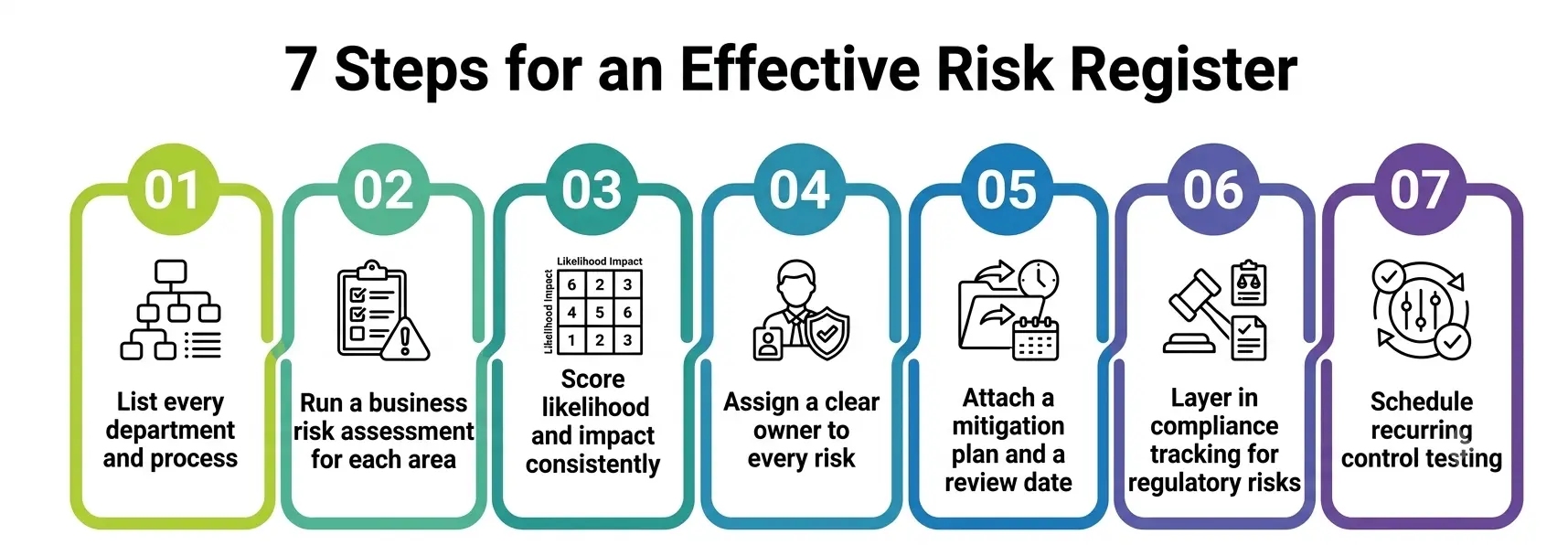
- List every department and process. Walk through finance, operations, IT, HR, and compliance separately—risks hide in the gaps between departments.
- Run a business risk assessment for each area. Ask what could realistically go wrong and how it would show up first.
- Score likelihood and impact consistently. Use the same numeric scale across every entry so scores are comparable.
- Assign a clear owner to every risk. A risk with no owner never gets managed—it just gets forgotten.
- Attach a mitigation plan and a review date. Every row needs a next action, not just a description of the problem.
- Layer in compliance tracking for regulatory risks. Set automated reminders so nothing regulatory slips past a deadline.
- Schedule recurring control testing. Confirm mitigations are actually working, and adjust risk scores when they aren’t.
These seven steps turn theory into a working risk management template your team can actually maintain, rather than a one-off exercise for a class assignment or a single audit cycle.
Once the structure is built, pair it with a business impact analysis template for your highest-scoring risks. That combination—what could go wrong, and exactly how much it would cost—is what separates a real risk program from a spreadsheet nobody opens after the first meeting.
Common Mistakes to Avoid
- Treating the risk register template as a one-time project. Risks change constantly; the register has to change with them.
- Skipping ownership. A risk without a named owner is a risk nobody is actually managing.
- Ignoring low-probability, high-impact risks. These are exactly the ones a thorough assessment exists to catch before they’re overlooked.
- Letting regulatory monitoring lapse between audits. Waiting for the auditor to find the gap is far more expensive than finding it yourself.
- Never repeating the testing cycle. A control that passed once, two years ago, tells you nothing about whether it’s working today.
A Quick Industry Note
2026 has made a strong case for taking all of this seriously. Regulators in the US and EU have both flagged geopolitical and third-party risk as growing blind spots in business continuity planning, and standards guidance on impact analysis now expects climate-related disruption and vendor dependency to be scored as first-class risks, not footnotes.
Bank examiners in particular have started treating outdated continuity plans as a finding in their own right, not just a gap waiting to be discovered after something breaks.
None of that is theoretical for students heading into risk, audit, or compliance careers—it’s the exact skill set employers are now testing for in interviews, case studies, and entry-level analyst work. Knowing how to read a scoring matrix is no longer a nice-to-have on a resume; it’s assumed.
Conclusion
A risk register template isn’t complicated, but it is easy to underestimate. Used properly—updated regularly, backed by a genuine assessment of risk, connected to a clear-eyed look at potential impact, monitored through active oversight, and verified with regular testing—it becomes one of the most useful documents a business owns. Used carelessly, it’s just a spreadsheet nobody opens again. The difference isn’t the format. It’s the habit of keeping it alive, one review cycle at a time.
A Personal Note
I’ve sat through enough post-incident reviews to notice a pattern: the risk was almost always identified beforehand, somewhere, by someone. It just never made it onto a document anyone was actively watching.
That’s really the whole argument for a risk register template—not that it predicts the future, but that it stops good instincts from getting lost in a hallway conversation or a Slack message nobody scrolls back to.
If you’re a student building your first one for a class project, don’t aim for perfection. Aim for a version you’ll actually open again next month. That’s the one that teaches you something a textbook can’t.