
If you’ve ever wondered why a single missed update can bring down an entire network, you’re really asking about the value of a solid patch management policy. Every week, somewhere, a security team is scrambling because a system that should have been updated months ago just got exploited.
A clear, well-enforced policy like this isn’t a bureaucratic checkbox tucked away in a compliance folder—it’s the difference between catching a vulnerability before it’s weaponized and reading about your organization in next quarter’s breach report.
This guide walks through what a patch management policy actually covers, why it matters more in 2026 than it did even two or three years ago, and how you can build one that survives contact with a busy, distracted, real-world IT team.
Whether you’re a student learning the fundamentals of cybersecurity or an IT lead trying to formalize a process that currently lives in someone’s head, the goal here is the same: a policy you can actually follow, not just file away.
What Is a Patch Management Policy?
In plain terms, this kind of policy is the internal rulebook that tells your organization when, how, and by whom software patches get tested and installed. It answers practical questions: which systems get patched first, how long you have before a critical flaw must be fixed, who’s allowed to approve an emergency patch outside the normal cycle, and what happens if an update breaks something important.
According to NIST’s Guide to Enterprise Patch Management Planning, patching should be treated as preventive maintenance for technology, not an optional chore squeezed in when nothing else is urgent. Just as a fleet manager wouldn’t wait for a truck’s brakes to fail before servicing them, an IT team shouldn’t wait for an exploit to appear in the wild before applying a known fix.
A written policy turns that mindset into something repeatable, instead of something that depends on one engineer remembering to check for updates on a Friday afternoon.
Why Every Organization Needs a Patch Management Policy in 2026
Here’s an uncomfortable fact: most breaches don’t start with some brand-new, never-before-seen exploit. They start with a known vulnerability that sat unpatched for weeks or months while attackers quietly probed for it. CISA’s Known Exploited Vulnerabilities Catalog adds new entries almost every week in 2026, and every single one represents a flaw that’s already being actively exploited—not a theoretical risk someone might get around to eventually.
Under Binding Operational Directive 26-04, U.S. federal civilian agencies are now required to prioritize remediation based on real-world exploitation risk rather than treating every vulnerability the same way.
That risk-based approach is exactly the thinking a strong patching policy should borrow, whether you’re running a five-person startup or a multinational enterprise with thousands of endpoints.
The financial argument is just as blunt. Independent research from the Ponemon Institute, cited in recent industry analysis, found that the cost of non-compliance with security and data-protection obligations can run dramatically higher than the cost of simply patching right in the first place—in some studied cases, nearly double. Regular security audits exist precisely to catch these gaps before an attacker, a regulator, or a customer finds them first.
The pattern keeps repeating across different platforms. Earlier in 2026, attackers began exploiting on-premises collaboration server vulnerabilities within days of public disclosure, forcing organizations without a fast-track response process to pull affected servers offline entirely rather than risk further compromise.
The lesson isn’t that any single vendor is uniquely risky—it’s that patch cycles measured in weeks are no longer fast enough for anything exposed to the internet. Attackers are reading the same disclosure notes your team is, and they’re usually faster to act on them.
The Core Building Blocks of a Strong Patch Management Policy
A patch management policy isn’t really one document—it’s five interlocking habits that reinforce each other. Get these right and most of the operational headaches tend to sort themselves out.
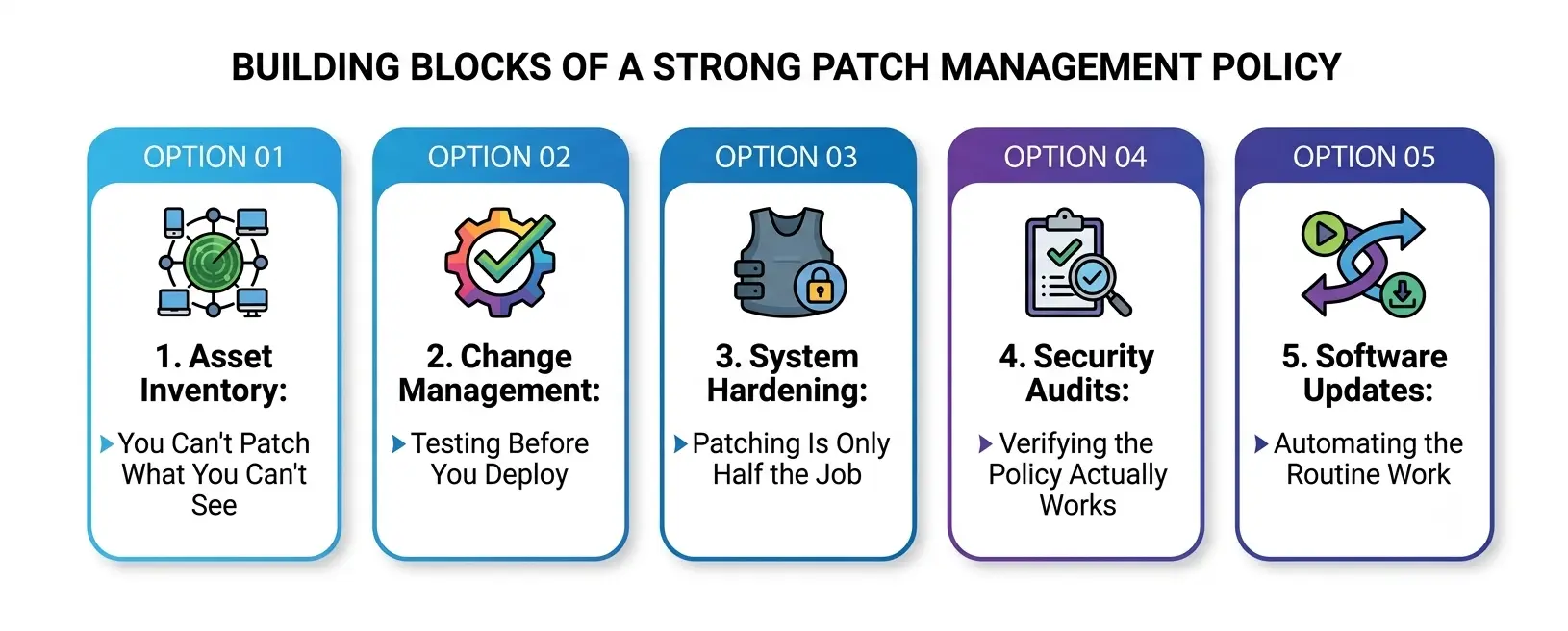
1. Asset Inventory: You Can’t Patch What You Can’t See
You cannot secure a device you don’t know exists. Before you write a single rule, build a complete asset inventory of every laptop, server, IoT device, cloud instance, and piece of software running across your environment. Shadow IT—the forgotten test server, the marketing team’s unsanctioned SaaS app, the old printer still connected to the network—is where most missed patches quietly hide for years.
A living asset inventory, refreshed continuously through automated discovery tools rather than updated once a year in a spreadsheet, is the foundation everything else in this article depends on. Skip this step, and every other part of your policy is guesswork.
2. Change Management: Testing Before You Deploy
Patching without change management is how a well-intentioned Tuesday-night update turns into a Wednesday-morning outage. Every patch—especially for production or business-critical systems—should pass through a lightweight approval and testing step before it goes live. This doesn’t need to be slow; even a 24-to-48-hour test window on a staging environment catches most compatibility issues before they reach users.
Good change management also means documenting exactly what changed and when. If something does break after deployment, that record lets you trace the cause and roll back quickly instead of guessing which of twelve simultaneous updates caused the problem.
3. System Hardening: Patching Is Only Half the Job
Patches close known holes, but system hardening closes the ones attackers haven’t needed to exploit yet—disabling unused services, enforcing least-privilege access, turning off default credentials, and tightening firewall rules. Think of patching as fixing a broken lock and system hardening as making sure you didn’t leave five other doors wide open in the meantime.
The two work together, and neither one alone is sufficient. A perfectly patched server with default admin credentials still enabled is still an easy target.
4. Security Audits: Verifying the Policy Actually Works
A policy that looks great on paper can quietly fail in practice. Scheduled security audits—whether internal reviews or third-party assessments—confirm that patches are genuinely being applied on schedule, not just logged as “complete” in a ticketing system that nobody double-checks.
ISO/IEC 27001’s Annex A Control 8.8 treats vulnerability management as a continuous, auditable process for exactly this reason: good intentions don’t stop breaches, but verified execution does. An audit is where you find out whether your policy is real or aspirational.
5. Software Updates: Automating the Routine Work
Not every one of your software updates needs a human sitting in the approval loop. Routine, low-risk software updates—browser patches, minor OS revisions, driver refreshes—are ideal candidates for automation through a dedicated patch management tool.
Save your team’s limited attention for the updates that actually carry judgment calls: emergency fixes for actively exploited flaws, major version upgrades, or anything touching a system you genuinely cannot afford to have go down.
How to Build a Patch Management Policy Step by Step?
Putting this into a document doesn’t need to be complicated. Here’s a practical sequence:
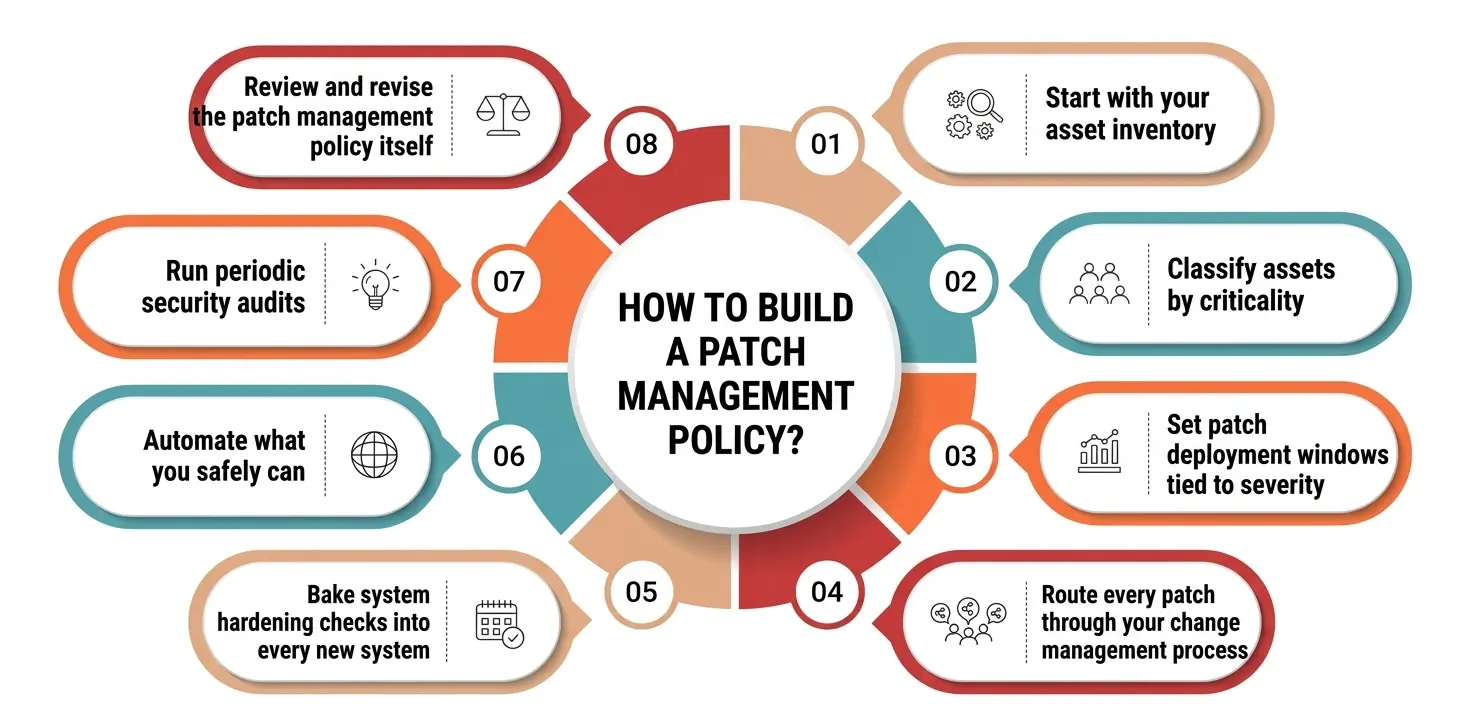
- Start with your asset inventory so you know the full scope of what actually needs protecting, including cloud and remote-work devices.
- Classify assets by criticality. A public-facing web server deserves a faster response window than an internal test box nobody relies on.
- Set patch deployment windows tied to severity, not a single blanket deadline for every kind of update.
- Route every patch through your change management process, even emergency ones—just on a faster, pre-approved track.
- Bake system hardening checks into every new system before it goes live, rather than treating it as an afterthought once something goes wrong.
- Automate what you safely can. Most software updates don’t need manual sign-off, and automation frees your team for the updates that do.
- Run periodic security audits to confirm the policy is actually being followed, not just written down and forgotten.
- Review and revise the patch management policy itself at least once a year, because the environment you’re protecting in 2026 doesn’t look like it did even eighteen months ago.
Patch Severity Levels and Response Windows
One thing every patch management policy should spell out clearly is how urgently different types of patches get handled. Here’s a simple structure many teams use as a starting point:
|
Severity |
Example | Response Window |
Who Approves |
|
Critical |
Actively exploited flaw (listed in CISA’s KEV catalog) | 24–72 hours |
Security lead, via expedited change management |
|
High |
Remote code execution, no confirmed exploit yet | 7 days |
IT security team |
|
Medium |
Privilege escalation, limited exposure | 30 days |
Standard review board |
|
Low |
Minor bug fixes, non-security updates | Next scheduled maintenance window |
System owner |
Adjust the specific timeframes to match your organization’s risk tolerance and regulatory obligations—but write the table down somewhere your whole team can see it. Ambiguity is where delays creep in.
Common Challenges in Implementation
Even well-intentioned teams hit the same walls. Legacy systems that can’t be patched without breaking a critical piece of business software. Departments that push back on any downtime, however brief.
An asset inventory that was accurate on the day it was created and stale a month later. And the classic problem: far too many CVEs are disclosed each week, and there are nowhere near enough hours to triage all of them by hand.
None of these are reasons to abandon the process—they’re reasons to build flexibility into it. Maintain compensating controls, such as extra system hardening measures like network segmentation, for systems that genuinely can’t be patched on schedule.
Automate triage using severity scoring so your team spends its limited time on what actually matters, instead of working through an unranked list top to bottom.
Best Practices to Strengthen Your Policy in 2026
The threat landscape this year rewards speed more than it ever has. Ransomware groups are now weaponizing disclosed vulnerabilities within days — sometimes hours — of a patch release, reverse-engineering the fix itself to build a working exploit before most organizations have even finished testing the update. A few practices help close that gap:
- Prioritize by exploitability, not just severity score. A vulnerability sitting on CISA’s KEV list beats a theoretical 9.8 CVSS-rated flaw that nobody’s actively using in the wild.
- Keep software updates as close to real time as your testing process allows for anything internet-facing, since exposure windows are shrinking fast.
- Run tabletop exercises alongside your regular security audits so the team already knows what to do the moment a critical patch drops late on a Friday night.
- Document every exception in writing. If a system genuinely can’t be patched on schedule, record why, what compensating controls are in place, and when the exception will be revisited.
- Loop in non-technical stakeholders early. A policy that finance or operations discovers only after a system goes down for patching is a policy people will quietly work around.
Why Does This Matter for Students and Future IT Professionals?
If you’re studying cybersecurity, IT administration, or a related field, this is one of the most practical, employable skills you can start building now. Employers don’t just want people who can define what a patch is—they want people who can write, defend, and continually improve a real policy document under real constraints like budget, staffing, and legacy systems that refuse to cooperate.
Try turning this into a project: pick a fictional company, sketch out its asset-tracking approach, propose severity tiers and response windows, and defend your reasoning to a classmate playing the role of a skeptical operations manager.
That single exercise will teach you more about how security teams actually operate than memorizing CVE definitions ever will, and it gives you something concrete to talk about in an interview. Hiring managers consistently say they’d rather see a rough, well-reasoned draft policy in a portfolio than another certificate listing tools you’ve never actually configured.
A Personal Note
I’ve sat through more than one post-incident review where the root cause traced back to a patch that had been sitting in a queue for weeks—not because anyone on the team was careless, but because no clear process existed to test, approve, and deploy it on a predictable schedule.
Writing the rules down, as unglamorous as that sounds, is genuinely what prevents that same meeting from happening again six months later. If there’s one thing I’d tell anyone starting this work, student or seasoned administrator alike, it’s this: build the policy before you need it, not while you’re explaining to leadership why you didn’t have one.
It’s not glamorous work, and it rarely gets credit when things go right—but the quiet weeks where nothing breaks are the actual measure of whether it’s working.