

A few months ago, a friend studying information systems asked me why her university had suddenly replaced the library’s swipe-card entry with a face scan. She wasn’t annoyed, just curious: “Isn’t a card easier?” It is easier until someone loses it, lends it to a roommate, or has it cloned in a parking lot.
That one small campus change is really a snapshot of a much bigger shift happening across the security industry right now. Biometric authentication methods in cybersecurity have quietly moved from “interesting research topic” to the default way banks, hospitals, airports, and yes, university libraries verify that you are who you say you are.
This guide breaks the subject down the way I wish someone had broken it down for me: no vendor jargon, no assumption that you already know what an FRR is, and no pretending that biometrics are a flawless magic fix.
By the end, you’ll understand the main biometric authentication methods in cybersecurity being deployed in 2027, how they compare, and where the field still has real problems to solve.
What Are Biometric Authentication Methods in Cybersecurity?
At the core, biometric authentication verifies identity using something you are rather than something you know, like a password, or something you carry, like a card. A fingerprint, a face, an iris pattern, a voice, and even the rhythm of how you type are physical or behavioral traits that are extremely hard to fake and impossible to forget, the way you forget a password.
That’s the entire appeal behind biometric authentication methods in cybersecurity: they don’t depend on memory or on a physical object you could misplace. The system captures a sample, converts it into a mathematical template rather than storing a raw photo or scan, and compares that template against the one saved at enrollment. If the match score clears a set threshold, access is granted.
Two accuracy numbers decide how well any of this works in the real world: the false acceptance rate, which measures how often an impostor slips through, and the false rejection rate, which measures how often a legitimate person gets turned away. Get either one wrong, and the system either opens a security hole or becomes too frustrating to actually use.
Why Biometric Authentication Methods in Cybersecurity Matter in 2026?
Three trends are pushing biometrics from a nice-to-have into a baseline expectation this year. Passkey adoption has surged across major platforms, and passkeys are typically unlocked locally on a device using a fingerprint or face scan rather than a password, which means the plumbing for widespread biometric login was basically already being built for another reason.
According to Aware, Inc.’s 2026 industry outlook, passkeys meaningfully reduce phishing risk, but they still can’t answer the one question that matters most in security: is the right person actually behind the device?
Fraud also got noticeably smarter, so verification had to catch up. Deepfake-driven identity fraud is no longer a fringe concern reserved for security conference talks; industry reporting on the 2027 Entrust Identity Fraud Report notes that roughly one in five biometric fraud attempts now involves some form of synthetic media, which is pushing vendors hard toward passive liveness checks that analyze micro-movements and depth mapping that a deepfake can’t replicate.
And biometrics simply spread. What started as a way to unlock a phone now shows up in workforce access badges, high-value transaction approvals, airport boarding gates, and hospital record systems. HID Global’s 2026 identity trends report notes that facial recognition has become the default choice for self-service kiosks across travel, healthcare, and retail specifically because it needs no extra hardware on the user’s side.
Face Authentication: The Biometric Everyone Already Uses
Face authentication is the biometric most people already interact with daily, since it’s the default unlock method on most modern smartphones. It works by mapping facial geometry, including the distance between the eyes and the shape of the jawline, sometimes paired with infrared depth data, into a stored template. Modern facial recognition systems also run liveness checks to block someone from holding up a photo or a video on a second screen.
The strength of face authentication is pure convenience: no physical contact required, works from a short distance, and slots easily into kiosks and mobile apps. The weakness is environmental sensitivity.
Poor lighting, an odd camera angle, natural aging, or a face partially covered can all degrade accuracy, and facial recognition has historically shown a higher FRR than some other biometric methods used in security systems, particularly fingerprint and iris-based systems.
Iris Scanning and Its Remarkably Low FRR
Iris scanning is widely regarded as one of the most accurate biometric methods available today, and it’s a favorite example I bring up whenever someone assumes all biometrics perform roughly the same. The iris carries a highly complex, stable pattern that barely changes from around age one until death, which is exactly why iris-based verification gets trusted for high-security applications like border checkpoints and data center access.
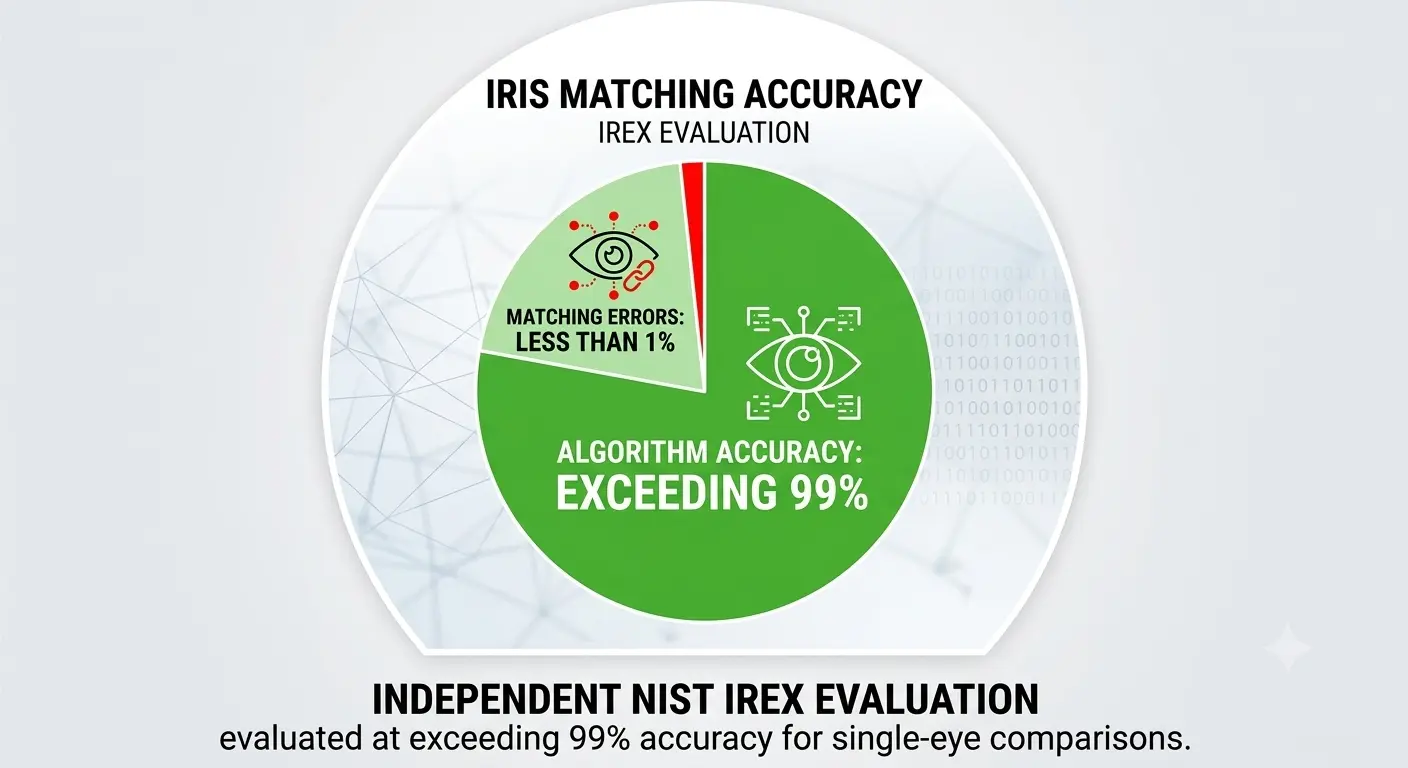
Independent testing through NIST’s Iris Exchange (IREX) program has evaluated iris-matching algorithms at accuracy levels exceeding 99% for single-eye comparisons, reflecting how mature this technology has become.
Iris-based verification also tends to produce a notably low FRR compared to fingerprint or facial recognition, largely because the iris pattern is far less affected by everyday conditions such as a scratched fingertip or a bad camera angle.
The trade-off is cost: iris-based systems need specialized near-infrared cameras, so they show up more often in government and enterprise-grade deployments than in everyday consumer sign-in flows.
Biometric Login for Everyday Devices: Fingerprint and Voice
Fingerprint scanning remains the most familiar form of biometric login for consumer phones, banking apps, and workplace laptops. Capacitive and ultrasonic sensors read ridge patterns and convert them into templates in a fraction of a second.
It’s cheap, fast, and well understood by users, but it isn’t flawless. Wet, dirty, or worn fingertips push the FRR higher, and older optical sensors have historically been easier to spoof with a convincing fake print.
Voice biometrics analyzes pitch, cadence, and vocal tract characteristics, and it’s useful for phone banking and call centers. In 2027, though, voice is rarely deployed as a standalone authentication method.
The sensible pattern pairs voice with a liveness challenge, such as a random spoken phrase the system generates on the spot, since AI voice cloning has made static voiceprints far easier to fake than they were even a couple of years ago.
Continuous Authentication: Security That Doesn’t Stop at Login
This is the category most students underestimate, and it’s arguably the most important shift among current biometric authentication methods in cybersecurity. Traditional authentication treats login as a locked gate: prove who you are once, and you stay trusted for the rest of the session. That model is outdated. A session can be hijacked, a device can be left unlocked, or a stolen token can be reused minutes after a legitimate sign-in.
Continuous authentication closes that gap by re-checking identity signals throughout an active session instead of only at the start. A 2027 enterprise guide on Security Boulevard describes this well: a session that authenticates correctly at 9:07 a.m. can still be compromised by 9:44 a.m., and only ongoing identity verification that watches behavior throughout the session, not a one-time login check, would catch that kind of deviation before real damage is done.
Instead of a single sign-in check, ongoing behavioral verification quietly watches typing rhythm, mouse movement, navigation patterns, and device posture. If those signals suddenly look wrong mid-session, the system can trigger a silent step-up check or cut the session off entirely, all without bothering the legitimate user.
Continuous authentication is what makes zero-trust security practical rather than just a slogan on a slide, because it stretches verification across the entire session instead of stopping at the front door.
Comparing the Main Biometric Authentication Methods in Cybersecurity
|
Method |
Typical Accuracy | FRR | Best Suited For |
Main Weakness |
|
Facial recognition |
High, improves with liveness detection | Moderate, sensitive to lighting and angle | Phones, kiosks, self-service travel |
Environmental sensitivity, deepfake risk |
|
Iris-based verification |
Very high (99%+ in independent testing) | Very low | Border checkpoints, data centers, high-security facilities |
Hardware cost, limited consumer use |
|
Fingerprint (biometric login) |
High | Moderate, sensitive to skin condition | Everyday device and app unlock |
Wear, moisture, older-sensor spoofing |
|
Voice biometrics |
Moderate | Moderate to high | Call centers, phone banking |
Vulnerable to cloning if used alone |
|
Behavioral monitoring (session-long) |
Improves over time as baseline data grows | High initially, drops with more session data | Zero-trust session monitoring, fraud detection |
Needs several sessions to build a reliable baseline |
Understanding the False Rejection Rate
If you remember one technical term from this entire guide, make it a false rejection rate. It’s the percentage of legitimate users a biometric system incorrectly turns away, and it matters more than most students expect. A high FRR doesn’t just annoy people at the door; it pushes organizations toward weaker fallback methods, like security questions, that quietly undo the security benefit biometric authentication was supposed to provide in the first place.
Different methods carry very different FRR profiles. Iris scanning generally holds one of the lowest figures among common biometric methods, while fingerprint and facial recognition systems tend to show a noticeably higher FRR under real-world conditions, since a scarred fingertip or dim lighting rarely shows up in a vendor’s lab-tested accuracy claim.
Serious security teams ask for the FRR and false acceptance rate together, under realistic conditions, not marketing conditions, before trusting any biometric deployment.
Risks Worth Understanding Before You Trust the System
Biometrics solve the “I forgot my password” problem, but they introduce one that’s arguably harder: biometric data can’t be reset. If a password leaks, you change it. If a fingerprint template leaks, there’s no replacement fingerprint to issue yourself.
That permanence is exactly why the UK’s Information Commissioner’s Office classifies biometric data used for identification as special category data, requiring explicit consent, encrypted storage, and strict purpose limitation.
Spoofing is the second major risk. Deepfakes, synthetic voices, and convincing fake fingerprints are getting cheaper to produce, which is why passive liveness detection, checking for genuine physical presence rather than just matching a pattern, has become close to mandatory in any serious 2027 deployment rather than an optional add-on.
Storage design is the third risk. Systems that keep raw biometric templates in one central database create a massive single point of failure. Better-designed systems favor decentralized, on-device storage, where the biometric proof never leaves the user’s own hardware, paired with public-key cryptography so a server breach exposes nothing meaningful to steal.
Where Biometric Authentication Methods in Cybersecurity Are Headed Next?
Multimodal authentication, combining two or more biometric signals such as facial recognition plus a behavioral check, or fingerprint plus ongoing behavioral verification, is becoming the default for anything security-sensitive. Combining independent systems pushes both the FRR and the false acceptance rate down at the same time, instead of trading one for the other.
Zero-knowledge biometric verification is also gaining ground: the idea that identity can be confirmed without ever exposing the underlying biometric data to the service requesting it. Paired with risk-based authentication that only asks for extra proof when something looks unusual, the direction of travel favors security that’s both stronger and less irritating to actually use, which is a rare combination in this field.
Conclusion
Biometric authentication methods in cybersecurity have moved well past the fingerprint-scanner-in-a-spy-movie stage. Facial recognition and iris-based verification now sit alongside everyday biometric sign-in on our phones, while session-long behavioral monitoring quietly extends protection across an entire session rather than stopping at the front door.
None of it is flawless: FRR trade-offs, spoofing risk, and the simple fact that biometric data can’t be reset all remain real, unresolved problems. But the direction is clear. Identity verification is shifting from proving what you know toward proving who you probably are, and understanding that shift is quickly becoming a baseline skill for anyone entering this field rather than a specialty one.
A Personal Note
I’ve read enough breach reports at this point to stop being surprised by them, and what strikes me about biometrics isn’t how flashy they look in a product demo; it’s that they finally remove the weakest link in the whole chain: human memory. That said, I’d tell any student starting out not to treat biometrics as a silver bullet. Study the failure cases as hard as the success stories.
What happens when the sensor misreads someone, when a template leaks, when the system locks out the exact person it was built to protect? That’s usually where the real engineering judgment gets built, not in the marketing slide showing a 99% accuracy number.