
The customer buys a product. The money is being paid. The receipt is being created. However, the following problems arise because of the service provider, the employee’s access, the database, the payments, and the card itself. Who will notice the problem? When? It will be easier to comprehend the PCI DSS vs 4.0 using the case study instead of the set of requirements. The whole process of the research starts from one simple question:
1. The First Study: What is the way of the information flow concerning the payment card, and what is exposed?
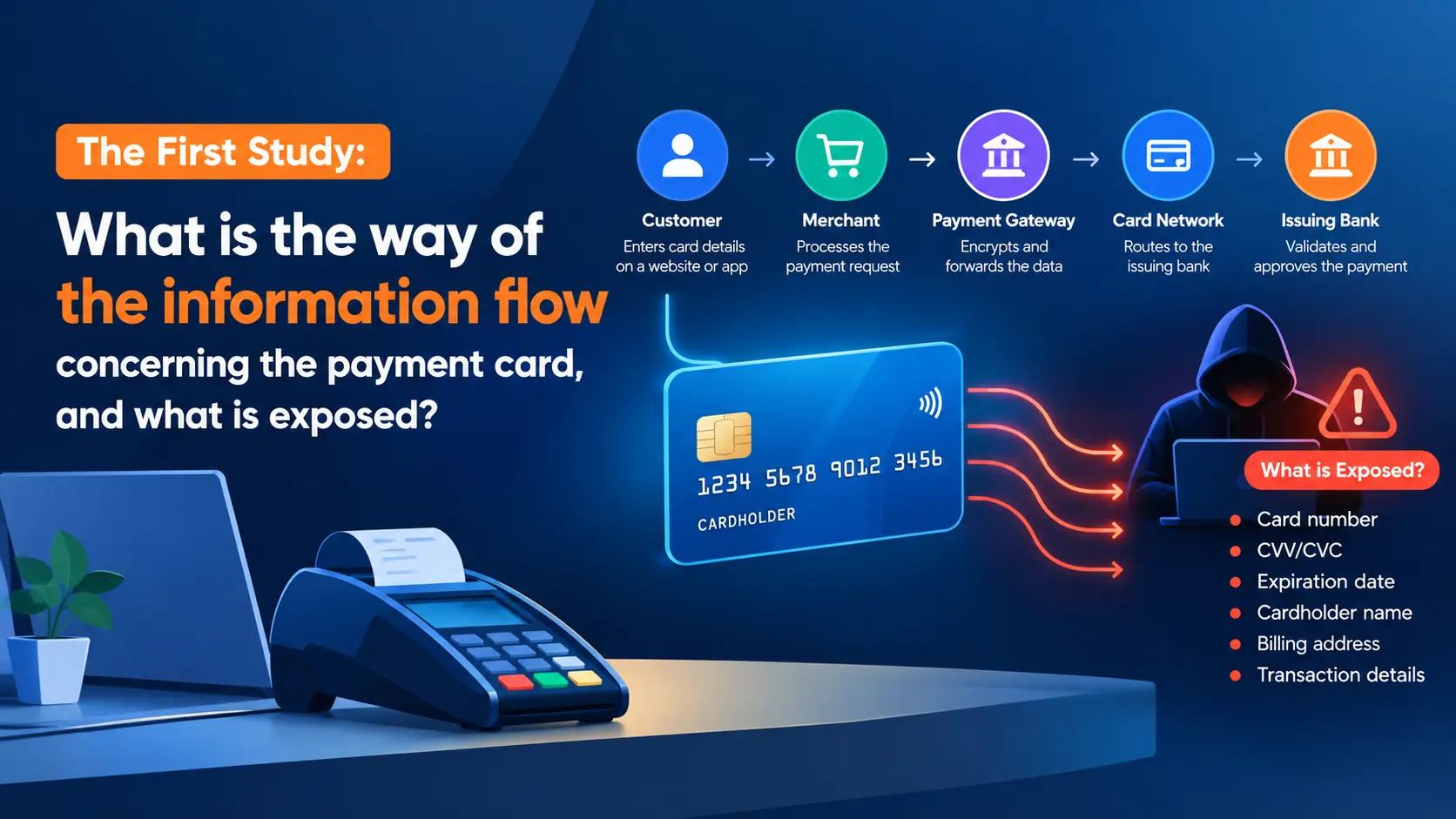
During the processes of receiving, processing, storing, accessing, transmitting, monitoring, and disposal, the company traces the path of the information and puts such questions on each stage: What should be done? What was actually done? And what is the evidence? In this way, the circle continues:
Payment → data movement → control → evidence → checking → problem detection → solving → checking → improving
Where does it come from? Where does it go? What factor may influence it? What may be the place of its storage? When did it disappear? As defined by PCI SSC, the scope of the data security standard for the payment card industry goes beyond the technologies of data storage and includes people, processes, and technology aspects of payment account data security. Therefore, the first design decision is to define what needs to be protected. Or in other words, the well-documented control will protect another object.
2. The Second Investigation: What Should Be Done Each Time?
Having identified the apparent path of payments, the next question is not “What is the number of the requirements?” It is: there should be an appropriate need for access as well as approval for such access. There should be comprehension of changes in software before its introduction into the payment system. There should be some reason for sensitive information being outdated. The unusual incidents should follow some understanding of the incident and what should follow thereafter. It changes the compliance design paradigm.
Control measures should become an integral part of the business process, rather than a separate measure implemented with an aim to satisfy the auditor. For instance, there should be automatic approval generation for any request for access. There should be an automatic change record for any software changes. And any security incident should trigger automatic generation of a response record.
The most critical aspect of the design now becomes the ability of the organisation to document that the incident did indeed occur as described by the organisation. It thus creates a bridge between people, process, and technology without becoming a technical guide. In addition, although the new PCI DSS v4.x is more flexible for the organization, it increases the organization’s responsibility for design, justification, testing, and maintenance.
3. The Third Study: When a Single Record Meets Multiple Conditions
The most fascinating aspect of the integration process is this. Imagine how the employee’s single access record is maintained for authorization, access, and revocation. That single business transaction might serve as proof of satisfying more than one requirement for compliance. But this does not imply that one record will satisfy all requirements. The key question here is, what does this record prove?
In the case of PCI DSS, this record will probably prove some point concerning payment data protection. The same business transaction will be irrelevant to SOX/ICFR unless any risks to financial reporting exist. In the case of ISO 27001, this record will serve as proof of information security objectives. And in the case of SOC 2, this record will prove service commitment and controls.
This will lead to an improved process: One valid test, one valid document, and many valid tests. If the document does not validate a specific requirement, the organization should not make any attempts to interpret it that way. The organization should locate the missing information. In this way, unnecessary bureaucracy is avoided. Integration is about reuse and not assuming homogeneity.
4. The fourth discovery: What happens when there is change?
The payment environment is constantly changing. New payment providers. The database is moved. There have been changes in the payment page due to software changes. There has been reporting implemented. There is a new service provider. There is a new employee process.
Even though the organization may believe they have everything covered, the reality is the environment is actually changing. Upgrading your systems, changing the way that payment data is being processed and handled, the scope of the assessment itself, changes to infrastructure, and changes done by third parties are just a few examples of changes that PCI SSC has come up with for organizations to assess. Here is where we start seeing the real-time compliance cycle:
Change → ask what moved → reassess exposure → adjust protection → verify → record the result.
The important insight is that change management and compliance should not live in separate worlds. Having requested the change, it will be clear that the question that needs to be asked is
“Is there any impact on the security of payment data due to this change?”
This is followed by a compliance assessment.
5. The Fifth Investigation: What If the Control Is Not Operating As Intended?
The key thing we should take away from this audit is not “The document is missing.” The key thing is to make sure that the actual process is different from the documented process. Suppose the individual’s access was to be blocked as a result of the change in his/her role. The document states that the request has been made; however, the access is still available. Now, we should look at the whole chain of events:
Expected action → actual action → difference → reason → consequence → correction.
There may have been no one to oversee the final stage. There may have been no knowledge about the change in the system. There may have been a review that came too late. There may have been a design that assumes another individual’s accountability. This will prevent us from making our compliance program into a blaming process. PCI DSS v4.x allows some frequencies of activities to be defined through a targeted risk analysis. This means that it is up to the organization to show its justification.
The deeper lesson is: A control is valuable because it works, not because it exists on paper.
An honest finding should therefore lead to a better process, not merely a better audit response.
6. The Last Check of Compliance: Is There Any Learning Happening?
The review is not over yet, even when the vulnerability has been fixed. Please recall that an access issue has been fixed recently. What will happen when the change in the payment gateway occurs in a month? What will happen when a new application starts working? What will happen when the current employee process is used in a new site? This brings us to the last but not least feedback loop:
Business activity → change → risk → protection → evidence → review → weakness → correction → verification → new activity.
All are parts of the business process and compliance. The other compliance requirements, while they may connect together at points of intersection, PCI DSS will continue to remain the primary backbone of the payment security initiative. Rather than creating separate worlds for each of the requirements, the organization should have only one single view of its business processes and their potential exposure areas.
The purpose is not to create a perfect system that would never make errors at any time. On the contrary, the goal is to create a system that recognizes when reality changes, when there is no longer adequate protection, and reacts appropriately. That is what makes GRC move beyond mere compliance. It is the system through which one fulfills one’s promises to the customers, to employees, to business partners, and to the regulators through responsible protection in the normal course of operation.
Conclusion: PCI DSS as a Continuous GRC Approach
The whole concept makes sense when we consider PCI DSS version 4.0 through the lens of a continuous GRC audit rather than a one-off check on compliance with the standard. The process starts from data exposure identification, control design according to the business processes, linking evidence with requirements, detection of changes, and analysis of control weaknesses and mistakes. Although SOX/ICFR, ISO 27001, and SOC 2 can become interconnected if their goals coincide, PCI DSS remains central to the security of payment card account data. The whole process chain includes the following:
Identify → Design → Connect → Detect Changes → Investigate → Learn.
A good audit does not just confirm the existence of a requirement, but it confirms the protection as well as fixes the weaknesses, ensures verifiability of evidence, and continually improves accountability for the organization towards its clients, employees, partners, and regulators.