

A recruiter messaged me last month asking if I knew anyone who could fill a mid-level compliance role in under six weeks. She’d already lost two candidates to counter-offers. That’s not a one-off story — it’s the shape of the governance, risk, and compliance hiring market right now across the UK, Canada, and the USA. Everyone wants to break into this field, but very few know which GRC Courses actually move the needle versus which ones just pad a LinkedIn profile.
This guide is not a recycled list of acronyms. It walks through the GRC certification courses that employers in 2026 are genuinely screening for, what they cost, what they pay, and how to pick the right one depending on which country you’re job-hunting in. If you’ve been Googling “GRC courses for jobs” at 1 a.m. wondering if any of it is worth the money, this is written for you.
Why Governance, Risk and Compliance Careers Are Booming?
The short version: regulation isn’t slowing down, and neither is the budget organizations are throwing at people who can manage it. A few data points worth sitting with:
- The global GRC software market is on track to grow from roughly $6.5 billion in 2025 to nearly $11 billion by 2031, with North America alone accounting for close to $4.9 billion of that spend.
- The EU AI Act’s compliance obligations, which phase in heavily from August 2026, are pushing business-services firms to hire GRC talent faster than almost any other sector.
- In the UK, 91% of organizations say compliance complexity has increased in recent years, per PwC research cited by the Cybersecurity Jobsite community, and recruiters openly admit they can’t find enough experienced candidates.
- London operational risk manager salaries climbed from roughly £75,375 in 2025 to £83,750 in 2026 — an 11.1% jump in a single year — while CISO pay rose 14.2% over the same period.
- In the United States, professionals holding ISACA’s CRISC credential report an average base salary near $147,000, with early-career risk analysts earning anywhere from $123,000 to $203,000 depending on industry.
None of that growth translates into an automatic job offer. It does mean that governance risk and compliance courses have stopped being a “nice to have” line on a resume and started being the thing applicant-tracking systems and hiring managers are specifically scanning for.
Top GRC Certification Courses Compared
Rather than ranking these by hype, here’s how the GRC certification courses that actually matter in 2026 stack up against each other — what they cost, who issues them, and what kind of role they tend to unlock.
This shortlist draws heavily on the credentials named in Security Boulevard’s 2026 roundup of industry-recognized GRC certifications, cross-checked against what actually appears in UK, Canadian, and US job postings today.
|
Course / Certification |
Issuing Body | Approx. Cost | Best For |
Typical Region of Demand |
|
CRISC |
ISACA | 575–760 | IT and cyber risk management roles |
USA, Canada |
|
GRCP (GRC Professional) |
OCEG | Varies by provider | Broad governance, risk, ethics, and controls roles |
UK, USA |
|
ISC2 CGRC |
ISC2 | ~$599 | Security and privacy governance with compliance emphasis |
USA, UK |
|
CISA |
ISACA | 575–760 | IT audit, assurance, and control testing |
UK, USA, Canada |
|
ISO 27001 Lead Implementer |
PECB / BSI | 1,000–1,500 | Building and running an ISMS from scratch |
UK, Canada |
|
CCEP |
SCCE | 350–450 | Corporate compliance and ethics programs |
USA, Canada |
|
IAPP AIGP |
IAPP | 649–799 | AI governance and algorithmic risk |
UK, USA, Canada |
|
CCSK |
Cloud Security Alliance | ~$445 | Cloud risk and compliance |
USA, UK |
This table is a starting point, not a shopping list to complete end to end. A hiring manager would much rather see one or two credentials pursued in depth, paired with real project experience, than five badges collected with no clear direction. Picking a lane — technology risk, corporate compliance, or audit — before choosing from these GRC Courses saves both money and months of unfocused studying.
Top GRC Courses for UK Employers
The UK market currently rewards breadth plus one deep specialization. Financial services firms regulated by the FCA are hiring heavily for operational resilience and third-party risk roles, and they consistently ask for CISA or CRISC alongside a working knowledge of ISO 27001.
If you’re targeting the UK specifically, these GRC courses for jobs tend to open the most doors:
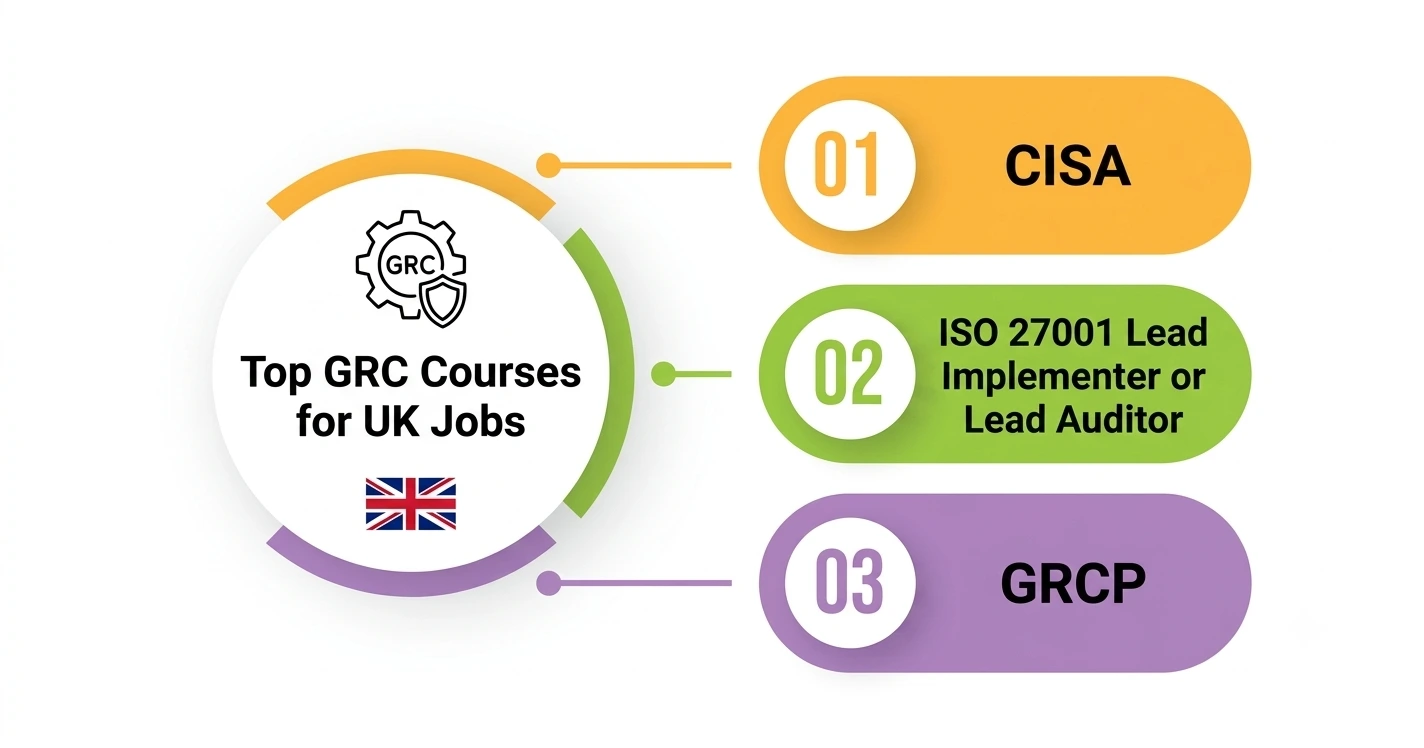
- CISA — still the gold standard for anyone wanting to work inside internal audit or regulatory assurance teams in London or Edinburgh’s financial sector.
- ISO 27001 Lead Implementer or Lead Auditor — UK employers building out information security management systems value hands-on implementation knowledge over theory alone.
- GRCP — useful for professionals pivoting from legal, policy, or operations backgrounds into a dedicated governance function.
Legal and financial-services employers in the UK listed risk management as their top hiring priority for H1 2026, ahead of data privacy and general compliance, which tells you where the money is actually flowing this year.
Top GRC Courses for Canadian Employers
Canada’s market leans more conservative on titles but pays steadily once you’re past the entry level. Banks, insurers, and federally regulated institutions dominate hiring, and OSFI’s guidelines mean third-party risk and operational resilience knowledge is almost always a requirement, not a bonus.
For Canadian job seekers, these GRC courses for jobs carry the most weight with hiring panels:
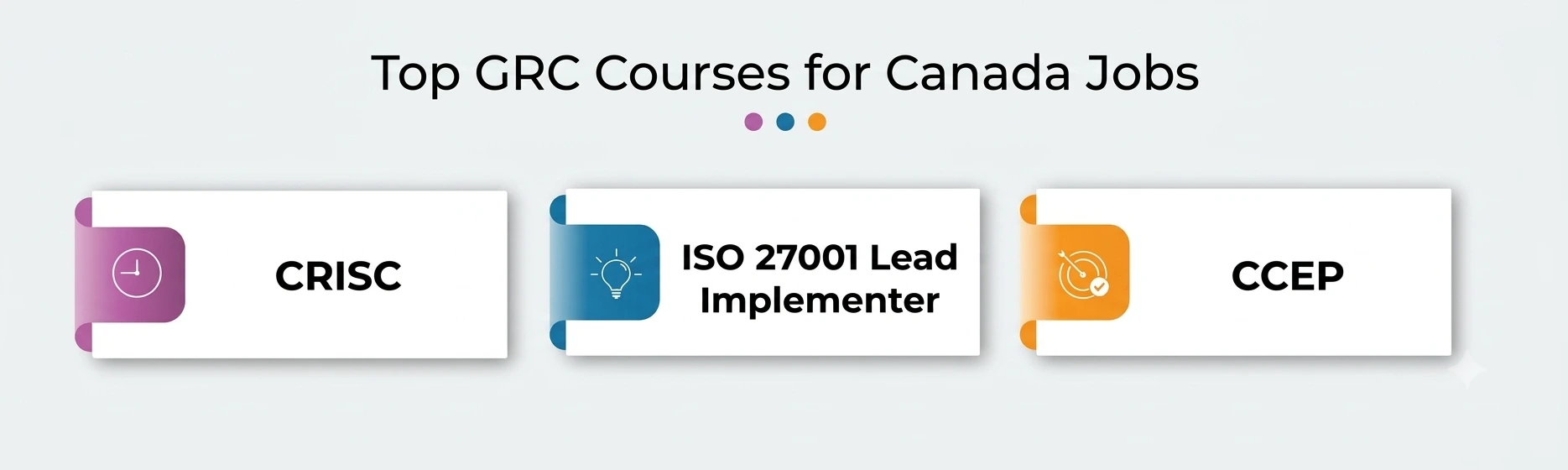
- CRISC — heavily recognized across Canadian banking and insurance, especially in Toronto and Vancouver.
- ISO 27001 Lead Implementer — Canadian federally regulated entities frequently build their security programs around ISO frameworks, making this credential directly applicable.
- CCEP — useful for compliance roles inside Canadian corporate and financial institutions where ethics programs are a formal regulatory expectation.
Entry-level compliance officer salaries in Canada currently average around C$66,955, with experienced professionals earning considerably more once they combine a credential with a few years of regulated-industry experience.
Top GRC Courses for US Employers
The US market is the broadest and the most fragmented by industry — healthcare, finance, tech, and government each have their own expectations. That said, a handful of GRC certification courses show up again and again across job postings regardless of sector.
American employers screening for GRC courses for jobs most often list:
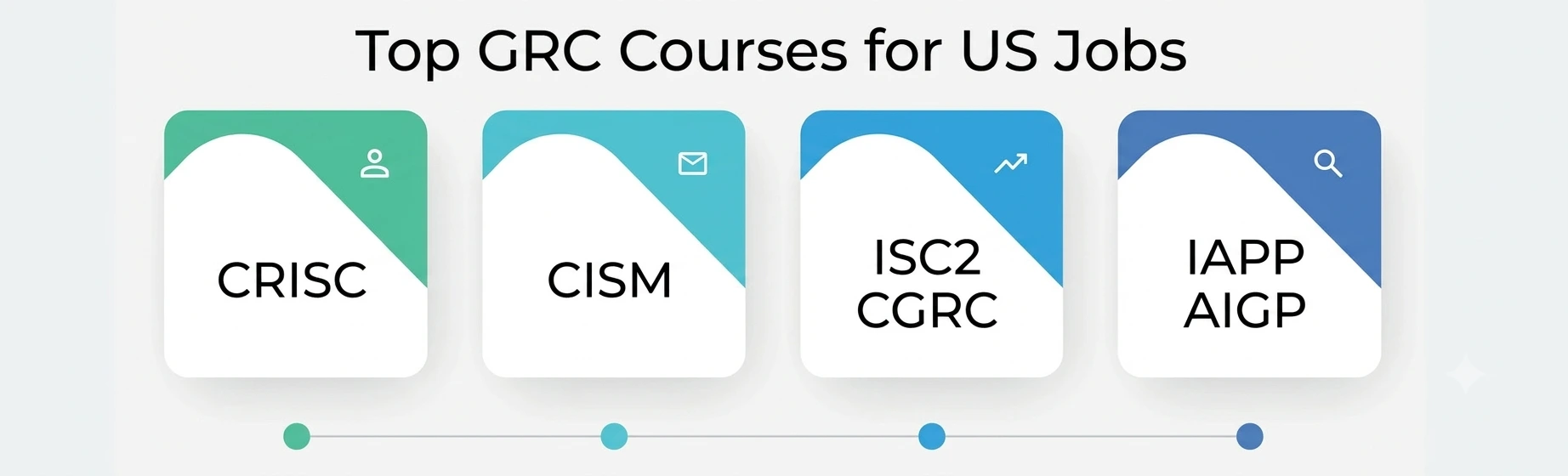
- CRISC — the single most requested credential in US risk and compliance postings, particularly in finance and healthcare.
- CISM — pairs well with CRISC for anyone aiming at a security-program-leadership track rather than pure audit.
- ISC2 CGRC — common in government and defense-adjacent roles where formal security and privacy governance documentation is a contractual requirement.
- IAPP AIGP — increasingly requested as US companies build internal AI governance committees ahead of state-level AI regulation.
Major metro areas — New York, Washington D.C., San Francisco, and Chicago — continue to pay a real premium for candidates holding one of these credentials alongside two or more years of hands-on risk or compliance work.
GRC Cybersecurity Courses: The Fastest-Growing Niche
If there’s one lane inside this field growing faster than the rest, it’s the overlap between security and governance. GRC cybersecurity courses specifically — ones that teach you to translate technical vulnerabilities into business risk language — are the credentials recruiters mention unprompted in almost every conversation about 2026 hiring.
CCSK (cloud-focused), CRISC (enterprise risk-focused), and ISC2 CGRC (federal and defense-focused) make up the core trio here. What makes GRC cybersecurity courses different from a purely technical security certification is the emphasis on communication: you’re not just identifying a vulnerability, you’re deciding how much it actually matters to the business and documenting that decision in a way an auditor or regulator can follow.
Employers across all three countries are explicit that this translation skill, more than raw technical depth, is what separates a hire-ready candidate from someone who still needs another year of seasoning.
Anyone coming from a pure IT or security background should treat GRC cybersecurity courses as the bridge credential — the thing that moves you from “the person who finds the problem” to “the person leadership trusts to prioritize it.”
How to Choose the Right GRC Certification Courses?
With dozens of options competing for your attention and your exam fee, here’s a sequence that actually works for most people starting from scratch:
- Pick your lane first. Technology and cyber risk, corporate ethics and compliance, or audit and assurance — choose one before you choose a course, not the other way around.
- Match the course to your target country. The UK rewards ISO 27001 and CISA; Canada rewards CRISC and ISO frameworks; the US rewards CRISC and CISM most broadly.
- Budget for the exam and the study time, not just the fee. Most of these governance risk and compliance courses require 80–150 hours of serious preparation, and underestimating that is the most common reason people fail on the first attempt.
- Pair the certification with a real artifact. A sample risk register, a mock audit report, or a documented control framework you built yourself gives an interviewer something concrete to ask about.
- Stop at one or two credentials before you have two years of experience. A resume with four unrelated GRC Courses and no practical project work reads as scattered, not ambitious.
Governance risk and compliance courses are only as valuable as the direction behind them. The people who land offers quickly are rarely the ones with the longest list of letters after their name — they’re the ones who can explain, clearly, why they chose the specific path they’re on.
What These Courses Actually Pay?
It’s worth being honest about what a single exam does and doesn’t do for your paycheck. A certification doesn’t guarantee a raise. What it does is get your application past the automated filters and give a hiring manager one less reason to say no. The real compensation jumps come from stacking a recognized credential on top of two or three years of applied, regulated-industry experience.
That said, the numbers are genuinely strong across all three markets. US CRISC holders average close to $147,000 base salary, with early-career risk analysts clearing $123,000 to $203,000 depending on industry and location, according to a detailed CRISC salary breakdown from DestCert.
UK operational risk managers now clear £83,750, up over 11% in a single year. Canadian compliance officers average C$66,955 at the general level, climbing meaningfully once professionals reach the experienced and late-career brackets. Governance risk and compliance courses won’t hand you those numbers on day one, but they’re consistently the credential employers name when explaining why one candidate got the offer and another didn’t.
A Personal Note
I spent the better part of a year advising people who kept asking me which single certification would “finally” get them hired, as if the right acronym was a magic password. It never worked that way.
The people I watched actually land offers were the ones who picked one country, one lane, and one of these GRC Courses, then spent the next few months building something real alongside it — a sample audit, a mock risk assessment, a documented policy they could walk an interviewer through line by line. The credential opened the door.
The thing they built with their own hands is what kept them in the room long enough to get the offer. If you’re standing at the start of this looking at a dozen options, my honest advice is to pick the one that matches where you actually want to work, and stop comparing it to the other eleven.