
If you want a serious career in AWS Data Engineering, reading documentation is not enough. You need labs that force you to build, break, and fix real pipelines under a clock, the same way you would on a live production system.
This guide walks through the AWS data engineering labs worth your time in 2026, the AWS data engineering projects that actually belong on a resume, and the exact order to tackle both so you stop collecting badges and start collecting job offers.
I have spent the past few years building pipelines on AWS for mid-sized companies — mostly retail and logistics outfits in the US and Europe — and the pattern is always the same. The engineers who get hired are not the ones with the most certifications.
They are the ones who can open a broken Glue job at 2 a.m., read the CloudWatch logs, and fix it before the morning dashboards fail. That skill is not built by watching videos. It is built by doing AWS data engineering hands-on labs until the AWS console stops feeling unfamiliar.
Why Do AWS Data Engineering Labs Matter More Than Courses?
Most people preparing for a role in AWS Data Engineering make the same mistake: they binge video courses, pass a multiple-choice exam, and assume they are job-ready. Then they get asked in an interview to design a pipeline that ingests 50 GB of clickstream data daily, deduplicates it, and lands it in a queryable format within fifteen minutes — and they freeze.
Employers today don’t just want certificates. They want proof that you can handle AWS Data Engineering work under real constraints: messy data, cost limits, and tight service-level agreements. That proof comes from labs, not slides. A good lab environment throws a half-broken dataset at you and makes you fix the ingestion logic yourself, the same way a production incident would.
This is exactly why AWS data engineering hands-on labs have become the fastest way to close the gap between theory and an actual offer letter. They compress months of on-the-job learning into a weekend, because you are forced to make the same decisions a working engineer makes: which service fits the latency requirement, how to partition data so queries don’t time out, and where to put the alerting so a silent failure doesn’t cost someone their weekend.
Core AWS Services You Will Use in Every Lab
Before you touch any AWS data engineering practice environment, you need a working mental map of the services that show up in almost every pipeline. These are not optional extras — they are the backbone of AWS Data Engineering, and most labs assume you already know roughly what each one is for.
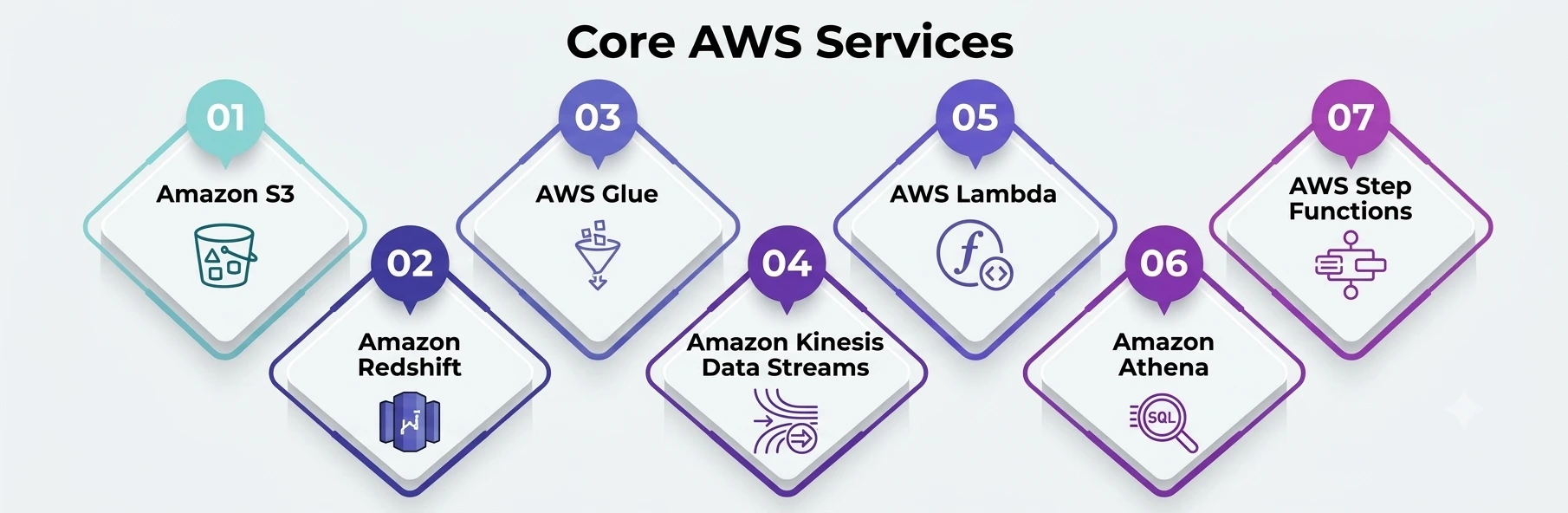
- Amazon S3 — the default landing zone and data lake storage layer for almost every pipeline; cheap, durable, and the starting point for lakehouse patterns built on Apache Iceberg and Amazon S3 Tables.
- AWS Glue — serverless ETL for cataloging, transforming, and crawling data; the tool most labs center around because it mirrors real production ETL jobs.
- Amazon Redshift — the warehouse layer for structured analytics at scale, now commonly paired with Redshift Serverless to avoid managing clusters.
- Amazon Kinesis Data Streams — real-time ingestion for clickstream, IoT, or log data that needs to be processed within seconds, not hours.
- AWS Lambda — lightweight, event-driven compute that glues pipeline stages together without standing up a server.
- Amazon Athena — serverless SQL querying directly against data sitting in S3, useful for validating pipeline output without loading it anywhere else.
- AWS Step Functions — orchestration for multi-stage pipelines, so a Glue job, a Lambda function, and a Redshift load all run in the correct order with retries built in.
Treat this list as the minimum vocabulary for AWS data engineering practice before you move into the labs below. Skipping straight to Kinesis or Step Functions without a solid grip on S3 and IAM is the single most common reason beginners get stuck halfway through a lab and give up.
Common Mistakes Beginners Make
Most of these mistakes cost people weeks, not minutes, because they go unnoticed until a lab or a project quietly fails:
- Skipping IAM until something breaks. Permissions errors are confusing precisely because the error message rarely tells you which policy is missing. Learn IAM roles and policies before anything else.
- Leaving billable resources running. A Redshift Serverless workgroup or a Kinesis stream left overnight is the single most common reason a free lab turns into a surprise charge.
- Copying architecture diagrams without understanding the trade-offs. A pipeline that looks right on a whiteboard can still fail under real data volume; always ask why a service was chosen, not just which one was chosen.
- Treating every pipeline as a batch. Plenty of beginners build five variations of the same nightly ETL job and never touch streaming, which is exactly the gap interviewers probe for.
- Not writing down failures. The lab or project that broke and taught you something is more valuable on a resume, in your own notes, than the one that worked on the first try.
Best Platforms for AWS Data Engineering Hands-On Labs in 2026
Not every lab platform is worth your time, and a few have gotten noticeably better over the past year. Here is where to actually spend your hours if you are serious about AWS Data Engineering and want labs that resemble real work rather than clicking through pre-filled forms.
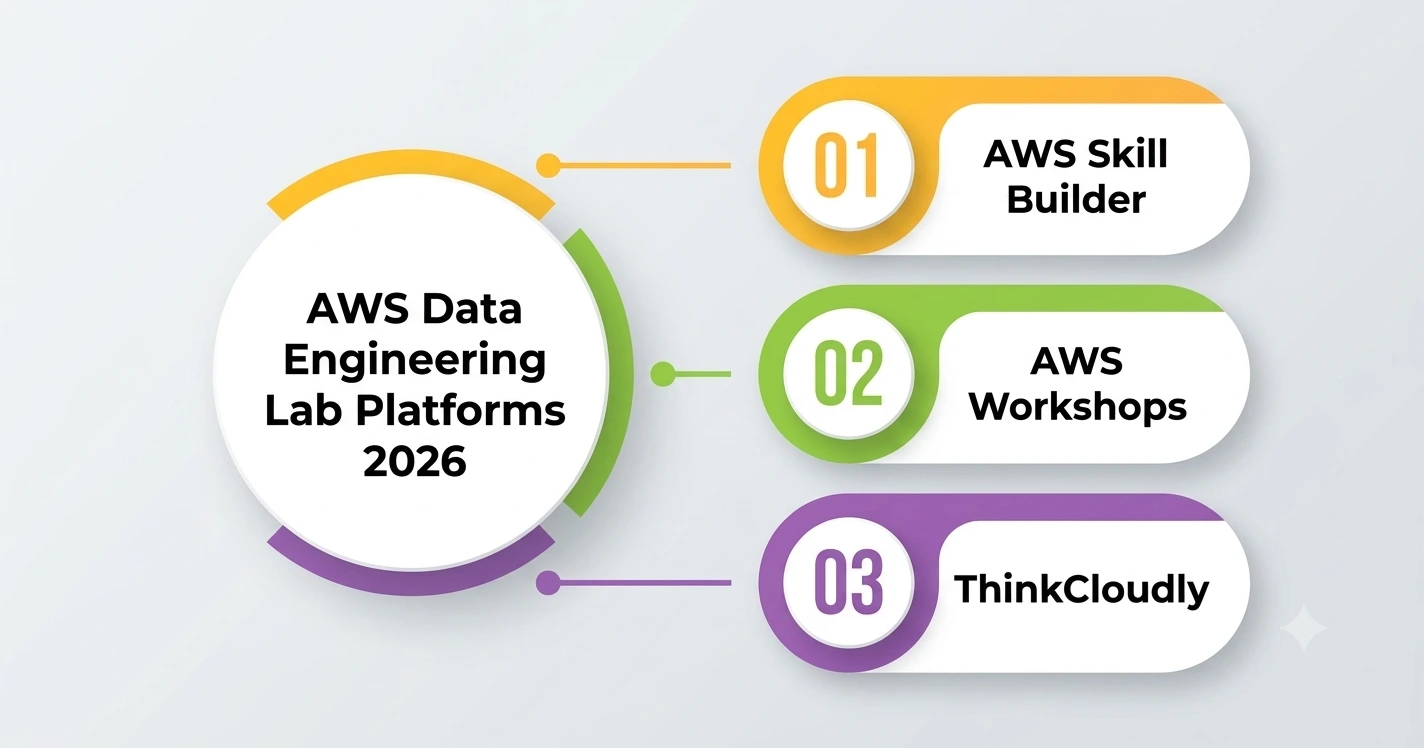
- AWS Skill Builder — AWS’s own platform, and the most reliable source for official AWS data engineering hands-on labs tied directly to the current certification exam guide.
- AWS Workshops — a free library of guided, scenario-based builds (data lakes, streaming pipelines, lakehouse migrations) maintained by AWS solutions architects.
- ThinkCloudly — provides AWS Data Engineering hands-on training with practical labs, real-world projects, guided exercises, and instructor support, helping learners build practical skills beyond theory.
Across all of these platforms, the common thread worth noticing is that genuine AWS data engineering hands-on labs put you inside a real AWS console with real IAM permissions and real error messages, not a simulated UI with the hard parts removed. That distinction matters more than which logo is on the course.
A quick honest note on free-tier limits: most AWS Data Engineering environments run fine on the free tier for a few hours, but Kinesis, Redshift Serverless, and anything left running overnight will start generating charges fast. Set a billing alarm before you start, every single time.
AWS Services at a Glance: What to Practice and Why
|
AWS Service |
Primary Role in the Pipeline | Where It Shows Up in AWS Data Engineering Labs |
Good First Project |
|
Amazon S3 |
Storage and data lake foundation | Nearly every lab, as the landing and output zone |
Build a raw-to-curated bucket structure |
|
AWS Glue |
ETL, cataloging, schema discovery | Batch transformation labs |
Clean and reshape a messy CSV dataset |
|
Amazon Redshift |
Data warehousing and analytics | Warehouse-loading labs |
Load curated S3 data into Redshift Serverless |
|
Amazon Kinesis |
Real-time stream ingestion | Streaming pipeline labs |
Process a simulated clickstream in near real time |
|
AWS Lambda |
Event-driven glue logic | Nearly all orchestration labs | Trigger a Glue job automatically when a file lands in S3 |
| Amazon Athena | Ad-hoc SQL on S3 data | Validation and reporting labs |
Query a partitioned dataset and compare runtimes |
|
AWS Step Functions |
Pipeline orchestration | Multi-stage, production-style labs |
Chain three services into one retryable workflow |
6 Real-World AWS Data Engineering Projects to Build Your Portfolio
Labs teach you the mechanics. AWS data engineering projects are what you actually show a hiring manager, because they prove you can combine services into something that solves a real problem rather than following a tutorial’s exact steps. Build these in your own account, document your decisions, and put the repository link on your resume.
- Batch ETL pipeline for e-commerce order data — ingest raw CSV order exports into S3, clean and transform them with Glue, and load the result into Redshift for a sales dashboard. This is the single most common AWS data engineering projects pattern asked about in interviews.
- Real-time log analytics pipeline — stream application logs through Kinesis Data Streams, process them with a Lambda consumer, and push aggregated error rates into a dashboard. Great for demonstrating you understand latency trade-offs, not just batch thinking. A European logistics company I worked with runs a near-identical pattern to catch delivery-tracking failures within two minutes instead of finding out from a customer complaint the next morning.
- Serverless data lake with Glue and Athena — build a lakehouse layer on S3 using Parquet and Apache Iceberg table formats, crawl it with Glue, and query it with Athena. This is where 2026’s push toward lakehouse-first architecture actually becomes visible in your portfolio.
- Event-driven file ingestion pipeline — trigger a Lambda function the moment a file lands in S3, validate its schema, and route good records to one bucket and bad records to another with an alert.
- CDC pipeline from a relational database — use AWS Database Migration Service to stream change-data-capture events out of a sample RDS database into S3 for downstream analytics, mimicking how companies replicate production databases without touching them directly. This is a favorite interview topic for roles tied to e-commerce or subscription billing systems, where the source database can never be queried directly for reporting.
- Cost-optimized data pipeline teardown — take any of the above and add lifecycle policies, Redshift Serverless auto-pause, and a Step Functions schedule that shuts resources down outside business hours. This project alone tells an interviewer you think about cost, not just function.
A Practical Roadmap for AWS Data Engineering Practice
- Weeks 1–2 — Get comfortable with S3, IAM, and the AWS CLI before touching anything else. Most hands-on environments for AWS Data Engineering assume this baseline and will not slow down for you.
- Weeks 3–4 — Work through AWS Glue and Athena labs until you can clean and query a dataset without checking documentation every five minutes.
- Weeks 5–6 — Move into Redshift and Kinesis, since these two services account for most of the complexity in real AWS Data Engineering interviews.
- Weeks 7–8 — Build one full project end to end from the list above, document it in a README with architecture diagrams, and push it to GitHub.
- Weeks 9–10 — Add orchestration with Step Functions and monitoring with CloudWatch so your project behaves like something a team would actually run, not a one-off script.
- Week 11 onward — Repeat with a second, different project pattern (streaming instead of batch, or CDC instead of flat files) so your portfolio shows range, not one trick done twice, and so your overall AWS data engineering practice stays broad enough to match what real job postings actually ask for.
If certification is part of your plan, the AWS Certified Data Engineer – Associate exam maps closely to everything above, and studying for it after — not instead of — the labs will make the material stick rather than feel memorized. For deeper service-level reference while you work, the AWS Glue documentation is worth bookmarking; it is more current and more precise than most third-party tutorials.
A Personal Note
I will be honest about something most guides skip: the first pipeline I ever built on AWS failed silently for three days before I noticed. No alert, no error in the console I was watching, just a dashboard quietly showing stale numbers while I assumed everything was fine. It was humbling, and it is also the single best lesson I can pass on.
AWS data engineering practice is not really about memorizing which service does what. It is about developing the instinct to ask “how would this fail, and would I know?” before you consider anything finished. Build the projects, break them on purpose, fix them without searching for the exact error message online first — that struggle is where the actual skill lives. The certificate is just paperwork that comes after.