
Every year, a new batch of IT professionals sits down to plan a certification path and asks the same question: should I go the AWS SysOps Administrator vs. Cloud Engineering route? It sounds like a small decision—pick a cert, pick a job title—but it actually shapes what your next five years of work will look like.
One path keeps you close to the machines that are already running, patching them, watching them, and making sure nothing quietly breaks overnight. The other pushes you toward building the machines and pipelines that haven’t been built yet, then handing them off once they’re stable. Neither is a wrong answer, and neither is automatically the “senior” or “junior” choice, but picking blind usually leads to a career that feels one size too small a few years in.
This piece is written for the person actually staring at that fork in the road: a student weighing which certification to study for first, or an IT operations professional wondering whether it’s time to specialize.
I’ll walk through what each path actually demands day to day, what the current 2026 job market says about pay and demand, and where the AWS SysOps Administrator vs. Cloud Engineering decision tends to go right—or wrong—once someone is a year or two into the job rather than just reading about it.
What Each Path Actually Involves?
The AWS Certified SysOps Administrator credential is built for people who already live inside IT operations. According to AWS’s own certification page, the exam covers monitoring and maintaining AWS workloads, implementing security controls, performing business continuity procedures, and applying cost and performance optimizations.
It’s a hands-on, keep-the-lights-on credential—65 questions, 130 minutes, aimed at someone with roughly a year of experience running production systems. AWS itself recommends candidates without prior systems experience start with the Cloud Practitioner exam first, then build toward SysOps once they’ve spent real time inside a live AWS account.
Cloud engineering isn’t a single certification at all; it’s a job function that borrows from several disciplines—infrastructure-as-code, automation, and increasingly, platform engineering.
A cloud engineer might start from the same AWS foundation but end up building the pipelines and provisioning workflows that a SysOps administrator later has to monitor and keep stable.
That distinction is really the heart of the AWS SysOps Administrator vs. Cloud Engineering debate: one role keeps existing cloud infrastructure management running smoothly, the other designs and expands it before it exists at all.
A Side-by-Side Look
Reading job postings alone won’t settle the AWS SysOps Administrator vs. Cloud Engineering question, because titles are inconsistent across companies and even within the same company across teams. A table helps more than prose here, since it forces the comparison into the categories that actually matter for a career decision rather than whatever language a recruiter happens to use.
|
Category |
AWS SysOps Administrator |
Cloud Engineer |
|
Primary focus |
Keeping existing systems healthy—monitoring, patching, incident response |
Building and extending cloud systems before they go live |
|
Cloud infrastructure management |
Maintains and tunes what’s already deployed |
Designs, provisions, and scales new environments |
|
Deployment automation |
Watches pipelines and rolls back failed releases |
Builds and owns the automation pipeline itself |
|
Networking skills |
Applies existing network configs, troubleshoots connectivity |
Designs VPC layouts, routing, and hybrid connectivity from scratch |
|
Linux administration |
Deep day-to-day OS-level maintenance—patching, permissions, log analysis |
Uses those same OS skills to build and script infrastructure |
|
Typical background |
Systems administration, help desk, NOC operations |
DevOps, software engineering, or systems administration |
|
Average US salary (2026) |
~$98,056/year |
~$151,879/year |
That salary gap isn’t a judgment on either role’s difficulty. It largely reflects scope: a cloud engineer’s decisions tend to touch more systems and carry more downstream consequences across an entire environment, which employers price accordingly over time.
The Daily Reality of IT Operations vs. Building New Systems
If you ask people already working in either role what their week actually looks like, the answers diverge fast. A SysOps Administrator’s week is dominated by hands-on operations tasks—checking dashboards, responding to alerts, applying patches, and making sure nothing that was working yesterday breaks today.
It’s reactive by design, and the best people in this seat are the ones who stay calm when something goes sideways at an inconvenient hour rather than the ones who panic and start guessing.
A cloud engineer’s week looks more forward-facing. Instead of reacting to what’s already running, they’re writing infrastructure-as-code templates, standing up new environments, and iterating on release pipelines so deployments ship faster and with fewer manual steps. Both jobs require serious technical depth, and both spend real time inside the AWS console and CLI, but one is built around stability and the other around change.
Recognizing which rhythm suits you is arguably more useful than comparing salary tables when you’re deciding between AWS SysOps Administrator vs. Cloud Engineering as a starting point, since the wrong rhythm for your temperament will wear you down no matter how good the pay looks on paper.
Linux Administration and Networking Skills: The Common Ground
Whatever your final answer to the AWS SysOps Administrator vs. Cloud Engineering question turns out to be, there are two skill areas neither role lets you skip. The first is Linux administration. Whether you’re troubleshooting a production incident or scripting a provisioning workflow, it is the operating layer underneath almost everything AWS runs.
Log analysis, permission management, process monitoring, and shell scripting all trace back to solid Linux administration fundamentals, and weakness here shows up quickly in either job, usually during an incident when there’s no time to look things up.
The second is networking skills. A SysOps Administrator uses networking skills to troubleshoot why a service suddenly can’t reach another service or why latency spiked after a routing change nobody flagged in advance.
A cloud engineer applies the same fundamentals earlier in the process—designing the VPC structure, subnetting strategy, and security group rules that the operations side will later have to keep healthy for years. Neither path forgives a shaky grasp of networking, so this is worth treating as a permanent study area rather than a box to check once for a certification exam and then forget about.
Deployment Automation: Who Builds It, Who Watches It
Deployment automation is one of the clearest dividing lines in the AWS SysOps Administrator vs. Cloud Engineering split. Cloud engineers typically own it from the design stage—choosing the CI/CD tooling, defining pipeline stages, and building the rollback logic that catches a bad release before it reaches production. It’s engineering work in the fullest sense: build something once, document it, then make it repeatable for every team that comes after.
SysOps Administrators sit on the other end of that same pipeline. Their job isn’t to build the automation but to keep it honest—watching for failed builds, verifying that a rollback actually worked, and flagging when a pipeline’s behavior quietly drifts from what it’s supposed to do.
A team can have an excellent deployment automation strategy on paper and still ship broken releases if nobody is watching the pipeline in practice day to day, which is exactly the gap a strong SysOps Administrator closes.
The Tools You’ll Actually Use Day to Day
Certification exams describe the theory, but the tools each role lives in day to day are worth knowing before you commit either way. A SysOps Administrator typically spends the workday inside CloudWatch dashboards, Systems Manager, AWS Config, and Trusted Advisor—services built to observe, alert on, and gently correct systems that are already running. Ticketing systems and runbooks matter almost as much as the AWS console itself, since consistency during an incident often beats cleverness.
A cloud engineer’s toolbox looks different. Expect Terraform or the AWS CDK for infrastructure-as-code, Git for version control on every change, and a CI/CD platform like CodePipeline, GitHub Actions, or Jenkins for shipping updates.
The work is closer to software engineering than classic systems administration, even though both roles ultimately answer to the same AWS account and the same production environment. If you enjoy reading a runbook and executing it precisely, the operations side will feel natural; if you’d rather write the runbook nobody has needed yet, engineering will feel like home.
What the 2026 Job Market Actually Shows
Numbers help take some of the guesswork out of the AWS SysOps Administrator vs. Cloud Engineering decision, and the 2026 data tells a fairly direct story. On the traditional systems side, the projects a slight decline in classic network and computer systems administrator roles through 2035, even as roughly 13,400 openings are expected annually—mostly from workers retiring or moving into other roles rather than from new headcount being added. Median pay in that category sits around $99,130 a year, which lines up closely with what AWS SysOps Administrators earn today according to current salary data.
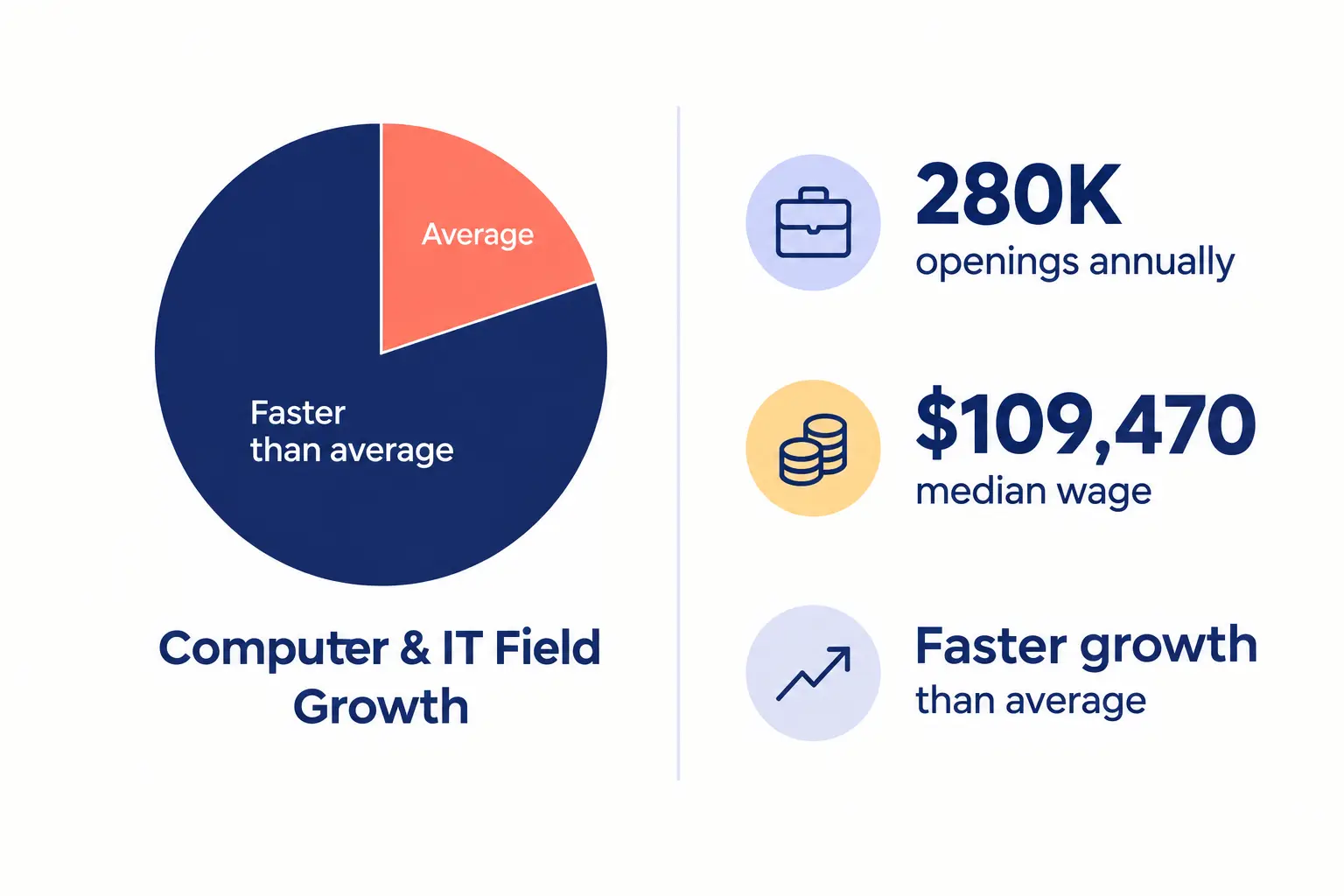
Cloud-focused roles tell a different story. Broader Bureau of Labor Statistics projections show the entire computer and information technology field growing faster than the average for all occupations through 2035, with around 280,000 openings expected annually and a median wage of $109,470—well above the all-occupation median.
As more companies keep expanding their cloud infrastructure management footprint and migrating workloads off legacy data centers, engineering-focused roles have generally outpaced traditional operations positions in both demand and average pay, and there’s little in the current data suggesting that trend reverses soon.
None of this means SysOps Administration is a dead end. Plenty of companies still need someone dedicated to keeping AWS workloads stable, secure, and cost-efficient, and that expertise doesn’t go out of style just because a job title trends differently on a chart.
It does mean that anyone choosing between AWS SysOps Administrator vs Cloud Engineering purely by growth numbers should lean toward engineering — but anyone choosing mainly by day-to-day enjoyment should weigh that far more heavily than any single projection, since you’ll be living with the daily reality long after the chart stops mattering.
Making the Call for Your Own Career
If steady, structured IT operations work appeals to you — clear priorities, defined incident response processes, a strong sense of ownership over keeping something stable and running — the SysOps Administrator path is a legitimate, well-paying career on its own, not just a stepping stone to something else.
If you’d rather be the one designing the system before it exists, writing the deployment automation pipeline instead of monitoring it, and shaping cloud infrastructure management strategy rather than executing within someone else’s plan, Cloud Engineering will likely satisfy you more over the long run.
Most people don’t have to choose forever, and plenty don’t. A common, low-risk path is starting in SysOps Administration to build real hands-on systems and networking skills against production workloads that actually matter, then moving into Cloud Engineering once the operational fundamentals feel automatic rather than effortful.
Employers tend to respect that trajectory because it means the engineer already understands what breaks in practice under real load, not just what the architecture diagram claims should happen in theory. It’s a far stronger starting position than jumping straight into design work with no scar tissue from actually running anything.
A Personal Note
I’ve reviewed enough resumes and sat in enough hiring conversations to notice that people rarely regret starting in SysOps Administration, but they sometimes regret skipping it entirely to chase a fancier title early. There’s something about troubleshooting a real production incident late at night that teaches you more about how AWS actually behaves than any course or practice exam ever will.
If you’re early in your career and unsure which way to go, I’d rather see you spend a year genuinely good at hands-on operations than three years mediocre at architecture work you jumped into before you were ready for it.
The title on your business card matters far less than whether you actually understand the systems you’re responsible for — that part never goes out of style, whichever side of this decision you eventually land on.