
Most AWS course roundups are written by people who have never had to actually use what they’re recommending on the job. They rank courses by enrollment numbers or affiliate payouts, not by whether the material still matches what employers are testing for in interviews right now.
That gap matters more heading into 2027 than it did two years ago, because AWS itself is in the middle of rewriting several of its certification exams around AI-assisted workflows, and a course built for the old exam guide can quietly waste months of your time.
This guide skips the recycled lists. It looks at what actually separates the best AWS course options from the forgettable ones in 2027, maps each path to the skills employers are paying extra for, and points to where that data is actually coming from, rather than asking you to take it on faith.
Why 2027 Is a Turning Point for AWS Careers?
Cloud hiring didn’t slow down this year, but it did get more specific. Hiring managers aren’t looking for someone who vaguely “knows AWS.” They want someone who can walk into a messy production environment and handle workload management without needing six weeks of hand-holding.
According to AWS’s own training and certification announcements, three major exams are being rebuilt this cycle: The Machine Learning Engineer – Associate exam moves into beta now with a January 2027 general-availability date and folds in agentic AI workflow orchestration; the Solutions Architect – Professional exam reopens registration in late October 2026 with eleven new skill areas built around generative AI architectures on Amazon Bedrock, resilience engineering, and DevSecOps automation; and the Developer – Associate exam adds an entirely new domain on AI security, including prompt-injection defense.
That’s not a minor refresh. It means a course written even twelve months ago may be teaching toward an exam blueprint that no longer exists by the time you sit for it. The best AWS course for anyone serious about 2027 hiring cycles is one that’s been visibly updated against these specific changes, not one that’s simply popular.
It’s also worth budgeting for the retired-exam cutoff dates directly, since AWS is phasing out the older versions (SAP-C02 retires November 16, 2026; DVA-C02 retires November 30, 2026) well before most people finish a slow, part-time study plan.
What Makes the Best AWS Course Different From the Rest?
Not every course labeled “updated for 2027” actually is one. A handful of filters separate the ones worth your evenings from the ones that waste them:
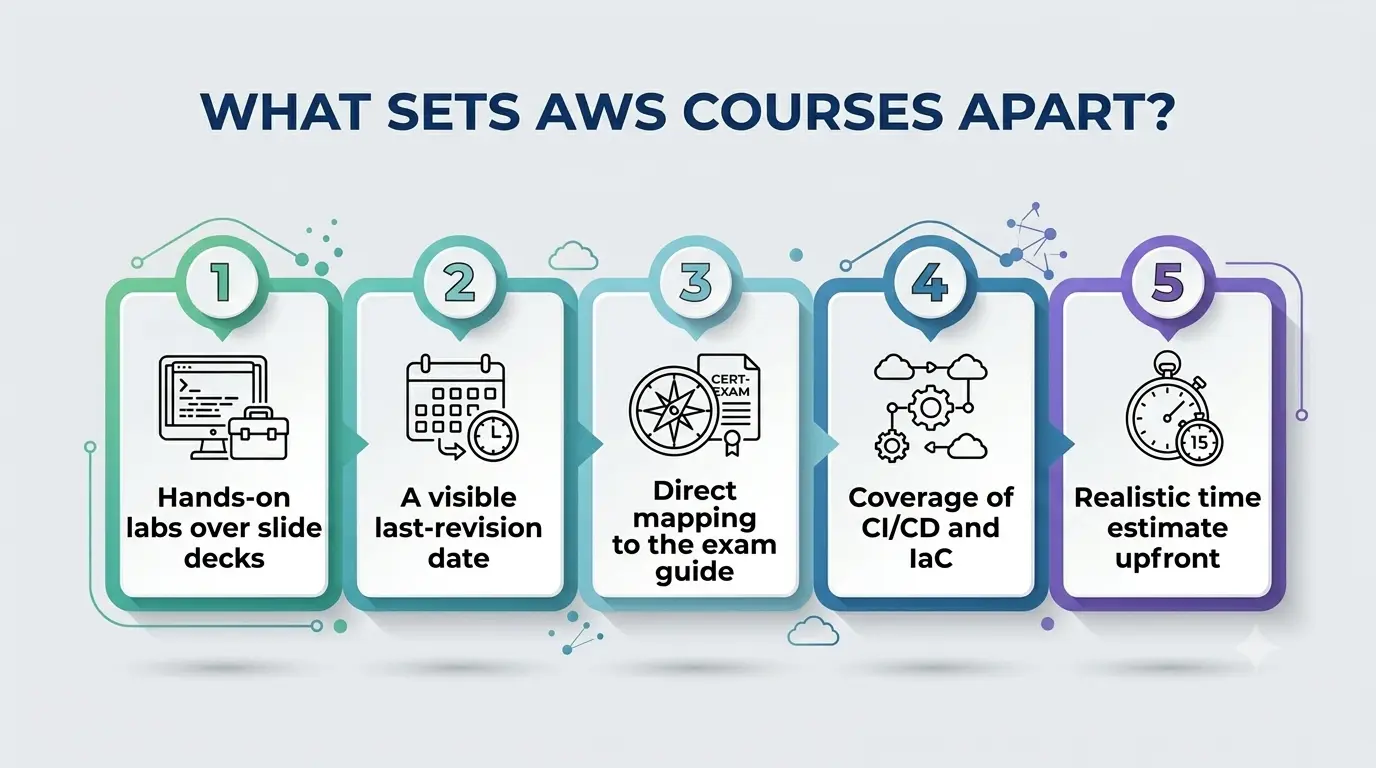
- Hands-on labs over slide decks. A course where you actually provision, break, and rebuild resources teaches workload management far better than a narrated video ever will.
- A visible last-revision date. AWS services move fast enough that a three-year-old module can be flatly wrong about default settings or pricing tiers.
- Direct mapping to the current exam guide. If a course can’t point to which domain of the official exam guide each module covers, assume it was built before the guide changed.
- Coverage of CI/CD pipelines and infrastructure as code, not just manual console clicks. Courses that still teach everything through the AWS console, with no pipeline or scripted provisioning component, are preparing you for a job that mostly doesn’t exist anymore.
- A realistic time estimate upfront. The strongest AWS course programs tell you honestly how many hours the material takes, so you can plan around a job search instead of guessing and falling behind.
Keeping these five filters in mind when comparing options saves a lot of wasted study time, and it’s a habit worth carrying into every certification you chase after this one.
What Does Pay Data Actually Look Like?
Salary numbers get thrown around loosely in this space, so it’s worth anchoring to a real figure. According to current compensation data, the average total pay for a cloud architect in the United States sits at roughly $203,130 a year, with base pay generally landing between $123,000 and $191,000 and additional compensation adding another $38,000 to $70,000 on top of that.
That range tracks closely with what recruiters describe when they talk about candidates who can demonstrate real, deployable experience across environments, not just associate-level theory.
The table below breaks down how specific AWS skill areas map to the kind of role and pay band they typically unlock, based on what’s showing up in job postings and training-provider data through 2026.
|
Skill Focus |
Typical Role | What Employers Test For |
Rough Pay Signal |
|
Deployment automation |
DevOps / Platform Engineer | CI/CD pipelines, infrastructure-as-code, rollback handling |
Upper-associate to professional band |
|
Workload management |
Solutions Architect |
Capacity planning, autoscaling, multi-service orchestration |
Professional band |
|
Resource optimization |
Cloud FinOps / Cost Engineer | Rightsizing, tagging discipline, reserved capacity strategy |
Mid to senior specialist band |
|
Workload migration |
Cloud Migration Engineer | Dependency mapping, cutover planning, legacy application assessment |
Senior specialist band |
|
Hybrid infrastructure |
Network / Hybrid Cloud Architect | On-prem to cloud connectivity, Direct Connect, Outposts |
Senior architect band |
None of these pay bands are guaranteed, and location, company size, and years of experience all move the number meaningfully. But the pattern holds across most listings: the more of these specific, named skills a candidate can demonstrate with a real project, the higher the band they tend to get slotted into.
That’s especially true for workload migration work, where the gap between exam theory and hands-on cutover experience tends to show up fastest, usually in the first technical interview rather than later.
Skills Employers Are Actually Paying For in 2027
Course marketing tends to talk in vague terms—”master the cloud,” “become job-ready.” Job postings don’t. They name specific, testable skills, and five of them keep showing up across nearly every mid-to-senior AWS listing right now:
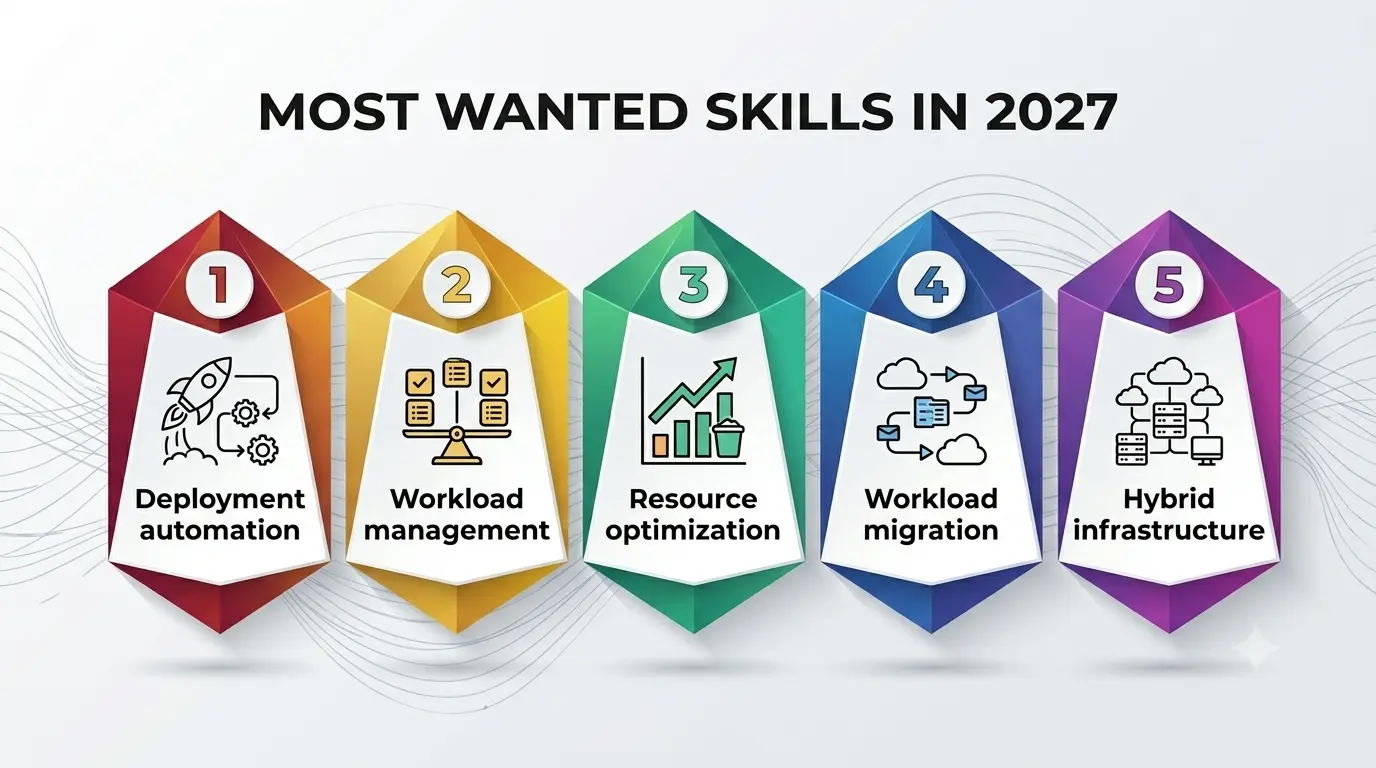
- Deployment automation. Teams want engineers who can build a pipeline that ships on every commit and rolls back cleanly when something breaks, not someone who deploys manually through a console and hopes nothing drifts.
- Workload management. This covers capacity planning, autoscaling policy, and keeping a multi-service application stable under unpredictable traffic, which is a different skill than simply knowing a service exists.
- Resource optimization. According to the 2026 Flexera State of the Cloud report, cloud waste actually climbed to 29% this year, the first increase in five years, which is exactly why resource optimization has become a standalone, hireable skill rather than a line item nobody owns.
- Workload migration. The same Flexera data points to dependency mapping (cited by 54% of organizations) and technical-feasibility assessment (44%) as the two biggest barriers teams hit when moving a workload, which is precisely the gap a strong migration-focused engineer gets hired to close.
- Hybrid infrastructure. With 73% of organizations now running some form of hybrid cloud setup, understanding how AWS connects back to an on-premises environment through Direct Connect or AWS Outposts isn’t a specialty skill anymore—it’s close to a baseline expectation for anyone past entry level.
A course that genuinely builds all five of these into its labs, rather than mentioning them in a single slide each, is doing something meaningfully different from a course that just lists services and hopes the exam questions line up.
Best AWS Course Picks by Career Path
There isn’t one single best AWS course that fits everyone, because the right choice depends heavily on which of the five skill areas above you’re actually trying to build toward.
- For cloud architecture and hybrid infrastructure roles: Start with the AWS Certified Solutions Architect – Associate exam material, then move into a dedicated hybrid-networking course that covers Direct Connect, Transit Gateway, and Outposts in real labs rather than diagrams alone. This path rewards people who enjoy sketching a system, then redesigning it under a tighter budget or a stricter availability requirement.
- For DevOps and deployment automation roles: Look for AWS Certified DevOps Engineer – Professional prep material built around an actual CI/CD pipeline you build and intentionally break, not a slide-only walkthrough. The strongest programs here treat blue-green deployments and canary releases as core material, since both show up constantly in real incident reviews.
- For cloud migration and resource optimization roles: Prioritize course material that walks through a full workload migration end to end—dependency mapping, a cutover plan, and a post-migration cost review—because that’s the exact sequence Flexera’s data shows teams struggling with most. A course that skips the cost-review step is only teaching half the job.
- For general career starters: The free tier of AWS Skill Builder remains a sensible first stop before paying for anything, since it’s built directly around the current exam guides and costs nothing to try before committing real money or evening hours to a paid program.
How to Choose the Best AWS Course for Your Goals?
Once you know which skill area you’re aiming for, picking the best AWS course for that specific goal gets a lot simpler. Match the course’s labs to the skill, not the certification badge alone—a program that teaches deployment automation through a real pipeline will serve you better in an interview than one that only prepares you to answer multiple-choice questions about CodePipeline.
Ask whether the course includes a sandbox environment you control, whether it’s been revised against the current exam guide, and whether it ends with something you can actually show a hiring manager, like a working repository or an architecture diagram you built yourself.
It’s also worth being honest about pacing. Associate-level exams generally run around $150 and professional-level exams closer to $300, and rushing either one tends to cost more in retake fees than it saves in calendar time. A course that gives you an honest hours estimate upfront is doing you a favor, even when that number is bigger than you wanted to hear.
Building Your 2027 Roadmap
None of the five career paths above are mutually exclusive, and most experienced AWS professionals end up touching all of them at different points. A reasonably low-risk sequence looks like this: lock in the fundamentals first, build one real project that demonstrates workload management under some kind of load, then branch into whichever specialty — hybrid infrastructure, or pipeline-heavy platform work — actually matches the work you want to be doing day to day.
The mistake to avoid is stacking certifications without ever shipping anything real. A resume with several badges and zero deployed projects tends to raise more questions in an interview than it answers, especially now that hiring managers increasingly ask candidates to walk through something they personally built rather than recite exam trivia.
Treat every course, no matter how well reviewed, as an excuse to ship something small and slightly imperfect — a migrated workload, a cost-optimization dashboard, a pipeline with proper rollback handling — because that combination of credential plus visible proof is what actually moves the needle in a hiring market that’s gotten noticeably more selective about who gets a callback.
A simple way to keep that roadmap honest is to write down, before you start, the one artifact you’ll have at the end of each phase — a working repository link, a short architecture write-up, a before-and-after cost report.
If a study plan doesn’t produce something concrete you can point to in an interview, it’s worth asking whether the hours are going toward the right material at all, or just toward passing a single exam and moving on without anything to show for the months spent getting there.
A Personal Note
I’ve sat across from enough students who collected certifications the way other people collect stamps, and the ones who actually landed the high-paying roles were rarely the ones with the longest list of badges.
They were the ones who got stuck debugging a broken deployment pipeline late on a Tuesday, got genuinely annoyed about it, and fixed it anyway before moving on to a harder version of the same problem the following week.
If this guide leaves you with one thing, let it be this: choose the Best AWS Course that makes you build something real and slightly broken over the one that just hands you a certificate at the end.
The certificate gets you past the first screening call. The thing you actually built is what carries the rest of the interview, and it’s usually the part you end up enjoying instead of dreading.