
Classification vs Regression vs Clustering is Starting a new data science project can be exciting, but one question arises that confuses beginners:
“Which machine learning technique should I use?”
Some of the popular data science algorithms are
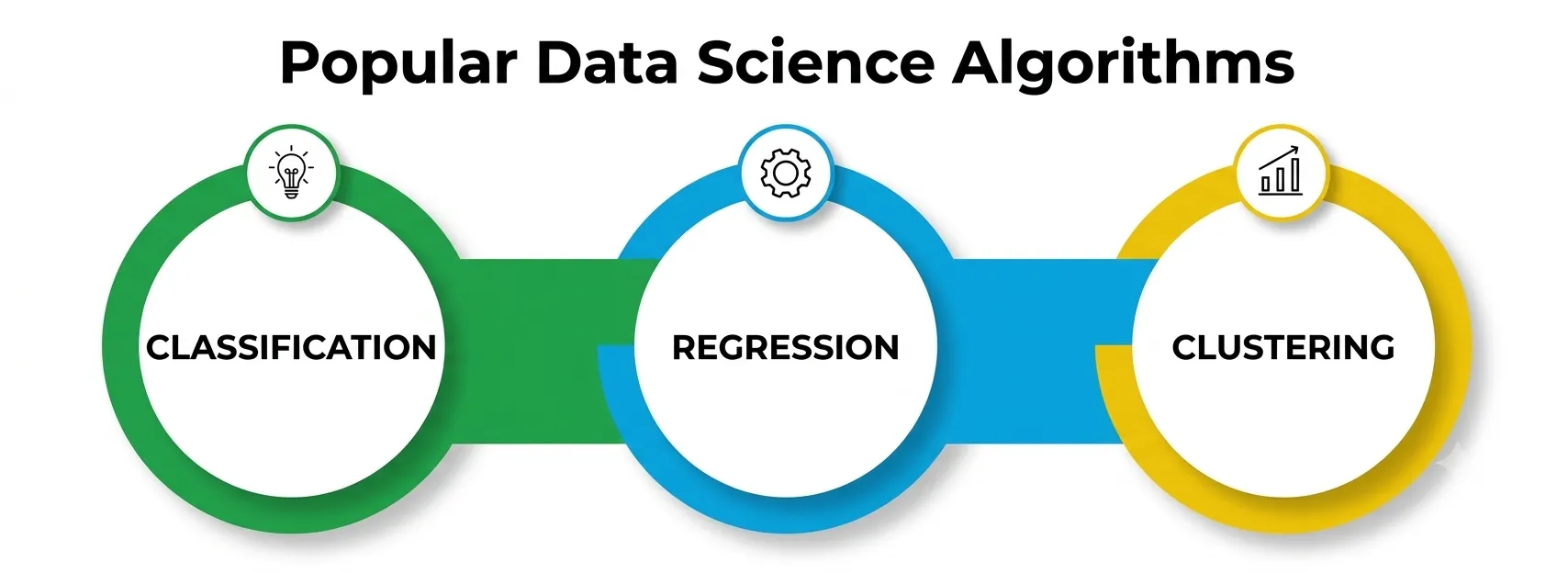
- Classification,
- Regression
- Clustering
How each algorithm works, you know very well. But when someone receives a real-world project and a dataset, the bigger challenge is deciding which approach actually fits the problem. For example, imagine an e-commerce company gives you customer data and asks you to “build a machine learning model.” And the model should be able to answer the following questions:
- Will the customer leave or stay?
- How much will the customer spend?
- Divide customers into different groups?
Here the question arises: which algorithm should a data analyst use?
This is the wrong question. Rather than focus on the algorithm, a data analyst should start with “What exactly are we trying to solve?”
Let’s understand here…
Do not start with the algorithm; start with the problem.
A common mistake beginners make is choosing an algorithm before understanding the business problem.
For example, someone might say:
“I learned decision trees, so I’ll use a decision tree.”
But machine learning will not work this way.
A decision tree you can use for one problem, but for another problem it may not work fine. So understand the problem first.
For example, a food delivery company wants to analyze its customers. The company wants to know the following from the data:
- Which customers are likely to stop ordering?
- How much will a customer spend next month?
- What different types of customers do we have?
Although all three questions use the same customer data, the machine learning approach would be different.
- The first question can be solved using classification.
- The second question can be solved using regression.
- The third question can be solved using clustering.
So, understand the problem first, then think of an algorithm.
Classification vs Regression vs Clustering
1. Classification
Let’s understand with an example. If the answer to the question is like “Yes/No,” “Fraud/Not Fraud,” “Pass/Fail,” or “Premium/Regular.”
In the above case, classification will work best. A classification algorithm will produce the answer in the above way.
Some real-life questions that a classification algorithm can solve are:
- Is this email spam or not spam?
- Will the customer leave or stay?
- Should the loan be approved or rejected?
- What type of customer is this: Premium or Regular?
Some commonly used classification algorithms are
- Logistic Regression
- Decision Tree
- Random Forest
- K-Nearest Neighbors
- Support Vector Machine
- Naive Bayes
2. Regression
Let’s understand with an example. How much revenue can we expect next month?
Here in the above question, we want to predict some value. Regression is used when the output is a continuous numerical value.
For example, a real estate company may want to predict the price of a house.
The answer can be
₹55,00,000
or
₹72,50,000
These are numerical values, so this is a regression problem.
Some commonly used regression algorithms include:
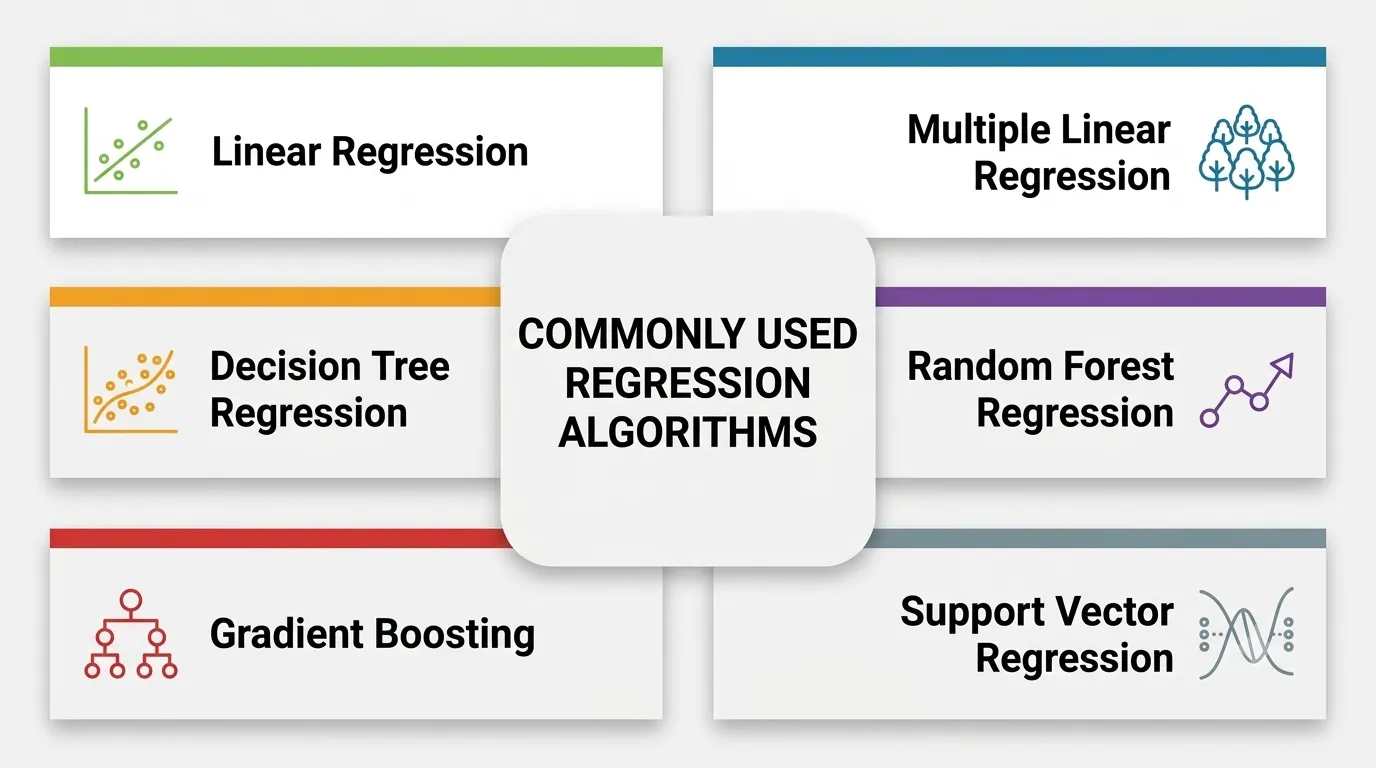
- Linear Regression
- Multiple Linear Regression
- Decision Tree Regression
- Random Forest Regression
- Gradient Boosting
- Support Vector Regression
3. Clustering
Let’s understand with an example. An e-commerce company wants to know the following:
- Customer spending habits
- Customer’s most liked product
- Customer visit frequency on app or website
We cannot answer the question directly from the data, but for that we need to categorize data based on age group, income base, area base, etc. This is where clustering becomes useful.
The model observes customer behavior and may discover groups such as:
- Group 1: Customers who purchase frequently and spend a lot.
- Group 2: Customers who purchase occasionally and spend less.
- Group 3: Customers who visit the website frequently but rarely purchase.
Clustering can be useful for:
- Customer segmentation
- Market segmentation
- Product grouping
- Recommendation systems
- Document grouping
- Image segmentation
- Identifying unusual behavior patterns
The most popular clustering algorithm is K-Means.
Do not decide based on the dataset.
Based on the data set, I do not decide which machine learning algorithm will work best. The same dataset can be used for classification, regression, and clustering.
Decision-Making Process:
Step 1: Understand the Business Problem
Step 2: Identify the output.
Step 3: Check your target variable.
Step 4: Understand your Data
Step 5: Start Simple
Step 6: Practical Implementation
Model Evaluation
Choosing the right machine learning technique is only the beginning.
You also need to check whether the model is actually performing well.
For classification, you might look at:
- Accuracy
- Precision
- Recall
- F1-score
- ROC-AUC
Once all things are done, then your business problem will be solved.
Conclusion
The choice between classification, regression, and clustering should be made on the basis of the business problem and not the algorithm or data set. Classification is used when the aim is to predict categories, regression is used to predict continuous numerical values, and clustering helps us find meaningful groups in the unlabeled data.
Determine the expected result. Identify the dependent variable. Check the data. Go with a simple approach. Choose a way. Finally, evaluate the model on the performance using suitable metrics. Understanding the problem in detail ensures that the machine learning approach chosen is technically appropriate and useful to solve real-world business challenges.