

Everyone keeps telling you cybersecurity is “the hot field to get into,” and then nobody tells you where to actually start. That gap is exactly why so many beginners stall out after one Udemy course and a half-finished Security+ study guide, still unsure which door to knock on first.
A real cybersecurity career path isn’t a single certificate or a lucky job posting—it’s a sequence of small, deliberate moves that compound over a year or two, not a sprint that ends the day you pass an exam.
This guide lays out that sequence in plain, practical terms: which roles to target first, what a realistic roadmap actually looks like week to week, where most beginners quietly go wrong, and how to think about the cybersecurity degree vs. certification question without getting stuck on it for months.
Why This Is a Good Time to Start a Cybersecurity Career Path?
The honest case for starting now isn’t hype; it’s math. The U.S. Bureau of Labor Statistics projects information security analyst roles to grow 21% between 2025 and 2035, which is roughly seven times faster than the average occupation, with median pay already north of $129,000 a year for analysts who’ve put in a few years of work. That’s the senior end of the pipeline, not the entry point, but it tells you the pipeline itself is expanding.
At the same time, ISC2’s Cybersecurity Workforce Study puts the global talent gap at close to 4.76 million unfilled positions and separately found that 31% of security teams currently have zero entry-level staff on the roster despite the hiring pressure. Read those two numbers together, and you get a strange, almost contradictory picture: huge demand for cybersecurity work overall, but a stubborn reluctance to actually hire beginners into it.
That contradiction is the single biggest obstacle on any cybersecurity career path right now, and understanding it changes how you should plan your first eighteen months—which is exactly what the rest of this guide is built around, starting with the roadmap itself.
Cyber Security Roadmap for Beginners: A Step-by-Step Plan
A workable cybersecurity roadmap for beginners doesn’t start with a certification exam. It starts with fundamentals that most people skip because they’re impatient to get to the “fun” part. Here’s the order that actually holds up:
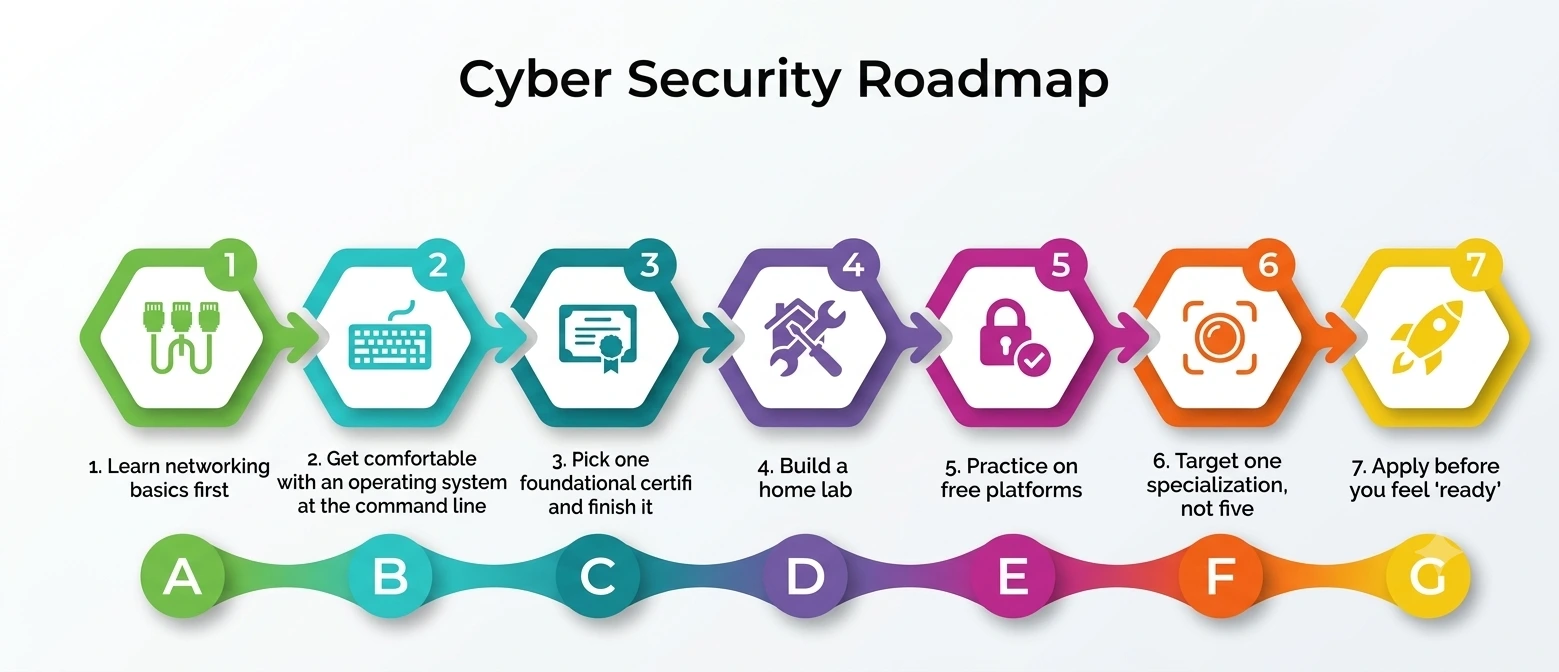
- Learn networking basics first. You cannot secure what you don’t understand. Spend real hours on how TCP/IP, DNS, firewalls, and routing actually work before touching a security tool.
- Get comfortable with an operating system at the command line. Linux fundamentals matter more than most beginners expect, since the majority of servers and security tooling run on it.
- Pick one foundational certification and finish it. CompTIA Security+ remains the most widely recognized starting point because it maps closely to entry-level job postings rather than academic theory, and employers rarely need it explained to them in an interview.
- Build a home lab. Set up a small virtual environment, break things on purpose, and fix them. Employers notice candidates who can describe a project, not just a badge.
- Practice on free platforms. Try beginner-friendly capture-the-flag style environments to build real troubleshooting instincts rather than memorized answers.
- Target one specialization, not five. Trying to become a generalist in security, cloud, and development all at once slows everyone down. Pick SOC work, GRC, or cloud security and go deep.
- Apply before you feel “ready.” Nobody feels fully ready. Apply once you can explain your lab work and one certification clearly in an interview.
This cybersecurity training for beginners works because it mirrors how hiring managers actually evaluate junior candidates—not by credential count, but by whether a person can reason through a basic incident calmly. Skipping steps to rush toward an impressive-looking resume is the most common reason a promising cybersecurity career path stalls before it starts.
Entry Level Cybersecurity Career: Where Beginners Actually Start
Most people picture a penetration tester or a “hacker” when they imagine cybersecurity work and then feel discouraged when that role isn’t available to them yet. In reality, almost every entry-level cybersecurity career begins somewhere quieter: a Tier 1 security operations center seat, an IT help desk role with security exposure, or a GRC (governance, risk, and compliance) analyst position doing documentation and audits.
These roles aren’t consolation prizes. They’re where you learn how real organizations actually get breached, which tickets matter, and how incident response plays out under time pressure—context that no certification alone can teach.
An entry-level cybersecurity career built on a help desk or Tier 1 SOC foundation tends to produce stronger mid-career professionals than one that jumps straight into a specialized niche with no operational grounding.
Common Mistakes That Quietly Stall Beginners
Even people who follow a cybersecurity roadmap for beginners step by step manage to slow themselves down in a few predictable ways.
- The most common one is certification hoarding—collecting four or five badges before applying anywhere, as if a thicker resume substitutes for interview practice.
- A second mistake is ignoring soft skills; most entry-level cybersecurity career rejections happen after the technical screen, during a conversation about how a candidate communicates under pressure, not because of a missing credential.
- A third is applying only to roles that match a dream Title: If a posting lists ten different cybersecurity job roles and only one looks exciting, apply anyway, since lateral moves inside security happen constantly once you’re already employed.
Finally, treating CyberSeek’s career pathway tool as optional is a mistake. It maps real supply-and-demand data by region and role, and it’s one of the few free resources that shows exactly which cybersecurity jobs for beginners are actually hiring in your area right now, rather than which ones merely sound impressive online.
If this cybersecurity roadmap for beginners sticks with you in only one place, let it be here: Check the local hiring data before you specialize, not after.
Cybersecurity Job Roles Explained
Understanding the different cybersecurity job roles available at the entry level helps you target your learning instead of trying to prepare for everything at once. Here’s a practical breakdown:
|
Role |
What You’ll Actually Do |
Typical Entry Requirement |
|
SOC Analyst (Tier 1) |
Monitor alerts, triage incidents, and escalate real threats. |
Security+ or equivalent, some lab experience |
|
IT Support with Security Focus |
Help desk tickets, access management, basic patching |
High school diploma plus certification, or an associate degree |
|
GRC Analyst |
Policy documentation, audits, compliance tracking |
Degree or certification in compliance frameworks (ISO 27001, NIST) |
|
Junior Penetration Tester |
Assist senior testers, run scoped scans, and write findings. |
Security+ plus a hands-on credential like eJPT or PNPT |
|
Cloud Security Associate |
Monitor cloud configurations, flag misconfigurations. |
Cloud platform certification plus basic security knowledge |
|
Incident Response Trainee |
Support containment and documentation during live incidents. |
SOC experience or strong lab/CTF background |
Notice how none of these cybersecurity job roles demand five years of experience to start. They demand demonstrable curiosity and a willingness to do unglamorous work first.
Top Cybersecurity Jobs for Beginners to Target Right Now
If you’re applying this month, these are the cybersecurity jobs for beginners worth prioritizing over flashier titles you’re not yet qualified for:
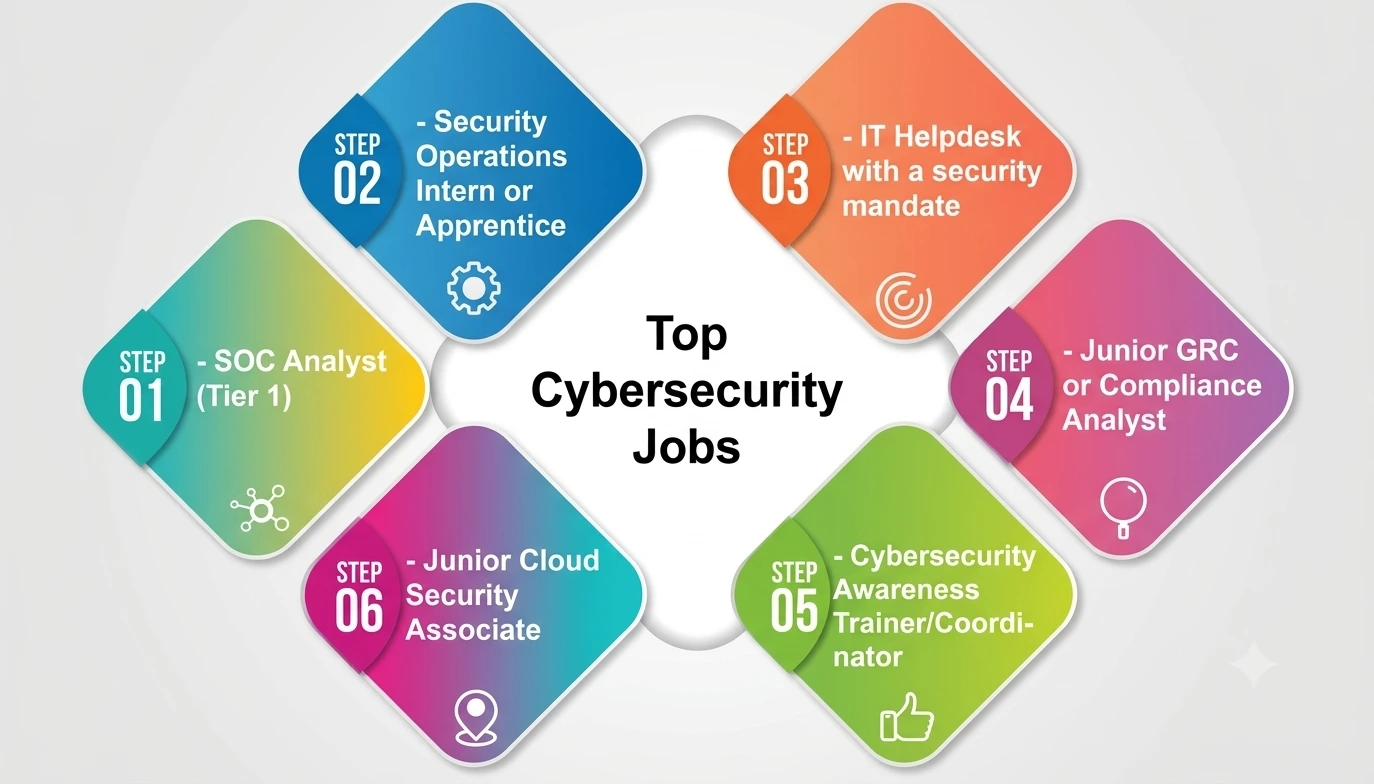
- SOC Analyst (Tier 1): The single most common true entry point. High ticket volume, but excellent exposure to real alerts and tooling.
- Security Operations Intern or Apprentice: Many mid-size companies and managed security providers run structured apprenticeship tracks specifically because unfilled entry-level seats are a known problem.
- IT Helpdesk with a security mandate: Not glamorous, but it builds the troubleshooting muscle every security role eventually needs.
- Junior GRC or Compliance Analyst: A strong option for people who are organized and detail-oriented rather than purely technical.
- Cybersecurity Awareness Trainer/Coordinator: Smaller organizations often need someone to run phishing simulations and employee training, and it’s a legitimate way into the field.
- Junior Cloud Security Associate: As companies keep shifting workloads to the cloud, even basic cloud security literacy opens doors faster than a generic IT background.
These cybersecurity jobs for beginners share one trait: they trade glamour for access. Take the access first. The title upgrade follows once you’ve proven you can be trusted with more responsibility.
Cybersecurity Degree vs. Certification: Which Builds a Faster Career?
This is the question that paralyzes more beginners than any other, and the honest answer is that the cybersecurity degree vs certification debate is framed wrong. It’s rarely an either/or choice once you look at real hiring data.
A four-year degree still helps for roles with strict educational requirements, government clearances, or long-term leadership tracks, and the BLS notes that employers typically expect a bachelor’s degree for mid-level information security analyst roles. But a degree alone, without any hands-on lab work or certification, often produces graduates who struggle in their first technical interview.
Certifications, on the other hand, map directly onto what entry-level job postings actually ask for. CompTIA Security+ shows up in an enormous share of junior postings because it’s cheap, fast, and vendor-neutral. The catch is that certifications without any practical project work can look thin to an experienced interviewer who’s seen plenty of candidates memorize dumps rather than concepts.
So when people ask about cybersecurity degree vs certification as if it’s a single fork in the road, the more useful framing is this: certifications get you interviews faster, a degree widens your ceiling over a ten-year career, and neither one replaces hands-on lab time.
If you’re choosing between the two because of cost or time constraints, lean toward certification plus a home lab first — you can always add a degree later once you’re already earning a cybersecurity salary.
That decision matters less than most beginners assume, as long as you’re building real, demonstrable skill either way, and not using the debate itself as an excuse to delay applying.
Building a Realistic Cybersecurity Career Path Plan
Pulling this together, here’s what a sane first-eighteen-months cybersecurity career path actually looks like for someone starting from zero:
- Months 1–3: Networking and OS fundamentals, plus a home lab.
- Months 3–6: CompTIA Security+ or an equivalent foundational certification.
- Months 6–9: Apply broadly to Tier 1 SOC, help desk, and GRC roles while continuing lab practice.
- Months 9–18: Specialize once you’re in a role — SOC work toward detection engineering, GRC toward audit leadership, or cloud security toward a cloud-native security specialty.
A cybersecurity career path built this way doesn’t rely on luck or a perfect resume. It relies on sequencing — fundamentals before specialization, access before title, and consistency over any single exam. The people who stall out usually didn’t lack intelligence; they tried to skip straight to the senior-sounding job title without building the operational base underneath it.
None of this moves in a perfectly straight line, either. Some months you’ll finish ahead of schedule; other months a failed exam attempt or a rejected application will eat two weeks you didn’t plan to lose. That’s normal, not a sign you picked the wrong field.
The candidates who actually break in are rarely the fastest — they’re the ones who kept applying and kept lab notes even during the slow stretches, when progress wasn’t visible from the outside.
Final Thoughts
There is no universal cybersecurity career path that fits everyone, and anyone promising you a guaranteed six-figure outcome in ninety days is selling something, not teaching something. What actually works is unglamorous: fundamentals first, one certification finished rather than three half-started, a home lab you can talk about in an interview, and a willingness to take the Tier 1 or help desk seat that gets you in the door.
A Personal Note
I’ve mentored enough career-changers to notice the same pattern every time — the ones who make it aren’t the ones with the most certifications pinned to their LinkedIn profile.
They’re the ones who kept showing up to the boring parts: the ticket queue, the log review, the lab environment that broke for the third time that week. If you’re early in this journey and feeling behind everyone else’s highlight reel, you’re not behind. You’re just at the part of the process nobody posts about. Keep going.