

I’ve reviewed a lot of resumes over the years, and the ones that stall at the first screen almost always say the same thing: “experience with Agile methodologies” and nothing to back it up.
That line used to be enough. It isn’t anymore. In a market where nearly three out of four organizations now run some flavor of Agile or hybrid Agile, a hiring manager needs more than a claim on a page.
An Agile project management certification gives them something they can actually verify—a registry entry, an exam score, or a body of knowledge you were tested against rather than one you simply picked up on the job.
This piece walks through why that credential still carries real weight this year, which option actually matches your career stage, what the training behind it covers once you get past the brochure language, and how the skills map onto the day-to-day work of running delivery management rather than just passing an exam.
I won’t pretend every program is equally rigorous or that a badge alone rewires your career. But paired with real practice, it remains one of the fastest, most portable ways to prove you can handle project scheduling and project execution under real constraints—not just describe them in an interview.
Why This Certification Still Pays Off in 2027?
Agile hasn’t slowed down, but it has matured past the point where enthusiasm alone counts as expertise. Here’s what a verified credential actually buys you in today’s market:
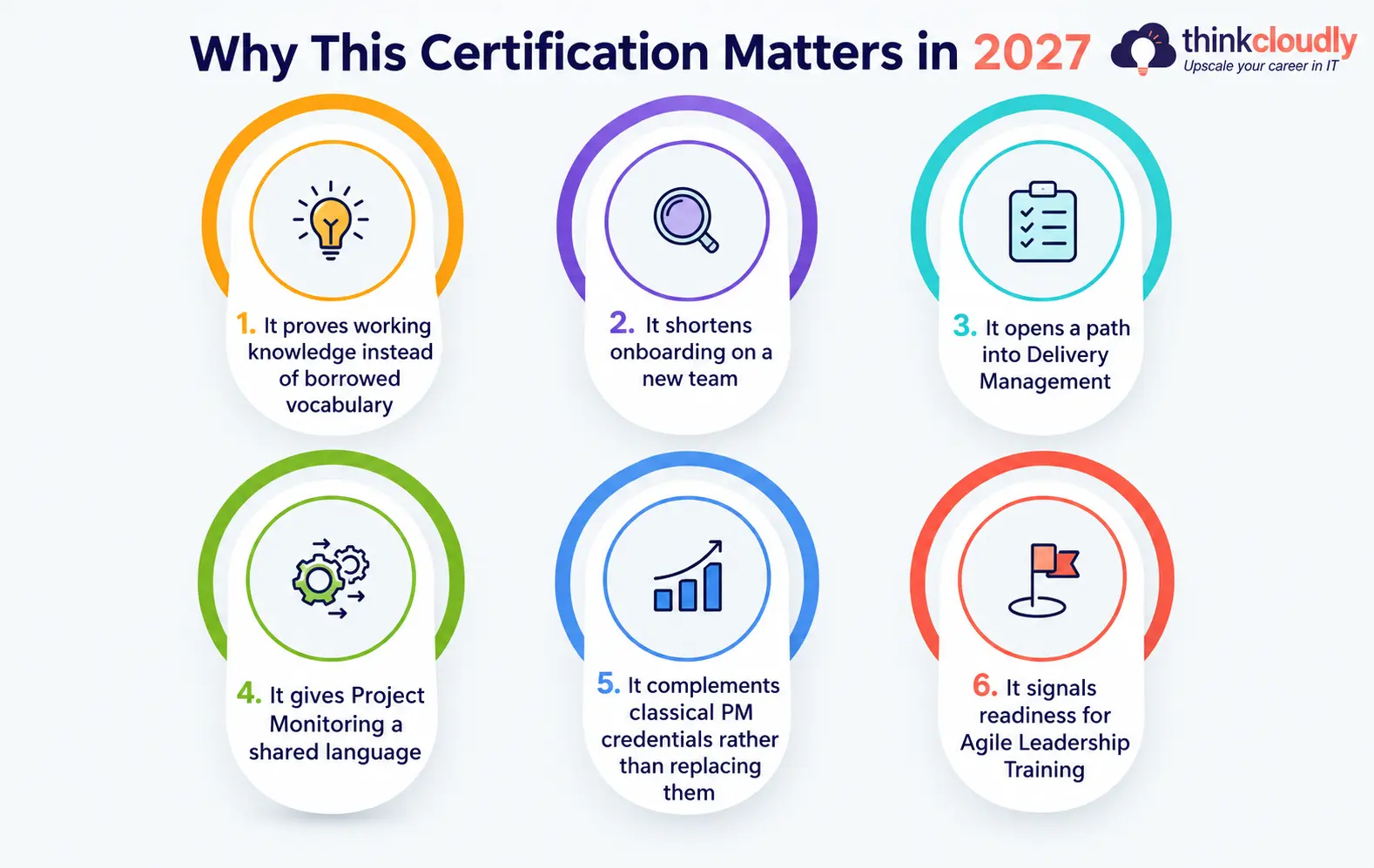
- It proves working knowledge instead of borrowed vocabulary. Anyone can repeat the words “sprint” and “backlog.” An Agile project management certification confirms you’ve been tested on applying them under exam conditions, not just hearing them in a standup.
- It shortens onboarding on a new team. A certified hire needs far less hand-holding through scheduling conventions, ceremony cadence, and reporting formats than someone learning the vocabulary for the first time.
- It opens a path into delivery management. Professionals who can demonstrate certified execution skills are the ones usually tapped first when a department needs someone to own cross-team outcomes rather than a single backlog.
- It gives Project Monitoring a shared language. When a team’s leads and sponsors are trained on the same framework, status conversations stop being arguments about definitions and start being decisions about risk.
- It complements classical PM credentials rather than replacing them. Professionals holding a traditional project management badge often add this certification specifically to cover facilitation and adaptive-planning gaps the older frameworks don’t test.
- It signals readiness for Agile Leadership Training. Certifying bodies increasingly treat the fundamental-level exam as a gateway, not an endpoint, pointing successful candidates toward coaching and leadership tracks within the same ecosystem.
None of that replaces judgment built from actually running a release under pressure. But a verified certification is still the fastest signal of competence a resume carries this year, and it’s something recruiters can check in minutes rather than take on faith.
Comparing the Top Agile PM Certifications
Picking a lane before you study saves you from prepping for the wrong exam entirely. Here’s how the main options compare right now.
|
Certification |
Issuing Body | Focus Area | Typical Cost (USD) |
Best Fit |
|
PMI-ACP (Agile Certified Practitioner) |
Project Management Institute | Cross-framework agile practice | 435–495 |
PMs who want a vendor-neutral credential spanning Scrum, Kanban, and Lean |
|
SAFe Agilist (SA) |
Scaled Agile, Inc. | Enterprise-scale delivery | 500–1,000 |
Professionals in large organizations running the Scaled Agile Framework |
|
PRINCE2 Agile |
PeopleCert / Axelos | Governance plus agile delivery | 600–900 |
PMs in regulated or governance-heavy industries blending structure with agility |
|
ICAgile Certified Professional (ICP) |
ICAgile | Foundational agile mindset | 300–600 |
Early-career professionals building a framework-agnostic base |
|
Disciplined Agile Scrum Master (DASM) |
PMI / Disciplined Agile | Choose-your-way-of-working | 300–500 |
Teams that blend multiple agile approaches rather than following one strictly |
The PMI-ACP exam outline published by PMI is worth reading before you commit, since it spells out exactly how much weight the exam gives to domains like value-driven delivery versus team performance—detail most prep courses summarize but rarely show you in the certifying body’s own words.
Anyone weighing an Agile project management certification against the enterprise route should also check what Scaled Agile’s catalog actually requires, since SAFe’s tiers assume a different starting point than a standalone PMI-ACP track.
What Does the Training Actually Cover?
A lot of candidates assume the coursework behind this kind of program is mostly terminology—story points, velocity, and burndown charts. That’s a reasonable guess, and it’s incomplete. The better-run programs spend most of their hours on Project Scheduling and Project Execution under realistic constraints: how to replan a release when a dependency slips, how to sequence work when two teams are fighting over the same shared service, and how to keep a stakeholder calendar honest when scope keeps shifting underneath it.
Good project scheduling in an agile setting isn’t about locking a Gantt chart six months out. It’s about building a cadence the team can actually hold to, then adjusting the plan in public rather than quietly absorbing slippage until it becomes a crisis.
Project Execution gets tested the same way—not as a checklist of completed tasks, but as judgment calls about what to cut, what to protect, and when a sprint commitment needs renegotiating instead of forcing through. Reading a certifying body’s guide cover to cover gets you through the exam.
It doesn’t prepare you for a stakeholder who wants a hard date for something the team hasn’t scoped yet, which is exactly the scenario most training is built to simulate.
Core Skills Every Program Tests
Exam blueprints vary slightly by issuing body, but the core competencies of every credible Agile project management certification measure are remarkably consistent. Here’s what shows up across nearly all of them:
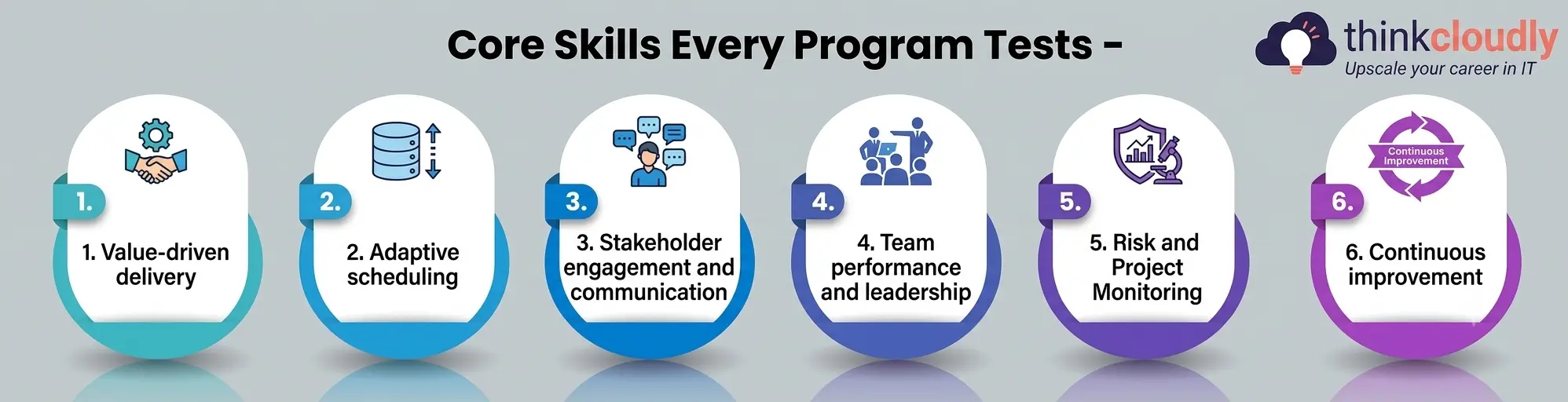
- Value-driven delivery. Prioritizing backlog items by business value rather than ease of implementation and defending that order when a louder stakeholder disagrees.
- Adaptive scheduling. Building release plans that assume change, then re-sequencing work without derailing the whole roadmap every time a single assumption breaks.
- Stakeholder engagement and communication. Translating technical status into language a sponsor without a technical background can act on.
- Team performance and leadership. Coaching self-organizing teams toward better decisions rather than directing every task yourself—a skill most classical project management backgrounds don’t teach by default.
- Risk and Project Monitoring. Tracking leading indicators—cycle time, scope churn, blocked-item age—instead of waiting for a missed deadline to surface a problem that was visible weeks earlier.
- Continuous improvement. Running retrospectives that produce actual process changes rather than a list of complaints nobody revisits.
Notice how little of that list resembles the traditional, resource-leveling side of project management. It’s mostly about judgment under changing conditions, which is exactly why professionals coming from a rigid, waterfall-style planning background sometimes need real leadership coaching to unlearn habits that worked fine in a fixed-scope world but actively slow down an adaptive one.
Agile Leadership Training and the Rise of Delivery Management Roles
Most people don’t stay in an entry-level certified role forever. Within two or three years, a meaningful share moves into dedicated delivery leadership positions, where the job shifts from running one team’s backlog to owning outcomes across several teams at once.
That shift rarely happens without deliberate Agile Leadership Training, because coordinating multiple squads, each with its own scheduling rhythm, demands a different muscle than facilitating a single team’s ceremonies.
This is also where the PMI-ACP’s cross-framework design earns its reputation. Because it doesn’t assume a single methodology, professionals moving into delivery management roles often find an Agile project management certification like this one transfers better across departments running different flavors of agile than a framework-specific badge does.
PMI-ACP-aligned roles in the US typically land between $95,000 and $145,000 depending on location, sector, and seniority—a wide range, but one that consistently sits above generalist project coordinator pay.
The same review points out that some job postings still name a specific framework credential outright, so pairing it with a framework-specific one, like SAFe’s Agilist track, often beats relying on either alone.
This kind of delivery leadership role increasingly blends technical fluency with the softer coaching skills built around it: negotiating scope across competing priorities, protecting a release calendar from well-meaning scope creep, and keeping multiple status dashboards honest instead of letting each team report its own version of “on track.”
Salary and Job Market Data for 2027
Numbers help more than vague reassurance. PMI’s own research shows an average project performance rate of roughly 73.8%, meaning close to one in four projects still misses its intended business outcome even with formal methodology in place—a reminder that an Agile project management certification improves your odds without eliminating the real difficulty of the work.
The same body of research found fewer than half of organizations report a consistent track record of on-time, on-budget delivery, which is precisely the gap that disciplined project monitoring and honest scheduling are meant to close.
On pay, UK salary data for technical project managers with agile skills shows a meaningful premium over generalist PM roles once agile-specific credentials and experience are factored in, with senior practitioners pulling well ahead of entry-level pay in the same title.
US figures tell a similar story: PMI-ACP-aligned professionals routinely clear six figures by mid-career, while SAFe-certified Agilists working inside large enterprises command a further premium tied to the scale of coordination their role demands.
None of this is guaranteed by the badge alone — it tends to pay off fastest for people who pair it with actually running Project Execution for a real team within the following few months, rather than letting it sit unused on a resume while nothing in their day-to-day work actually changes.
How to Choose the Right Path for Your Career Stage?
There’s no single “best” option here — only the right fit for where you currently sit.
- New to agile entirely? Start with ICAgile’s foundational certificate or PMI-ACP if you’re comfortable with a broader, framework-spanning exam. Both validate core judgment without assuming years of prior execution experience.
- Coming from a classical, plan-driven background? A fundamental-level Agile project management certification plus deliberate Agile Leadership Training will matter more than the letters after your name, especially if your prior Project Scheduling habits leaned on fixed-scope, fixed-date planning.
- Already running agile teams day to day? An advanced or coaching-track credential pushes you toward Delivery Management responsibilities and the compensation that tends to come with them.
- Working inside a large enterprise running scaled frameworks? SAFe’s certification path matters more locally than a vendor-neutral badge, since it’s built specifically around multi-team Project Monitoring and synchronized planning.
Whatever you choose, give yourself real preparation time instead of cramming the night before. Training that skips hands-on scenario practice in favor of flashcards produces people who pass the exam and then struggle the first time a real release slips two days before a hard deadline. The exam tests recall. The job tests judgment, and only deliberate practice — not repetition of sample questions — builds the second one.
A Personal Note
I’ve watched capable people treat their Agile project management certification like a finish line instead of a starting point. The exam proves you understand the framework. It doesn’t prove you can hold a room steady when a release falls apart two days out, or tell a well-meaning sponsor that their new request has to wait for the next planning cycle.
Give yourself permission to feel clumsy in your first few months of real Project Execution after certifying — that discomfort is just the gap between knowing the material and having lived it, and it closes faster than you’d expect if you stay curious about what goes wrong instead of defensive about it.