

I still remember the exact moment a career-switching friend of mine, a former paralegal, told me she’d given up on this field before even applying. She’d read three job postings, saw the word “technical” twice, and decided governance, risk, and compliance work was reserved for people who could write scripts and read server logs.
Eight months later, she was two weeks into a GRC analyst role at a mid-sized healthcare company, and not one task on her desk involved a single line of code. What changed wasn’t her skill set. It was her understanding of what the job actually asks for.
That misunderstanding is more common than it should be, and it’s keeping genuinely qualified people—writers, auditors, paralegals, operations coordinators—out of a field that badly needs them.
If you’ve been wondering whether you can become a GRC analyst without a programming background, the honest answer is yes, and this guide walks through exactly why, what the role really involves day to day, and the concrete steps that will get you there in 2027 without ever opening a code editor.
I’m writing this piece for exactly that person—someone with real, transferable skills who has talked themselves out of applying because a handful of job postings used language they didn’t recognize.
By the end of this guide you should have a clear, honest picture of what this work involves, what employers actually screen for, and a sequence you can follow starting this week, not after another certification you don’t yet need.
What a GRC Analyst Actually Does (And Why Coding Rarely Shows Up)?
Strip away the job-title mystique, and the daily work of a GRC analyst is mostly reading, writing, organizing, and following up. A typical week involves updating a risk register, chasing down evidence for an upcoming audit, and translating a dense regulatory requirement into a plain-language policy someone outside the security team can actually follow.
Much of it centers on audit documentation—collecting screenshots, sign-offs, and system reports that prove a control is actually working, then filing them in a way an external auditor can follow without asking ten follow-up questions.
Another large chunk of the role involves control testing, but not in the sense most people assume. The analyst isn’t writing test scripts; they’re coordinating the exercise—confirming a control operated as described, interviewing the control owner, and documenting the result.
Compliance reporting fills out the rest of the week: turning raw findings into a dashboard or summary, a non-technical executive can skim in two minutes. None of this requires a programming language. It requires precision, patience, and the ability to ask the right follow-up question when a document doesn’t quite match what a policy says it should.
This is also where IT Governance enters the picture, and it’s less intimidating than the name suggests. Most of the job isn’t building governance structures from scratch; it’s checking whether day-to-day practice actually matches the policy leadership already signed off on, and flagging the gap when it doesn’t. That’s a documentation and communication exercise, not a technical one.
That’s the real reason people without a technical background routinely become a GRC analyst and thrive in the role. The skills that matter most—structured writing, careful documentation, and comfort with repetitive detail work—are the same skills a paralegal, an operations coordinator, or a former teacher already has.
Why Is the Demand for This Path Growing Heading Into 2027?
This isn’t a niche career bet. The U.S. Bureau of Labor Statistics projects employment for compliance officers—the wider occupational family this role sits inside—to keep growing faster than the average for all occupations over the next decade, as regulatory obligations expand across healthcare, finance, and technology, according to the BLS Occupational Outlook Handbook.
The staffing pressure behind that growth is just as telling. ISACA’s 2026 State of Cybersecurity survey of more than 1,800 professionals found that 58% of teams describe themselves as understaffed, and 55% report real difficulty retaining qualified people, a gap that pushes many organizations to hire for judgment and documentation discipline first and teach the specific framework on the job.
That same research found 45% of teams now name AI-related skills gaps as a growing concern—which, counterintuitively, is good news for non-coders, because it means employers are actively looking for people who can govern and document AI use responsibly, not necessarily people who can build the models themselves.
The same survey found that 51% of respondents are now involved in developing, onboarding, or governing AI tools at their organization, up from 40% in 2025 and 29% the year before—a trend that is creating entirely new governance and documentation work faster than it’s creating new coding work.
Employers facing that gap increasingly treat a completed round of GRC training as a reasonable stand-in for years of direct industry experience, provided the candidate can also point to one concrete project they built themselves.
Put it in an easy way: the shortage is in people who can reliably manage IT governance processes and keep documentation airtight, not in people who can write software. That’s exactly the gap a motivated beginner can fill.
7 Steps to Become a GRC Analyst With Zero Coding Background
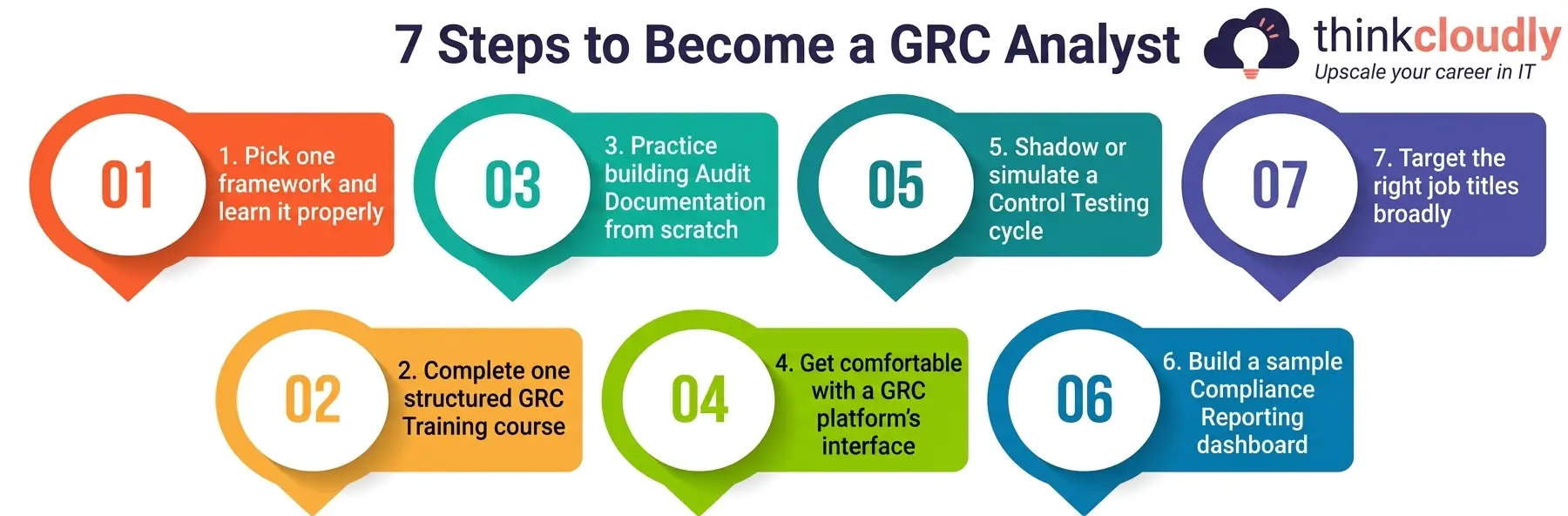
- Pick one framework and learn it properly. Choose ISO 27001, SOC 2, or NIST CSF and go deep rather than skimming five frameworks shallowly. Understanding how one framework’s controls map to real evidence is worth more than a surface-level list of acronyms.
- Complete one structured GRC training course. A single well-chosen program gives you the shared vocabulary every interviewer will expect—risk appetite, control owner, residual risk—without requiring any technical prerequisite.
- Practice building audit documentation from scratch. Create a mock evidence folder for a fictional company: policies, screenshots, and sign-off logs. This single project does more for your credibility than a long list of unused credentials.
- Get comfortable with a GRC platform’s interface. Most vendors offer free trials. Spend a weekend logging findings and building a report so you can speak specifically about navigating a real tool, not a theoretical one.
- Shadow or simulate a control testing cycle. Even a self-run exercise—picking one control, interviewing a stand-in “owner,” and writing up the result—teaches you the interview-and-document rhythm employers screen for.
- Build a sample compliance reporting dashboard. A clean one-page summary turning a handful of findings into a readable status report shows you understand the audience side of the job, not just the data-collection side.
- Target the right job titles broadly. “GRC Analyst,” “Compliance Analyst,” “IT Compliance Analyst,” and “Risk and Compliance Coordinator” often describe overlapping, non-technical work—widen your search instead of filtering on one exact title.
Following this sequence in order is how most people without a technical background actually become a GRC analyst within a realistic three-to-six-month window, rather than spending a year second-guessing whether they belong in the field at all.
Core Skills vs. Technical Skills: What Actually Gets You Hired
|
Skill Area |
Is It Required to Become a GRC Analyst? |
Who Already Has It |
|
Writing clear policy language |
Yes—essential. |
Writers, paralegals, teachers |
|
Audit Documentation and Evidence Organization |
Yes—essential. |
Auditors, administrators, project coordinators |
|
Programming or scripting |
No—rarely required |
— |
|
Compliance reporting and dashboard summarizing |
Yes—highly valued |
Analysts, operations staff, former consultants |
|
Deep database or network engineering knowledge |
No—not expected at entry level |
— |
|
Interviewing control owners during control testing |
Yes—core to the role |
HR, audit, customer-facing professionals |
|
Basic IT Governance literacy (frameworks, terminology) |
Yes—learnable through training |
Anyone willing to complete a course |
Read this table as a reality check more than a checklist. The two “no” rows are exactly the two assumptions that keep capable non-technical candidates from applying in the first place.
6 Non-Technical Skills Employers Actually Want
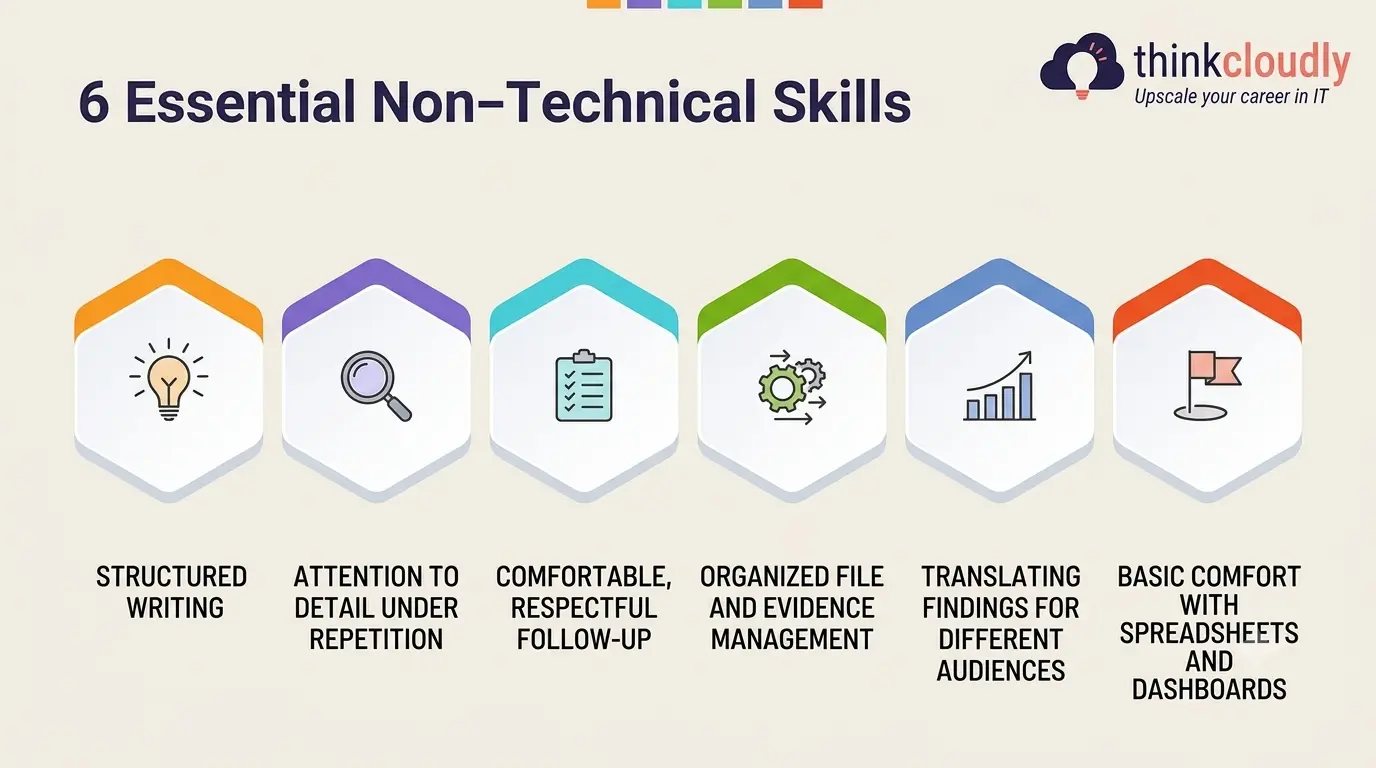
- Structured writing. The ability to turn a dense regulation into three clear sentences a non-specialist can act on is one of the most valued, least taught skills in this field.
- Attention to detail under repetition. Reviewing the fortieth piece of evidence with the same care as the first is a genuine, trainable skill, not a personality trait you either have or don’t.
- Comfortable, respectful follow-up. Chasing a busy control owner for missing evidence without burning the relationship is a soft skill that shows up constantly in day-to-day control testing work.
- Organized file and evidence management. Clean, well-labeled audit documentation is often the single biggest differentiator between a smooth audit and a painful one.
- Translating findings for different audiences. Good Compliance Reporting means writing one version for engineers and a shorter, plainer version for the board, without losing accuracy.
- Basic comfort with spreadsheets and dashboards. Nothing approaching programming—just enough spreadsheet fluency to track a risk register or build a simple status report.
Notice that every one of these six skills is something a motivated beginner can build or demonstrate within a few weeks, which is exactly why this list, not a coding bootcamp, is the real on-ramp for anyone trying to become a GRC analyst from a non-technical background.
GRC Training and Certifications That Don’t Require Coding
Formal GRC training matters less for the technical knowledge it hands you and more for the signal it sends: that you’ve chosen a direction and done the work to back it up. (ISC)²’s Certified in Governance, Risk, and Compliance credential, for instance, was built specifically around governance, documentation, and oversight knowledge rather than hands-on technical skills, and it remains one of the more accessible entry points for candidates coming from legal, audit, or operations backgrounds, according to ISC2’s official CGRC certification page.
On the framework side, ISO/IEC 27001 is worth learning even if you never touch the technical implementation, because so much of IT Governance work in practice is checking whether an organization’s actual behavior matches what the standard requires, not configuring the systems themselves, as the standard’s own official guidance makes clear.
Pairing one certification like this with a self-built documentation project is consistently a stronger combination than collecting several credentials with nothing concrete to show for any of them.
Common Myths That Keep Non-Technical People From Applying
The biggest myth is that you need a computer science degree or scripting ability to even be considered — most entry-level postings ask for framework familiarity and documentation skills, not programming languages.
A close second is the belief that certifications alone will get you hired; in practice, a credential paired with zero demonstrable project work loses out every time to a candidate who built even a small mock Audit Documentation folder.
A third myth is that Control Testing is a hands-on technical exercise; for an analyst, it’s almost always an interview-and-verify process, not a technical audit of code.
And the last one is timing: people assume they need years of adjacent experience before they can even apply, when in reality a single well-chosen course plus one built project is often enough to become a GRC analyst within a single hiring cycle.
Where the Non-Technical Path Actually Leads
Analysts who start without a technical background don’t stay boxed into entry-level Compliance Reporting forever. Many move into roles overseeing broader IT Governance programs, lead control-testing cycles across multiple departments, or specialize in a single framework and become the organization’s go-to person for a specific type of audit.
The path upward rewards the same qualities that got someone hired in the first place — clear writing, reliable documentation, and the judgment to know when a finding actually matters versus when it’s noise.
None of that trajectory requires circling back for a computer science degree partway through; a second, more specialized certification is usually the bigger lever for moving up a level than any technical course would be.
A Personal Note
What keeps surprising me about this field is how much of the hesitation is self-imposed. The friend I mentioned at the start didn’t need eight months to become qualified — she needed about three weeks to realize the postings scaring her off were describing work she’d already been doing under a different job title.
If you’re reading this while convinced you’re missing some technical gene everyone else has, my honest advice is to stop reading job descriptions as a test you might fail and start reading them as a checklist of skills you can prove in a weekend.
Build one small documentation project, finish one course, and apply before you feel fully ready. Readiness in this field is almost always demonstrated, not declared.