

A friend of mine spent three months studying for the wrong exam. She wanted to move from a general compliance role into a risk-focused GRC seat, so she signed up for CISA because it was the name she’d heard most on LinkedIn.
Halfway through her prep, a hiring manager told her the job she actually wanted was asking for CRISC, not CISA. She’d lost a quarter of studying material that wasn’t wrong, exactly—just aimed at a different job than the one she was chasing.
That mix-up happens constantly, and it’s the entire reason the CRISC vs CISA question keeps showing up in GRC forums, Reddit threads, and inboxes from students who are one exam fee away from committing to a path. Both are ISACA credentials. Both carry real weight with employers.
And both get lumped together so often that people assume they’re interchangeable when they test completely different skills and open different doors. This guide breaks down what each one actually covers, what they cost in 2026, what they pay, and — more usefully — how to figure out which one matches the job you’re actually trying to get, not just the one with the more familiar acronym.
CRISC vs. CISA: What the Two Letters Actually Mean
CRISC stands for Certified in Risk and Information Systems Control. CISA stands for Certified Information Systems Auditor. Both come from ISACA, both lean on scenario-based exam questions, and both are frequently listed side by side in the same job posting—which is exactly why the CRISC vs. CISA comparison trips people up. But the overlap stops at the issuing body.
CRISC is built around a single question: how much risk does this specific control, system, or decision expose the organization to, and what should be done about it? CISA is built around a different question entirely: can we independently verify that the systems and controls we’ve been told are working actually are?
One certification trains you to assess and manage exposure before something breaks. The other trains you to test, audit, and prove whether existing controls are holding up. Students chasing a risk management certification path want the first. Students aiming at compliance auditing work want the second.
CRISC Certification: What It Tests and Who It’s For
The CRISC certification is built around four domains, and the weighting tells you exactly where ISACA wants your attention:

- Governance — 26%: risk management frameworks, organizational risk culture, and how risk strategy ties back to business objectives.
- IT Risk Assessment — 22%: identifying risk, analyzing it, and prioritizing what actually deserves attention.
- Risk Response and Reporting—32%: the largest domain by far, covering how risk gets communicated upward and how responses get implemented and tracked.
- Information Technology and Security—20%: the technical backbone—controls, security concepts, and the IT environment the other three domains operate inside.
The exam runs 150 questions (15 unscored pretest items) over four hours, scored on a 200–800 scale with 450 as the passing mark. To hold the CRISC certification—not just pass the exam—you need at least three cumulative years of IT risk management and control experience, spanning at least two of the four domains, earned within ten years of applying or five years of passing. There’s no substitution path; the experience requirement is fixed.
People who get the most value from a CRISC certification are already sitting in, or moving directly into, IT risk management, third-party risk, or governance-adjacent GRC roles. It’s a poor first move for someone brand new to the field with no risk exposure yet, because the exam assumes you’ve already made real risk decisions, not just read about how they’re made.
CISA Certification: What It Tests and Who It’s For
The CISA certification is built around five domains instead of four, and the weighting skews heavily toward operational and asset-protection content:
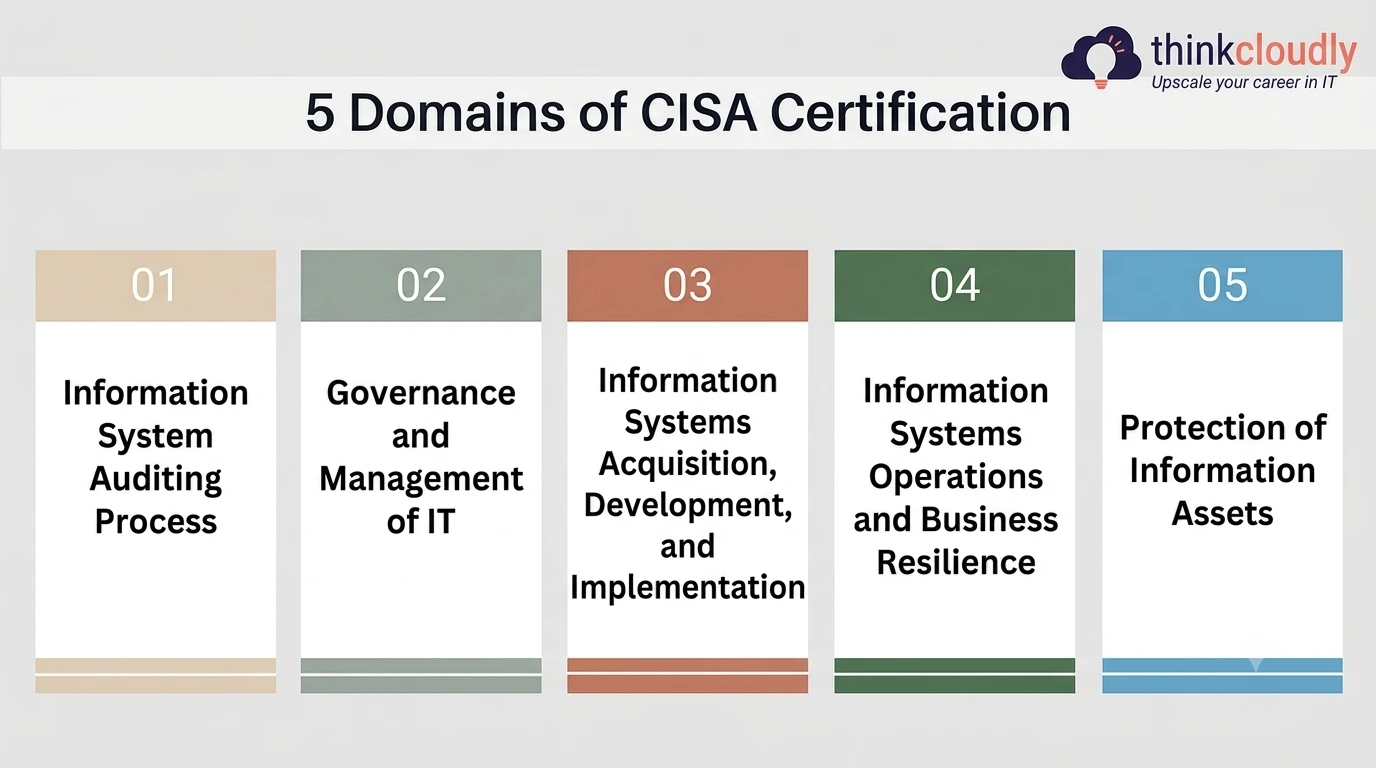
- Information System Auditing Process — 18%
- Governance and Management of IT — 18%
- Information Systems Acquisition, Development, and Implementation — 12%
- Information Systems Operations and Business Resilience — 26%
- Protection of Information Assets — 26%
Like CRISC, the CISA exam runs 150 questions over four hours with a passing score of 450 out of 800. The experience bar diverges sharply: CISA requires five years in information systems auditing, control, security, or assurance, with at least two years tied directly to one or more of the five domains. Some of that can be offset through substitutions for other certifications or academic credit, but the baseline sits well above CRISC’s three-year mark.
The CISA certification is the standard credential for internal audit teams, IT assurance functions, and regulatory examiners—anyone whose job is to independently test whether a control that’s supposed to be working is actually working. It’s a strong fit for people who enjoy methodical verification work more than open-ended risk judgment calls.
CRISC vs CISA: 5 Quick Differences
- Focus. CRISC manages and responds to risk before it becomes a problem. CISA audits and verifies controls after they’re already in place.
- Domain count. CRISC has four domains; CISA has five, with a heavier weighting toward operational resilience and asset protection.
- Experience requirement. CRISC asks for three years of risk-and-control experience. CISA asks for five years of audit, control, or security experience.
- Market demand. CISA shows up in roughly three and a half times as many US job postings as CRISC, according to data compiled by certdemand.com’s CISA vs. CRISC comparison, largely because audit functions are more standardized across industries than risk-management functions.
- Typical next role. CRISC holders tend to move into IT Risk Manager, GRC Analyst, or Risk Officer titles. CISA holders tend to move into IT auditor, audit manager, or internal controls lead titles.
Neither difference makes one certification objectively “better”—they’re simply built for different jobs, which is the entire point of treating CRISC vs. CISA as a fit question rather than a ranking question.
Both the CRISC certification and the CISA certification run on the same ISACA exam engine, so the real decision comes down to domain fit: pick CRISC as your risk management certification of choice if you want to manage exposure, or pick CISA if you’d rather verify controls after the fact.
CRISC vs CISA Certification Comparison Table
|
Factor |
CRISC |
CISA |
|
Full Name |
Certified in Risk and Information Systems Control |
Certified Information Systems Auditor |
|
Issuing Body |
ISACA |
ISACA |
|
Core Focus |
Risk identification, response, and reporting |
IT audit, control testing, and assurance |
|
Number of Domains |
4 |
5 |
|
Exam Format |
150 questions, 4 hours, pass score 450/800 |
150 questions, 4 hours, pass score 450/800 |
|
Experience Required |
3 years (risk and control) |
5 years (audit, control, or security) |
|
Exam Fee (2026) |
$575 members / $760 non-members |
$575 members / $760 non-members |
|
Annual Maintenance Fee |
$45 members / $85 non-members |
$45 members / $85 non-members |
|
CPE Requirement |
120 hours over 3 years |
120 hours over 3 years |
|
Best Suited For |
Risk managers, GRC analysts, third-party risk roles |
Internal auditors, IT assurance, compliance examiners |
Read this table as a planning tool, not a scoreboard. The costs and CPE cycles are nearly identical because both are ISACA credentials run on the same administrative framework—the real decision point is the domain focus and the experience path, not the fees.
Risk Management Certification or Compliance Auditing Path — Which Fits You?
This is where most people actually get stuck, and it’s less about the exam content and more about which side of the GRC function excites you. If you like getting ahead of problems—modeling what could go wrong, deciding how much exposure is acceptable, and building the response plan before anything breaks—a risk management certification like CRISC is the natural fit.
If you’d rather be the person who walks in after controls are already built and independently tests whether they’re holding up under pressure, compliance auditing work—and the CISA path behind it—is the better match.
A simple gut-check: if your current job involves writing or updating a risk register, scoring likelihood and impact, or deciding how to respond to an identified exposure, you’re already doing CRISC-adjacent work and the certification will formalize skills you’re using weekly.
If your current job involves testing controls against a framework, documenting audit findings, or verifying evidence for a regulator, you’re doing CISA-adjacent work already. Compliance auditing and risk management overlap constantly in practice—plenty of professionals end up holding both certifications over a career—but almost nobody starts fluent in both disciplines at once, which is exactly why the CRISC vs. CISA decision matters more at the start of a career than five years into one.
Salary and Demand: What Governance Risk Compliance Employers Actually Pay
Governance risk compliance hiring hasn’t slowed in 2026, and both certifications still command a real premium over uncertified peers, though the ranges differ. US CRISC holders report average salaries of roughly 145,000–151,000, with figures spanning $81,000 for newer holders up to $218,000 for senior risk leaders, according to Destination Certification’s 2026 CRISC ROI analysis.
CISA pay runs slightly lower but with a wider base of postings: US figures land between $110,000 and $150,000 depending on experience and metro, with entry-level holders near 85,000–105,000 and senior audit leaders clearing 145,000–180,000. Outside the US, CISA-related IT audit roles in the UK trend toward £62,000–£67,000, while Canadian figures generally fall between CA70,000 and CA105,000.
The pay gap isn’t really about which governance risk compliance skill is more “valuable”—it reflects supply and demand. CISA appears in far more postings because audit functions exist in nearly every mid-sized and large organization as a near-universal requirement.
CRISC shows up less often but is frequently attached to senior, risk-ownership titles, which pushes its average salary higher despite the smaller applicant pool. Neither certification hands you a raise automatically; both consistently show up as the credential that gets a resume past the initial screen in governance risk compliance hiring.
How to Decide Which to Take First: A 5-Step Framework?
- Audit your current work, not your job title. Look at what you actually spend your week doing — assessing and responding to risk, or testing and verifying controls — and let that answer point you toward CRISC or CISA before you look at anything else.
- Check whether you meet the experience bar today. CRISC’s three-year requirement is reachable faster for people early in a risk-adjacent role; CISA’s five-year requirement often means waiting longer unless substitutions apply.
- Look at the actual job postings you want, not a general ranking. Pull up five postings for the exact title you want in twelve months and see which certification shows up more often in the requirements section.
- Weigh the exam content honestly. If scenario-based risk-prioritization questions sound more engaging than control-testing and audit-methodology questions, that preference is worth taking seriously — motivation during 100–150 hours of study matters more than most people admit.
- Plan for both eventually, but commit to one now. Many senior GRC professionals hold both certifications, but almost none of them started by studying for two exams simultaneously. Pick the one that matches your next role, not your eventual one.
This isn’t a way to avoid the decision — it’s a way to base it on your actual trajectory, not on which acronym trended in your feed this month.
Common Mistakes People Make With CRISC vs CISA
The most common mistake is picking a risk management certification or a compliance auditing credential based on name recognition rather than job fit — exactly what happened to my friend at the start of this piece.
The second is underestimating the experience requirement and discovering, mid-application, that two of their qualifying years don’t actually count because the role wasn’t domain-relevant.
The third is assuming either credential is hands-on technical training; neither teaches penetration testing or incident response.
The fourth, and costliest, is treating the CRISC vs CISA choice as permanent. It isn’t — plenty of professionals earn one, work that lane for a few years, then pick up the other once their role shifts toward audit or risk ownership instead.
A Personal Note
What struck me most while pulling this comparison together wasn’t the domain weightings or the salary ranges — it was how often people treat this decision like it’s higher-stakes than it actually is. Neither certification locks you out of the other path permanently.
The exam fee stings, the CPE cycle is real work, and three to five years of qualifying experience isn’t nothing — but choosing CRISC first and discovering two years later that you actually want audit work isn’t a failure, it’s just a career finding its shape.
If you’re stuck between these two right now, my honest suggestion is to stop trying to find the “correct” answer and instead go look at the actual job you want in twelve months. The certification that matches that job is the right one to study for today, full stop.