

Security operations centers don’t run on generalists anymore. In 2027, a SOC is a 24/7 floor fighting AI-assisted phishing kits, deepfake-voice social engineering, ransomware crews that negotiate like businesses, and insider risk that no firewall catches on its own.
The gap between someone who “watches a dashboard” and a certified SOC analyst shows up in the first technical interview question, and it shows up again, a few weeks later, in the pay offer.
One quick disambiguation before we go further: this article is about the Security Operations Center role, not a SOC 2 compliance audit. Same three letters, two completely different worlds—one is a job, the other is a paperwork exercise for auditors.
This is a practical look at what the role actually involves day to day, which SOC certification path is worth the time right now, and what real pay looks like across the US, UK, and Canada heading into 2027. No recycled 2022 statistics and no vague “cybersecurity is booming” filler—just the roles, the numbers, and the skills that are genuinely getting people hired this year.
What Does It Mean to Be a Certified SOC Analyst in 2027?
Someone who has proven, through a recognized exam rather than a résumé bullet point, that they can do the work. That distinction matters more than it used to. The demand for information security analysts is projected to grow 21% between 2025 and 2035—”much faster than average” for any occupation—with roughly 40,600 new positions expected as the field grows from 192,900 jobs in 2025 to 233,400 by 2035. SOC seats sit squarely inside that number, and most of the net-new hiring is happening at the entry and mid tiers, exactly where certifications carry the most weight.
The job itself hasn’t changed in spirit — someone still has to watch an environment and respond when it looks wrong — but the tooling has. The role now runs across a SIEM, an EDR console, a ticketing system, and increasingly an AI-assisted triage layer, often all before lunch.
Teams that were three people and a shared inbox five years ago are now full-shift rotations, because the volume of events hitting a mid-size company’s environment has simply outgrown what a handful of generalists could watch manually.
Core Job Roles of a SOC Analyst
Here’s how the work actually breaks down, by tier, at most mid-size and enterprise teams:
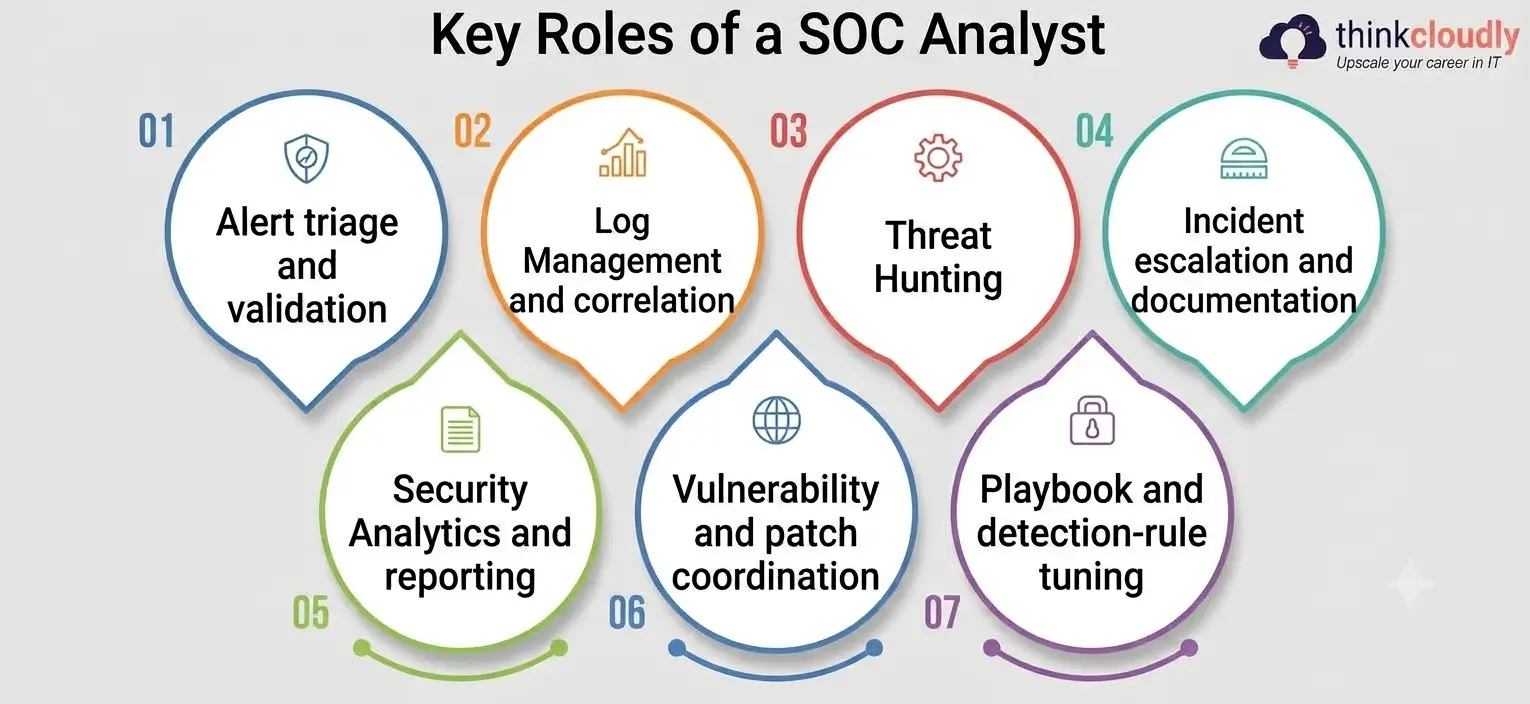
- Alert triage and validation—separating real incidents from noise, usually the entire first six months on the job
- Log Management and Correlation—pulling events from firewalls, endpoints, identity providers, and cloud platforms into one searchable timeline
- Threat Hunting—proactively searching for attacker behavior that automated rules missed, rather than waiting for an alert to fire
- Incident escalation and documentation—writing up what happened, when, and how, in a format a Tier 3 responder can act on immediately
- Security Analytics and reporting—turning raw event data into trend lines leadership can actually use for budget and staffing calls
- Vulnerability and patch coordination—flagging exposed systems to IT before they become the next headline
- Playbook and detection-rule tuning—adjusting correlation logic so the team stops drowning in false positives
Most postings for this role list three or four of these duties up front, then bury the rest under “other duties as assigned. ” In practice, the first ninety days are almost entirely triage and ticket cleanup; the more interesting work—hunting, analytics, tuning—comes once a manager trusts the analyst’s judgment.
At managed security service providers (MSSPs), the breakdown shifts again: analysts rotate across multiple client environments in a single shift, which sounds chaotic but actually builds broader pattern recognition faster than sitting inside one company’s network for years.
Why Employers Are Paying More for SOC Certification in 2027?
Security budgets are tighter than they were two years ago, and that’s exactly why certification has turned into a filter rather than a nice-to-have. The ISC2 Cybersecurity Workforce Study found that 95% of organizations now report at least one critical skills gap, with critical shortages rising 15% year over year, and AI skills have overtaken cloud security as the fastest-growing demand (41% versus 36%).
Hiring managers short on headcount aren’t willing to train a generalist from zero anymore; they want a certified SOC analyst who can sit down at the console on day one and already know what a false positive looks like.
That shift shows up directly in compensation. A SOC certification doesn’t just get a résumé past an applicant-tracking filter—it increasingly maps to a specific pay band, because it tells a hiring manager exactly which skills gap they don’t have to budget training time around.
With security budgets flat or shrinking at a third of organizations surveyed in that same ISC2 report, every open seat has to justify itself, and a verified credential is the cheapest justification a hiring manager can point to when finance asks why headcount is going up.
Certified SOC Analyst Salary Growth in 2027: US, UK, and Canada
Here’s where it gets concrete. Pulling current figures from Payscale, ZipRecruiter, and the UK’s ITJobsWatch, the SOC analyst salary trend for 2027 looks like this:
|
Region |
Entry-Level Average | Senior / Lead Average |
2027 Trend |
|
United States |
$57,761/yr | $77,419/yr base (total pay up to $116K) |
Steady, pushed by AI security hiring |
|
United Kingdom |
roughly £38,000/yr | £55,000/yr median, all levels |
Up 28.8% year over year—the sharpest jump of the three |
|
Canada |
C$71,345/yr (junior) | roughly C$95,000–105,000/yr (senior, estimated) |
Rising, tracking US demand with a lag |
The UK figure is the one worth sitting with: a near-29% median jump in a single year isn’t ordinary salary inflation; it’s a market that genuinely cannot find enough qualified people fast enough. For a broader information-security-analyst sample, the US median sits at $129,180 a year per the BLS; SOC-specific roles trend lower mainly because so many SOC seats are still entry-level Tier 1 positions rather than senior ones.
The pattern across all three countries is consistent: the SOC analyst salary gap between a certified hire and an uncertified one widens every year, not because the paper is magic, but because it’s the fastest proxy employers have for “this person won’t need six months of ramp-up before they’re useful.”
Remote and hybrid postings complicate the picture slightly—a fully remote Tier 1 seat in a lower-cost US metro can pay noticeably less than an onsite role in New York or London, so always check whether a quoted figure is location-adjusted before comparing it against your own offer.
On-call and shift differentials add another 5–10% on top of base pay at most SOCs running genuine 24/7 coverage, which rarely shows up in the headline salary numbers but matters a great deal in a real offer letter.
Career Progression Path for a SOC Analyst
A typical ladder, assuming someone actually works a certification roadmap instead of just collecting badges:
- Tier 1 Analyst (0–1 yr)—triage, alert classification, and the daily grind of ticket queues; the entry point even for someone fresh off the exam
- Tier 2 Analyst (1–3 yrs)—incident response, deeper threat hunting, correlation-rule tuning
- Tier 3 / Senior Analyst (3–5 yrs)—leads investigations, mentors junior staff, owns security analytics dashboards and reporting
- SOC Lead / Shift Supervisor (5–7 yrs)—manages a shift’s analysts, escalation calls, and SLA accountability
- SOC Manager / Detection Engineer (7+ yrs) — builds the detection logic the whole floor works from, often the highest-paid non-management technical seat in the SOC
Each rung up this ladder tends to pair with a harder SOC certification: Security+ or EC-Council’s Certified SOC Analyst exam near the bottom, CySA+ or GIAC’s GSEC in the middle, and CISA or CISSP once someone is managing rather than investigating.
Skipping rungs rarely works well in practice—managers interviewing for a Tier 3 seat routinely ask candidates to walk through a real triage decision, and it’s obvious within minutes whether someone actually spent time at the console or just collected the paper.
Must-Have Skills: Threat Hunting, Log Management, and Security Analytics
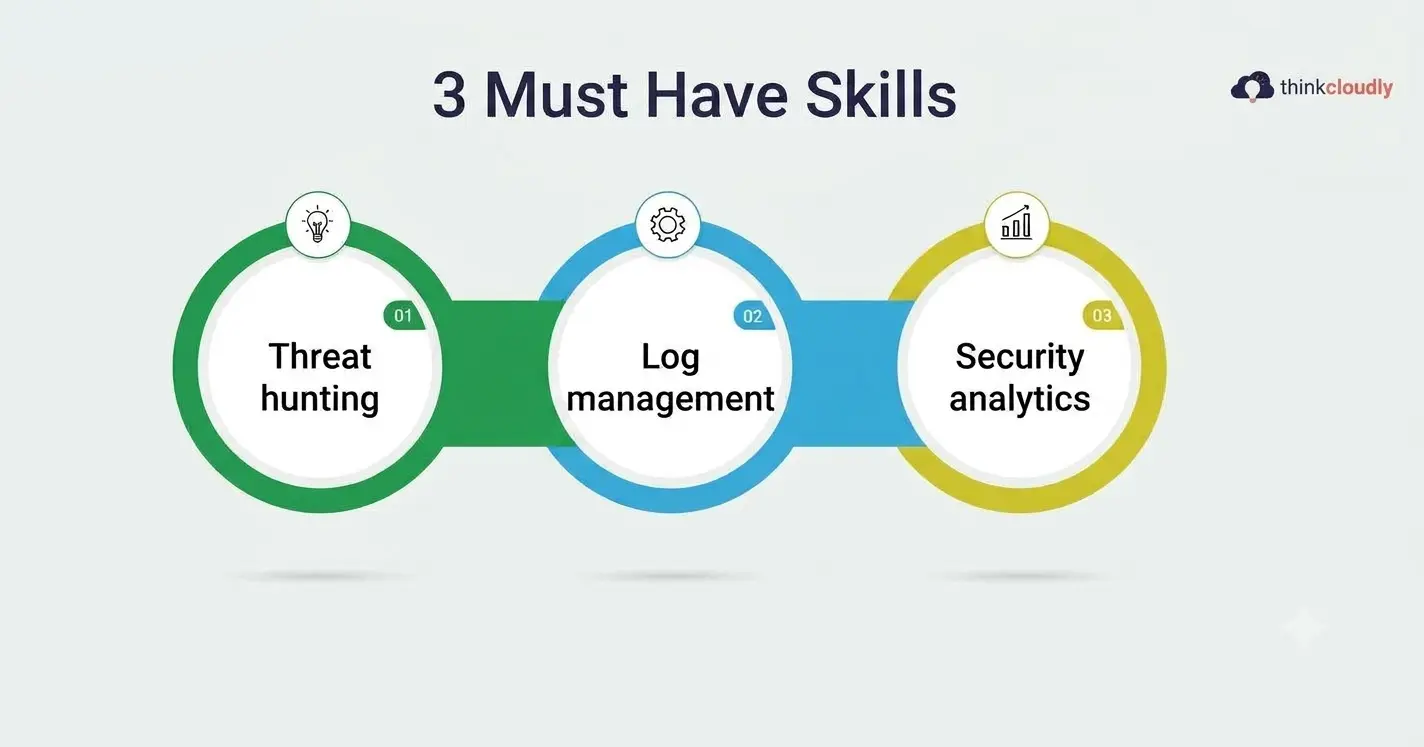
Three skills separate an analyst who gets promoted from one who plateaus at Tier 1.
1. Threat hunting
It means not waiting for the SIEM to flag something. It’s forming a hypothesis—”if an attacker pivoted through this service account, what would that look like in the logs?”—and then checking. Analysts who are genuinely good at this get pulled into incident response early, because they already think the way the people they’re defending against think.
2. Log management
It is less glamorous but arguably more foundational. If logs aren’t normalized, retained, and searchable across every system in scope, nothing else on this list is possible. An analyst who actually understands this discipline—not just how to run a query, but how data moves from source to SIEM—becomes the person everyone else asks when an investigation stalls at 2 a.m.
3. Security analytics
It is where a career bends upward. Turning twelve months of incident data into a chart that tells a CISO where to spend next year’s budget is a different skill from triaging alerts, and it’s the one that pulls analysts off the console and into strategy conversations.
None of this works without a less technical skill most job descriptions never mention: writing clearly under pressure. An incident write-up that a Tier 3 responder or outside counsel can act on in two minutes, during an actual breach, is worth more to a team than another dashboard nobody reads. Analysts who can explain what happened in plain language, fast, tend to get promoted ahead of peers with marginally stronger technical chops but weaker documentation habits.
Best SOC Certification Options to Become a Certified SOC Analyst
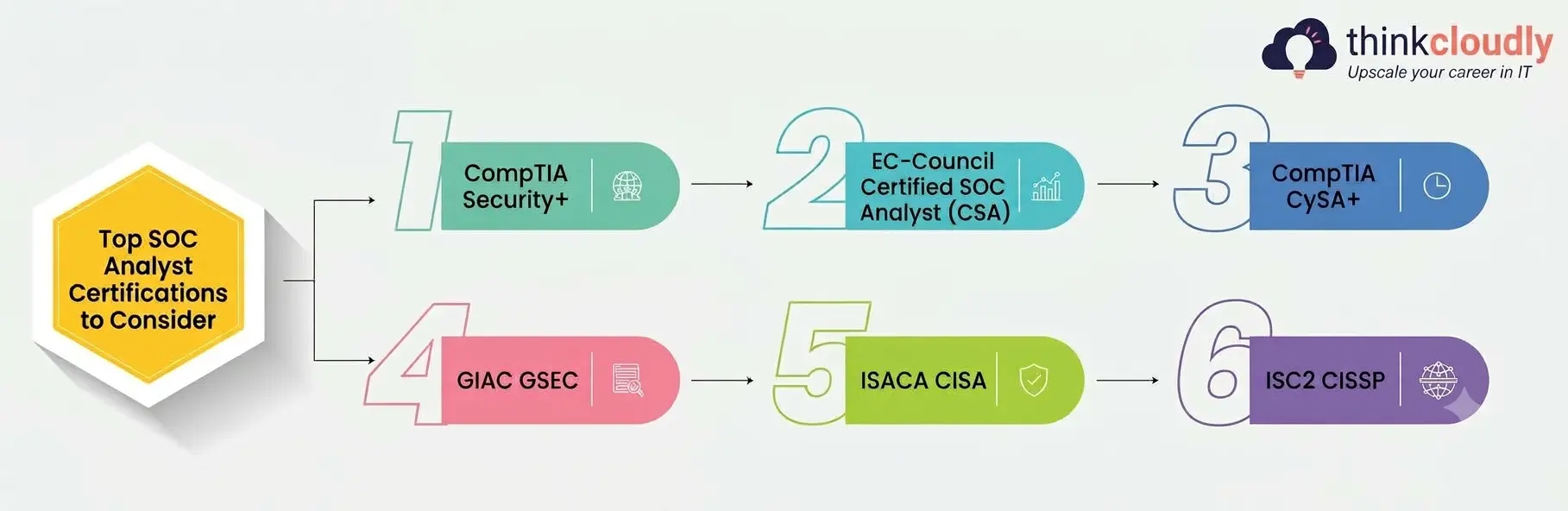
A quick caution before the list: collecting acronyms for their own sake is a waste of money and study time. The order below follows how most hiring managers actually read a résumé — starting broad, then narrowing into SOC-specific skills, and only later into governance or leadership tracks that matter less for someone still doing hands-on investigation work. There isn’t one correct path, but there is a sensible order, based on where most hiring managers actually set the bar, as mapped out in StationX’s certification guide:
-
CompTIA Security+ — the baseline most postings now assume by default
-
EC-Council Certified SOC Analyst (CSA) — exam code 312-39, 100 questions, three hours, 70% to pass; built specifically for Tier I/II analysts and arguably the most directly named entry point into the title
-
CompTIA CySA+ — behavioral analytics and threat detection, a natural second step
-
GIAC GSEC — more hands-on and technical than most CompTIA exams
-
ISACA CISA — for analysts moving toward audit, governance, or compliance-adjacent SOC work
-
ISC2 CISSP — the ceiling certification, usually pursued once someone is managing a team rather than staffing one
Stacking two or three of these in order, rather than chasing every acronym at once, is what actually moves a SOC analyst salary conversation in someone’s favor.
What the Next Two Years Look Like?
Nobody can promise exact numbers for 2027 — anyone who does is guessing with more confidence than the underlying data supports. What’s visible right now: AI-driven attacks are forcing SOCs to hire people who can supervise automated triage rather than do all of it by hand, Log Management and Security Analytics skills are turning into table stakes rather than specializations, and the UK’s near-30% jump suggests other regions facing similar hiring gaps could follow a comparable curve through 2027.
A certified SOC analyst who keeps stacking the right credentials and stays sharp on modern tooling is better positioned than almost anyone else in entry-to-mid cybersecurity hiring right now, and that gap looks likely to widen rather than close.
A Personal Note
I’ve gone through enough certification cycles myself to say this plainly: nobody passes an exam and walks straight into a six-figure senior role. Certifications open the door — they don’t carry anyone through it. What actually built my own grasp of this field was sitting with real, messy log data until the patterns stopped feeling random, and that part never shows up on an exam blueprint.
The exam questions are tidy; a real environment at 3 a.m. with four alerts firing at once is not, and no multiple-choice test fully prepares anyone for that gap. If you’re starting out, treat the certification as a floor, not a finish line, build a home lab if you can, volunteer for the messy investigations nobody else wants, and go find real data to practice on as soon as you possibly can. That’s the part that actually compounds into a career.