

A former student of mine spent four months in 2025 getting very good at prompting ChatGPT—writing emails, summarizing reports, and generating marketing copy. He thought that was the finish line.
Then his company rolled out an AI system that didn’t just draft a client follow-up email; it read the client’s account history, decided the follow-up was needed, scheduled it, sent it, and logged the outcome in the CRM without anyone asking it to. He messaged me, half excited and half panicked, asking, “Wait, is prompting even still a skill worth having?”
That question is really the agentic ai vs generative AI question in disguise, and in 2027 it’s the single most common confusion I see among students planning an AI career. Both terms get used interchangeably in job postings, but they don’t mean the same thing.
One writes. The other acts. This guide breaks down the real, practical difference, backs it with current 2027 data, and tells you which one deserves your study hours first.
What Is Generative AI?
Generative AI is the category most people already know, even if they’ve never used the term. It’s the branch of artificial intelligence that takes a prompt and produces something new in response—text, an image, code, a voice clip, or a video—by predicting the most statistically likely next piece of content based on patterns learned from huge training datasets. Tools like ChatGPT, Midjourney, and Claude itself are generative systems at their core: you ask, they generate, and the interaction typically ends there.
The defining trait of generative AI is that it’s reactive. It waits for an instruction, produces an output, and stops. It doesn’t independently decide to check whether the output was correct, doesn’t go fetch new information unless you tell it to, and doesn’t take any action in the real world on its own. It’s an extraordinarily capable collaborator, but it’s still fundamentally a response engine—brilliant artificial intelligence applied to a single turn of conversation at a time.
What Is Agentic AI?
Agentic AI is a newer, more autonomous layer built on top of the same underlying models—in practice, it’s intelligent automation given a reasoning engine instead of a fixed script. Rather than simply responding to a single prompt, an agentic system can set sub-goals, plan a sequence of steps, call external tools or APIs, evaluate its own output, and keep working through a multi-step task with minimal human nudging.
According to IBM’s own explainer on the technology, agentic AI systems are designed to pursue goals with limited supervision, using reasoning loops that let them adjust their approach mid-task rather than stopping after one response.
This is where the student’s panicked message comes back into focus. The system that emailed his client wasn’t just generating text — it was performing intelligent automation of an entire workflow: noticing a trigger condition, deciding on an action, executing it across multiple tools, and verifying the result.
That loop of perceive-plan-act-check is the real dividing line in the agentic ai vs generative ai debate, and it’s why agentic systems are being described as the next major shift in enterprise artificial intelligence rather than a minor upgrade to chatbots.
Agentic AI vs Generative AI: The Core Differences
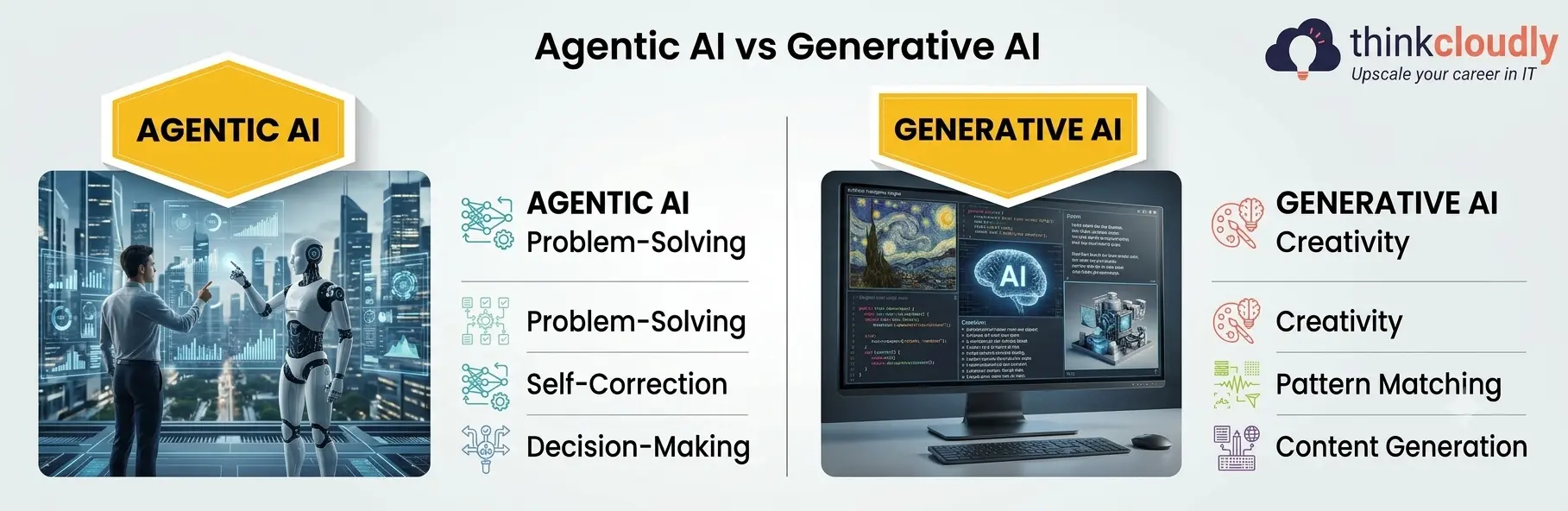
Here’s the comparison distilled into the points students ask me about most often—useful if you’re sketching this out as a quick infographic or study sheet:
- Scope of work: Generative AI handles one request at a time. Agentic AI chains together many requests, tools, and decisions to complete an entire multi-step objective without constant re-prompting.
- Autonomy level: A generative model waits for your next instruction. An agentic system decides its own next step based on intelligent automation logic it sets for itself mid-task.
- Memory and context use: Generative tools mostly work within a single conversation window. Agentic systems maintain state across steps, remembering what they already tried and why it did or didn’t work.
- Tool and API access: Generative AI typically stays inside the chat box. Agentic AI actively reaches outside itself—querying databases, triggering software, booking actions, or updating records.
- Error handling: A generative model will confidently produce a wrong answer and move on. An agentic system is built to notice a failed step and attempt a different path before reporting back.
- Human involvement: Generative AI needs a human at every turn. Agentic AI needs a human mainly to set the goal and guardrails, then checks back in only when the loop finishes or hits a wall.
- Best-fit use case: Generative AI shines at content creation—drafts, summaries, visuals. Agentic AI shines at process execution—running a customer support resolution end-to-end, managing a multi-step data pipeline, or coordinating several LLM applications together.
None of this makes generative AI obsolete. Most agentic systems are literally built using generative models as their reasoning core—the agent “thinks” in generated text even while it acts. The two aren’t rivals so much as two layers of the same technology stack, which is exactly why framing it as agentic AI vs generative AI as a strict either/or misses the more useful question: which layer should you be learning to build and manage?
Side-by-Side Comparison: Where Each One Wins
|
Dimension |
Generative AI |
Agentic AI |
|
Core function |
Produces content from a prompt | Plans and executes multi-step tasks |
| Autonomy | Low—waits for each instruction |
High—sets and pursues sub-goals |
|
Typical output |
Text, image, audio, video, code |
Completed workflows and decisions |
|
Tool/API use |
Rare, usually manual |
Core to how it operates |
|
Memory across steps |
Limited to session context |
Persists across the task lifecycle |
|
Example tools |
Claude, ChatGPT, Midjourney |
AI agent frameworks, autonomous copilots |
|
Risk profile |
Wrong or biased output |
Wrong action taken without review |
|
Career relevance |
Prompt engineering, content roles |
AI engineer skills, orchestration, oversight |
Read this table as a map of where effort pays off, not a verdict that one side is “better.” A marketing writer still needs generative fluency; a systems-minded builder benefits more from understanding how agentic loops are designed and supervised.
Where You’re Already Seeing Both, Whether You Notice or Not?
The agentic ai vs generative AI split isn’t theoretical—it’s showing up inside the LLM applications you already use. A generative layer writes the draft reply in your customer support tool; an agentic layer decides when to escalate the ticket, pulls the order history, and closes it out.
A generative model drafts a line of code when you ask; an agentic coding assistant can run the test suite, read the failure, and rewrite the broken function on its own before reporting back.
This blending matters because most real products aren’t purely one or the other anymore. Modern software increasingly stacks generative components for content and agentic components for orchestration, which means the practical skill isn’t choosing a side—it’s understanding how LLM applications combine both layers to get real work done reliably, safely, and without constant babysitting.
Gartner’s 2027 enterprise forecast puts a number on how fast this shift is happening: the firm projects that 40% of enterprise applications will feature task-specific AI agents by the end of 2027, up from under 5% just the year before.
That’s not a gradual trend—that’s a near-tenfold jump in twelve months, and it means the companies hiring right now are actively building for agentic workflows, not just generative chat features.
Career Opportunities in AI: Why This Debate Decides Your Job Search
Here’s the part students actually care about: career opportunities in AI are splitting along this exact line, and knowing the difference changes what you should study next. Roles tied purely to generative output—prompt writing, content generation, basic chatbot building—are getting more crowded and more commoditized as the tools themselves get easier to use.
Roles tied to agentic systems—designing the guardrails, building the tool integrations, monitoring autonomous decision loops, and handling the governance questions that come with letting software act on its own—are newer, scarcer, and paying accordingly.
The World Economic Forum’s January 2027 Davos coverage on jobs and skills transformation frames this directly: the skills employers are prioritizing right now are shifting faster than job titles can keep up, and the premium is landing on people who can manage and direct AI systems rather than simply use them.
That’s a meaningful signal for anyone mapping out career opportunities in AI this year—the advantage goes to whoever understands both layers, not just the one that’s easier to learn first.
Upwork’s own 2027 research into in-demand skills backs this up from the freelance and contract side of the market: its In-Demand Skills 2027 report shows employer demand increasingly concentrated around people who can implement and oversee AI-driven workflows, not just produce content with AI assistance.
If you’re weighing career opportunities in AI against career opportunities in a more traditional software track, this is the data point worth sitting with—the demand curve is bending toward builders and overseers of intelligent automation, not just prompt writers.
AI Engineer Skills You Need for Either Path
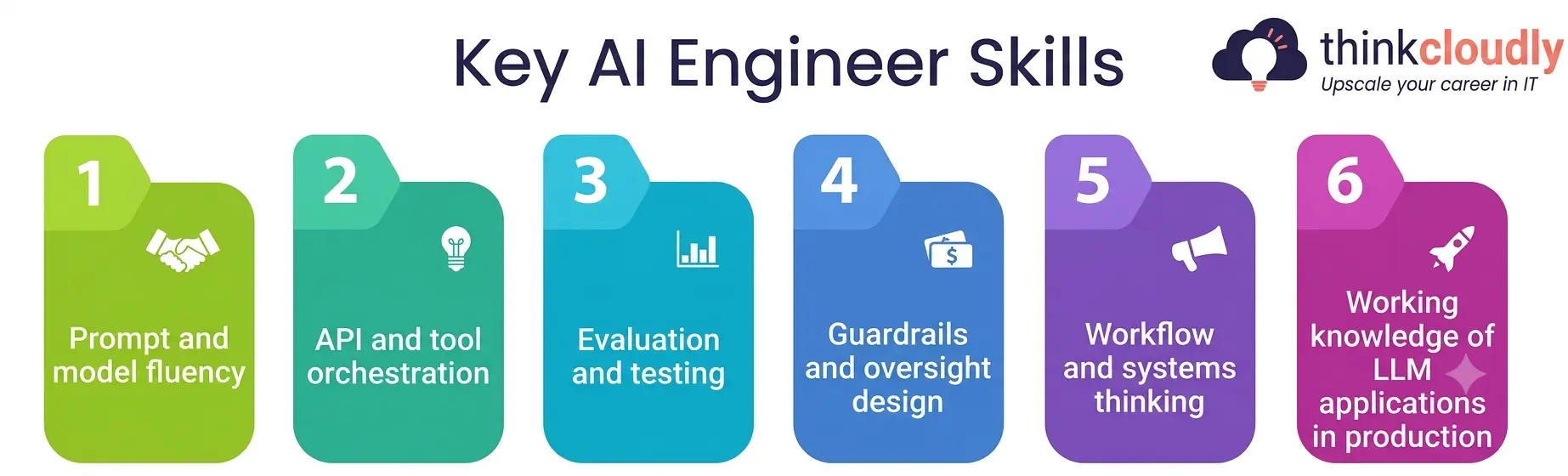
If you’re serious about building a career here, these are the AI engineer skills that actually show up in 2027 job postings, grouped by which side of the agentic ai vs generative ai divide they support:
-
Prompt and model fluency: Understanding how large language models generate output, including context windows, temperature settings, and failure modes, still underpins everything else—this is foundational artificial intelligence literacy, not optional background knowledge.
- API and tool orchestration: Agentic systems live or die on how well they’re wired into external tools, databases, and software—learning to connect an LLM to real systems is one of the highest-value AI engineer skills right now.
- Evaluation and testing: Knowing how to measure whether a generative output or an agentic decision was actually correct — not just plausible-sounding — separates hobbyists from hireable engineers, especially once your LLM applications are handling real customer data instead of demo prompts.
- Guardrails and oversight design: Because agentic systems act without constant approval, understanding how to build in checkpoints, permissions, and rollback logic is quickly becoming a core and well-paid specialty.
- Workflow and systems thinking: Agentic AI is fundamentally about chaining steps together, so comfort mapping out a full process — not just a single clever output — matters more here than raw coding speed.
- Working knowledge of LLM applications in production: Understanding how companies actually deploy these systems at scale, including cost, latency, and reliability trade-offs, is what moves a candidate from “knows AI” to “can ship AI.”
Notice that none of these require you to abandon generative AI skills to pick up agentic ones — they build directly on top of each other, which is the most practical reason not to treat agentic ai vs generative ai as a fork in the road you have to permanently choose.
So Which One Should You Learn First?
If you’re brand new to this field, start with generative AI fundamentals — prompt design, model behavior, and basic artificial intelligence concepts — because agentic systems are built on top of that foundation and won’t make sense without it. Once that’s solid, usually within a few focused months, move toward agentic AI: tool integration, multi-step orchestration, and oversight design.
That sequence, not a forced choice, is how most working AI engineers I talk to actually built their skill set, and it’s the most realistic path if you’re weighing career opportunities in AI as a student rather than guessing which buzzword will still matter in two years. Treat the move from generative fluency to intelligent automation as a staircase, not a cliff edge, and the whole field feels far less intimidating.
The honest answer to agentic ai vs generative ai, in other words, isn’t “pick one.” It’s “learn generative AI to get in the door, then learn agentic AI to become the person companies can’t easily replace.”
A Personal Note
I’ll be honest about something most career guides won’t say out loud: I didn’t take agentic AI seriously until I watched it make a decision I hadn’t told it to make. Up to that point, I’d treated every AI tool as a very fast typist — useful, impressive, still fundamentally waiting on me.
The moment that changed was small and a little unsettling, the same way it was for my former student. It’s a strange thing to admit, but that discomfort is exactly why I think this topic deserves more attention from students than it’s currently getting. The tools that just generate are easy to get comfortable with quickly.
The tools that act on their own are the ones that will quietly decide who’s indispensable at work five years from now — and getting curious about that early, even before it feels urgent, is the best career advice I can offer anyone reading this.