




Every CTO eventually hits the same wall: the business is growing faster than the security team can scale. Workloads move to the cloud, attack surfaces multiply, and the question that used to be a “someday” conversation becomes a board-level decision this quarter—do you build an internal team, or do you hand the job to a managed cloud security partner?
There’s no universal right answer here, and anyone who tells you otherwise is selling something. But there is a right answer for your organization, and it depends on a handful of factors. Most companies don’t actually sit down and weigh before they commit to a budget.
This piece walks through what it actually takes to outsource cloud protection, what running security in-house really costs—not just in salary, but in time and risk—and how to make the call without guessing.
What Is Managed Cloud Security?
Managed cloud security means handing the day-to-day protection of your cloud infrastructure—AWS, Azure, Google Cloud, or a hybrid setup—to a third-party provider that specializes in exactly that. Instead of hiring, training, and retaining your own analysts, you pay a provider to monitor your environment, hunt for threats, patch misconfigurations, and respond when something goes wrong.
Most providers bundle a few core pieces into their offering: continuous monitoring, vulnerability management, identity and access governance, compliance reporting, and round-the-clock security incident response. The pitch is simple—you get enterprise-grade cloud security solutions without having to build an enterprise-grade team from scratch.
What Does In-House Security Actually Involve?
In-house security is the traditional model: you hire your own engineers, analysts, and architects, and they live inside your organization full-time. They know your systems intimately, they’re available on Slack five seconds after something breaks, and they answer only to you.
The catch is cost and talent. Building a real internal team doesn’t mean hiring one person who does everything—it means covering detection, response, compliance, cloud architecture, and threat intelligence, often across multiple time zones if you need round-the-clock coverage.
That’s rarely one hire. It’s five, six, or sometimes more, and each one is hard to find and harder to keep in a market where every company is competing for the same small pool of people.
There’s also a quieter cost that rarely makes it into a budget spreadsheet: burnout. Analysts who are on call every night eventually leave, and when they go, they take months of tribal knowledge about your systems with them.
Replacing a single experienced hire can take four to six months in a tight labor market, during which the remaining team absorbs the gap—which is exactly how a staffing shortage turns into an actual incident.
Comparing the Two Models: Key Differences at a Glance
Here’s a side-by-side look at how the two approaches actually compare once you move past the sales pitch on either side.
|
Factor |
Managed Cloud Security |
In-House Security |
|
Setup time |
Days to a few weeks |
Months to over a year |
|
Coverage |
24/7/365 as standard | Often limited to business hours unless staffed in shifts |
| Upfront cost | Subscription or retainer fee |
Salaries, benefits, tooling, training |
|
Access to specialists |
Broad bench across threat types |
Limited to whoever you hired |
|
Institutional knowledge |
Built over time, shared across clients | Deep, specific to your systems |
| Scalability | Scales with contract terms |
Scales with hiring cycles |
|
Compliance support |
Usually included | Needs dedicated staff or consultants |
| Control over response | Shared, defined by SLA |
Full, immediate |
Neither column wins outright. A company that handles extremely sensitive data under strict regulatory oversight may lean toward keeping the response fully in-house even if it costs more. A fast-growing startup with no security hires yet will almost always get protection running faster by outsourcing than by trying to recruit a team from zero.
Picture two companies: a 40-person fintech startup and a 2,000-employee hospital network. The startup has no security hires at all and a product launch in six weeks—waiting a year to build a team isn’t realistic, so an outsourced setup is the obvious starting point.
The hospital network already has a compliance department, handles protected health information under strict regulation, and has the budget to keep specialists on staff around the clock. Same underlying decision, two very different right answers.
Key Benefits of Managed Cloud Security
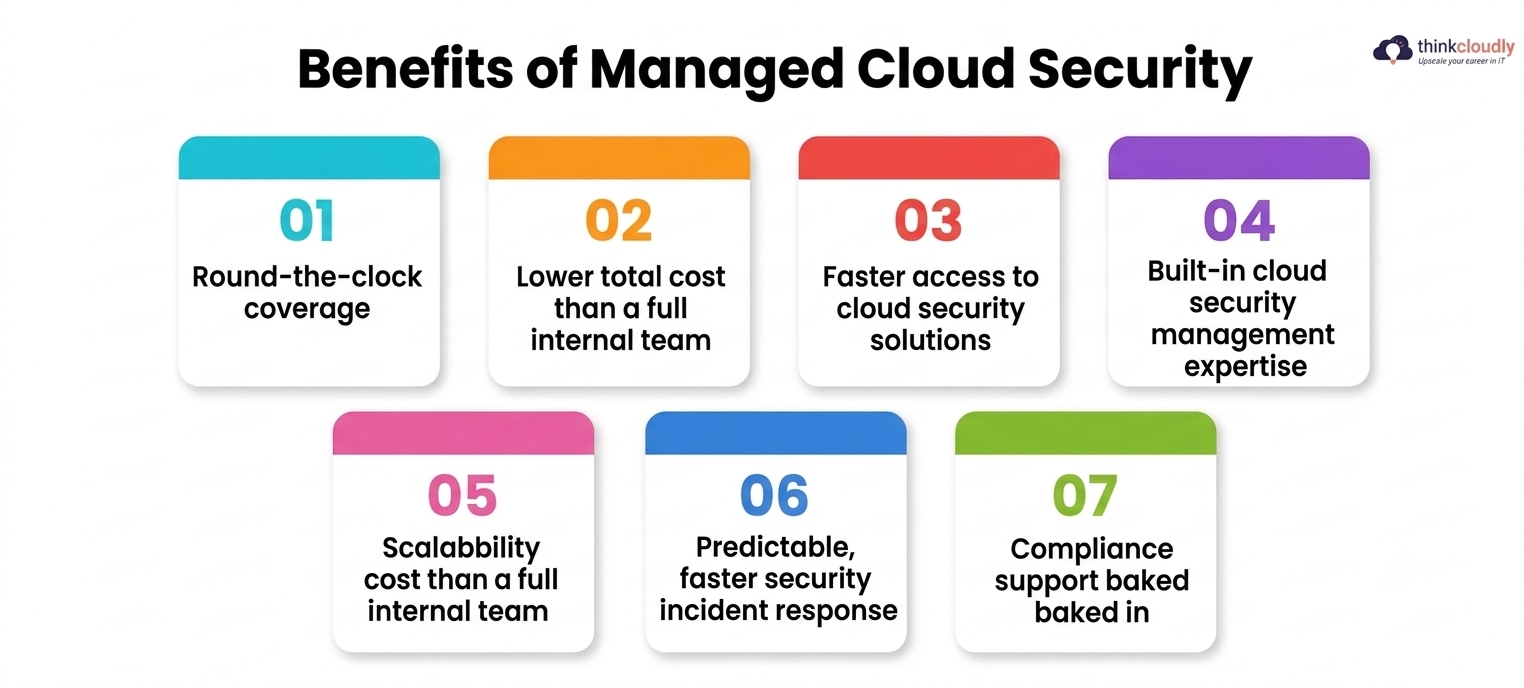
If you’re building a case for leadership, or sketching this out for a slide, these are the points that tend to matter most:
-
Round-the-clock coverage — threats don’t wait for business hours, and a provider’s security operations center (SOC) runs continuously, including nights, weekends, and holidays.
-
Lower total cost than a full internal team — you avoid the combined salary load of five-plus specialized hires, plus the tooling and training that go with them.
-
Faster access to cloud security solutions — providers already run the monitoring, scanning, and automation stacks, so you’re not building that infrastructure from scratch.
-
Built-in cloud security management expertise — providers see attacks across hundreds of client environments, which means they recognize patterns a single in-house team would rarely encounter often enough to spot quickly on its own.
-
Predictable, faster security incident response — most contracts include defined response-time guarantees, so you know exactly how fast a threat gets contained.
-
Compliance support baked in — many providers already map their controls to frameworks like SOC 2, ISO 27001, and HIPAA, which saves months of internal audit prep.
-
Scalability without a hiring cycle — when your cloud footprint grows, your protection grows with it, without a six-month recruitment process.
The flip side is real too: you’re trusting a third party with sensitive access, and the relationship only works if the provider is genuinely good and genuinely responsive—not every vendor in this space is.
Why Are More Companies Turning to Outsourced Cybersecurity Services?
The honest reason isn’t trendiness—it’s math. According to a study, 33% of security leaders say their teams lack the resources to staff adequately, and 95% report at least one meaningful skills gap on their team, with cloud security itself ranking as the second most-cited critical skill shortage after AI. When the talent simply isn’t available to hire, outsourced cybersecurity services stop being a cost-cutting shortcut and start being the only realistic way to get coverage at all.
There’s a financial argument too. IBM’s Cost of a Data Breach Report puts the global average cost of a breach at $4.99 million, and organizations now take an average of 247 days to identify and contain an incident—longer than in prior years.
A delay of that length turns a contained problem into a genuinely catastrophic one. Providers offering outsourced cybersecurity services are built around shrinking that exact window, because faster containment is the entire value proposition they’re selling.
That pressure is reshaping the market itself. Analysts now project the global managed security services market will top $100 billion by the end of 2027, driven almost entirely by this same gap between the threats companies face and the staff available to fight them. That kind of growth is a clear sign this model has moved from “nice to have” to default infrastructure for a large share of mid-sized businesses.
Part of what’s driving this isn’t just the talent shortage—it’s the nature of the threats themselves. Attackers increasingly use automation to probe for weak cloud configurations at a scale no small internal team can realistically watch by hand around the clock. That shift alone is pushing many companies that swore they’d always stay fully in-house to reconsider.
The Role of a Security Operations Center (SOC) in Cloud Security Management
Whether it’s run internally or by a provider, a security operations center (SOC) is the nerve center of any serious cloud security management program. It’s where alerts get triaged, where logs from dozens of tools get correlated into something a human can actually act on, and where the decision gets made about whether something is noise or a genuine incident.
Running your own security operations center (SOC) is expensive and operationally heavy—it needs staff around the clock, tooling that integrates across your entire stack, and constant tuning so analysts aren’t drowning in false positives. That’s exactly why so many mid-sized companies choose managed cloud security instead of building a 24/7 SOC from the ground up: the cloud security management overhead of running it well, every single day, is bigger than most teams expect going in.
A well-run security operations center (SOC)—whether outsourced or internal—is what turns cloud security solutions from passive dashboards into something that actually stops an attacker mid-breach, which is really the whole point of paying for any of this in the first place.
Signs Your Business Needs Better Security Incident Response
Not sure which side of this decision you’re on yet? These are the warning signs that your current setup—whatever it is—doesn’t cut it:
- Your team finds out about incidents from customers or outside researchers before your own monitoring flags them.
- There’s no documented security incident response plan, or the one you have hasn’t been tested in over a year.
- Cloud misconfigurations get discovered during audits instead of in real time.
- One or two people hold all the institutional knowledge about your security tooling, and they’re both on vacation at the same time more often than you’d like.
- Compliance reporting takes weeks of manual work every quarter instead of being continuously ready.
- Your last breach took days to fully contain rather than hours.
- You’ve delayed cloud migrations or new feature launches specifically because security couldn’t keep pace.
If three or more of these sound familiar, it’s less a question of whether to change your approach and more a question of how fast you can move on it.
Choosing Between Managed Cloud Security and In-House Security: A Decision Framework
A few honest questions tend to settle this faster than any pros-and-cons list ever will.
First, can you actually hire the specialists you need, at the salary your budget allows, in the next six months? If the answer is no, managed cloud security isn’t a compromise — it’s the only realistic path to real coverage in a reasonable timeframe.
Second, how sensitive is your data, and how heavily regulated is your industry? Healthcare, finance, and government workloads often justify a hybrid model: in-house staff for strategy, oversight, and the most sensitive decisions, paired with cloud security solutions and outsourced monitoring for the round-the-clock grind.
Third, what does your growth curve look like over the next two years? A company scaling fast benefits enormously from the elasticity of an outsourced model, since contracts flex with usage in a way that headcount simply doesn’t.
Fourth — and this is the one people skip — how good is the specific provider you’re evaluating? This isn’t one standardized product; quality varies enormously between vendors, so the real decision isn’t “outsource or not,” it’s which outsourced cybersecurity services partner actually earns the trust.
Fifth, how will this decision look in three years, not just this quarter? A provider relationship that saves money today but locks you into rigid contract terms, or an internal team you can’t realistically scale back down, both create friction later. Build an exit ramp either way.
Most mature organizations don’t pick one model forever. They start with an outsourced setup while they’re small, build internal capability as they grow, and often land on a hybrid approach that keeps strategic control in-house while leaning on external cloud security management for the operational heavy lifting.
The Bottom Line
Managed cloud security and in-house security aren’t really competitors — they’re tools suited to different stages of a company’s life and different risk profiles. If you’re small, growing fast, or simply can’t find the specialists you need, this approach gets you real protection now instead of a half-built team in eighteen months. If your data is uniquely sensitive or your industry demands tight internal control, a stronger in-house investment — possibly blended with outsourced support for the round-the-clock grind — makes more sense. Either way, the goal is the same: faster detection, a tighter security posture, and a security incident response process that doesn’t take 247 days to close a gap that should’ve been shut in hours.
A Personal Note
I’ve sat in enough budget meetings to know this decision rarely gets made with a clean spreadsheet — it gets made under pressure, usually right after something almost went wrong. If there’s one thing I’d tell a founder or IT lead weighing this today, it’s don’t wait for the near-miss to force the decision.
Whether you end up fully in-house, fully outsourced, or somewhere in between, the organizations that handle this well are the ones that treated it as a deliberate choice instead of a reaction. Ask yourself the uncomfortable questions about your own gaps now, while you still have the luxury of time to answer them properly, instead of during an incident review six months from now.
I’ve also seen the opposite mistake — companies that outsource everything and then lose the internal fluency needed to even judge whether their provider is doing a good job. The goal isn’t to disappear from your own security program; it’s to spend your limited attention where it actually moves the needle.