





Here’s something most “learn to code” articles won’t tell you: the fastest-growing part of the AI hiring market right now isn’t engineers. It’s everyone around them—the writers, trainers, researchers, policy specialists, and project coordinators who make AI products usable, safe, and understandable for actual humans. If you’ve been putting off a move into tech because you assumed you needed Python first, that assumption is exactly what’s holding you back, and it’s simply out of date.
A career in AI without a coding is not a consolation prize or a workaround. It is a real, fast-growing, well-paid lane into one of the most active job markets in the world, and it’s one that plenty of beginners are walking into right now without ever opening a code editor.
This guide walks through why that’s true heading into 2027, which roles are actually hiring, what skills you need to build instead of syntax, and how to plan your first six months so you’re not guessing your way through it. If you’ve searched for “artificial intelligence jobs for beginners” and come up with nothing but engineering listings, that’s a search problem, not a sign the door is closed.
Why 2027 Is the Right Time to Build a Career in AI Without Coding?
The scale of change happening in the labor market right now is hard to overstate, and it’s the single biggest reason a career in AI without coding makes sense today rather than five years ago.
According to the World Economic Forum’s Future of Jobs Report, 86% of employers expect AI and information processing to transform their business by 2030, and the resulting churn is projected to create roughly 170 million new jobs against 92 million displaced—a net gain of about 78 million positions. That’s not a story about fewer jobs. It’s a story about different jobs, and a huge share of them don’t require a computer science degree.
The skills data backs this up just as clearly. The same WEF report found that workers can expect 39% of their current skills to be transformed or made obsolete by 2030, and AI and big data now sit at the very top of the fastest-growing skills list—ahead of cybersecurity, ahead of technology literacy, and ahead of almost everything else employers are hiring for.
Separately, LinkedIn’s hiring data reported through CIO Dive shows that job postings requiring general AI literacy grew more than 70% year over year—and AI literacy, notably, is not the same thing as programming ability. It’s the ability to understand, direct, evaluate, and communicate about AI systems, which is precisely what non-coding roles are built around.
Put simply, companies are hiring faster than they can train engineers, and they’re filling the gap with people who understand AI conceptually and can apply it to real business problems. That’s the opening driving so much of today’s demand for AI jobs without coding—and it’s part of why AI jobs for freshers now show up in places a job search five years ago never would have pointed to.
Is a Career in AI Without Coding Really Possible?
Skepticism here is fair, because for years “AI job” quietly meant “machine learning engineer” and nothing else. That’s no longer accurate, and it’s worth separating the myth from how hiring actually works in 2027.
Most AI products fail or succeed based on things that have nothing to do with code: whether the training data was labeled correctly, whether the chatbot’s tone matches the brand, whether the model’s outputs were fact-checked before shipping, whether the rollout followed internal policy, and whether users actually understood how to use the tool.
Companies rolling out customer-facing chat assistants, for instance, often need a larger review and training team than an engineering team, simply because every response has to be checked, tuned, and improved by a human before it reaches a customer.
None of that requires writing a function. All of it requires a human who understands AI well enough to make good judgment calls about it—which is exactly the profile companies are hiring for under titles like AI trainer, prompt writer, AI policy specialist, and AI content reviewer.
This is also why artificial intelligence jobs for beginners look so different from the software engineering postings people expect. A beginner isn’t competing against five years of coding bootcamps and computer science degrees.
They’re competing on communication, judgment, domain knowledge, and willingness to learn the tools—a much more level playing field, and one where a career in AI without coding has a genuinely fair shot. For the same reason, AI jobs for freshers rarely ask for a portfolio of production code; they ask for proof that you can think clearly about how an AI system should behave.
Skills You Need for AI Jobs Without Coding
These are the skills that actually show up across non-technical AI job postings right now. Treat this as your starting checklist, not a nice-to-have list:
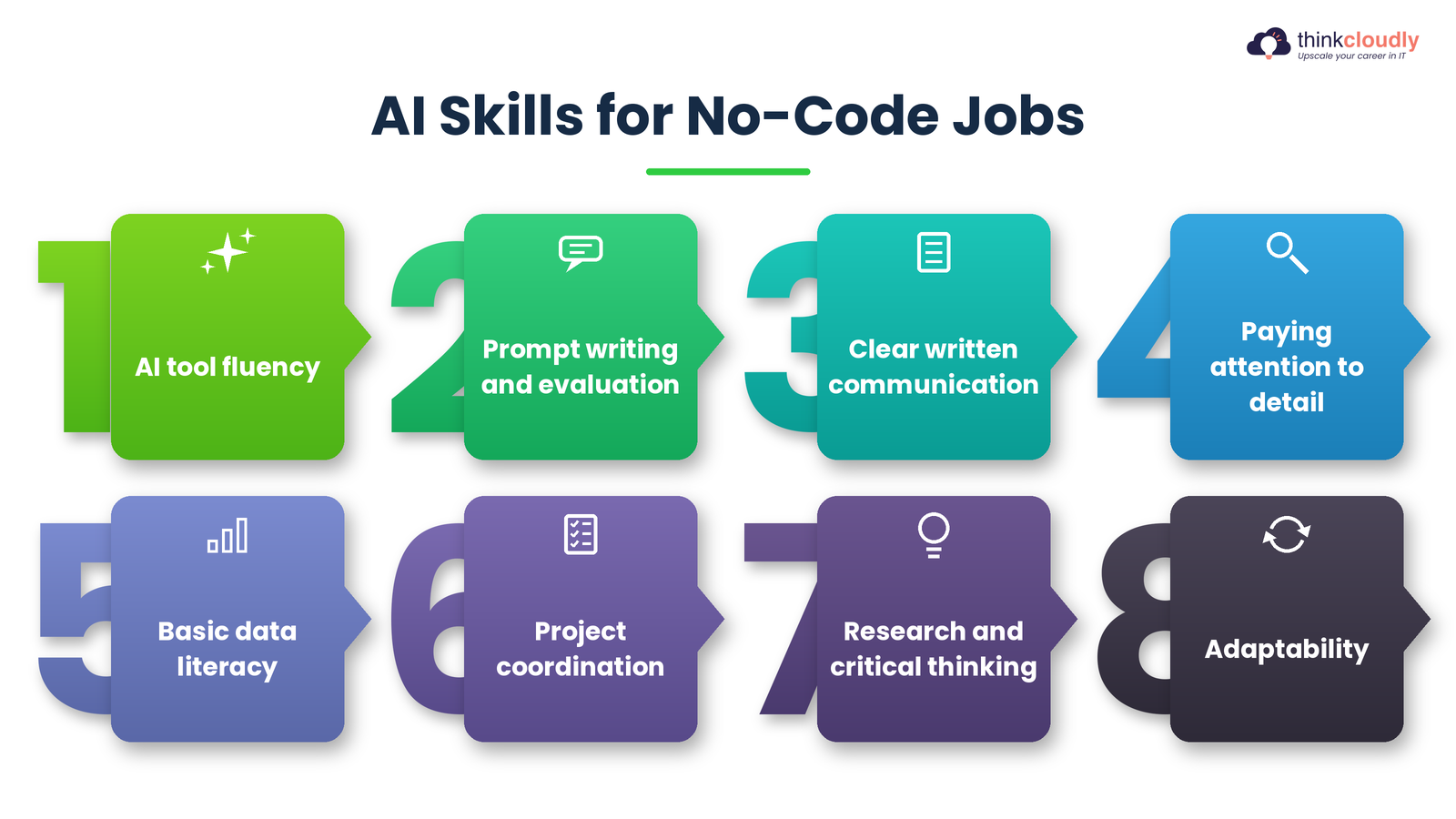
- AI tool fluency — hands-on comfort using tools like ChatGPT, Claude, Midjourney, or Jasper well enough to direct them, not just chat with them casually.
- Prompt writing and evaluation — knowing how to phrase instructions clearly and judge whether an AI’s output is actually good, accurate, or on-brand.
- Clear written communication — explaining how an AI feature works, writing FAQs, or documenting a decision in plain language a non-technical stakeholder can follow.
- Paying attention to detail — relevant for annotation, fact-checking, and review jobs where a small missed error affects model training or user trust.
- Basic data literacy — reading a dashboard, spotting a trend, or understanding what a metric actually measures, without requiring you to build the dashboard yourself.
- Project coordination — managing deliverables, deadlines, and handoffs between technical and non-technical teams.
- Research and critical thinking — digging into a topic, verifying sources, and spotting where an AI model’s answer might be wrong or biased.
- Adaptability — the tools themselves change every few months, so comfort learning new interfaces matters more than mastering any single one.
None of these require a line of code, and all of them are teachable through short courses, free tutorials, and hands-on practice with the tools themselves—which is part of why the best AI careers for beginners keep showing up in hiring reports as some of the fastest-filled junior roles in tech.
Best AI Careers for Beginners at a Glance
Here’s a realistic snapshot of where beginners are actually landing, based on current hiring and pay data rather than inflated marketing claims:
|
Role |
Typical Starting Pay (Annual) | Core Skill Required |
Coding Needed? |
|
AI Content Reviewer / Fact-Checker |
49,000–88,000 | Attention to detail, research |
No |
|
Prompt Writer / AI Conversation Designer |
~50,000–88,000 | Clear writing, tool fluency | No |
| Data Annotator / AI Trainer | 65,000–120,000 | Precision, domain knowledge |
No |
|
AI Project Coordinator |
60,000–95,000 | Organization, communication | No |
| AI Policy Support Specialist | ~$100,000 average | Research, regulatory awareness |
No |
|
AI Social Media / Marketing Specialist |
~$54,000 average | AI tool use, content strategy |
No |
These figures come from current market data on AI jobs for non-technical professionals, and they reflect U.S. market averages—actual pay varies by company size, location, and experience. The pattern worth noticing is that pay scales with responsibility and domain expertise, not with how close the role sits to a codebase.
Steps to Build Your AI Career Path for Beginners
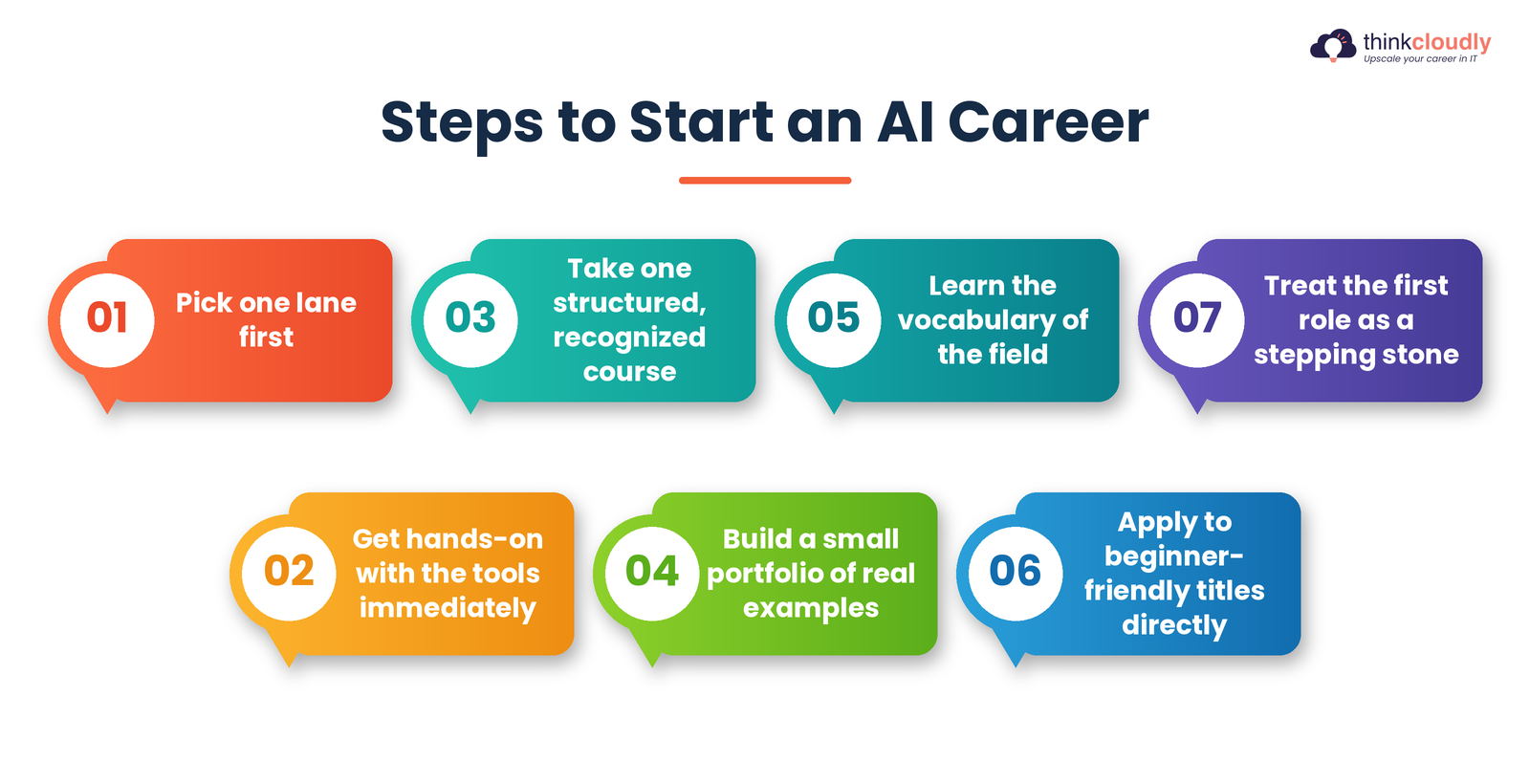
A realistic AI career path for beginners follows a sequence, not a sprint. Here’s the order that actually works:
-
Pick one lane first. Don’t try to become a prompt writer, policy specialist, and data annotator at once. Choose the role that matches your existing background—a teacher gravitates toward AI training roles, a writer toward prompt design or content review.
-
Get hands-on with the tools immediately. Spend real hours inside ChatGPT, Claude, or similar tools daily. Reading about prompting is not the same as practicing it on real tasks.
-
Take one structured, recognized course. A short, focused certificate beats three unfinished ones. Pick a single credible program and finish it before starting another.
-
Build a small portfolio of real examples. Three or four documented examples—a set of prompts you refined, a fact-check you performed, a workflow you improved—carry more weight than a certificate alone.
-
Learn the vocabulary of the field. Terms like fine-tuning, hallucination, context window, and bias testing come up constantly in interviews, even in non-technical roles.
-
Apply to beginner-friendly titles directly. Search for the specific role names above rather than generic “AI jobs,” which pulls up engineering postings that don’t match your skill set.
-
Treat the first role as a stepping stone. Most people who build a lasting career in AI without coding move up from a junior annotation or support role into strategy, training, or policy work within a year or two.
Where to Find Artificial Intelligence Jobs for Beginners?
Finding AI jobs without coding—and AI jobs for freshers specifically—is less about hunting rare postings and more about knowing where to look and how to search. A few practical starting points:
- Search job boards using exact phrases like “AI trainer,” “prompt writer,” “AI content reviewer,” and “AI policy associate” instead of the broad term “AI job.”
- Freelance platforms list a large volume of short-term AI annotation, review, and prompt-writing contracts, which are often the fastest way to gain real experience.
- Company career pages for AI-focused firms frequently post non-engineering roles under “Trust & Safety,” “AI Operations,” or “Content” rather than “Engineering,” so check those sections specifically.
- Entry-level, structured programs are built specifically for non-technical learners and double as a credible first credential on a resume.
- AI jobs for freshers rarely start with a single dream job appearing in a search. They start with a handful of smaller roles that build real, describable experience.
Common Mistakes Freshers Make When Starting a Career in AI Without a Coding
A few patterns show up again and again among people chasing AI jobs for freshers, and most of them are avoidable:
- Assuming every AI job requires Python. This single misconception stops more beginners than any actual skills gap does.
- Collecting certificates instead of finishing one. A stack of half-done courses is weaker than one completed program paired with real examples.
- Ignoring the business side of AI entirely. Roles in policy, strategy, and operations value people who understand how AI affects a business, not just how the tool works.
- Applying only to “AI Engineer” titles. This filters out the dozens of non-technical postings that match a beginner’s actual skill set.
- Underestimating how fast the tools change. Treating one AI tool as the only one worth learning leaves a gap when the market shifts, which it does every few months.
Final Thoughts
There is no shortcut version of any AI career path for beginners that skips the groundwork, but there’s also no requirement that the groundwork involve code. The people who successfully build a career in AI without coding share a pattern: they pick one lane, get genuinely comfortable with the tools rather than just curious about them, finish one credible course instead of starting five, and apply to the specific roles that match their actual background instead of waiting for a perfect title to appear.
Among the best AI careers for beginners, the ones with staying power are the ones built on judgment, communication, and domain knowledge — exactly the things a non-technical background already gives you a head start on.
A personal note
I’ve watched this exact shift happen with people who had every reason to assume AI wasn’t for them — a former customer support lead who now trains chatbot responses for a living, a content editor who moved into AI fact-checking within four months of starting. Neither of them learned to code, and neither needed to.
What they had in common was that they stopped waiting to feel “technical enough” and started practicing with the tools directly, every day, on real tasks. If you’re reading this wondering whether you’re the exception who can’t make this work, you’re probably not. You’re just at the part of the process that happens before anyone notices you.