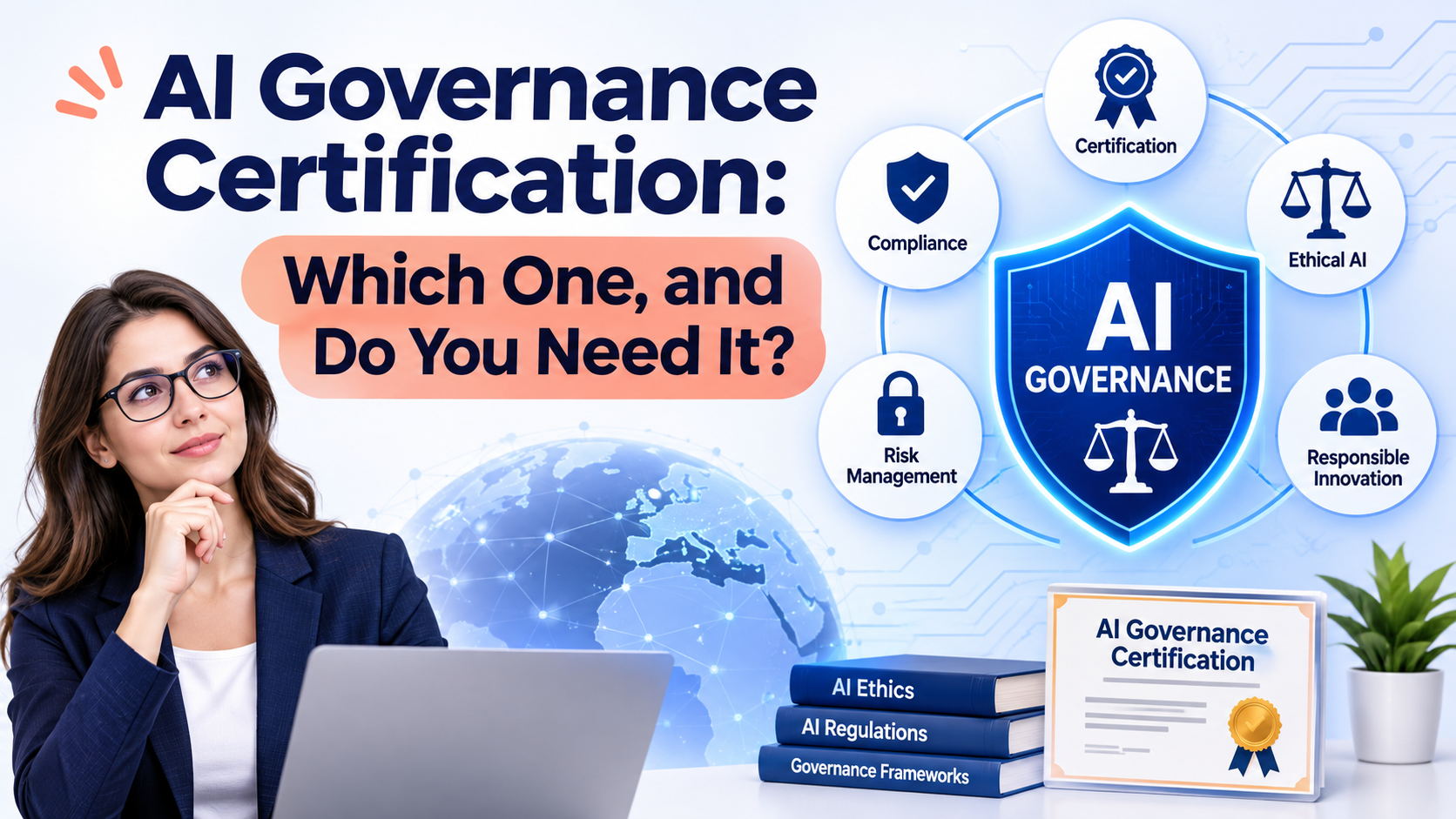






A year ago, “AI governance” was the kind of phrase that showed up in a conference keynote and nowhere else. In 2027, it shows up in job descriptions, procurement checklists, and board meeting minutes.
That shift is exactly why so many professionals are now asking a more practical question: is an AI governance certification actually worth pursuing, or is it another badge that looks good on a profile and does little else?
This guide walks through what an AI governance certification actually covers, how the major options differ, and how to decide — honestly, without the marketing gloss — whether you personally need one right now.
Why Is AI Governance Certification Suddenly Everywhere in 2027?
The timing isn’t random. Three things converged at once, and together they explain why this credential moved from “nice to have” to something recruiters actively screen for.
- First, regulation caught up with deployment. The EU’s AI Act moved into its higher-risk enforcement phases through 2026 and into 2027, and companies operating anywhere near the EU market—not just companies headquartered there—had to show documented compliance processes, not just good intentions.
- Second, the NIST AI Risk Management Framework became the default reference point for how US organizations structure their own internal AI governance programs, even outside regulated industries.
- Third, ISO/IEC 42001, the first international management-system standard built specifically for AI, gave organizations something they’d been missing for years: a certifiable, auditable AI governance framework rather than a loose set of internal guidelines.
Put those three together and you get a labor market where simply citing responsible AI principles is no longer enough on its own. Employers want evidence that a candidate can actually operationalize good governance—write policy, run a risk assessment, document a model’s lifecycle from design to retirement—not just talk about AI ethics in the abstract.
Gartner’s own 2027 guidance to technology leaders has repeatedly flagged AI governance roles and related risk-and-compliance functions as among the fastest-growing hiring categories inside IT and legal teams, which is a strong signal that this is a durable shift in hiring, not a short-lived fad tied to one product cycle.
None of that means every professional needs to drop everything and chase a credential immediately. But it does mean the conversation around this topic has shifted from theoretical to career-relevant, fast.
What “AI Governance” Means Before You Certify?
Before comparing programs, it helps to pin down the vocabulary, because these terms get used loosely, and that looseness is exactly what makes shopping for a credential in this space confusing. Here’s the short version, broken into the pieces that actually matter:
-
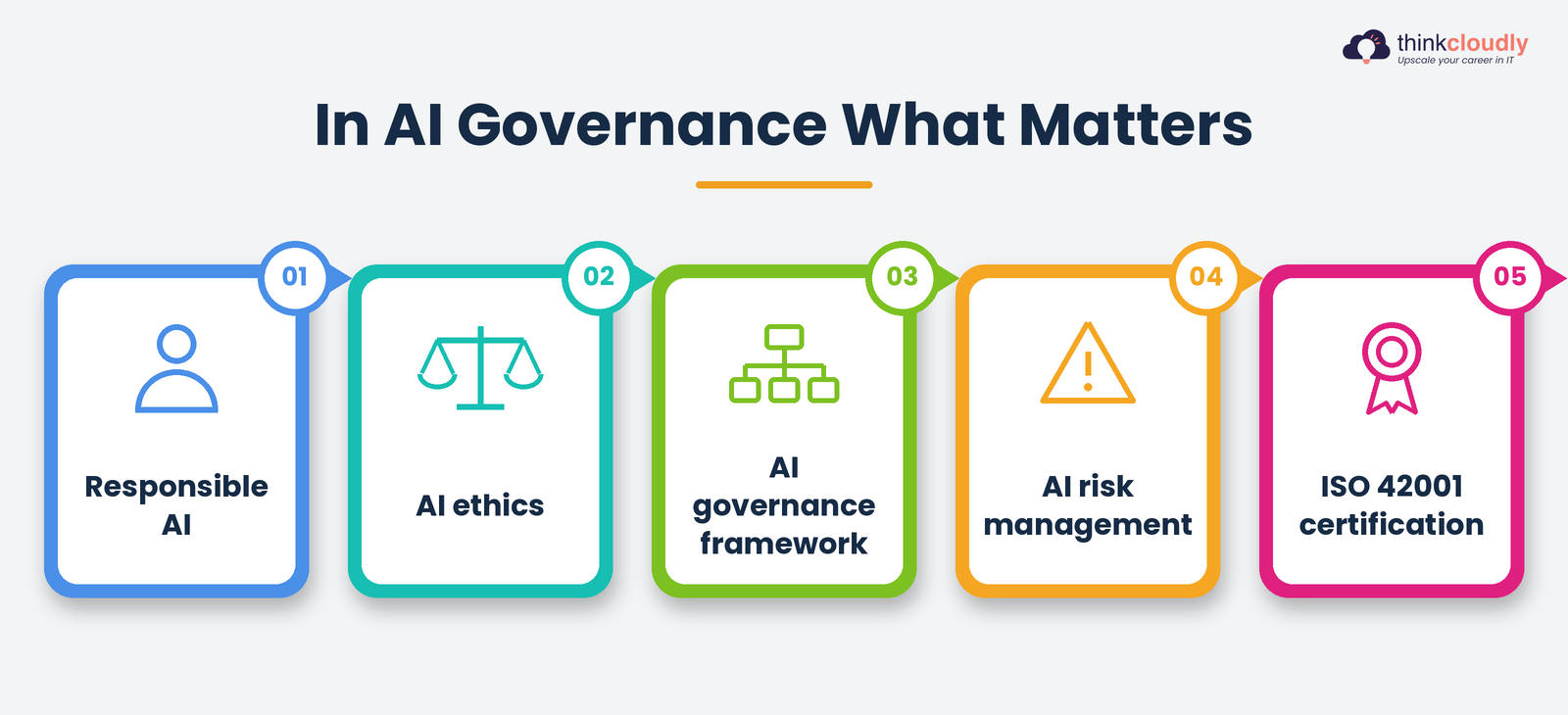
Responsible AI — the broad practice of building and deploying AI systems that are fair, transparent, and accountable, covering everything from data sourcing to model explainability.
-
AI ethics — the underlying principles (fairness, non-maleficence, human oversight) that responsible practices are supposed to put into action; this is the “why,” and governance is the “how.”
-
AI governance framework — the documented structure an organization uses to assign accountability, set policy, and track decisions across the AI lifecycle, from design through retirement.
-
AI risk management — the ongoing process of identifying, scoring, and mitigating risks specific to AI systems, including bias, security, and reliability failures, usually run as a continuous cycle rather than a one-time checklist.
-
ISO 42001 certification — third-party verification that an organization’s management system meets an internationally recognized standard for AI, similar in structure to how ISO 27001 works for information security.
Once those distinctions are clear, it’s easier to see why there isn’t one single program that covers everything. Some programs teach AI ethics and policy design; others teach you to audit a risk management system; a smaller group—built specifically around ISO 42001—trains people to implement or assess a certifiable management system inside a real organization.
The Main AI Governance Certification Options, Compared
There are now enough credentials on the market that comparing them side by side is more useful than reading five separate marketing pages. The table below focuses on programs that are actually recognized by employers and auditors in 2027, rather than generic awareness courses with no assessment behind them.
|
Certification |
Issuing Body | Focus Area | Typical Cost |
Best Fit |
|
AIGP (Artificial Intelligence Governance Professional) |
IAPP | Policy, law, and governance design | 550–750 |
Privacy, legal, and compliance professionals |
|
ISO 42001 Lead Implementer |
PECB / BSI | Building a certifiable AI management system | 1,200–1,800 |
AI program managers, consultants |
|
ISO 42001 Lead Auditor |
PECB / BSI | Auditing AI management systems | 1,200–1,800 |
Internal and third-party auditors |
|
CAIP (Certified Artificial Intelligence Practitioner) |
CertNexus | Technical and ethics overview for practitioners | 350–450 |
Engineers and data scientists |
|
Microsoft Responsible AI learning path |
Microsoft Learn | Applied governance tooling | Free—$165 |
Developers using Microsoft’s AI stack |
Notice that none of these compete directly with each other. The IAPP’s AIGP program trains you in policy and law; the ISO 42001 track trains you to build or audit the management system itself. Picking between them isn’t about which is “better”—it”‘s about which function you’re actually trying to move into.
Job boards reflect this split clearly if you actually read postings closely instead of skimming titles. A “Director of AI Governance” listing at a large financial services firm usually leans toward AIGP-style policy language, while a “Head of AI Assurance” or “AI Audit Lead” posting leans toward ISO 42001 experience and formal audit methodology.
Reading ten real postings in the role you want, before enrolling in anything, remains the single most reliable way to figure out which side of that split actually applies to you.
ISO 42001 Certification: The One Everyone’s Asking About
Of all the credentials above, this one generates the most questions, mostly because it’s genuinely new. ISO/IEC 42001 was published in late 2023 as the first global standard for an AI management system, and by 2026 and 2027 it had become the reference point auditors and procurement teams point to when they ask, “Can you prove your governance process actually works, not just that one exists on paper?”
There are two very different things people mean when they say “ISO 42001 certification,” and mixing them up causes real confusion:
-
Organizational certification — a company gets its AI management system formally audited and certified against ISO 42001, the same way a company gets ISO 27001 certified for information security.
-
Individual professional certification — a person completes a training program (Lead Implementer or Lead Auditor) and earns a credential showing they can build or assess a compliant management system.
Most people searching for this topic are really asking about the second kind—the individual credential—because that’s the one that affects a résumé and a job search. The Lead Implementer track is the most common starting point for professionals moving into governance roles, since it teaches you to build an AI governance framework from the ground up: risk assessment methodology, documentation requirements, and the internal controls an organization needs before it can even attempt formal ISO 42001 certification.
The Lead Auditor track, by contrast, is aimed at people who want to assess other organizations’ AI risk management systems—a smaller, more specialized audience, usually with existing audit experience from ISO 27001 or similar standards.
Do You Actually Need an AI Governance Certification?
This is the question most guides dodge in favor of selling you a course. Here’s a more honest breakdown of when it genuinely helps and when it probably won’t move the needle:
-
You likely need one if you’re moving into a dedicated AI governance, AI risk management, or compliance role, where the job description explicitly asks for familiarity with frameworks like the NIST AI RMF or ISO 42001.
-
You likely need one if you work in legal, privacy, or compliance and your organization is actively building out an AI governance framework—the credential gives you a shared vocabulary and a seat at that table.
-
You probably don’t need one yet if you’re a software engineer whose only exposure to AI oversight is a single internal training video; a shorter awareness course covers that gap without the cost of a full certification program.
-
You probably don’t need one yet if your organization has no formal governance program at all—in that case, understanding AI ethics principles generally matters more than a specific credential tied to a framework nobody at your company is using.
-
It’s worth delaying if you’re still deciding between a policy-focused career path and a technical one; AIGP and ISO 42001 pull in different directions, and picking before you’re sure wastes both time and money.
If two or more of the “likely need one” points describe your situation, an AI governance certification is a reasonable investment. If most of your situation matches the “probably don’t need one yet” column, a free course on responsible AI fundamentals is a smarter first step than jumping straight into a paid credential.
How to Choose the Right Credential for Your Career?
Assuming the decision above points toward “yes, pursue one,” the next question is which one. A few practical filters help narrow it down fast:
-
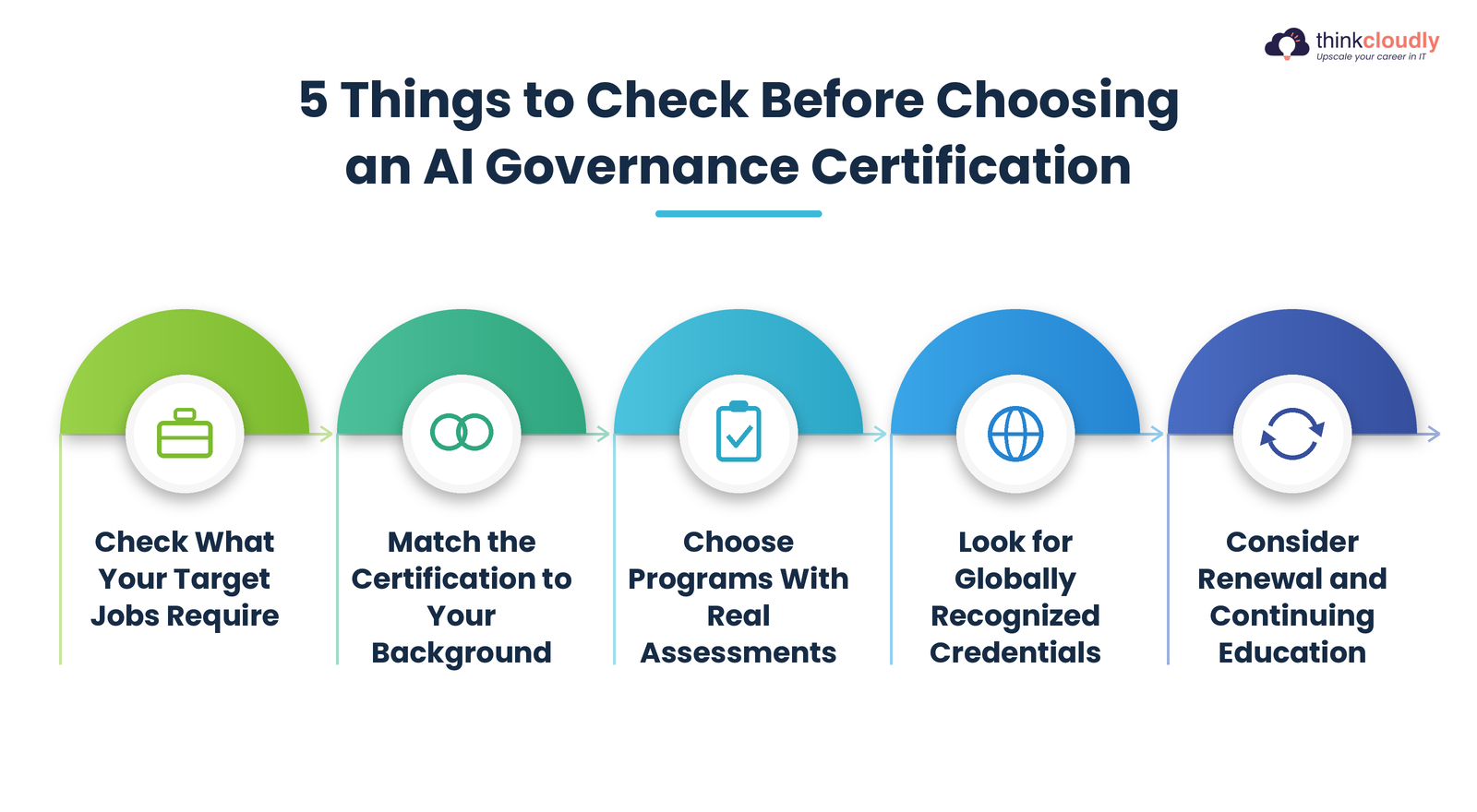
Check what your target job postings actually name. If three out of five postings for the role you want mention ISO 42001 specifically, that’s a stronger signal than general popularity.
-
Match the credential to your existing background. Legal and privacy professionals tend to get more immediate value from AIGP; people with a quality-management or audit background tend to pick up ISO 42001 concepts faster.
-
Confirm the program includes a real assessment, not just video completion. A credential without a proctored exam or practical assignment carries far less weight with employers evaluating a governance or compliance hire.
-
Ask whether the issuing body is recognized outside one region. IAPP and ISO-aligned bodies like PECB have international recognition, which matters if you might work across US, UK, or EU-regulated organizations.
-
Budget for renewal, not just the initial exam. Most serious programs require continuing education credits to stay current, since the underlying AI governance framework guidance keeps evolving.
Mistakes to Avoid When Pursuing This Certification
A few patterns show up again and again among people who end up disappointed with their choice. Chasing the most-advertised option instead of the one matching your actual role is the most common one — a Lead Auditor credential is wasted on someone who will never audit another organization’s AI management system.
Treating governance training as a one-time module instead of an ongoing practice is another; the processes behind ISO 42001 assume continuous monitoring, not a certificate earned once and shelved.
A third mistake is assuming a technical background alone prepares you for the policy and documentation work most of these programs actually test — these credentials lean heavily on written governance processes, not code.
A fourth, quieter mistake is collecting credentials instead of finishing one properly. It’s tempting to enroll in three overlapping programs at once because each one looked relevant during a late-night search, but hiring managers reviewing a résumé consistently favor one completed, well-understood credential over a stack of half-finished ones with no depth behind any of them.
A fifth mistake worth naming: assuming the certificate itself will be enough without any practical evidence behind it. Pairing the credential with a short written case study — how you’d apply a specific framework to a real deployment — demonstrates understanding in a way that a certificate number alone never will.
A Personal Note
I’ve watched this field go from a handful of specialists arguing about definitions to something with real exam syllabuses and real hiring managers checking boxes against it, and that shift still catches me off guard some weeks. What I’d tell anyone weighing an AI governance certification right now is this: don’t let the acronyms intimidate you into picking the wrong one just to have something to show.
Read one real job posting for the role you actually want, note which framework or standard it names, and let that single data point — not a ranked listicle — decide your next move. The people I’ve seen get the most out of this field aren’t the ones with the most badges; they’re the ones who can explain, in plain language, why a particular governance structure exists and what breaks without it.