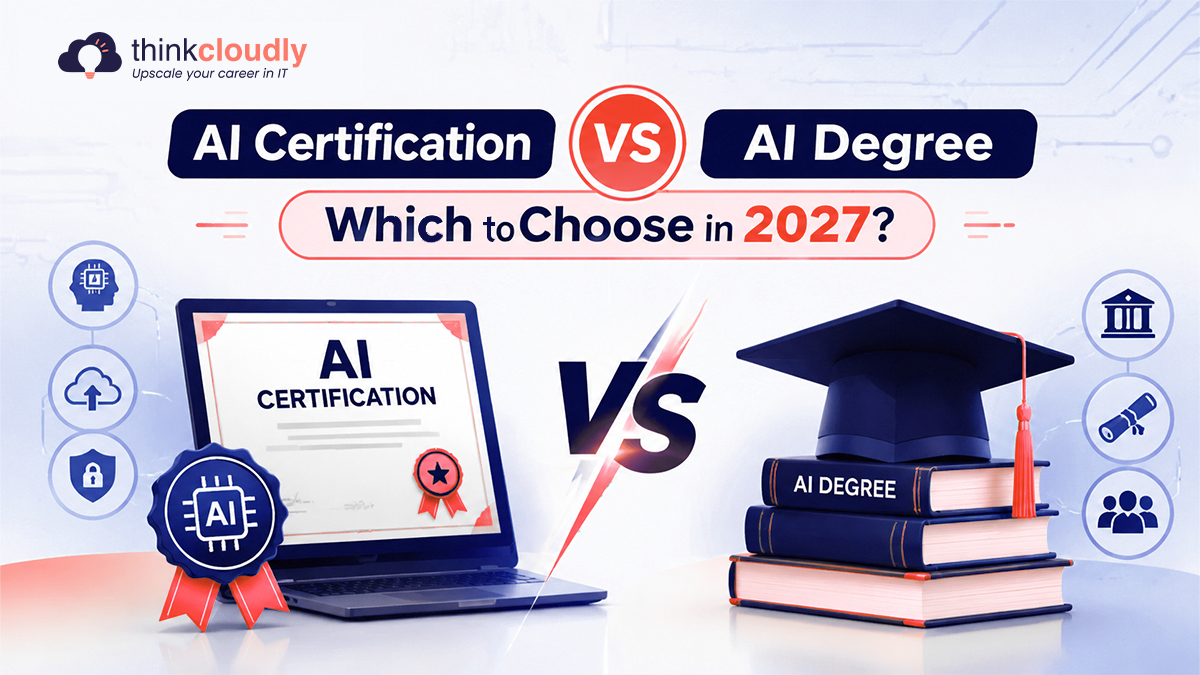






A former coworker of mine spent four years and a small fortune on a computer science degree, then watched a self-taught colleague land a generative AI role six months after finishing two online courses and a weekend project. That stung, and it’s the story behind most of the internet’s shouting match over AI certification vs. AI degree.
Neither path is a scam, and neither is a guaranteed shortcut. What decides the outcome is whether the credential matches the role you’re chasing, the time you can give it, and what you’re willing to build alongside it.
This guide walks through the AI certification vs. AI degree decision the way I wish someone had walked me through it: no hype, no pretending one option is obviously superior, and no ignoring the parts of the debate that are genuinely unresolved heading into 2027.
What Is the Real Difference Between an AI Certification and an AI Degree?
An AI certification is a short, focused credential, usually weeks to a few months, built around one skill set: a cloud provider’s AI tools, prompt engineering, machine learning fundamentals, or a narrow technical specialty. It proves you can do one thing well, quickly, and cheaply.
An artificial intelligence diploma or full degree is a different animal. It’s a multi-year academic program covering statistics, linear algebra, programming theory, and the broader computer science foundation most machine learning work depends on. A degree doesn’t just teach you a tool; it teaches you how the tool was built, which matters more in research-heavy or deeply technical roles than in applied, tool-using ones.
This question isn’t really “which one is better” in the abstract. It’s “which one matches the depth your target role actually needs. “A certificate that teaches you to use a model is not the same credential as a degree that teaches you to build one, and conflating the two is where most online arguments go wrong.
Why the AI Certification vs. AI Degree Debate Got Louder in 2027?
A few forces collided this year to make the decision harder than it was eighteen months ago:
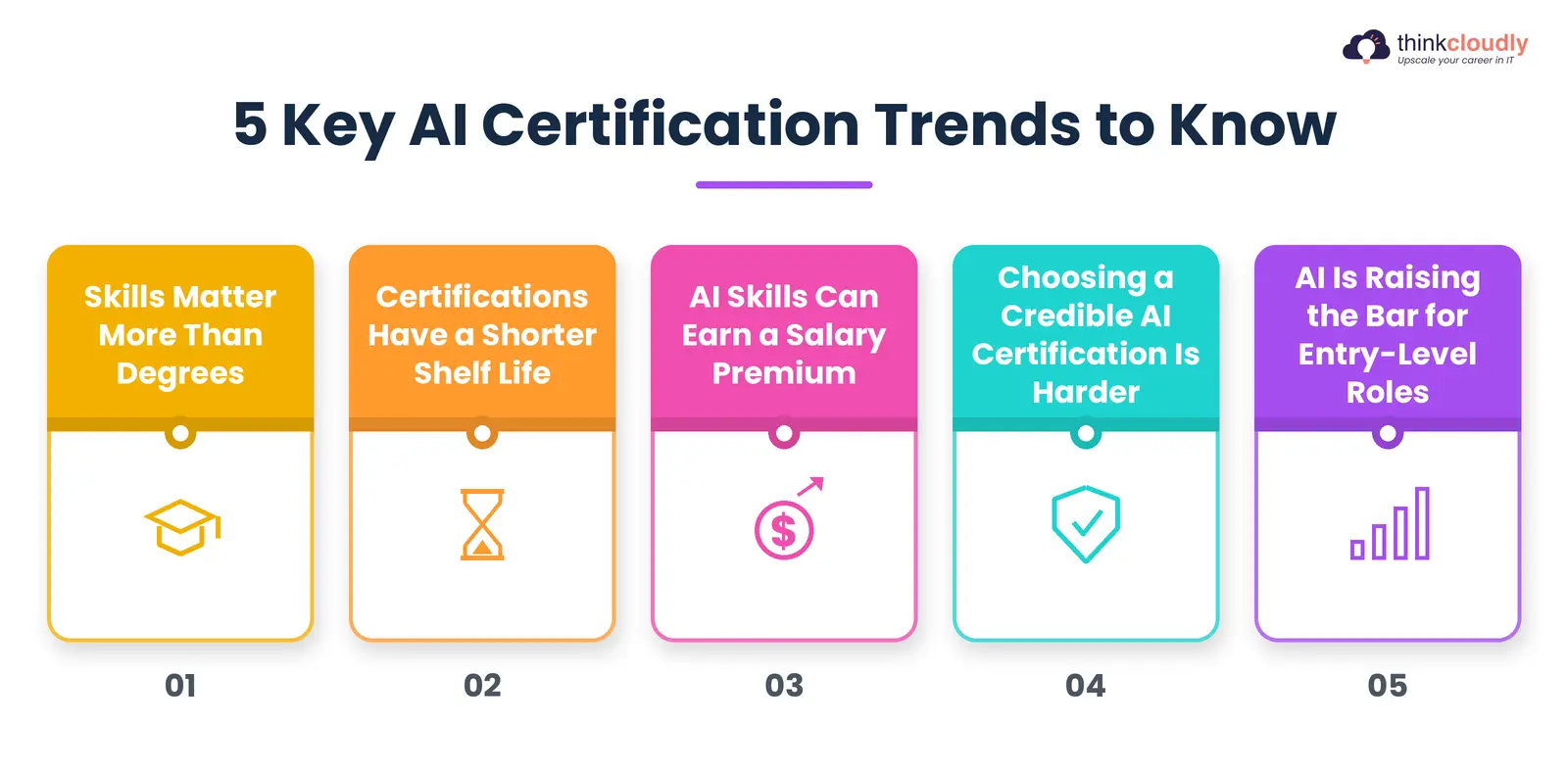
- Hiring has shifted toward demonstrated skill over degree in a lot of entry and mid-level tech roles, even as AI-specific postings have been slower to drop their degree requirements than the rest of the tech sector.
- Several flagship technical certifications quietly retired or were replaced in 2026, which means the shelf life of a certification is now measured in a couple of years, not a decade, unlike a degree.
- Employers are paying a real, measurable wage premium for industry-recognized credentials that prove applied AI skills, whether a certification or a degree supplied them.
- The volume of AI certification programs on the market has exploded, which makes picking a credible one harder than it was when there were only a handful of options.
- Generative AI tools have made certain entry-level technical tasks easier to automate, which has quietly raised the bar for what a junior credential-holder is expected to already know on day one.
Lightcast’s analysis of degree requirements in AI job postings found something that complicates the simple “degrees are dying” narrative: AI-related roles are still more likely to require a degree than the average non-AI tech job, even though that gap has been narrowing since 2024.
That single data point is the clearest evidence that the AI certification vs. AI degree decision shouldn’t be made the same way for every role—some AI jobs are genuinely easier to enter with a certificate than others.
Choosing between an AI certification and an AI degree in 2027 depends on your career goals, budget, and learning preferences. A degree offers broader academic knowledge, while certifications provide focused, industry-relevant skills in less time. Beginners can consider an AI and Data Science Training Program to understand AI fundamentals, machine learning, and practical applications before choosing a specialization. If you want to enter the AI industry faster, certifications combined with hands-on projects can help demonstrate job-ready skills.
Signs an AI Certification Program Is the Right Call
If most of the following describe your situation, one of the shorter AI certification programs is probably the smarter first move:
- You already have a degree in an adjacent field (business, data analytics, a different engineering discipline) and need a focused credential, not a second four-year commitment.
- You’re targeting applied, tool-using roles—prompt engineering, AI-enabled analyst work, and implementation support—rather than model research or architecture design.
- You need to be job-ready within three to nine months, not three to four years.
- You learn well from structured, hands-on modules and don’t need the broader theoretical grounding a full program provides.
- Your budget is measured in hundreds or low thousands of dollars, not tens of thousands.
- You’re comfortable treating this as the first of several AI certification programs over your career rather than a one-time purchase, since the skills underneath keep shifting.
Signs an Artificial Intelligence Diploma Is the Right Call
On the other side, a full artificial intelligence diploma or degree earns its cost back when most of these apply to you:
- You’re aiming at a role that genuinely requires building or researching models, not just using pre-built ones—core machine learning engineering, applied research, or AI infrastructure work.
- You’re early in your education and have the time, typically two to four years, to invest before you need an income from this specific field.
- You want the broader mathematical and statistical foundation that makes it easier to adapt when the specific tools and frameworks change, which they reliably do.
- The organizations you want to work for (certain research labs, larger enterprises, government-adjacent roles) still list a degree as a hard requirement rather than a preference.
- You value the structured mentorship, peer network, and internship pipeline that a formal academic program usually provides alongside the coursework itself.
- You’re comfortable with the degree being a foundation you’ll still need to supplement with ongoing AI certification programs later, because no single artificial intelligence diploma stays current forever.
AI Certification vs AI Degree: Cost, Time, and Depth Compared
|
Factor |
AI Certification |
AI Degree / Artificial Intelligence Diploma |
|
Typical time to complete |
Weeks to 6 months |
2 to 4 years |
|
Typical cost (USD) |
$0 – $3,000 |
$20,000 – $120,000+ |
|
Depth of theory covered |
Narrow, tool-specific |
Broad, foundational (math, stats, systems) |
|
Best suited for |
Applied, tool-using roles |
Research, model-building, core engineering roles |
|
Shelf life before it needs updating |
1 – 2 years for technical tracks |
Foundational knowledge ages slowly; tools still need refreshing. |
|
How employers tend to treat it |
Screening filter, proof of applied skill |
Baseline qualification for certain roles, signal of depth |
A quick look at that table makes one thing obvious: this isn’t really a fair fight on cost or speed, and it was never meant to be. A degree is a different kind of investment, built for a different kind of role, and comparing it to a certificate on price alone misses the point. Both remain industry-recognized credentials in their own right, just calibrated for different outcomes.
What Employers Actually Look For in 2027?
This is where the AI certification vs. AI degree debate gets interesting, because employer behavior doesn’t split neatly along either side. Research found that 81% of C-suite leaders surveyed said their organizations are actively adopting skills-based hiring practices, and 76% said freelancers with demonstrated skills add more value than employees who hold a degree but lack hands-on proof. That’s a meaningful shift away from credential-first hiring in general.
At the same time, the World Economic Forum’s Future of Jobs Report found that 66% of business leaders say they would not hire someone without demonstrated AI skills, yet only 25% of companies globally currently offer formal AI training to close that gap themselves.
That gap between expectation and support is exactly why Industry-recognized credentials, whether they come from a certification or a degree, carry real weight right now: employers want proof, and most aren’t building the pipeline to create that proof in-house.
A 2026 industry analysis on InfoWorld adds a useful wrinkle: two of the most respected technical AI certifications, AWS’s Machine Learning Specialty and Microsoft’s Azure AI Engineer Associate, were both retired in 2026, underscoring how quickly even strong industry-recognized credentials can expire.
The same piece cites a Resume Genius survey where 82% of hiring managers agreed certifications can be as valuable as a bachelor’s degree, but only 15% actually preferred candidates to demonstrate AI skills through certifications specifically, favoring hands-on project evidence instead. In other words, industry-recognized credentials open the door; what you can actually show once you’re through it still does most of the real work.
Building AI Learning Paths That Work With Either Choice
Whichever side of this decision you land on, the credential is the wrapper, not the content. Smart AI learning paths treat the certificate or the degree as a structured excuse to build real things, not the finish line itself.
A workable AI learning path usually has three ingredients regardless of format: a foundational stage where you learn the vocabulary and the basic tools, a project stage where you build something small but real and messy enough to talk about honestly in an interview, and a specialization stage where you pick one lane, such as applied generative AI, machine learning engineering, or AI-adjacent data analysis, and go deeper. Trying to run parallel AI learning paths in multiple directions at once is one of the most common reasons people finish a credential and still feel unprepared.
If you’re building your AI learning paths around certification programs specifically, sequence them instead of collecting them all at once. One foundational, no-code certificate followed by a project, then one deeper technical certificate followed by another project, tends to outperform stacking five badges with nothing built in between.
Can You Combine Both? A Hybrid AI Learning Path?
Plenty of people don’t actually have to choose only one side of the AI certification vs AI degree split. A genuinely common and effective hybrid AI learning path looks like this: finish a broader degree in a related field, like computer science, statistics, or even economics, and then layer one or two sharply focused AI certification programs on top once you know exactly which specialization you want. The degree supplies the foundation that ages slowly; the certification supplies the current, tool-specific skill that a degree program often can’t update fast enough to teach.
This hybrid approach tends to produce the strongest resume specifically because it answers both halves of what employers are actually asking for: proof you understand the underlying concepts, and proof you can use this year’s tools to apply them. It also sidesteps a lot of the all-or-nothing framing that makes the AI certification vs AI degree conversation feel more adversarial online than it needs to be in practice.
AI Career Opportunities: Does the Credential Type Actually Change Your Salary?
Here’s the part most people actually want answered. The honest finding across current labor-market research is that the credential type matters less than most people assume, and demonstrated skill matters more than either credential alone.
The real AI career opportunities, and the salary attached to them, track closest to what you can show, not which box you checked to get the interview — which is exactly why well-sequenced AI learning paths tend to outperform either credential picked in isolation.
That said, the two paths do tend to open different doors first. A degree still shows up as a stated or unstated requirement for a meaningful share of research-track and core engineering AI career opportunities, particularly at larger, more established employers.
Certification-led candidates, meanwhile, tend to find faster entry points into applied, tool-using AI career opportunities, implementation work, AI-enabled analyst roles, and support positions, where speed to hire matters more than depth of theory.
The data also flags something worth sitting with: more than half of postings asking for AI-related skills sit entirely outside the traditional tech industry, in healthcare, finance, retail, and manufacturing.
Those cross-industry opportunities are frequently far more open to a strong certification paired with a relevant project than the purely technical, research-heavy roles are, which is one more reason this decision should be made role-by-role rather than as a blanket life choice.
A Personal Note
I spent longer than I’d like to admit assuming this was a binary decision, pick one side and defend it forever, before I actually watched people succeed on both paths and plenty of people stumble on both too. The degree-holders who struggled were usually the ones who finished their program and assumed the diploma itself would do the talking in interviews.
The certificate-holders who struggled were usually the ones who collected badges the way some people collect stamps, without ever building anything uncomfortable or messy enough to actually talk about. The ones who did well could walk an interviewer through one real thing they’d built, mistakes included.
If you’re staring at this decision feeling like you have to pick the “correct” side of the AI certification vs AI degree debate, I’d gently push back on the framing. Pick the path that fits your timeline, your budget, and your target role, and spend more energy on the project you build with it than on which credential you chose. That’s the part that actually shows up in an offer letter.