







If you’ve typed “how to prepare for the CISA exam” into a search bar at 11 p.m. with a half-finished chapter of your review materials open in another tab, you already know the real problem isn’t motivation. It’s sequencing.
Most candidates don’t fail the CISA exam because they didn’t study — they fail because they studied the wrong domain at the wrong time, ran out of runway before the hard material, and walked in under-rehearsed on pacing. A proper weekly plan fixes that by assigning each week a job, instead of leaving you to “cover everything eventually.”
This guide answers how to prepare for CISA exam content with a literal week-by-week breakdown — not a vague three-month outline — built around how ISACA actually weights the exam domains. Follow it, and you’ll know on any given Tuesday exactly what you should be doing and why.
Why Do Most CISA Study Plans Fall Apart by Week 4?
Here’s the pattern that repeats across hundreds of candidates: someone downloads a generic CISA syllabus, blocks out “12 weeks of studying” on a calendar, and starts strong on Domain 1 because it’s listed first. Three weeks in, life happens — a work deadline, a sick kid, a missed weekend — and the plan never recovers, because it had no slack and no priority order.
Figuring out how to prepare for CISA exam material properly means accepting two uncomfortable facts up front. First, the five domains in the ISACA CISA outline are not equally weighted, so spending equal time on each one is mathematically wrong. Second, you will lose at least one week somewhere in a 12-week window — plan for it, don’t be surprised by it. This is the foundation every CISA study guide should start from but rarely does.
Preparing for the CISA exam requires a structured study plan, consistent practice, and a clear understanding of all five exam domains. Start by reviewing the syllabus, setting weekly learning goals, and using practice questions to identify knowledge gaps. ThinkCloudly can support your preparation with expert-led CISA training, structured study materials, and practical guidance. Follow a week-by-week schedule that balances concept learning, revision, and mock tests to build confidence and improve your chances of passing the CISA exam.
CISA Exam Format and Domain Weighting at a Glance
Before building your weekly schedule, you need the raw mechanics of the exam itself. These numbers come straight from the ISACA CISA exam content outline, and they should dictate how many hours you give each domain — not alphabetical order, not personal interest.
|
Domain |
Weight | What It Covers |
Study Priority |
|
Information Systems Auditing Process |
18% | Audit standards, risk-based planning, evidence gathering |
High |
|
Governance and Management of IT |
18% | IT strategy, risk management, organizational structure |
High |
|
IS Acquisition, Development & Implementation |
12% | SDLC, project governance, testing methodologies |
Medium |
|
IS Operations and Business Resilience |
26% | Operations, service management, BCP/DR |
Highest |
|
Protection of Information Assets |
26% | Security controls, cryptography, incident response |
Highest |
The exam itself is 150 multiple-choice questions over four hours, scored on a scale of 200 to 800, with 450 as the passing mark. Notice that Domains 4 and 5 alone account for 52% of your score — more than half the exam rides on two domains. Any CISA study guide that doesn’t reflect that ratio is already working against you before week one begins.
What to Gather Before Week 1 Starts?
Don’t start the clock on your plan until you have the right materials in hand — scrambling to find resources mid-plan is how weeks get wasted. This is the practical half of how to prepare for CISA exam content: the right inputs, lined up before Week 1.
- A current CISA review manual. This is still the backbone resource for studying each domain in sequence, and it maps directly onto the content outlined above, so you’re never studying something off the ISACA CISA syllabus.
- The official CISA QAE database. The Question, Answer and Explanation database from ISACA is non-negotiable — it’s the only practice bank built from retired exam logic rather than a third party’s guesswork, and you’ll lean on it heavily for every full-length practice exam in this plan.
- A current CISA syllabus printout. Pin the five-domain breakdown somewhere visible. You should be able to glance at it and instantly know which domain a topic belongs to.
- A blank calendar, not a study app. Apps are good for flashcards; they’re bad for seeing, at a glance, that Week 7 is already full.
Think of this stage as the setup cost of any serious CISA study guide — skip it, and every later week pays for it.
The Week-by-Week CISA Study Plan
This is the part most guides skip past with “spend a few weeks per domain.” That’s not a serious answer to how to prepare for CISA exam material when over half your score sits in two domains. Here is an actual week-by-week sequence, built around exam weighting rather than page order in your review materials:
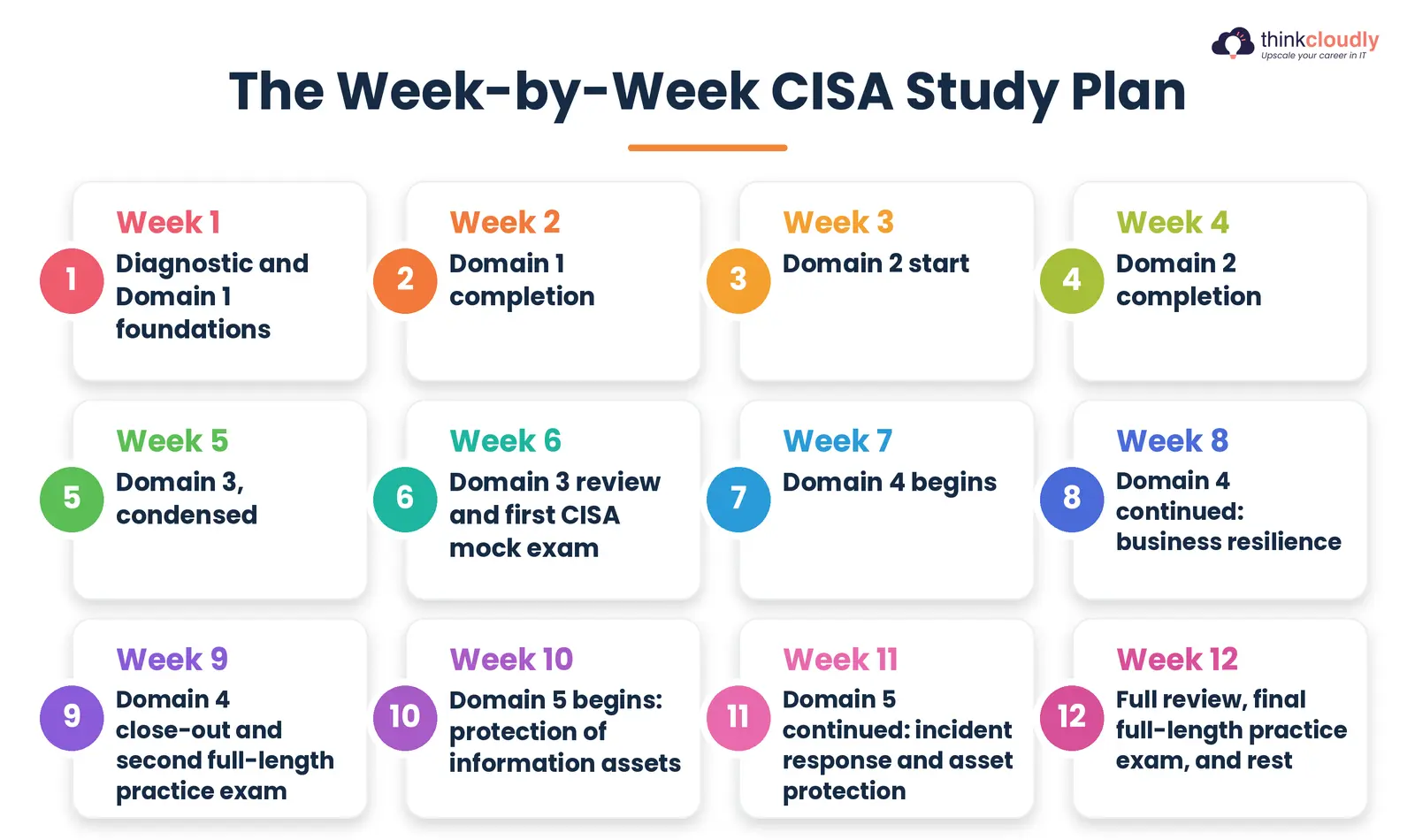
- Week 1 — Diagnostic and Domain 1 foundations. Take a cold, ungraded practice set from the CISA QAE database before studying anything. Don’t aim to pass it — aim to see which domains you’re weakest in. Spend the rest of the week on Domain 1’s audit standards and risk-based planning concepts.
- Week 2 — Domain 1 completion. Finish audit evidence-gathering, sampling methods, and reporting standards. Close the week with a 40-question domain-specific quiz.
- Week 3 — Domain 2 start. Move into IT governance frameworks, enterprise risk management, and organizational structures. This domain rewards understanding “why” over memorizing frameworks by name.
- Week 4 — Domain 2 completion. Finish governance with policy, strategy alignment, and resource management topics. This is the week most study plans lose momentum — build in a lighter Saturday here deliberately.
- Week 5 — Domain 3, condensed. Because this domain is only 12% of the exam, compress SDLC, project governance, and systems testing into a single focused week rather than stretching it.
- Week 6 — Domain 3 review and first CISA mock exam. Sit a timed, full-length mock exam under real conditions — four hours, no pausing, no notes. This is your real diagnostic, not Week 1’s warm-up.
- Week 7 — Domain 4 begins (the heaviest domain). Start IS operations: service management, infrastructure, and hardware/software controls. Give this domain more daily hours than any other, since it carries 26% of your score.
- Week 8 — Domain 4 continued: business resilience. Business continuity and disaster recovery planning live here. Work through real incident scenarios rather than flashcard-style definitions.
- Week 9 — Domain 4 close-out and second full-length practice exam. Finish any remaining Domain 4 subtopics, then sit another full mock exam and compare your score against Week 6’s — you should see Domain 4 questions improving specifically.
- Week 10 — Domain 5 begins: protection of information assets. Security controls, access management, and cryptography fundamentals. Treat this domain with the same priority as Domain 4 — together they are over half the exam.
- Week 11 — Domain 5 continued: incident response and asset protection. Finish the domain, then spend two full days doing nothing but domain-weighted QAE database drills — more time on Domains 4 and 5 questions than 1 through 3.
- Week 12 — Full review, final full-length practice exam, and rest. Sit one last complete practice exam early in the week, review every miss by domain, and then deliberately taper down. The final 48 hours before your appointment are for light review and sleep, not cramming.
Twelve weeks is the default here, but the sequencing — diagnostic first, lighter domains compressed, heaviest domains given the most real estate, mock exams spaced at Weeks 1, 6, 9, and 12 — holds whether you compress it into eight weeks or stretch it to sixteen. That flexibility is what separates a real CISA study plan from a generic calendar.
Turning Each Week Into a Daily Routine
A twelve-week outline only works once it breaks down into daily blocks — nobody studies well off a plan that only exists at the weekly level. The honest answer to how to prepare for CISA exam material day by day is simpler than it looks: split each study day into three short blocks instead of one long session, because retention from a tired two-hour block after work is far lower than retention from two focused forty-five-minute blocks.
A workable daily split looks like this: one block for new material from that week’s domain, one block for active recall — closing the book and writing out what you just read from memory, without looking — and one block for targeted practice questions on that same topic. Weekends carry the heavier load, since most candidates can’t give more than an hour or two to this on weeknights around a full-time job.
This is also where a good CISA study guide earns its keep. Rather than treating it as a book to read from start to finish, use it as a reference you return to after every quiz miss, looking up exactly the concept you got wrong rather than re-reading the whole chapter. That targeted use is what turns a CISA study guide from a shelf item into something that actually changes your weak spots week over week.
If a week’s daily total slips below an hour for more than two days running, flag it in your weekly review rather than ignore it and hope the next week makes up the difference. Treat this daily structure as the execution layer underneath the plan above — it’s what actually answers how to prepare for CISA exam content once the calendar itself is built.
Getting the Most Out of a CISA Mock Exam
A CISA mock exam is only useful if you treat it as a rehearsal, not a scorecard. Running a full-length, 150-question, four-hour session without interruption does two things a chapter quiz never can: it trains your pacing at roughly 96 seconds per question, and it exposes which domains fall apart under fatigue rather than in isolated review.
After every mock exam, don’t just note your overall percentage. Break the miss count down by domain and compare it against the weighting table above. A candidate missing 40% of Domain 3 questions and 15% of Domain 4 questions has very different work left to do than the raw score suggests, because Domain 4 is worth more than twice as much on exam day. This diagnostic habit is as much a part of how to prepare for CISA exam content as the reading itself.
Common Mistakes That Derail a CISA Study Plan
These show up often enough that they’re worth listing on their own, separate from the week-by-week structure above:
- Treating all five domains as equal. Spending 20% of your time on each domain when two of them carry 26% apiece and one carries only 12% guarantees you under-prepare for the parts that actually decide your score.
- Skipping the diagnostic mock exam. Starting a plan without a baseline means you’re guessing at weak spots instead of measuring them.
- Relying only on flashcard apps. They’re fine for terminology, but the CISA exam tests applied judgment in audit scenarios — flashcards don’t rehearse that skill.
- Using outdated or third-party question banks instead of the official CISA QAE database. Retired-item logic from ISACA mirrors real exam reasoning far more closely than generic vendor questions.
- Cramming the final week instead of tapering. Fatigue going into a four-hour exam costs more points than one more night of review gains you.
- Ignoring the CISA review manual’s cross-references. The domains overlap more than the syllabus suggests — governance concepts in Domain 2 show up again inside Domain 4’s resilience material, and missing that connection costs marks on both.
Final Week and Exam Day Checklist
In the days right before your appointment, confirm your testing center or remote-proctoring setup through PSI online platform, since the exam is delivered through PSI rather than administered directly. Reconfirm your six-month eligibility window hasn’t lapsed, bring the required identification, and resist the urge to open your review materials the night before — at this point, rest outperforms review. By now your CISA review manual reading and CISA QAE database drilling should both be finished; this final stretch is logistics and sleep, not new content.
If you’ve been wondering how to prepare for the CISA exam week on week right up to the finish line, this is the answer: treat the final 48 hours as recovery, not revision.
A Personal Note
I’ve sat across from enough CISA candidates to notice the same regret surface again and again: it’s never “I didn’t study enough.” It’s “I studied the wrong things for too long in the wrong order.” The candidates who pass on their first attempt aren’t usually the ones who read the CISA review manual cover to cover three times — they’re the ones who respected the domain weighting, measured themselves early with a real practice exam, and stopped treating Week 8 the same way they treated Week 1.
If this plan feels front-loaded toward Domains 4 and 5, that’s deliberate, not an accident. Anyone asking how to prepare for CISA exam material seriously should build their weeks around where the exam actually puts its weight, matching the real ISACA CISA domain split instead of a generic template — the pass becomes a function of discipline rather than luck.