

Introduction
Data is the biggest superpower right now. If the appropriate and pertinent information is gathered, I, as the business owner, can make better decisions. Moreover, efficient use of information could facilitate improvements in customer support. The unanticipated rise in demand for data scientists has been partly attributed to this. But nobody highlights the value of a data engineer in the clamor for data scientis.  An Azure data engineer is one of the most sought-after job roles in the Microsoft Azure ecosystem. The details we will provide in this blog will function as an example of an Azure data engineer certification handbook. Information regarding the advantages of pursuing a career in data engineering will also be covered in the discussion.
Azure Data Engineer Certification
For data engineers and developers who want to demonstrate that they are professionals at designing and executing data solutions using Microsoft Azure data services, there is an Azure Data Engineering Certificate.
On the Microsoft Azure cloud platform, Azure Data Engineers are responsible for the design, implementation, and management of data management and processing systems. When working with large and complex data sets, they are responsible for ensuring that data is processed, stored, and protected in an efficient and effective manner.
Azure Data Engineers employ a variety of Azure data services, such as Azure Synapse Analytics, Azure Data Factory, Azure Stream Analytics, and Azure Databricks, to design and construct data solutions that are suitable for their company.
Is DP-203 Still Available? The Latest Certification Update
The Microsoft Azure Data Engineer Associate certification was designed for professionals who wanted to demonstrate their ability to build, manage, and optimize data solutions using Azure services. However, Microsoft’s certification pathway has changed, making it important for candidates to understand which credential to pursue today.
Microsoft officially retired the DP-203: Data Engineering on Microsoft Azure exam on March 31, 2025. Candidates can no longer register for this retired exam. Those who are exploring a data engineering career should now consider the Microsoft Certified: Fabric Data Engineer Associate certification, which uses the DP-700 exam.
The DP-700 certification focuses on implementing and managing data engineering solutions in Microsoft Fabric. It covers data ingestion and transformation, analytics solution management, and monitoring and optimization. Candidates should also develop skills in SQL, PySpark, and Kusto Query Language (KQL).
This change does not mean that Azure data engineering skills are no longer useful. Instead, it highlights the importance of learning how Microsoft’s data platform and certification pathways are evolving.
Before enrolling in a certification program, check the latest exam requirements and learning resources on the official Microsoft Fabric Data Engineer Associate certification page. This helps ensure your preparation aligns with the currently available certification.
Is Azure Data Engineer Certification Worth It?
The Azure Data Engineer Certification is unquestionably worthwhile for anyone who wants to work in this industry, in my opinion. Even while it can be difficult, a career in Azure data engineering can be fulfilling. Data engineers and their skills are essential to an organization’s performance because they make it easier for decision-makers, data scientists, and analysts to access the data they need to do their jobs.
Businesses look to data engineers’ skills and knowledge to deliver scalable solutions to their clients. Data security will also become increasingly crucial as more businesses use data to guide their decisions. Data engineering skills will be crucial for developing and implementing security solutions that shield data from breaches and other threats.
By having your knowledge and abilities verified against pre-established benchmarks, you can demonstrate to potential employers that you possess the necessary skill set with the use of an Azure Data Engineer professional certification. This professional certification attests to the applicant’s status as a qualified professional and indicates that they have goals beyond developing their data engineering career.
If a data engineer possesses one or more of these credentials, they will have an advantage over competitors. For novice data engineers, certificates could serve as a useful substitute for prior work experience. Additionally, a professional certificate provides you with the certification needed to apply for jobs, increasing your chances of landing high-paying data engineering positions. The greatest courses on cloud computing will open doors to in-depth education.
Advantages of a Certified Azure Data Engineer

- Career Growth: Whether you want to work in the field or are presently employed there, you may often advance your career with an Azure certification. Azure certifications are currently in high demand and can help you progress in your present role or pursue a better job.
- Salary increase: Data engineering is one of the most in-demand job roles in existence today since it combines the programming, software engineering, and complex analytics skills required by data scientists. These professionals make good salaries since they are in high demand.
- Greater career flexibility: If you hold a Microsoft Azure certification, you can select from a number of different career routes. One could pursue a profession as a cloud architect, developer, or solution architect. The qualification allows you to work in a range of industries and locations.
- Enhanced security for your company: Being certified can help you boost cloud security for your organization by keeping you informed about the latest trends and alternatives. If you renew your credentials, you’ll remain up to date on modifications and emerging technologies. Employers find you more appealing when you have a deeper understanding of security, especially if you’re looking for work in cloud security.
- Enhanced skill set: If you have more experience with cloud computing, you’ll probably be more competitive in the job market. With Azure certification, you may enhance your machine learning and artificial intelligence skills.
What Skills Should You Learn for Azure Data Engineering in 2026?
Data engineering requires a combination of programming, data management, cloud services, and problem-solving skills. As organizations work with growing volumes of structured and unstructured data, they need professionals who can build reliable pipelines and make data available for analytics.
Here are the key skills aspiring data engineers should prioritize:
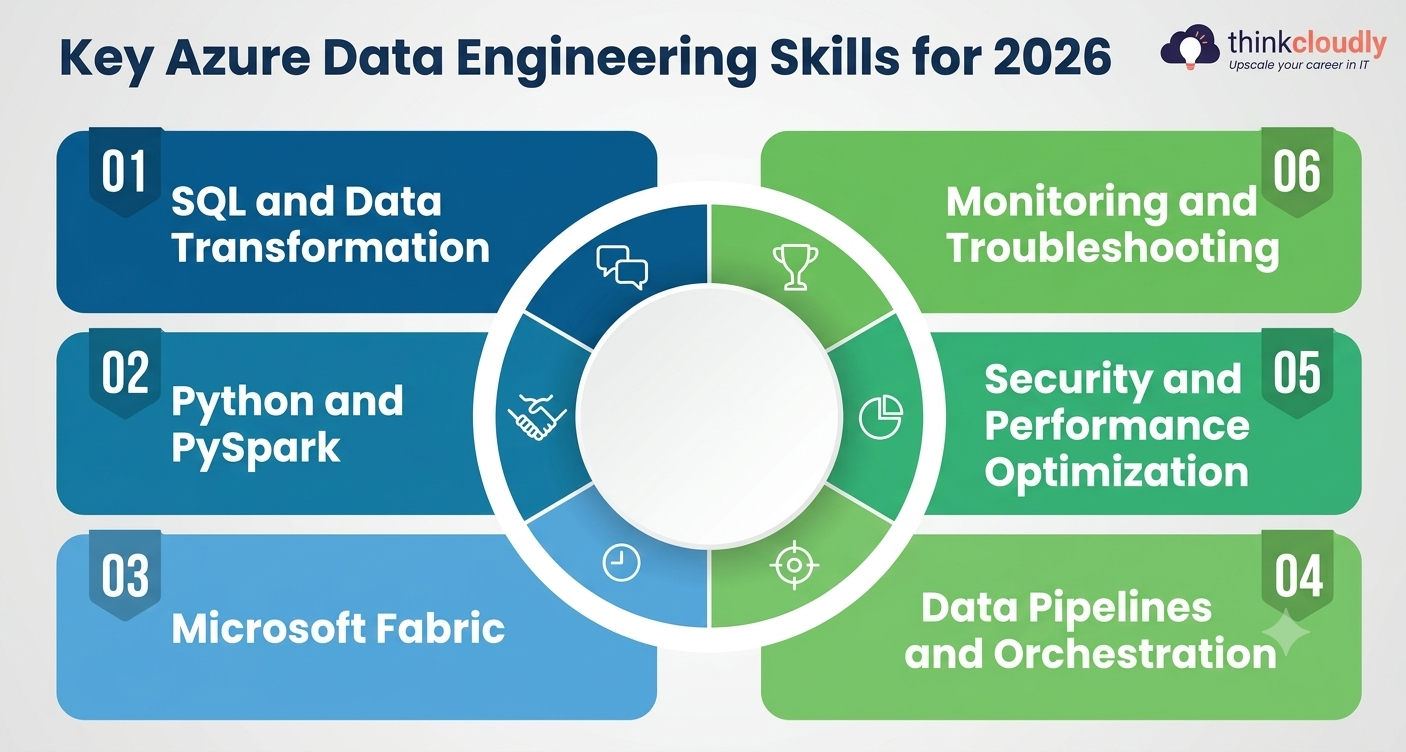
1. SQL and Data Transformation
SQL helps data engineers retrieve, filter, join, and transform data. A strong understanding of queries, data types, and data quality is essential for preparing reliable datasets.
2. Python and PySpark
Python supports data processing and automation, while PySpark helps process large datasets using distributed computing. These skills are valuable when working with modern analytics platforms.
3. Microsoft Fabric
Microsoft Fabric brings together data engineering and analytics capabilities in one platform. Learners should understand its lakehouse, data warehouse, data ingestion, transformation, and pipeline orchestration capabilities.
4. Data Pipelines and Orchestration
Data engineers need to understand how information moves from source systems to analytical destinations. This includes scheduling workflows, handling failures, managing dependencies, and maintaining data quality.
5. Security and Performance Optimization
Managing access permissions, protecting sensitive information, monitoring workloads, and improving processing efficiency are important responsibilities in production data environments.
6. Monitoring and Troubleshooting
Professionals should be able to identify failed pipelines, investigate data inconsistencies, monitor performance, and resolve processing issues.
Building these skills alongside practical projects can help candidates prepare for data engineering responsibilities. For certification-specific preparation, refer to Microsoft’s official DP-700 exam resources.
Duration required for this Certification
One thing that has been clear from my many conversations with candidates and certificate holders is that in order to accomplish this Professional Certificate, you must be prepared to put in a lot of effort. There will be about 20 hours of online coursework, 5 hours of practice exams, 5 hours of reading, and extra time needed to understand the resources and register.
The DP 203 test consists of 40–60 questions that can be multiple-choice, ordering, drop, scenario-based single-answer, and other question types. The exam takes 120 minutes to complete, and passing requires a score of 700. The examination is solely offered in English.
Career Opportunities
I’ve seen data engineers working on projects or in companies that cater to a range of industries, such as software, data analytics, artificial intelligence (AI), healthcare, IT, retail, marketing, government, transportation, and more. They can choose to work full-time on-site or remotely. Although a data engineer’s day is never the same, they may work with data scientists, perform queries, create pipelines for data, code, design data repositories, or combine data sources.
Data Engineers
Data engineers configure and provision technology for on-site and cloud data platforms. They manage and safeguard the flow of data from several sources, both organized and unstructured. As data platforms, they might make use of file stores, data streams, relational databases, and non-relational databases. The secure and seamless integration of data services with other application services or data platform technologies, such as Azure Cognitive Services, Azure Search, or even bots, is another responsibility of data engineers.
The focus of an Azure data engineer’s responsibilities is data in Azure. One of your primary responsibilities is to use services and technology to ingest, egress, and transform data from several sources. Azure data engineers collaborate with business stakeholders to identify and address data requirements, and then develop and implement solutions. They also supervise, manage, and ensure data security and privacy in order to satisfy organizational standards.
Data Scientists
Data scientists perform sophisticated analysis in order to derive value from data. As part of their work, they might use both predictive and descriptive analytics. Descriptive analytics uses exploratory data analysis (EDA) to evaluate the data. Predictive analytics is a tool that machine learning utilizes to use modeling techniques to find trends or anomalies. They constitute an essential part of forecasting models.
Descriptive and predictive analytics are only used in a tiny percentage of the tasks performed by data scientists. In order to solve challenging data problems through iterative experimentation with various approaches, some data scientists may even work in the field of deep learning.
Anecdotal evidence suggests that most data science project time is spent on feature engineering and data wrangling. When data engineers apply their skills to efficiently manage data, data scientists can accelerate the process of experimentation.
AI Engineer
AI engineers employ AI services such as Bot Framework, Cognitive Services, and Cognitive Search. Cognitive services include Bing Search, Computer Vision, Text Analytics, and Language Understanding (LUIS). Instead of creating their own models, AI professionals leverage the prebuilt features of Cognitive Services APIs. Thanks to AI engineers, a new or existing application or bot integrates these features. AI engineers store the information generated by AI using their understanding of data engineers.
An engineer specializing in artificial intelligence might work on a computer vision application that analyses images. An Azure Cosmos database instance would be set up by a data engineer at the request of the AI engineer in order to hold the data and tags that the Computer Vision software generates.
Level of difficulty for this Certification Exam
It is difficult to pass the Microsoft Azure Data Engineer Exam without prior experience and thorough study. You can prepare for this by taking a comprehensive training course, as you will need to develop and modify your knowledge to align with the content of the exam.
This test measures your proficiency in setting up and configuring each step of a data processing pipeline. It requires a thorough understanding of data architecture patterns, data computation languages (preferably SQL, Python, or Scala), and parallel processing.
How to Prepare for the DP-700 Certification Exam
Preparing for the DP-700 certification requires a structured learning plan that combines theoretical understanding with practical experience. Candidates should begin by reviewing Microsoft’s official exam study guide to understand the skills measured and identify areas that need additional attention.
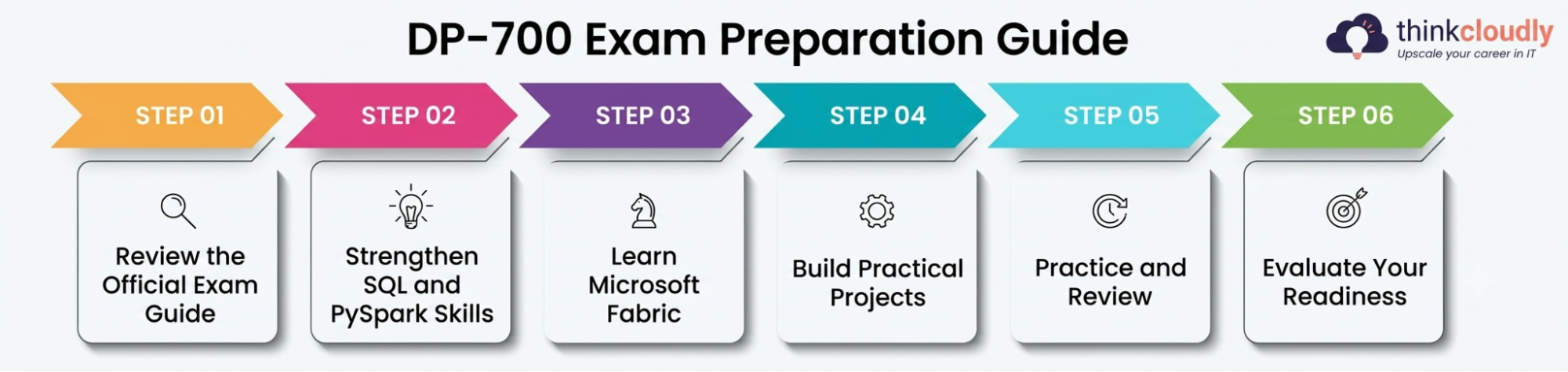
Step 1: Review the Official Exam Guide
Read the latest DP-700 study guide and understand the exam objectives. Use these objectives to organize your study schedule and track your progress.
Step 2: Strengthen SQL and PySpark Skills
Practice writing SQL queries and transforming datasets with PySpark. Focus on data cleaning, transformations, and preparing information for analytical workloads.
Step 3: Learn Microsoft Fabric
Explore the core capabilities of Microsoft Fabric, including lakehouses, data warehouses, data pipelines, and data ingestion. Understand when different components are appropriate for a given business requirement.
Step 4: Build Practical Projects
Create a small data engineering project that imports data from a source, transforms it, and loads it into an analytical destination. Include error handling, data quality checks, and basic performance monitoring.
Step 5: Practice and Review
Use Microsoft’s official practice assessment and exam sandbox to become familiar with the question format. Review incorrect answers and revisit the concepts you find challenging.
Step 6: Evaluate Your Readiness
Before scheduling the exam, check the current exam requirements, review the latest study guide, and make sure you can explain the main concepts without relying entirely on memorized answers.
A structured preparation plan helps candidates connect certification objectives with practical data engineering skills. Always use the latest Microsoft DP-700 certification resources because exam requirements can change.
Conclusion
As we mentioned in this blog, organizations value data since they can utilize it for a multitude of purposes. Cloud services, especially those offered by Azure, handle critical data-related tasks in enterprises. Data and Azure will be the hottest issues in the IT business for years to come. A Microsoft Azure Data Engineer certification is the most suitable certification for these two roles. The Azure Data Engineer certification from Thinkcloudly is one such program that can help you learn more.
For more information related to Azure data engineer training, azure data engineer course, azure data engineer associate, azure data engineer exam, & azure data engineer certification, do visit our web blog pages and grab all whole information on the above topics.