

A recruiter message promising a “huge jump” the moment you add a credential to your headline is background noise by now. What actually moves a paycheck is which Azure security certification you hold, how recently you earned it, and whether the role behind it still looks the way it did eighteen months ago.
That last part matters more in 2027 than it used to: Microsoft retired the AZ-500 exam on August 31, 2026, and folded most of its content into SC-500, its newer cloud and AI security credential.
If you’re mapping out salary and career scope around an Azure security certification this year, you’re really mapping it around a moving target, and the figures below reflect where that target has landed, not where it used to sit.
Pay for people holding an Azure security certification isn’t one number—it’s a spread wide enough that a junior analyst and a senior architect can list the same credential and still sit a six-figure gap apart. The rest of this piece breaks down by role, region, experience band, and the specific skills that push someone from the bottom of the range toward the top.
None of this is theoretical. The figures that follow come from government labor data and job-market trackers that update continuously, not a single survey taken once and repeated for years without checking it. That distinction matters if you’re trying to decide whether to invest the next two months of evenings into studying.
6 Reasons Azure Security Certification Pay Keeps Climbing in 2027
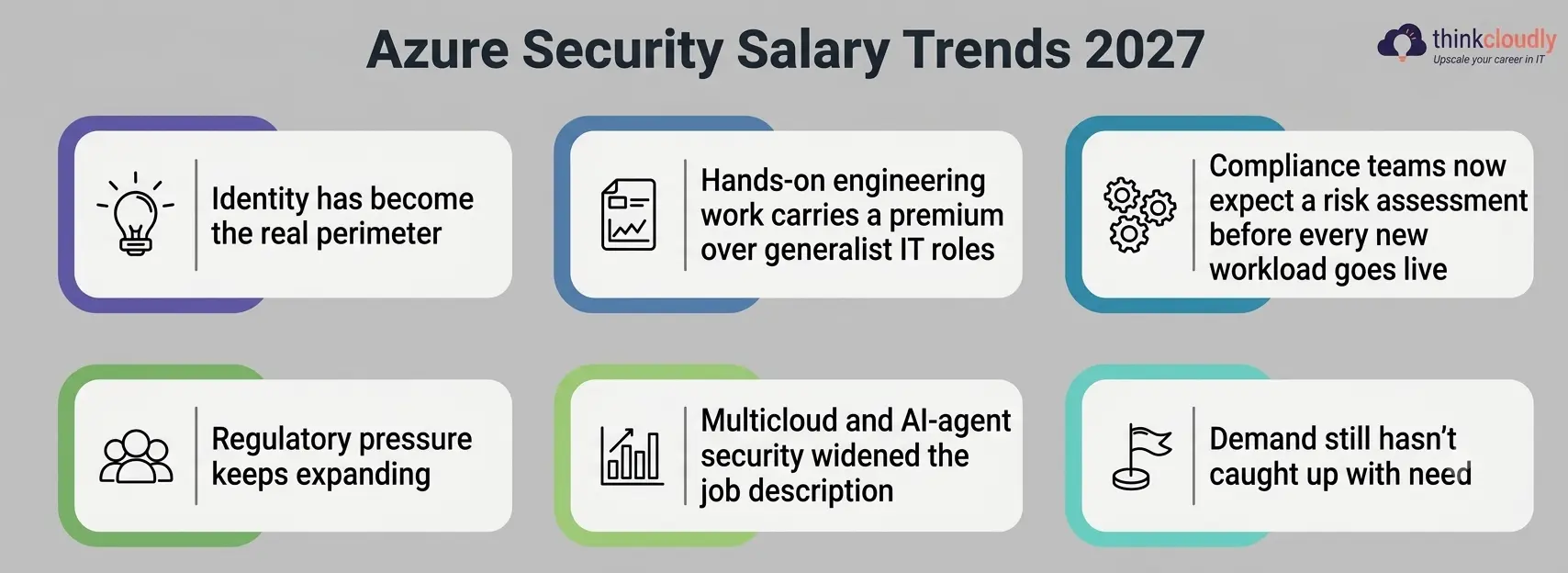
- Identity has become the real perimeter. Companies running production workloads on Microsoft’s cloud need staff who understand Azure identity at a level deeper than resetting a password. Conditional access, privileged identity management, and agent-level permissions for AI tools are daily work now, not edge cases.
- Hands-on engineering work carries a premium over generalist IT roles. Someone who can read a Defender for Cloud alert and actually act on it earns more than an administrator who mostly keeps the lights on.
- Compliance teams now expect a risk assessment before every new workload goes live, not once a year. The people who can run one quickly get pulled into senior decisions and senior pay bands faster than the people who treat it as paperwork.
- Regulatory pressure keeps expanding. Regulated industries across the US and UK increasingly require certified staff on anything security-adjacent, not just “experienced” ones, which pushes the baseline rate for an Azure security certification higher even at the mid-level.
- Multicloud and AI-agent security widened the job description. SC-500 folded in Copilot and agent-identity content that never existed under the old exam, and engineers who can speak to it get paid for covering more ground than the role used to require.
- Demand still hasn’t caught up with need. Even with hiring slowdowns across tech broadly, cloud security postings keep outpacing generalist IT roles, which keeps leverage on the side of anyone holding a current credential.
How Much an Azure Security Certification Actually Pays?
Numbers settle arguments better than vibes. Here’s what the role and that credential currently command across two markets with reliable, recent public data—the US and the UK—alongside how a cloud security analyst salary compares to the more specialized engineering track.
|
Role / Data Point |
United States (2027) |
United Kingdom (2027) |
|
Information security analyst—median wage |
$129,180/year |
— |
|
Cloud security analyst—average salary |
$108,153/year |
— |
|
Cloud security analyst—10th–90th percentile |
85,181–126,509/year |
— |
|
Azure security engineer—median salary |
— |
£55,000/year |
|
Azure security engineer—10th–25th percentile |
— |
£40,000–£45,000/year |
|
Projected job growth, information security roles |
21% through 2035 |
— |
The US figures line up with the Bureau of Labor Statistics’ broader information security analyst data: a median wage of $129,180 a year as of May 2025, with the field projected to grow 21% through 2035—more than six times the average growth rate across all occupations—and roughly 14,100 openings a year.
That growth rate alone is a strong argument for treating an Azure security certification as a career investment rather than a resume line. More specific cloud security analyst data puts the average at $108,153, with the middle band running from roughly $96,000 to $118,000 depending on employer size and region.
On the UK side, IT Jobs Watch’s tracking of live permanent postings puts the median Azure security engineer salary at £55,000 a year, with the bottom quartile sitting around £40,000 to £45,000 for people earlier in the ramp.
A cloud security analyst salary in the UK tends to land a notch below that median, especially outside London, but both figures move fast once someone adds real Azure identity work or Microsoft Sentinel experience to their day-to-day responsibilities.
What Actually Moves Your Pay Beyond the Exam?
Three variables explain most of the spread between the lowest and highest earners holding the same Azure security certification.
Region still matters more than people expect. A security engineer in San Francisco or London earns meaningfully more than someone with the identical title in a smaller market, even after accounting for cost of living, because enterprise security budgets concentrate where the enterprises already are.
Specialization matters more than the exam code on your resume. Someone who has built real Azure identity governance—conditional policies that don’t accidentally lock out the admin team, access reviews that actually get used instead of rubber-stamped—earns more than someone reciting the same material from a study guide.
The same goes for risk assessment: a person who can walk into a messy environment, run one well, and hand back a prioritized fix list gets pulled into senior conversations fast.
Tooling depth closes the rest of the gap. Microsoft Sentinel, Defender for Cloud, and increasingly Microsoft Purview sit at the center of day-to-day work, and candidates who have actually built an automation playbook—rather than just reading about one—tend to stand out in interviews.
Stacking a second, complementary badge on top of the base credential (an identity-focused exam, or an operations-focused one) also tends to move someone into a higher band faster than waiting around for tenure alone to do it.
How Experience Level Changes the Numbers?
The same job title can mean very different pay depending on how many years of production experience sit behind it. Someone fresh off a bootcamp or a career switch, holding the credential but with little hands-on time, usually lands near the bottom quartile of whatever range applies in their market—the entry point exists mainly to get a foot in the door.
Three to five years in, once someone has handled a real incident end to end and not just a tabletop exercise, pay typically climbs toward the median or just above it. Past the eight-year mark, especially for people who’ve moved into architecture, team leadership, or specialized identity work, compensation regularly clears the 75th percentile, and total packages in the US start including meaningful bonus or equity components that the base salary figures alone don’t capture.
None of these bands are fixed, either—a lateral move into a company with a bigger security budget, or a shift from a generalist IT department into a dedicated security team, can jump someone a full band without adding a single year of tenure.
Career Paths an Azure Security Certification Opens Up in 2027
The credential itself doesn’t lock you into one job title. Here’s where people typically land after they pass one.
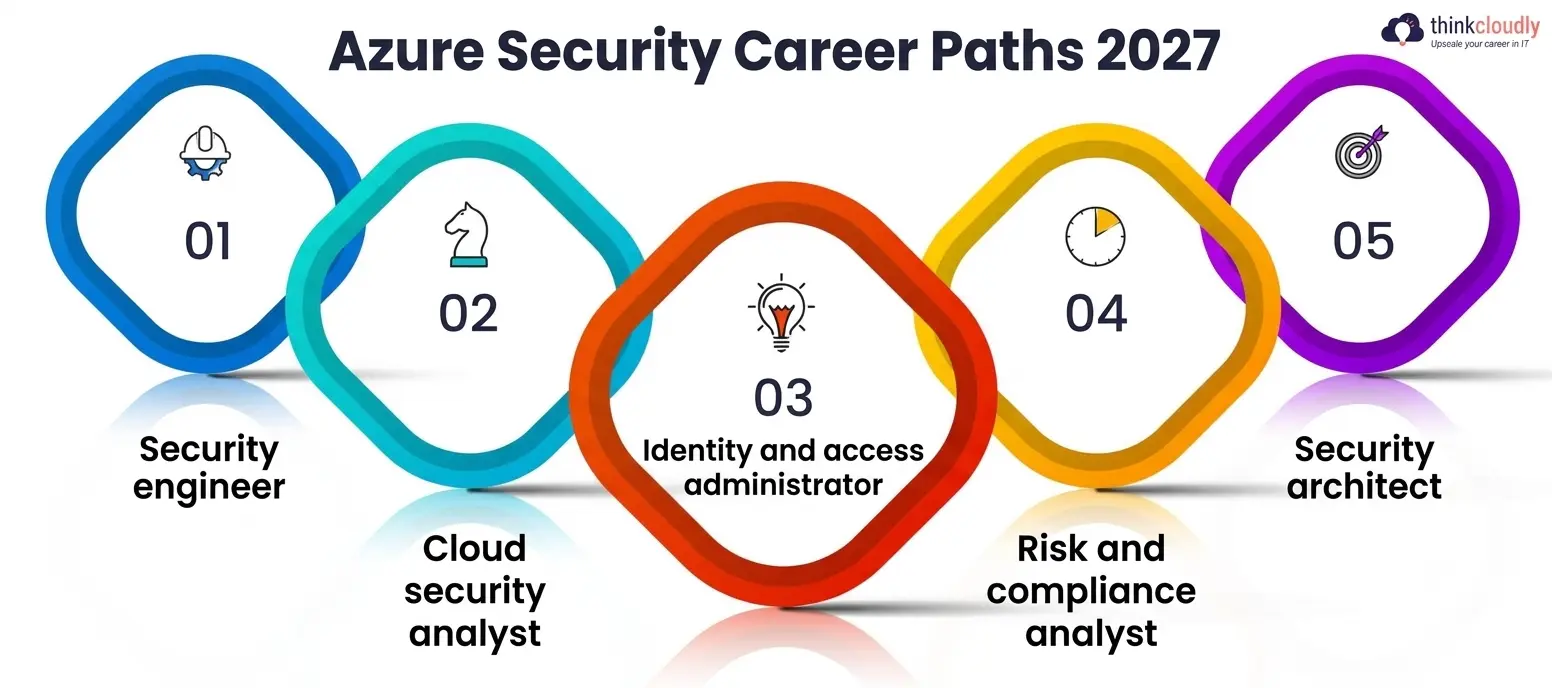
- Security engineer—hands-on hardening, Defender for Cloud configuration, and incident response inside live Azure environments.
- Cloud security analyst—monitoring, alert triage, and reporting; this is usually the role behind the cloud security analyst salary figures most people search for.
- Identity and access administrator—owns Azure identity governance full-time: conditional access, privileged access, and now agent identity for AI tools.
- Risk and compliance analyst—runs ongoing risk assessment work across cloud workloads and turns findings into policy, often sitting alongside a GRC or internal audit team.
- Security architect—designs environments with identity and data protection built in from the start rather than bolted on after an incident, typically a few years beyond entry level.
Where the Market Is Headed Outside the US and UK?
The US and UK simply publish the most reliable public salary data, but the demand isn’t limited to those two markets. Canadian employers in finance and healthcare are hiring for the same skill set as compliance rules tighten around cloud data residency.
Australian firms, especially in banking and telecom, are running similar hiring patterns to their UK counterparts, often pricing cloud security roles in a comparable band once currency is converted. Across all of these markets, the job itself looks nearly identical: fewer standalone “IT security” generalists and more people who can own identity, monitoring, and incident response together under one title.
Job titles still vary more than the actual work does. One employer’s “cloud security specialist” and another’s “platform security operations lead” can describe the exact same responsibilities, which means filtering job boards by title alone tends to undersell how many relevant openings actually exist. Reading the responsibilities section of a posting, not just the title, usually reveals more overlap than the naming suggests.
Skills That Separate a Junior Credential Holder From a Senior One
Two people can hold the exact same credential and land in completely different pay bands within two years. The difference almost never comes down to the exam score.
The senior ones build, break, and rebuild. They’ve configured Azure identity policies in a sandbox, watched a conditional access rule accidentally lock out an admin account, and fixed it under pressure—not just read about it.
They run a risk assessment on their own projects before anyone asks them to, and they can explain a Microsoft Sentinel analytics rule in plain language to a non-technical stakeholder.
Roles that pay at the top of the band also tend to require comfort outside pure Azure. Multicloud posture work, a working sense of how a cloud security analyst salary compares across platforms, and basic familiarity with AI-agent identity concepts all separate a $75,000 hire from a $140,000 one holding the same underlying credential.
Azure security work rewards people who stay curious about the parts of the job that weren’t on the exam blueprint, because those are usually the parts that show up in a real incident. For anyone structuring a study plan around this, Microsoft’s own SC-500 certification page is the most current source on exam domains, since Microsoft updates the weighting a few times a year.
Pairing that with a general framework like NIST’s risk management guidance gives candidates a vendor-neutral way to practice the judgment the exam actually tests, not just the tool names.
A Personal Note
I’ve reviewed enough resumes to notice a pattern: the people who get the better offer almost never have the flashier credential — they have the better story about what they did with it. I’ve watched someone with a single associate-level badge out-earn a colleague holding three certifications, simply because the first person could describe, in plain language, a production incident they’d actually fixed.
The second candidate had better paper and a thinner story, and the hiring manager noticed. If you’re studying for a cloud security credential right now, don’t stop at passing. Build the lab, break something on purpose in a sandbox, and keep a short list of problems you’ve personally solved. That list is worth more in a salary negotiation than the exam score ever will be.