

If your release cycle still feels like a relay race where someone always drops the baton between “code complete” and “code live,” the problem usually isn’t your developers. It’s the absence of solid DevOps practices holding the handoff together.
I’ve spent enough time inside engineering teams—some shipping daily, some still shipping quarterly out of fear—to know the gap between those two groups is rarely talent. It’s a process.
This guide walks through what DevOps practices actually look like on a working team in 2026, why they matter more than ever now that release cadence has become a competitive weapon, and how CI/CD best practices, cultural shifts, and the right DevOps methodologies combine to get code out faster without breaking it. I’m writing this the way I’d explain it to a student or junior engineer sitting across from me, not the way a vendor datasheet would.
What Are DevOps Practices?
DevOps practices are the specific, repeatable habits that let development and operations teams work as one unit instead of two departments throwing work over a wall. They are not a single tool or a job title—they are a set of DevOps methodologies covering automation, monitoring, collaboration, and shared accountability for what happens after code ships.
Where DevOps as a philosophy answers “Why should Dev and Ops work together?” the practices behind it answer, “What do we actually do on a Tuesday morning to make that true?” That distinction matters because a lot of teams adopt the language of DevOps—daily standups, a Slack channel named #devops—without adopting any of the practices that make the philosophy real: automated testing, infrastructure as code, continuous deployment, and shared on-call ownership.
Why DevOps Practices for Software Development Matter More
Software delivery expectations have shifted hard over the past few years, and DevOps practices for software development are no longer a nice-to-have for teams that want to stay competitive. A handful of forces are driving that shift right now:
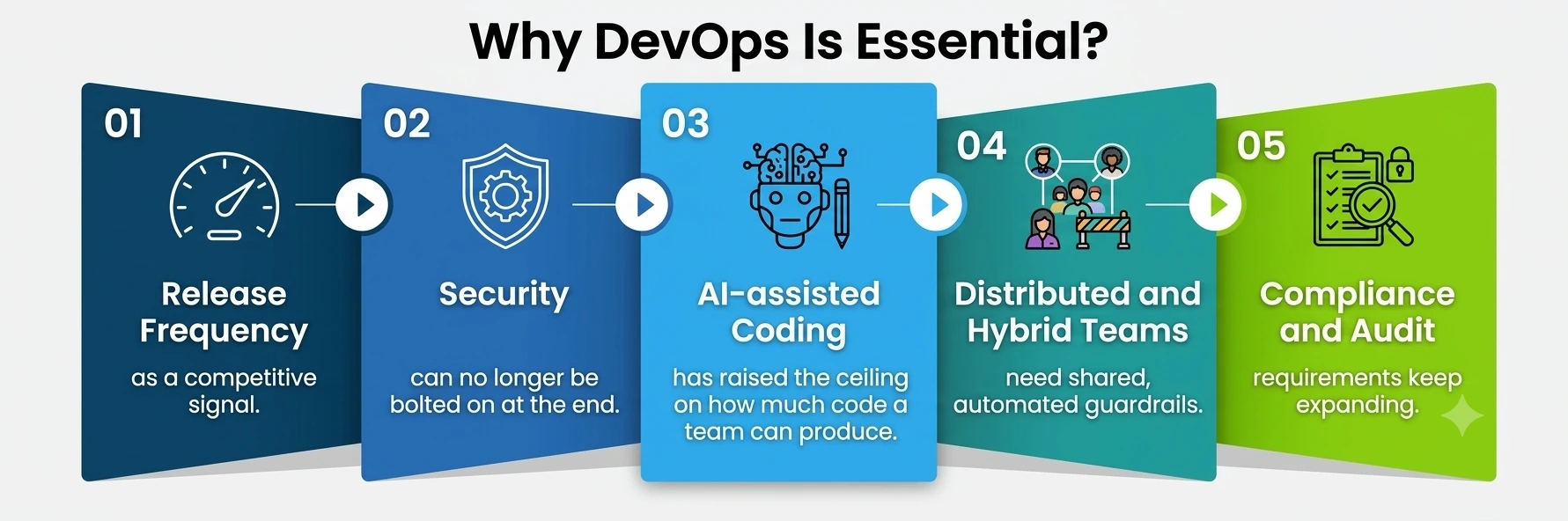
- Release frequency is now a competitive signal. Customers and investors alike read shipping speed as a proxy for engineering health, and teams without solid DevOps practices for software development simply can’t keep pace.
- Security can no longer be bolted on at the end. According to Datadog’s State of DevSecOps 2026 report, 87% of organizations still have exploitable vulnerabilities sitting in production, and the same research found a direct link between deployment frequency, DORA metrics, and overall security posture.
- AI-assisted coding has raised the ceiling on how much code a team can produce, which means the bottleneck has moved downstream—straight into testing, review, and release, exactly where these operational habits live.
- Distributed and hybrid teams need shared, automated guardrails instead of tribal knowledge that lives in one engineer’s head.
- Compliance and audit requirements keep expanding, and manual release processes simply can’t produce the evidence trail regulators and enterprise customers now expect.
None of these forces are going away in 2026, which is exactly why DevOps practices for software development have moved from an engineering nice-to-have to a board-level conversation at a growing number of companies.
Core DevOps Practices That Accelerate Software Delivery
Here’s where theory becomes action. These are the habits that show up, consistently, on teams that actually ship fast without breaking production:
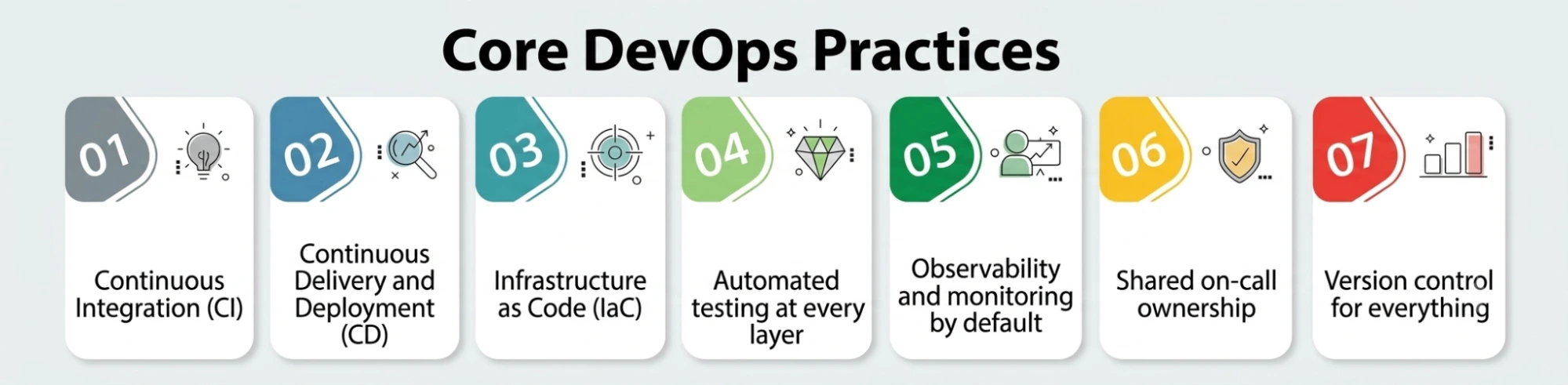
- Continuous Integration (CI). Every code change merges into a shared branch multiple times a day, with automated builds and tests catching problems within minutes instead of weeks.
- Continuous Delivery and Deployment (CD). Code that passes its checks is automatically packaged and, in mature setups, automatically released—no manual sign-off bottleneck.
- Infrastructure as Code (IaC). Environments are defined in version-controlled files (Terraform, Pulumi, CloudFormation) rather than configured by hand, so “it works on staging” stops being a mystery.
- Automated testing at every layer. Unit, integration, and end-to-end tests run on every commit, not just before a release deadline.
- Observability and monitoring by default. Logs, metrics, and traces are wired in from day one, not added after the first outage.
- Shared on-call ownership. The people who write the code also carry the pager, which closes the feedback loop between a bad decision and its consequence.
- Version control for everything, including infrastructure definitions, configuration files, and deployment scripts—not just application code.
Put together, these DevOps practices form a feedback loop: write code, test it automatically, ship it automatically, watch it in production, learn, and repeat. Teams that skip any one link in that chain tend to feel it first in their incident count and second in their deploy frequency.
CI/CD Best Practices That Make the Pipeline Actually Work
A pipeline that technically exists isn’t the same as a pipeline anyone trusts. These CI/CD best practices separate the two:
- Keep the pipeline fast. If a build takes 40 minutes, developers will batch changes and defeat the entire point of continuous integration. Aim for a feedback loop measured in minutes, not coffee breaks.
- Fail builds loudly and immediately, rather than letting a red test sit ignored for days. A pipeline nobody trusts gets routed around, which defeats every other CI/CD best practice on this list.
- Use feature flags instead of long-lived branches. Merging small, flagged changes into the main branch constantly beats maintaining a feature branch for six weeks and merging it in one terrifying afternoon.
- Automate rollback, not just rollout. Among the CI/CD best practices teams forget most often is planning the way back—a one-click or fully automatic rollback path matters as much as the deploy button itself.
- Scan for vulnerabilities inside the pipeline, not after release, so security checks run at the same speed as everything else rather than becoming a separate, slower gate.
- Treat pipeline configuration like production code—reviewed, version-controlled, and tested, because a broken pipeline script can take down releases just as badly as broken application code.
AWS’s own guidance on DevOps frames this well: the goal of a strong release pipeline isn’t speed for its own sake; it’s making small, frequent, low-risk changes instead of rare, large, high-risk ones. Smaller batches are simply easier to test, review, and roll back than giant ones.
DevOps Best Practices for Culture and Collaboration
Tools and pipelines only get a team halfway there. The other half of DevOps best practices is cultural, and it’s the half most teams underinvest in:
Blameless postmortems are one of the clearest DevOps best practices a team can adopt, because they shift the question after an incident from “who broke it” to “what in our system allowed this to happen.” That single reframe changes how openly engineers report near-misses, which is exactly the information you need to prevent the next real outage.
Cross-functional ownership is another of the core DevOps best practices worth protecting deliberately: developers who understand what happens to their code in production write noticeably better code than developers who hand it off and move on.
DevOps resources describe this as collapsing the distance between “building” and “running” software, and that distance is exactly what separates teams that fire constantly from teams that mostly don’t.
Documentation-as-you-go, rather than documentation-as-an-afterthought, rounds out the habits that compound over time—a runbook written during an incident is far more useful than one written six months later from memory, once nobody quite remembers what actually happened.
Common DevOps Methodologies in 2026
Not every team needs the same DevOps methodologies, and picking the wrong one for your size or maturity causes more friction than it solves. Here’s a quick comparison:
|
Methodology |
Best Fit For | Core Idea |
Typical Tooling |
|
Agile + DevOps |
Small- to mid-size product teams | Short iterations, continuous feedback, frequent releases |
Jira, GitHub Actions, GitLab CI |
|
GitOps |
Teams running Kubernetes at scale | Git as the single source of truth for infrastructure state |
ArgoCD, Flux, Kubernetes |
|
Platform Engineering |
Larger orgs with many product teams | A self-service internal platform abstracts infra complexity. |
Backstage, Terraform, internal CLIs |
|
Site Reliability Engineering (SRE) |
High-scale, reliability-critical systems | Operations treated as a software engineering problem |
Prometheus, Grafana, on-call tooling |
|
Lean / Continuous Delivery |
Teams optimizing for cycle time | Eliminate waste between idea and production. |
Trunk-based development, feature flags |
None of these approaches are mutually exclusive—most mature engineering orgs blend two or three depending on team size and the system they’re running. A 12-person startup rarely needs full platform engineering; a company running hundreds of microservices rarely survives without it.
The honest advice for picking between them is to match the methodology to the pain you actually have right now, not the one with the most conference talks. A small team struggling with slow, error-prone releases gets more mileage from tightening up Agile and basic CI/CD than from standing up a Kubernetes-based GitOps workflow it doesn’t yet need.
A larger org drowning in inconsistent environments across a dozen teams, on the other hand, will feel real relief from platform engineering long before it feels any from another round of sprint-planning tweaks. Match the fix to the actual bottleneck, and upgrade the approach as the bottleneck itself changes—because it will, as the team and the system both grow.
Real-World Impact: What the 2026 Data Shows
The numbers back up what practitioners already feel on the ground. Datadog’s 2026 research, cited earlier, found that teams can cut alert noise by roughly 80% simply by prioritizing vulnerabilities that carry genuine business risk, rather than chasing every flagged issue with equal urgency—a direct result of a mature monitoring and triage discipline.
The ongoing research program, now in its second decade of tracking software delivery performance, continues to find that the capabilities behind elite performance aren’t exotic — they’re the same fundamentals covered above, applied consistently rather than in bursts.
Google Cloud’s DevOps resources echo the same pattern: the teams that automate deployment, measure what matters, and keep batch sizes small outperform teams with more headcount but weaker process, year after year.
The pattern across all of this research is consistent: this discipline isn’t a one-time project you finish and move on from. It’s a standing practice, and the teams that treat it that way keep compounding the advantage.
How to Tell Whether It’s Actually Working?
Adopting the right tools doesn’t automatically mean the underlying process is healthy. A few signals separate teams where the habits above have genuinely taken root from teams that just bought the tooling and called it done:
- Deploy frequency is climbing, not flat. If your team deploys once a week today and deployed once a week a year ago, something upstream — review bottlenecks, fear of breaking production, manual approval chains — is quietly capping your pace regardless of what the pipeline dashboard claims.
- Mean time to recovery is measured in minutes, not hours. A fast rollback and a clear incident process matter more than preventing every failure, because failures in complex systems are inevitable; slow recovery from them is the part that’s optional.
- Change failure rate is trending down over quarters. A small, steady percentage of releases causing problems is normal. A rising trend usually means testing coverage or review rigor has quietly eroded as the team scaled.
- Engineers aren’t afraid of Friday deploys. This sounds like a joke metric, but it’s a genuinely useful gut check — fear of deploying before a weekend is a tell that the safety net underneath releases isn’t trusted.
Teams that track even two or three of these signals consistently tend to catch process decay long before it shows up as a painful outage, which is the entire point of building the habit of measuring in the first place.
A Personal Note
I’ve watched more than one talented team burn out chasing feature velocity while their deployment process stayed held together with duct tape and one engineer’s memorized checklist. The fix was never “work harder” — it was almost always “automate the boring, repeatable part so the smart part gets more attention.”
If you’re a student heading into this field, don’t wait for your first job to learn this lesson: build a small CI/CD pipeline for a side project this month, even a toy one. Watching a broken build get caught automatically, instead of in front of a user, is the moment DevOps practices for software development stop being a buzzword on a resume and start being something you actually understand in your hands.