
Every “top AWS services” roundup reads the same way: a list of twelve logos with a sentence each, written by someone who’s never debugged a failed Glue job at midnight. That’s not useful if you’re trying to figure out which AWS Services for Data Engineer roles actually require, versus which ones just look good on a slide.
Picking the best AWS services for data engineers isn’t about memorizing a service catalog — it’s about knowing which five or six tools you’ll touch in almost every real pipeline.
If you are mapping out a 2026 learning plan, understanding the right AWS Services for Data Engineer roles is the single most useful thing you can do this quarter, because the data stack has shifted meaningfully in the last two years. Storage, governance, and orchestration now matter as much as raw compute, and a lot of course material hasn’t caught up.
This guide breaks down the AWS Services for Data Engineer work that actually matters, skipping the service list nobody uses in production, and pointing to where the platform is genuinely headed in 2026.
Why Does the AWS Data Stack Look Different in 2026?
Three years ago, a data engineer’s AWS toolkit was mostly S3, Glue, and Redshift, with EMR for anything too big for a warehouse. That’s no longer the full picture. According to AWS’s own analytics recap from re:Invent, the platform’s biggest investment right now is unifying data, AI, and governance into one layer instead of a dozen loosely connected services.
That changes what “knowing AWS” means — it’s no longer enough to move data from point A to B; you’re expected to govern who can see it, track where it came from, and make it usable for AI workloads downstream.
AWS data engineering services have multiplied over the past two years, and most of that growth sits in the lakehouse and governance layer rather than in brand-new compute engines. Amazon S3 Tables, built on the open Apache Iceberg format, is the clearest example — it turns S3 from plain object storage into something that behaves like a transactional table, with support for schema evolution and time travel.
Pair that with tighter integration into Amazon SageMaker Lakehouse, and you get a single query layer across data lakes and warehouses that didn’t really exist in a clean form a few years back. Anyone studying the current AWS data engineering services landscape needs to understand this shift before memorizing individual service names.
Top AWS Services for Data Engineer Work in 2026
Below is the core AWS Services for Data Engineer stack — effectively the best AWS services for data engineers to know cold — ranked roughly by how often each one shows up in real pipelines rather than by marketing emphasis. Treat this as a checklist for what to actually learn, not a trivia list.
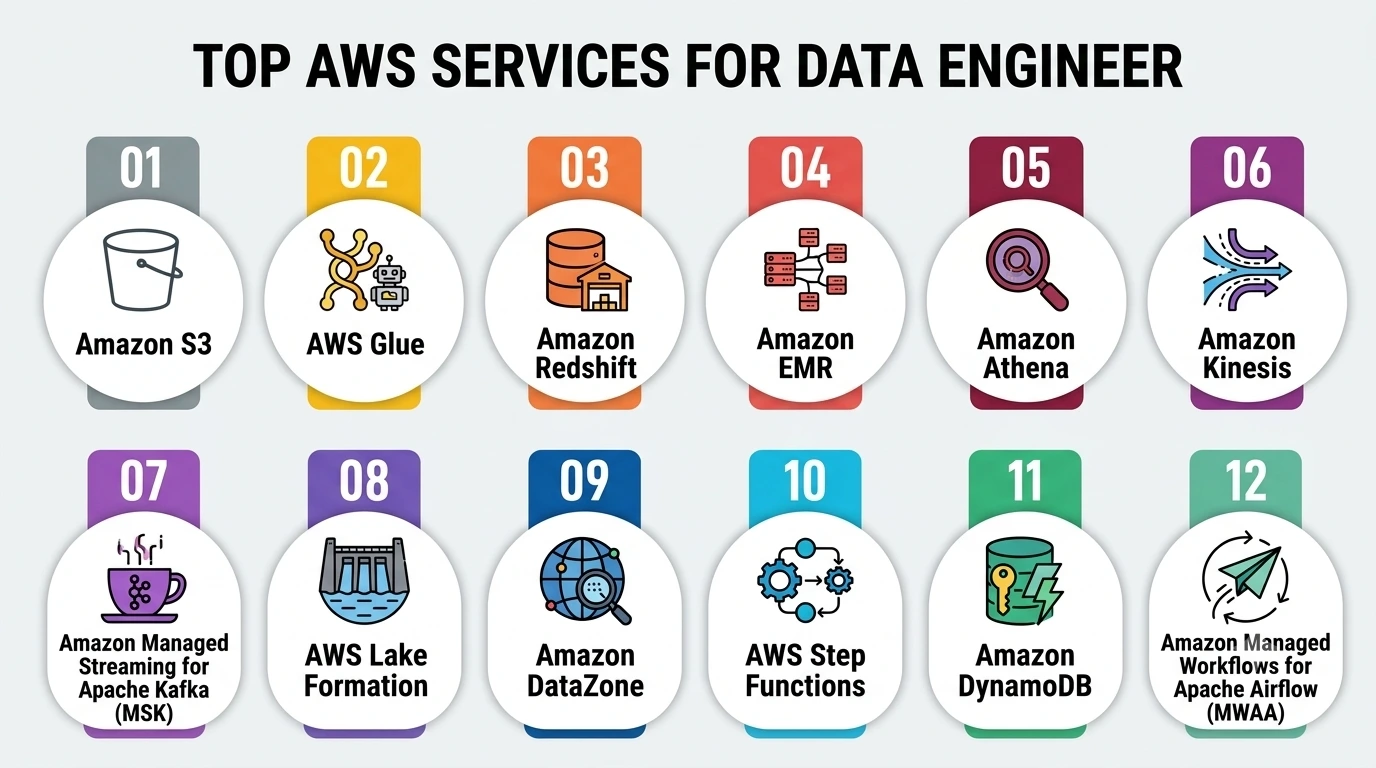
- Amazon S3 — the default landing zone and long-term storage layer for almost every pipeline; now with native table support through S3 Tables.
- AWS Glue — serverless ETL, data cataloging, and job scheduling without managing Spark infrastructure directly.
- Amazon Redshift — the managed data warehouse for structured, high-performance analytical queries at scale.
- Amazon EMR — managed big-data processing for Spark, Hive, and Flink workloads that outgrow a warehouse.
- Amazon Athena — serverless, SQL-based querying directly against data sitting in S3, no cluster required.
- Amazon Kinesis — real-time data streaming for clickstream data, IoT telemetry, and event-driven pipelines.
- Amazon Managed Streaming for Apache Kafka (MSK) — a managed Kafka service for teams already standardized on the Kafka ecosystem.
- AWS Lake Formation — centralized permissions and governance across every data lake a team maintains.
- Amazon DataZone — a data catalog and governance layer built for discovering and sharing trusted data across teams.
- AWS Step Functions — orchestration for multi-step workflows that chain Glue jobs, Lambda functions, and EMR steps together.
- Amazon DynamoDB — a managed NoSQL database for low-latency operational data that feeds downstream pipelines.
- Amazon Managed Workflows for Apache Airflow (MWAA) — managed Airflow for teams that need Python-based DAG orchestration instead of Step Functions.
Here’s a ranked look at the best AWS services for data engineers — notice that none of the top five are exotic. They’re the services you’ll configure, break, and fix repeatedly during your first year on the job, and fluency with this shorter list matters more than naming the exotic ones.
A Closer Look: What Each Category Actually Does
The table below maps each AWS Services for Data Engineer category to its primary job and when to reach for it, since the list above only tells half the story without context on how these pieces fit together.
|
Category |
Core Service(s) | What It Solves |
When You’d Use It |
|
Storage |
Amazon S3, S3 Tables | Durable, cheap, near-infinite storage for raw and structured data |
Every pipeline, as the landing zone and source of truth |
|
ETL & Transformation |
AWS Glue, EMR | Cleaning, reshaping, and moving data between systems |
Batch jobs, scheduled transformations, large-scale Spark processing |
|
Querying & Warehousing |
Redshift, Athena | Fast analytical queries over structured or semi-structured data |
Dashboards, BI tools, ad hoc analyst queries |
|
Streaming |
Kinesis, MSK | Moving data in near real time as events happen |
Fraud detection, IoT telemetry, live clickstream analysis |
|
Governance & Cataloging |
Lake Formation, DataZone | Access control, lineage, and data discovery across teams |
Multi-team organizations with sensitive or regulated data |
|
Orchestration |
Step Functions, MWAA | Chaining jobs together reliably, with retries and alerting |
Any pipeline with more than two dependent steps |
|
Operational Data |
DynamoDB | Low-latency reads and writes for live application data |
Feeding analytics pipelines from a production application |
Notice how often Amazon S3 for data engineering appears as a dependency in the table above — almost every other service reads from or writes back to it at some stage. That’s not a coincidence; it’s the reason storage decisions tend to outlast every other architectural choice a team makes.
Storage First: Why Amazon S3 Still Anchors Everything
Amazon S3 for data engineering is less a single service and more the foundation everything else in this list sits on top of. Glue jobs read from it, Redshift can query it directly through Spectrum, Athena queries it without needing a warehouse at all, and EMR clusters treat it as the default data source for Spark jobs.
If S3 is poorly organized — flat buckets, no partitioning, inconsistent file formats — every downstream service inherits that mess and gets slower and more expensive as a direct result.
Using Amazon S3 for data engineering well means understanding partitioning strategy (by date, region, or whatever your query patterns actually filter on), lifecycle rules that automatically move cold data to cheaper storage tiers, and the newer S3 Tables format for Apache Iceberg, which adds ACID transactions and schema evolution to what used to be plain object storage.
A data engineer who treats S3 as an afterthought — “just dump it in a bucket” — tends to spend the next two years cleaning up that decision. Any list of AWS data engineer tools has to start with Amazon S3 for data engineering, because nothing else in the stack functions reliably without disciplined storage underneath it.
Compute and Transformation: Glue, EMR, and Redshift
AWS Glue remains one of the best AWS services for data engineers who need serverless ETL without managing Spark clusters by hand. It handles schema discovery through its Data Catalog, runs transformation jobs on a managed Spark environment, and triggers on schedules or events without someone babysitting a cluster.
For teams without dedicated infrastructure engineers, Glue is usually the fastest path from “we have raw data somewhere” to “we have clean tables analysts can query.”
Amazon EMR earns its spot when a workload genuinely outgrows what Glue or a warehouse can handle — petabyte-scale batch processing, custom Spark tuning, or feature pipelines that need fine-grained cluster control. It trades managed simplicity for deeper configuration control when a job’s scale demands it.
Redshift, meanwhile, is where transformed data usually lands for business-facing analytics: a columnar, massively parallel warehouse built for the aggregation-heavy queries a BI dashboard runs constantly.
Pairing it with Redshift Spectrum lets it query data sitting in S3 directly, blurring the line between “warehouse” and “data lake” in a way that’s become standard practice across most AWS data engineering services in 2026.
Governance Is No Longer Optional
A few years ago, a data engineer could reasonably ignore governance until a compliance team asked uncomfortable questions. That window has closed. Lake Formation and Amazon DataZone are the newest AWS data engineering services built to solve governance at scale, handling fine-grained access permissions, column-level security, and lineage tracking across every team touching a shared data lake.
DataZone adds a discovery layer on top — a catalog where analysts find trusted, already-governed datasets instead of re-requesting the same extract for the fifth time this month. For any organization running more than two or three data teams, this isn’t a nice-to-have; it’s the difference between a data lake that stays usable and one that quietly turns into a swamp nobody trusts.
AWS Data Engineer Tools Worth Mastering in 2026
The AWS data engineer tools below aren’t optional extras — they’re the baseline most teams now expect from anyone applying for a mid-level or senior data engineering role, regardless of industry.
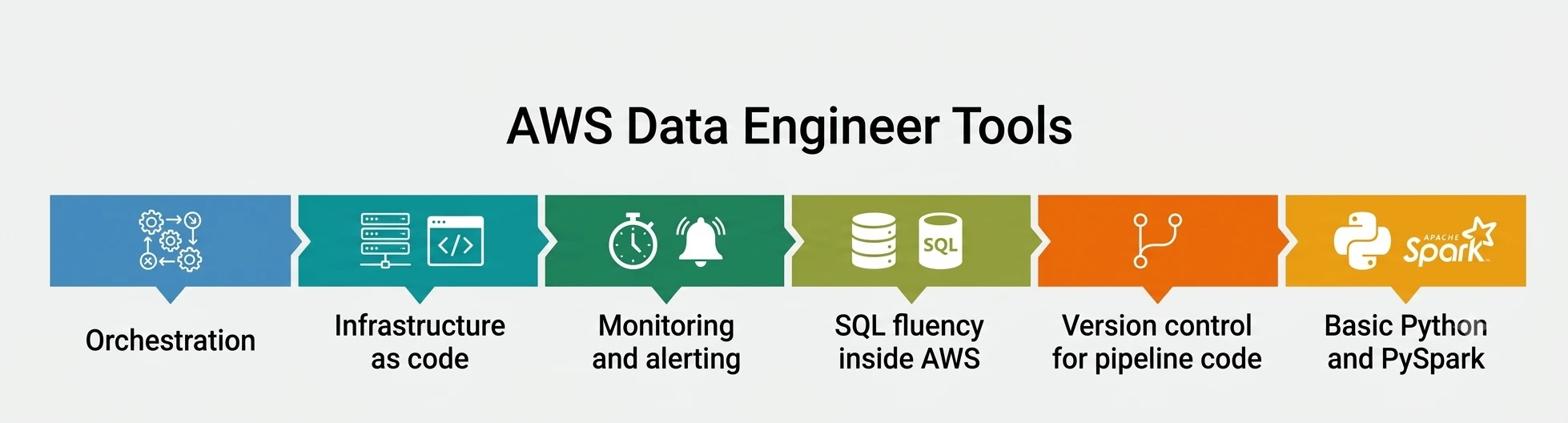
- Orchestration: Step Functions and Managed Workflows for Apache Airflow are the AWS data engineer tools that keep multi-step pipelines from falling apart silently when one job fails at 3 a.m.
- Infrastructure as code: CloudFormation or the AWS CDK, so pipeline infrastructure is reproducible instead of click-built in a console that nobody documented.
- Monitoring and alerting: CloudWatch, paired with structured logging inside Glue and Lambda jobs, so failures surface before an analyst notices a stale dashboard.
- SQL fluency inside AWS: comfortable querying across Athena, Redshift, and Glue-cataloged tables without needing to export data elsewhere first.
- Version control for pipeline code: Git-based workflows for Glue scripts, Airflow DAGs, and Step Functions definitions, treated with the same discipline as application code.
- Basic Python and PySpark: the practical language layer underneath most AWS Glue and EMR transformation logic.
Students asking which are the best AWS services for data engineers to learn first should start with storage and orchestration before touching anything else, since those two categories show up in almost every single pipeline regardless of industry or company size. Streaming and governance tools matter, but they’re easier to pick up once the fundamentals are solid.
Certification: Proving You Know This Stack
AWS backs this up with a dedicated credential built around AWS Services for Data Engineer responsibilities rather than general cloud knowledge: the AWS Certified Data Engineer – Associate exam (code DEA-C01). It’s 130 minutes, 65 questions, and tests data ingestion, transformation, orchestration, governance, and security — a much closer match to real day-to-day work than a general architecture exam.
AWS recommends candidates have two to three years of data engineering experience and one to two years of hands-on AWS work before attempting it, which makes it a realistic second step rather than a starting point.
The exam tests hands-on familiarity with this stack rather than abstract theory, which is exactly why course material that skips labs tends to produce candidates who pass the exam but struggle in their first real pipeline review. Studying a service list without ever building something with it is a common and avoidable mistake.
What Does This Look Like in Terms of Career and Pay?
Employers hiring in 2026 are explicit about wanting candidates who’ve touched real AWS data engineering services, not just read about them in a course outline. Per compensation data, data engineers in the United States average around $134,798 a year, typically ranging from roughly $106,000 to $173,000 depending on seniority, location, and how deep a candidate’s hands-on AWS experience actually runs.
The U.S. Bureau of Labor Statistics also projects database-architecture-adjacent roles — the closest official category to advanced data infrastructure work — to grow faster than the average across all occupations through the mid-2030s, which tracks with how much governance and lakehouse work has expanded industry-wide.
The fastest way to build real AWS Services for Data Engineer experience is to pipe public data through the exact stack a hiring manager expects you to know: land a dataset in S3, catalog it with Glue, transform it, query it through Athena or Redshift, and wrap the whole thing in a Step Functions workflow with basic error handling. That single project, done properly, demonstrates more mastery of real AWS data engineer tools than a stack of practice exam scores ever will.
A Personal Note
I still tell every student the same thing when they ask where to start: get comfortable with Amazon S3 for data engineering before anything else, because every other service on this list eventually hands data back to it in one form or another.
It’s tempting to skip ahead to the flashier parts — streaming, machine learning features, orchestration graphs — but every AWS Services for Data Engineer skill on this list is easiest to test for free with a sandbox account and a dataset you actually care about, starting with storage. Learn that part properly first. Everything else gets easier once that habit is solid, and that order has never once failed a student who stuck with it.
Want guided practice? Check our AWS certification training courses to build these pipelines hands-on.