
A friend of mine spent eleven months this year studying for three unrelated credentials at once, convinced that stacking more letters after her name would eventually translate into a bigger paycheck.
It didn’t move the needle at all. What actually got her a 22% raise was one AWS certification, finished properly, paired with a project she could talk through in detail during her next review. That gap—between collecting credentials and actually using one well—is the entire reason this piece exists.
Searching for IT certifications online in 2027 gets you thousands of course listings and almost no honest answer about which ones actually move your salary. This guide skips the marketing language and goes straight to what the 2027 data shows: which credentials are tied to real pay increases, how much those increases typically run, and which combinations are worth the exam fee heading into 2027.
Why Are IT Certifications Online Becoming the Default Path to Higher Pay?
Four years ago, a certification was something you added to a resume that already had a degree behind it. That’s no longer how most employers screen candidates. Skills-based hiring has pushed online credentials from a nice-to-have into something closer to a baseline filter, particularly for cloud, security, and project-leadership roles where the underlying technology changes faster than most university curricula can keep up with.
Remote hiring has pushed this along further than most people realize. Once a company is comfortable hiring someone it has never met in person, the resume has to carry more proof on its own, and a credential issued by a recognized body does exactly that job.
It’s a big reason employers across North America, the UK, and the EU now list named certifications directly in job postings rather than a vague “cloud experience preferred” line that leaves too much open to interpretation.
Part of this shift comes down to verification. A degree tells an employer you finished a program years ago. A current cybersecurity certification or a cloud credential tells them you can do a specific, testable thing right now.
That immediacy is exactly why recruiters increasingly search resumes for named credentials rather than relying on a general “IT background” line, and it’s why IT certifications online have become one of the fastest ways to get past an automated resume filter before a human ever reads your application.
The pay data backs this up directly. The skills-based hiring and continuous workforce development remain defining trends in the sector, with employers explicitly prioritizing verified, current skills over tenure or academic background when setting starting offers. That’s a meaningful shift from how hiring worked even five years ago, and it’s a big part of why these credentials keep showing up near the top of salary-negotiation advice for 2027.
IT Certifications Online Compared: Salary Impact by Specialization
Rather than list credentials in no particular order, here’s how the major options actually compare once you line them up by specialization, typical cost, and the salary range tied to the role each one unlocks.
|
Certification |
Specialization | Typical Exam Cost | Associated Role |
Typical Salary Range (2027) |
|
AWS certification (Solutions Architect Associate) |
Cloud computing | $150 | Cloud Engineer / Cloud Architect |
111,000–150,000 |
|
Cloud computing certification (Azure/GCP Associate) |
Cloud computing | 99–165 | Cloud Support / Junior Cloud Engineer |
100,000–140,000 |
|
Cybersecurity certification (CompTIA Security+) |
Cybersecurity | $400 | SOC Analyst / Security Specialist |
80,000–105,000 |
|
CISA certification |
Audit / Governance | 575–760 | IT Auditor / GRC Analyst |
95,000–135,000 |
|
PMP certification |
Project Leadership | 405–555 | Project Manager / Program Lead |
110,000–135,000 |
A few things stand out once they’re side by side. The entry cost of a cloud credential is low relative to the pay it unlocks, which is exactly why cloud-focused options are among the most recommended credentials for people pivoting from a different industry.
The audit and leadership rows sit at the higher end of both cost and payoff, because both assume a few years of real experience behind the exam rather than functioning as a true starting point.
Cloud Computing Certification Paths Worth Paying For
Of every category in that table, a cloud computing certification is probably the safest bet for someone browsing certification options in 2027, mostly because cloud infrastructure isn’t going anywhere and the skills gap hasn’t closed.
AWS’s own certification roadmap still treats the Cloud Practitioner exam as the logical entry point, with the Solutions Architect Associate as the credential that actually opens cloud-engineering job postings.
The AWS certification path specifically tends to pay better than its closest Azure or Google Cloud equivalents in markets where AWS still holds the largest share of enterprise cloud infrastructure, though that gap has been narrowing as more companies run multi-cloud environments.
Someone comparing cloud options purely on projected salary should weigh which platform their target employer actually runs, not just which one has the most course listings—choosing this path is close to wasted effort if the company you want to work for standardized on Azure three years ago.
What makes a cloud computing certification different from a cybersecurity credential is how directly it maps to infrastructure decisions a company is already paying to make. Cloud spend is a visible line item on nearly every tech budget now, which means someone who can prove they can manage, secure, and optimize that spend has a built-in case for a higher starting salary—not a theoretical one.
Why Does a CISA Certification Still Commands Premium Pay?
The CISA certification is the odd one out on this list, and it’s worth explaining why it pays as well as it does. Unlike most entry-friendly online credentials, ISACA’s CISA credential requires five years of relevant professional experience before you can even sit the exam, which immediately filters out anyone trying to use it as a first certification.
That barrier is exactly what keeps the CISA certification’s associated salaries high. Employers aren’t paying for an exam pass; they’re paying for a verified track record in IT audit, governance, or risk work, with the exam functioning as the final confirmation rather than the proof itself.
Compared to a general cybersecurity certification, the CISA credential sits closer to the audit and compliance side of security than the technical defense side, which is why it pairs well with a governance-focused career rather than a hands-on security-operations one.
Anyone weighing a CISA certification against other credentials at a similar price point should be honest about timing. If you don’t already have the audit or compliance experience it requires, it isn’t a near-term option—it’s a multi-year target worth planning toward, not something to add to this year’s study list.
PMP Certification and the Leadership Pay Jump
A PMP certification sits in a different lane entirely from the technical credentials above, and it’s often the one people underestimate when comparing certification options. PMI’s own certification page notes that PMP holders are drawn from across industries, not just technology, which is part of why the credential travels so well between sectors.
What makes this credential valuable specifically for IT professionals is the career pivot it enables. Someone who’s spent years doing hands-on technical work—configuring systems, running migrations, closing security tickets—can use it to move into a leadership track without starting over in a completely unrelated field.
That’s a different kind of salary jump than a technical credential produces, because it’s less about proving a skill and more about proving you can run the people and budget behind the work.
The tradeoff is prerequisites. A PMP certification requires a documented minimum of project-management experience hours before you’re eligible to sit the exam, similar in spirit to the audit credential’s experience requirement above. Among the options covered here, it’s one of the few that genuinely rewards patience over speed—rushing toward it before you have the hours logged just means a wasted application.
Steps to Pick the Right IT Certifications Online for Your Career Lane
Rather than studying for whichever credential trends on social media that month, work through this sequence instead:
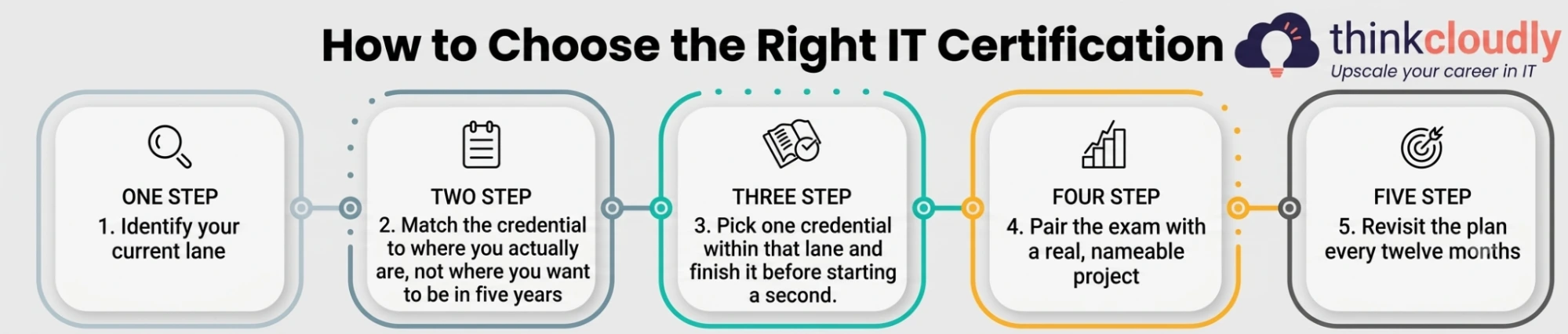
- Identify your current lane. Technical execution, security, cloud infrastructure, audit and governance, or project leadership—most careers already sit closer to one of these than people admit.
- Match the credential to where you actually are, not where you want to be in five years. Experience-gated credentials without the required background behind them are a wasted application fee, not a shortcut.
- Pick one credential within that lane and finish it before starting a second. Half-finished study guides for three unrelated specialties don’t add up to one job offer.
- Pair the exam with a real, nameable project. A cloud credential means more in an interview when you can describe a migration or cost-optimization project you actually worked on, not just the objectives you memorized.
- Revisit the plan every twelve months. What counted as the strongest security credential in 2023 may already need a refresh by 2027, given how quickly threat models and tooling shift.
Common Mistakes That Shrink the Salary Bump From Online Credentials
Even a well-chosen certification can underperform if it’s handled the wrong way. None of these mistakes are exotic—most people reading this have already made at least one of them without realizing it cost them a stronger offer. The most frequent issues look like this:
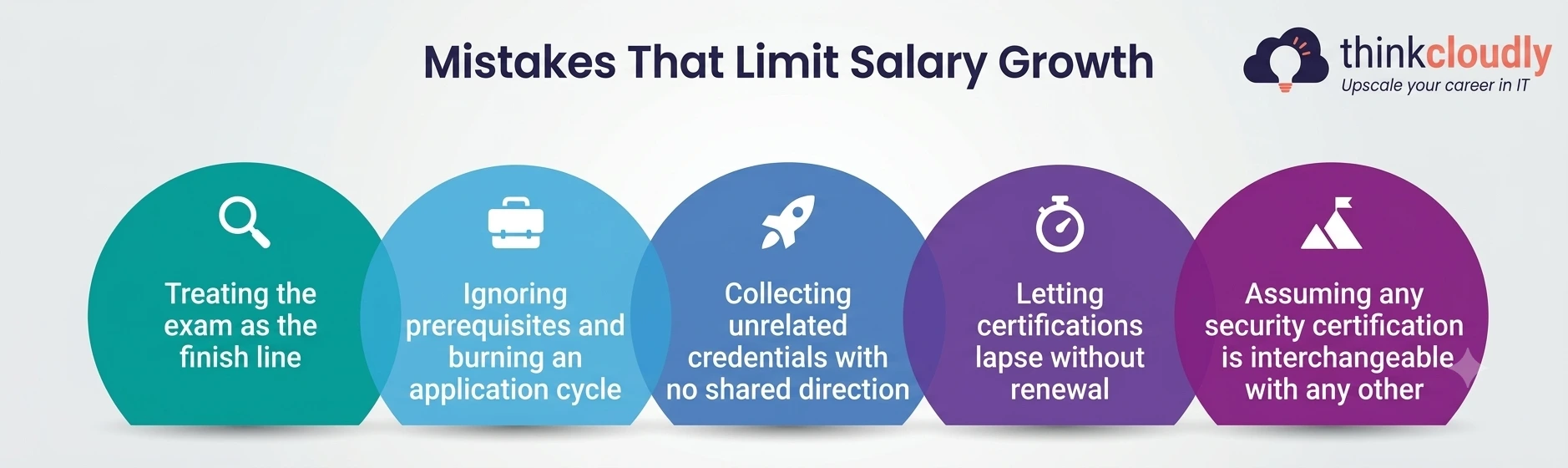
- Treating the exam as the finish line. A cloud or security credential proves baseline knowledge; employers still expect you to apply it, which is why hands-on labs matter as much as exam prep.
- Ignoring prerequisites and burning an application cycle. Sitting for an experience-gated credential before you have the required background wastes both the fee and the attempt.
- Collecting unrelated credentials with no shared direction. A resume with five scattered credentials reads as indecision, not ambition, to most hiring managers.
- Letting certifications lapse without renewal. Most credentials, cloud-focused ones included, require continuing education or periodic renewal — an expired one carries less weight than people assume.
- Assuming any security certification is interchangeable with any other. A foundational cybersecurity credential and an audit-focused one solve different problems and open different job titles.
What the 2027 Data Says About Certification ROI?
It’s worth being direct about what a single exam does and doesn’t do for your paycheck. The research consistently shows that specialized, in-demand skills — particularly cloud platforms and security — command measurable pay premiums over general IT roles, but the increase tends to show up alongside demonstrated experience, not immediately after an exam result lands in your inbox.
That distinction matters for anyone comparing IT certifications online purely by sticker price or pass rate. A cloud computing certification or a security-focused one earned without any applied practice behind it will still open doors a resume without it wouldn’t reach, but the biggest pay jumps consistently go to people who combine the credential with real, demonstrable work — a project, a lab, a volunteer engagement, anything concrete enough to discuss past the first interview question.
A Personal Note
I used to assume the certification itself was the valuable thing, and the job was just what happened afterward. I don’t think that anymore. The friend I mentioned at the start didn’t get her raise because an AWS certification appeared on her resume — she got it because she could walk her manager through exactly what she’d built with it, in detail, without hesitating.
The certification opened the conversation. The project she’d done alongside it is what actually closed the raise. If you’re choosing among IT certifications online right now, my honest advice is to spend as much time lining up something real to build with it as you spend studying for the exam itself. The exam gets you in the room. What you can show once you’re there is what gets you paid.