


A reader emailed me last month with a question I get at least once a week now: “I’ve never written a line of code, I’ve never worked a help-desk ticket, and I’m thirty-four. Is it too late to start with the cloud?” My answer surprised her. No, it isn’t too late, and no, you don’t need a computer science degree to start.
What you need is the right entry level AWS certification, a realistic study plan, and about ninety days of consistent effort. That’s the whole secret, and it’s less dramatic than most LinkedIn posts make it sound.
This guide exists because most advice about breaking into cloud computing assumes you already work in tech. It tells you to “brush up” on networking or “revisit” your Linux skills you supposedly already have. If you’re starting from zero, that advice is useless.
So this is written specifically for the person who has no IT history at all—a teacher, a retail manager, a nurse, a recent graduate in an unrelated field—and wants a straight answer on how an entry-level AWS certification actually works in 2027, what it costs, and whether it genuinely opens doors without a technical résumé behind it. Think of it as an AWS certification for beginners playbook, not a technical manual written for people who already know the jargon.
What Is an Entry-Level AWS Certification?
When people say “entry-level AWS certification,” they almost always mean the AWS Certified Cloud Practitioner. According to AWS’s own certification page, this exam is explicitly built for people new to the cloud, including “individuals with no prior IT or cloud experience switching to a cloud career.” That’s not marketing language softened for beginners—it’s the stated target audience, which is rare for a tech credential.
The exam costs 100 USD, runs for 90 minutes, and contains 65 questions in a multiple-choice or multiple-response format. There’s no coding section, no command-line test, and no requirement that you’ve ever touched a server. AWS says candidates “could have up to six months of exposure to AWS Cloud, but this is not required” — meaning the exam is designed to be passable by someone who has simply studied the material, not someone who has already worked the job. The certification stays valid for three years, after which you recertify through a game-based course, a retake, or by passing a higher-level AWS exam.
This is the starting point for almost every cloud computing career path I’ve seen succeed from a non-technical background. Not because it teaches deep technical skills, but because it builds a shared vocabulary—the terms, services, and pricing logic that every cloud conversation after this one assumes you already know.
Why Do Cloud Technology Basics Matter More Than Coding Skills Right Now?
Here’s something beginners get backward constantly: they assume the hard part of an entry-level AWS certification is technical difficulty. It isn’t. The hard part is learning an entirely new vocabulary for things you’ve probably never thought about—what a region is, why availability zones matter, and how pricing shifts between on-demand and reserved capacity. That’s cloud technology basics, and it’s conceptual, not mathematical.
Once you have cloud technology basics down, everything else gets easier to learn, because you stop translating every new term back into something familiar and start understanding the cloud on its own logic. I’ve watched people who struggled with cloud technology basics for weeks suddenly click once they stopped trying to map AWS onto their old mental model of a regular computer.
The cloud isn’t a bigger hard drive. It’s a rented, elastic version of an entire data center, and cloud technology basics exist specifically to teach you that shift in thinking before you touch a single real service.
This is also why an AWS certification for beginners works as a credential even without prior experience—it tests whether you understand the shift, not whether you can already execute it under pressure. Employers reading a resume with this certification aren’t expecting a systems administrator. They’re expecting someone who has already absorbed the orientation phase that usually eats a new hire’s first month on the job.
7 Steps to Earn Your Entry Level AWS Certification With Zero Tech Background
Breaking this down into a sequence matters, because skipping steps is exactly how people with no background burn out and quit halfway through. Here’s the order that actually works:
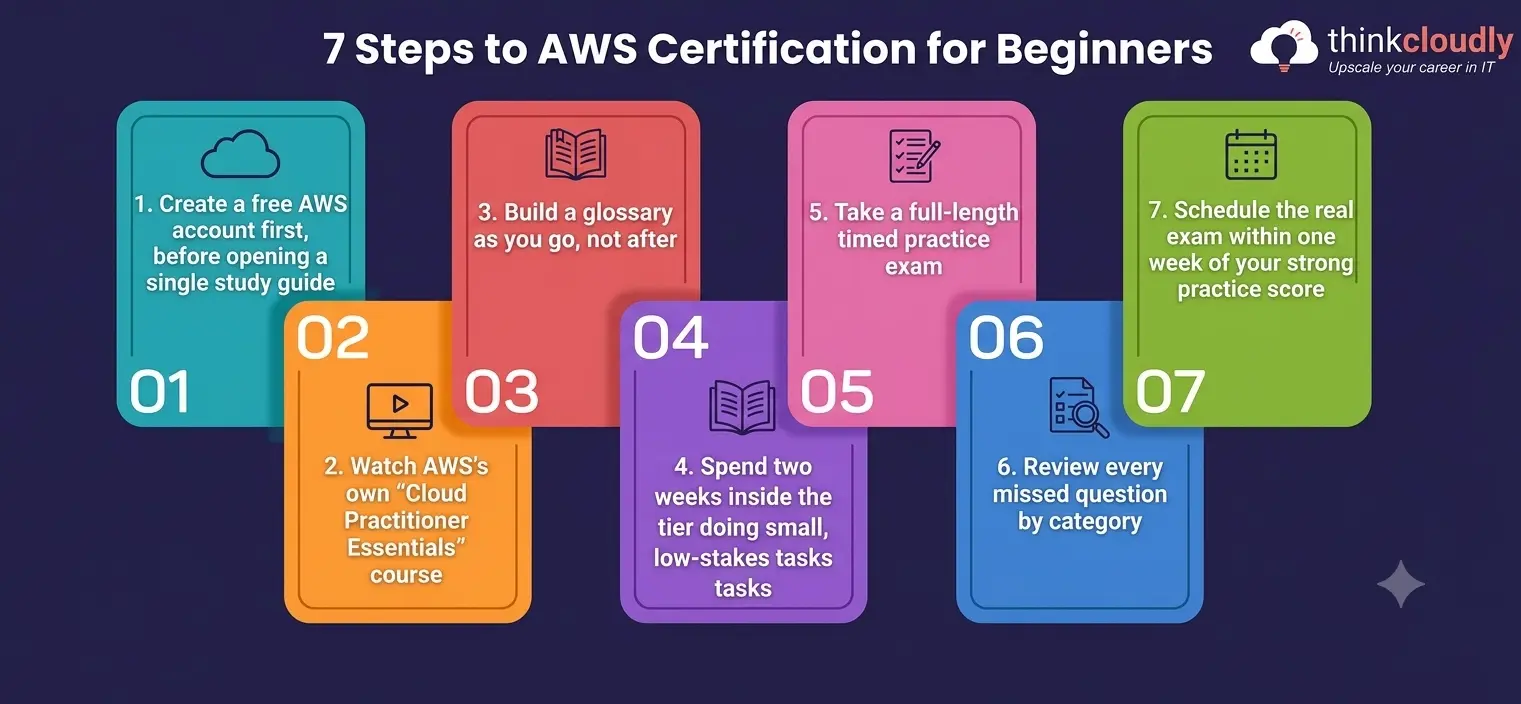
- Create a free AWS account first, before opening a single study guide. Seeing the console with your own eyes removes the abstraction that makes cloud computing fundamentals feel intimidating on paper.
- Watch AWS’s own “Cloud Practitioner Essentials” course. It’s free, built by AWS itself, and assumes zero background—the right entry point for cloud computing fundamentals.
- Build a glossary as you go, not after. Write down every new term the moment you hit it. This single habit does more for retention than any flashcard app.
- Spend two weeks inside the free tier doing small, low-stakes tasks—launch a basic storage bucket, set a billing alert, and explore IAM permissions. Hands-on time turns cloud computing fundamentals into memory instead of trivia.
- Take a full-length timed practice exam once you’ve covered every domain, not before. Early practice exams just measure how little you know yet, which is discouraging and not useful.
- Review every missed question by category, not just the ones you got wrong individually, so you find the actual weak domain rather than patching one random fact.
-
Schedule the real exam within one week of your last strong practice score. Waiting longer lets confidence fade faster than knowledge does.
Treat this as the backbone of any realistic AWS certification for beginners’ plan—people who follow a sequence like this rarely fail on their first attempt, because they stop treating the exam like trivia and start treating it like a skill they’re actually building.
5 Cloud Computing Fundamentals Every Beginner Needs Before Exam Day
If you only have time to deeply understand five things before sitting the exam, make them these. This list alone covers a disproportionate share of real exam questions.
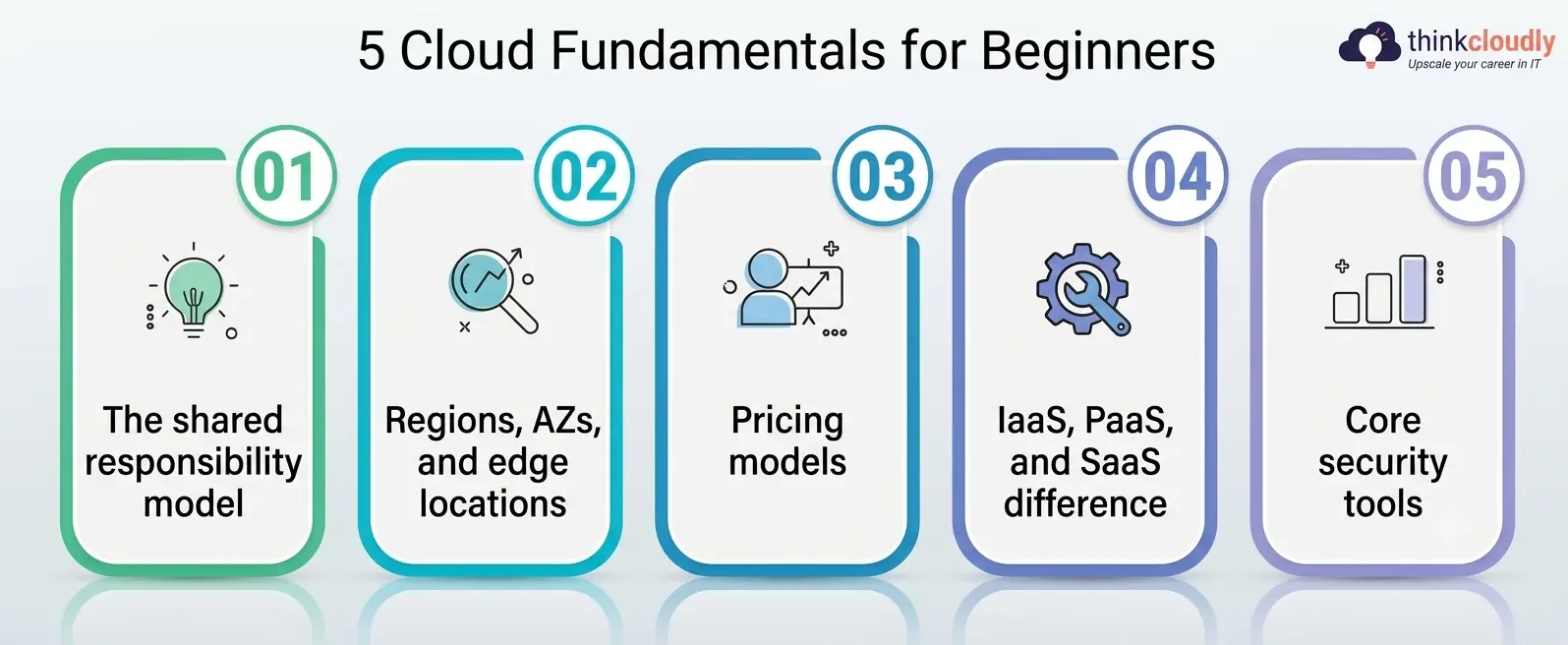
- The shared responsibility model. AWS secures the cloud infrastructure itself; you’re responsible for securing what you put inside it. Nearly every security question on the exam traces back to this one idea.
- Regions, availability zones, and edge locations. These aren’t interchangeable, and confusing them is the single most common beginner mistake on practice tests.
- Pricing models—on-demand versus reserved versus spot capacity. You don’t need to calculate exact costs, but you do need to understand why flexibility costs more and commitment costs less.
- The difference between IaaS, PaaS, and SaaS, and where core AWS services like EC2, Lambda, and S3 each sit on that spectrum.
- Core security tools, especially IAM roles, multi-factor authentication, and the principle of least privilege—concepts that show up constantly once you’re actually working, not just on the exam.
Master these five cloud computing fundamentals properly, and the rest of the exam content tends to fall into place around them, because almost every scenario question is really just testing one of these five ideas wearing a different costume. This is exactly the kind of groundwork a serious AWS certification for beginners plan is built on.
Exam Snapshot: AWS Certified Cloud Practitioner (CLF-C02)
|
Detail |
AWS Certified Cloud Practitioner |
|
Exam code |
CLF-C02 |
|
Format |
65 questions, multiple choice, and multiple response |
|
Duration |
90 minutes |
|
Cost |
$100 USD |
|
Prerequisites |
None required |
|
Target candidate |
No prior IT or cloud experience needed |
|
Validity |
3 years |
|
Delivery |
Testing center or online proctoring |
Technical Skills Development Doesn’t Stop the Day You Pass
This is where most beginners misjudge the finish line. Passing the exam is not the end of technical skills development—it’s the point where real technical skills development actually starts, because now you have enough vocabulary to learn by doing instead of learning by guessing.
The people who turn an entry-level AWS certification into an actual job offer are the ones who treat the badge as a permission slip to start building, not as proof they’re finished studying. Spend the month after your exam doing small hands-on projects inside the AWS free tier: host a static website, set up a basic monitoring dashboard, and automate a simple backup.
None of this requires coding fluency. It requires curiosity and about an hour a day, and it’s the single biggest differentiator between candidates who stall out after certification and those who land an interview within a few months.
Technical skills development at this stage also means getting comfortable reading AWS documentation without panicking. It’s dense, it’s technical, and it assumes more than it should for a beginner—but every working cloud professional I know still reads it constantly. Getting comfortable with that discomfort now is worth more than any single course you’ll take next.
Where This Sits on a Realistic Cloud Computing Career Path?
Let’s be honest about what one credential can and can’t do for a cloud computing career path, because overselling this helps no one. A 2027 overview of entry-level cloud roles lists cloud administrator, cloud support engineer, cloud developer, and cloud engineer as common starting points, with U.S. base pay for zero to one year of experience ranging roughly from $76,000 for a cloud administrator to over $95,000 for a cloud engineer.
The same overview notes that while a traditional IT background is common for these roles, certifications and a demonstrated project portfolio can substitute for it—which is exactly the lane an entry-level AWS certification is built to open.
The honest version of a cloud computing career path for a total beginner usually looks like this: Cloud Practitioner first, to prove you understand the fundamentals; then a cloud support or junior administrator role, where you’re paid to keep learning on the job; then a more specialized associate-level certification—Solutions Architect or SysOps Administrator—once you know which direction actually interests you.
Skipping straight to an associate-level exam without this foundation is exactly where I see motivated beginners stall out, because the associate exams assume a baseline this entry level AWS certification is specifically designed to provide.
The macro picture backs up why this investment is worth making now. 2027 U.S. Bureau of Labor Statistics report on AI and information technology employment projects information security analyst roles to grow 28.5 percent and data scientist roles to grow 33.5 percent between 2024 and 2034 — both far faster than the average occupation — and notes that AI adoption is expected to drive strong job growth across computer and mathematical occupations generally. None of that growth is handed to anyone automatically, but it’s a real tailwind underneath every cloud computing career path that starts today rather than two years from now.
Common Mistakes Beginners Make With Their First AWS Certification
Even a well-researched AWS certification for beginners plan can fall apart over small, avoidable habits. Watch for these:
- Memorizing service names without understanding use cases. Knowing that S3 stores objects means nothing if you can’t explain why you’d choose it over EBS for a given scenario.
- Skipping hands-on practice entirely because the free tier feels intimidating, then wondering why scenario-based questions feel impossible on exam day.
- Treating this as a one-and-done credential instead of the first rung of a longer cloud computing career path that keeps paying off as you add certifications.
- Studying only the week before the exam instead of spacing practice out, which hurts retention far more for complete beginners than for people with any prior technical exposure.
- Assuming no technical skills development is needed after passing — the certification opens a door, but walking through it still requires continued, deliberate practice.
The Real ROI of Starting Here
If you’re weighing whether an entry level AWS certification is worth the time investment against, say, a bootcamp or a degree, the honest math favors starting here. It costs $100, takes most beginners six to ten weeks of part-time study, and gives you a credible, third-party-verified signal that you understand cloud technology basics well enough to be useful on day one of a junior role.
Global IT spending is projected to hit $6.31 trillion in 2027, growing roughly 13.5 percent year over year largely on the back of cloud and AI infrastructure demand, and that spending has to translate into hiring somewhere. An entry level AWS certification is a reasonable, low-risk way to position yourself for a small slice of that growth without quitting your current job or taking on debt first.
A Personal Note
I didn’t come from IT either, and I remember exactly how it felt to sit down with AWS’s documentation for the first time and understand almost nothing on the page. What changed things wasn’t talent or a hidden technical gift — it was deciding to treat the confusion as temporary instead of permanent, and showing up to the free tier console most days even when I had no idea what I was doing yet.
If you’re reading this wondering whether an entry level AWS certification is realistic for someone exactly like you, with no safety net of prior experience to fall back on, it is. Just don’t expect the badge to do the work your own hundred hours of practice still has to do. Start today, start small, and let the certification prove what you already know rather than hoping it teaches you everything from a standing start.