




Every enterprise security questionnaire eventually lands on the same two lines: “Are you SOC 2 compliant?” and “Are you ISO 27001 certified?” Procurement teams ask both because they’ve stopped trusting one credential to answer every question, and founders answer both badly because nobody explained the difference before the deal was on the line.
SOC 2 vs. ISO 27001 sounds like a technical footnote, but in 2027 it behaves more like a revenue decision—the wrong choice can quietly cost you deals with buyers who won’t sign without the right paperwork attached.
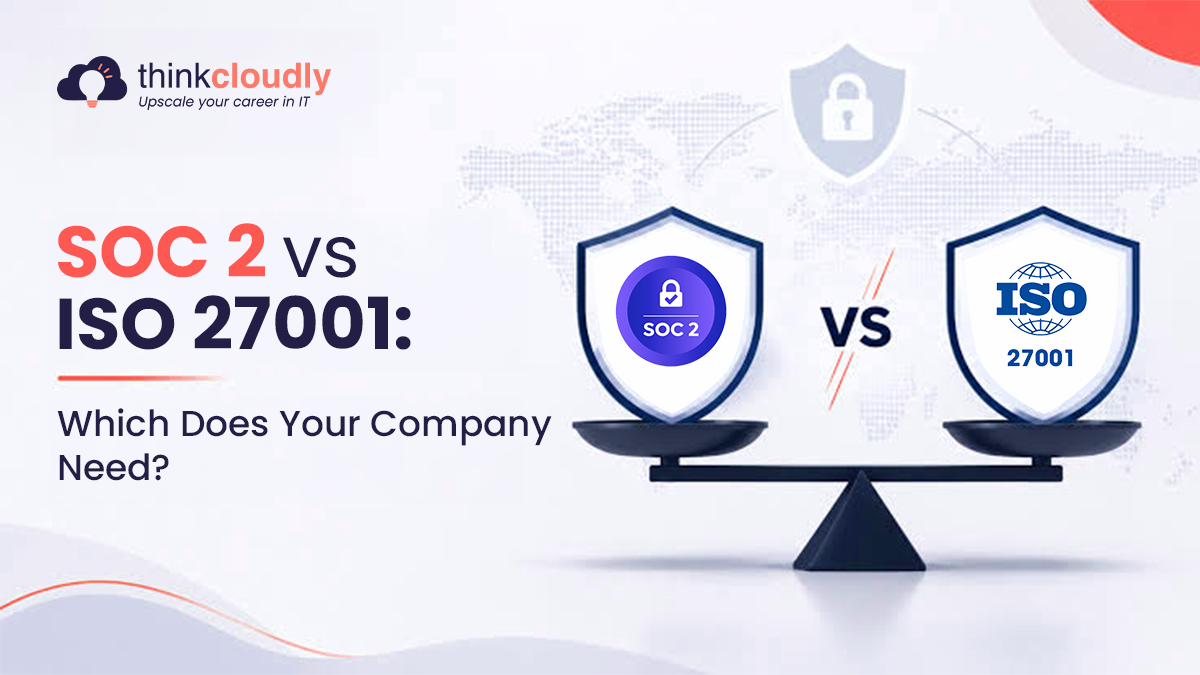
Here’s the part most comparison articles skip: SOC 2 and ISO 27001 were never built to compete with each other. One is an American audit report built around a specific set of trust criteria; the other is an international management-system standard any company, anywhere, can get certified against.
The honest answer to SOC 2 vs. ISO 27001 depends on where your customers are, what they’re actually asking for in diligence, and how your business is structured to produce evidence—not on which framework sounds more impressive on a landing page.
What Is SOC 2?
SOC 2—System and Organization Controls 2—is an attestation report built around the AICPA’s Trust Services.. Criteria: security, availability, processing integrity, confidentiality, and privacy. It isn’t a certification in the ISO sense; there’s no certificate to frame on a wall.
An independent CPA firm examines your actual controls and writes an opinion on whether they’re designed appropriately and, depending on the report type, whether they operated effectively over a defined period. That’s why SOC 2 compliance is reported rather than certified—the deliverable is an audit opinion, not a badge.
Most B2B software companies selling into the US end up needing SOC 2 compliance simply because enterprise procurement and security teams ask for it by name, often before anyone on the vendor side fully understands what the report covers.
The scope is flexible by design: a company can be assessed only against the security criterion or add availability and Confidentiality once customers ask harder questions about uptime and data handling. The AICPA maintains the official criteria on its own SOC 2 resource hub, worth reading directly instead of relying on secondhand summaries from vendor sales pages.
What Is ISO 27001?
ISO/IEC 27001 is the international standard for building and operating an Information Security Management System, or ISMS. Rather than auditing a fixed checklist, it asks an organization to run a continuous risk-management process: identify risks, select controls from Annex A to treat them (or formally justify excluding one), and prove the management system actually operates day to day, not just on paper. Where SOC 2 produces a report, ISO 27001 produces an actual certificate, issued by an accredited body after a two-stage audit.
Meeting the formal ISO 27001 requirements means documenting a risk assessment methodology, a Statement of Applicability, an internal audit program, and a management review cycle—the standard cares as much about how consistently you manage security as which controls you pick.
Companies selling into the UK, the European Union, or Asia-Pacific markets run into ISO 27001 requirements far more often than purely US-focused vendors do, largely because procurement culture there has standardized around ISO certification in a way the US market still hasn’t. The official scope and revision details sit on ISO’s own standard page, the only reliable place to confirm current clause numbering.
SOC 2 vs ISO 27001: Core Differences at a Glance
The table below lays out the comparison side by side before getting into the reasoning that actually drives most companies’ real-world decisions.
|
Factor |
SOC 2 |
ISO 27001 |
|
Full name |
System and Organization Controls 2 | |
|
Governing body |
AICPA (American Institute of CPAs) |
ISO/IEC (International Organization for Standardization) |
|
Output |
Audit report (attestation opinion) |
Certificate, valid three years with annual surveillance audits |
|
Core focus |
Trust Services Criteria: security, availability, processing integrity, confidentiality, privacy |
Risk-based Information Security Management System (ISMS) |
|
Geographic pull |
Strongest in the US, especially SaaS and B2B tech |
Strongest in the UK, EU, and Asia-Pacific markets |
|
Report/cert types |
Type 1 (point in time) and Type 2 (over a period, usually 3–12 months) |
Single certification, reassessed annually, renewed every 3 years |
|
Typical timeline |
2–6 months for Type 1; 6–12 months to a mature Type 2 |
6–18 months to first certification |
|
Who performs it? |
Licensed CPA firm |
Accredited certification body |
|
Best fit |
US-focused SaaS and B2B vendors facing enterprise buyers |
Global or UK/EU/APAC-facing companies needing a transferable certificate |
A table is a useful shortcut, but it can’t capture how either process actually feels month to month, which is what the rest of this piece gets into.
Framework and Requirements
Here is the structural picture broken into quick-reference points—useful if you’re building this into a decision memo or an internal comparison slide:
- Format: SOC 2 is an attestation report from a licensed CPA firm; ISO 27001 is a formal certification from an accredited body after a structured audit.
- Structure: SOC 2 scopes around five Trust Services Criteria individually; ISO 27001 requires a full ISMS covering governance, risk treatment, and roughly 93 Annex A controls.
- Flexibility: ISO 27001 lets you exclude controls that don’t apply if documented in the Statement of Applicability; SOC 2’s criteria are less negotiable once scoped.
- Renewal cycle: SOC 2 reports refresh every twelve months; ISO 27001 certificates run three years, with lighter annual surveillance audits in between.
- Evidence style: SOC 2 Type 2 evidence accumulates across an observation window; ISO 27001 evidence centers on ongoing operation, documented through minutes, risk registers, and internal audits.
- Who asks for which: US security teams and cyber insurers lean on a SOC 2 report by default; international RFPs and EU-based buyers lean on ISO 27001 certification almost by reflex.
None of this settles which framework is objectively harder—both represent genuine, sustained work. It does make clear this isn’t a difficult contest; it’s a question of which market is actually asking.
SOC 2 Type 1 vs. Type 2: What Most Comparisons Skip
A lot of SOC 2 vs. ISO 27001 debates skip a detail that matters just as much as the ISO comparison itself: SOC 2 comes in two distinct flavors, and conflating them causes more confusion than the ISO question does. SOC 2 Type 1 vs. Type 2 isn’t a difficulty tier—it’s a difference in what is actually being tested.
A Type 1 report examines whether controls are designed appropriately at a single point in time—a snapshot. A Type 2 report examines whether those same controls operated effectively across an observation window, typically three to twelve months. Buyers increasingly treat Type 1 as a placeholder and ask for Type 2 before a real contract, which is why most companies serious about SOC 2 compliance treat Type 1 as a stepping stone, not a destination.
The SOC 2 Type 1 vs. Type 2 decision usually comes down to timing. A startup closing a deal within the quarter often starts with Type 1, then rolls into the Type 2 observation period. Companies with more runway skip Type 1 and go straight for a six-to-twelve-month Type 2 window, since a mature report carries more weight than two sequential ones. Understanding SOC 2 Type 1 vs. Type 2 before signing an engagement letter saves you from paying for a report nobody downstream asked for.
ISO 27001 vs. SOC 2 Cost
Budget is usually the real decision-maker in these conversations, so it’s worth being direct about ISO 27001 vs SOC 2 cost rather than letting a sales rep frame it for you after the fact.
A SOC 2 Type 2 engagement commonly runs $20,000 to $60,000 in direct audit fees for a mid-sized SaaS company in 2027 with larger environments running higher. That excludes internal engineering and compliance hours, which often match or exceed the audit fee itself.
ISO 27001 certification tends to cost more upfront. Between certification body fees, a Stage 1 and Stage 2 audit, and building a full ISMS, companies typically spend $25,000 to $75,000 for first-time certification against the full ISO 27001 requirements with smaller annual surveillance audits after.
So where does ISO 27001 vs SOC 2 cost actually land? SOC 2 is cheaper to start; ISO 27001 costs more upfront but produces a three-year certificate instead of something refreshed annually.
Over three years, total cost of ownership often evens out—you’re paying for ISO 27001 earlier and less often, versus paying for SOC 2 compliance in smaller, frequent installments. Anyone judging the ISO 27001 vs. SOC 2 cost on a single year’s invoice is looking at an incomplete number.
SOC 2 or ISO 27001 for Startups: Decision Checklist, Point by Point
For founders asking SOC 2 or ISO 27001 for startups as a day-one question, the honest answer is usually neither—not yet. Early-stage companies without paying enterprise customers often spend real money on a framework they won’t need for a year. Once enterprise deals start requiring proof, here’s how to decide which to pursue first:
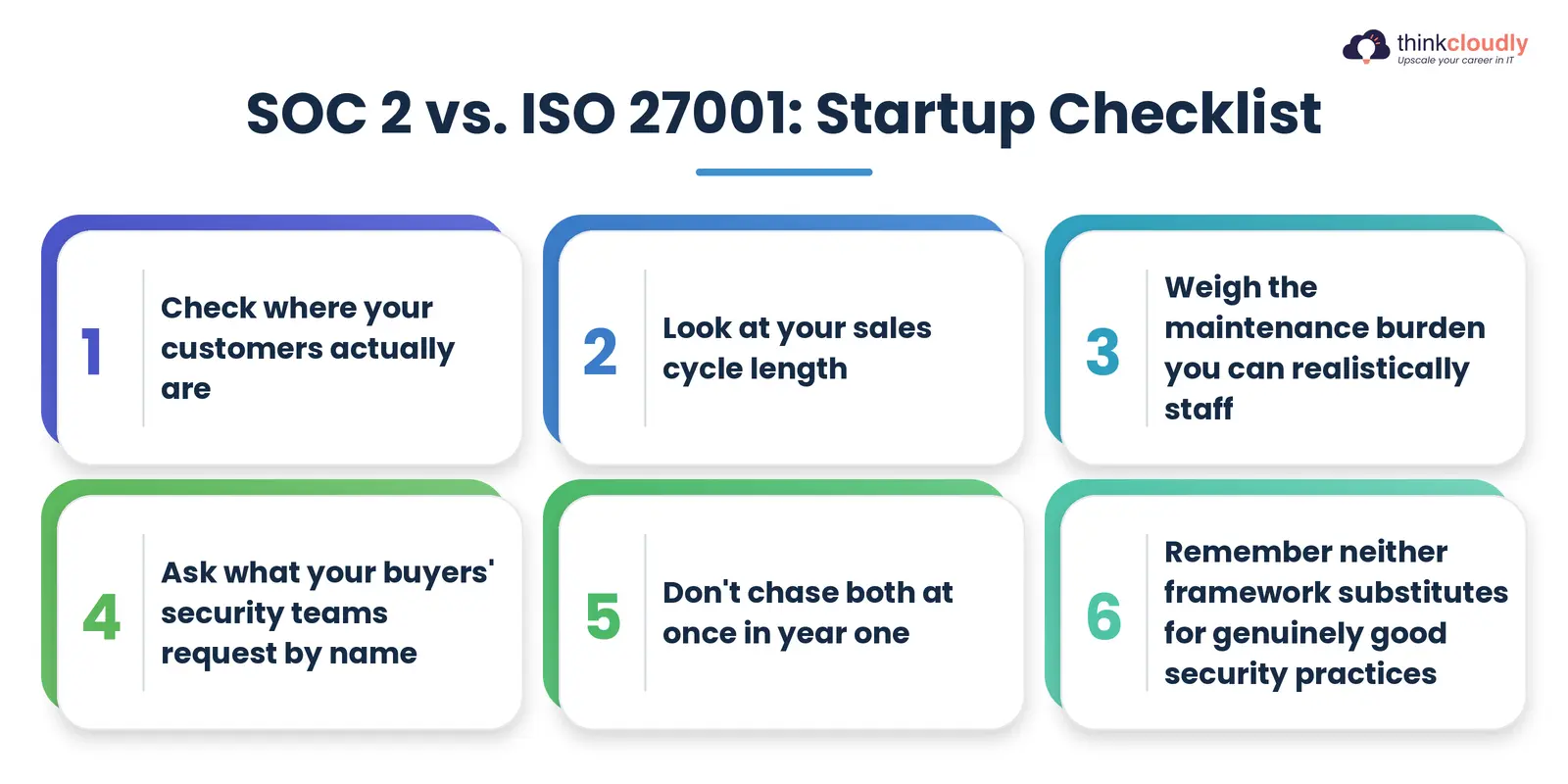
- Check where your customers actually are: mostly US mid-market and enterprise SaaS buyers mean a SOC 2 report usually gets requested first; UK, EU, or Asia-Pacific deals mean ISO 27001 requirements show up in RFPs more often.
- Look at your sales cycle length: a SOC 2 Type 1 report can be ready in a couple of months, which matters more for startups racing a deal clock than for established companies.
- Weigh the maintenance burden you can realistically staff: ISO 27001 demands an ongoing ISMS with internal audits and management reviews, harder for a five-person team than a once-a-year SOC 2 engagement.
- Ask what your buyers’ security teams request by name, rather than guessing — pull the last five lost-deal questionnaires and see which credential kept appearing.
- Don’t chase both at once in year one: most founders choosing between SOC 2 or ISO 27001 for startups start with whichever framework their nearest signed deal is actually blocking on.
- Remember neither framework substitutes for genuinely good security practices: both document what you already do — they don’t create it for you.
That last point matters more than the acronym debate. Companies that treat SOC 2 or ISO 27001 for startups as a checkbox exercise usually fail their first audit cycle, because auditors test whether controls are actually followed, not whether a policy document exists somewhere.
Do You Need Both, Eventually?
Yes, increasingly — and not only at the top end of the market. A growing number of mid-market SaaS companies selling globally end up holding both, because SOC 2 vs ISO 27001 stops being a strict either/or question once you have customers on both sides of the Atlantic who each ask for a different credential by name.
Running both isn’t duplicate work if sequenced properly, because most of the underlying control evidence overlaps: access management, encryption, incident response, and vendor risk management are foundational to both frameworks. Companies that build their control environment once and map it to both SOC 2’s criteria and ISO 27001’s Annex A controls spend considerably less on the second framework than the first.
A 2027 compliance benchmark report from Vanta found that companies pursuing a second framework after their first typically cut implementation time by nearly half, since the control foundation was already in place.
If you’re still early-stage and only chasing one framework right now, that’s a reasonable place to be — SOC 2 vs ISO 27001 doesn’t need solving permanently on day one. Pick the one your nearest real deal actually requires, build genuine controls rather than paperwork for its own sake, and let the second certification follow revenue rather than anxiety.
A Personal Note
I’ve watched too many founders burn six figures chasing whichever credential their most recent lost deal happened to blame, without stepping back to ask which framework their customer base genuinely needed.
That’s an expensive lesson a single honest sales call could have taught for free. Read your own pipeline before you read either framework’s control list. Who is actually asking you for proof, and what did they ask for by name — not what you assume a “serious” company is supposed to have.
I’ll say the part most compliance vendors won’t say out loud: neither a SOC 2 report nor an ISO 27001 certificate makes your company secure by itself. They make your existing security practices visible and verifiable to someone who wasn’t in the room when you built them. Treat SOC 2 vs ISO 27001 as a question about who needs to trust you and how, not as a race to collect credentials for their own sake, and the whole decision gets considerably less stressful.