





If you’ve spent any time in a cybersecurity forum, a LinkedIn comment thread, or a Discord full of SOC analysts certification, you’ve run into the same argument. Someone asks which platform to learn first, and within minutes the thread splits into two camps. The Splunk vs Microsoft Sentinel debate has become one of the most common questions I get from students and junior analysts, and honestly, it doesn’t have a one-line answer.
Both tools started as humble log management tools before they grew into full-blown SIEM platforms that sit at the center of modern security operations. Both are respected, both pay well if you’re good at them, and both show up constantly in job postings. So working out which SIEM to learn first can feel like guesswork if you don’t know what each platform is actually asking of you.
This guide breaks down the Splunk vs Microsoft Sentinel debate from the angle that actually matters to a learner: what you’ll study, how long it takes, what the job market looks like, and which one fits your current skills and budget. I’ll also throw in a comparison table, a career breakdown, and my own take at the end, because I think the “right” answer depends more on your situation than on which tool is objectively superior.
What Is a SIEM?
SIEM stands for Security Information and Event Management, and it’s easy to confuse with simpler tools because the acronym gets thrown around loosely. A plain log collector just gathers data; a true SIEM platform centralizes that data, correlates events across systems, flags anomalies, and gives analysts a single pane of glass to investigate from.
By 2027, that correlation layer is doing far more work than it used to, since most mid-sized security teams are drowning in alerts from a dozen disconnected tools before they even open a SIEM console.
Here’s the distinction that trips up a lot of beginners: log management tools collect and store data, while a SIEM adds correlation, alerting, and context on top of that storage. You can run a basic logging platform for years without ever touching a single detection rule. A SIEM, by contrast, is built around the idea that raw logs are useless until something turns them into a signal analysts can act on.
Over the last few years, the line between plain storage and full SIEM capability has blurred, since both Splunk and Microsoft Sentinel now offer tiers that scale from “just store my logs” to “run full detection and response.”
This matters for your learning path because Splunk and Microsoft Sentinel approach that correlation layer very differently, which is really what the Splunk vs. Microsoft Sentinel conversation is about underneath all the marketing language.
Context matters too. Heading into 2027, most mid-sized and large organizations already run several detection tools side by side—endpoint protection, cloud security posture management, and identity monitoring—and the SIEM is still the place where all of that noise gets correlated into something a human can triage in minutes rather than hours. That’s a big part of why hiring for SIEM skills hasn’t slowed down even as budgets tighten elsewhere in IT.
Splunk vs Microsoft Sentinel: The Core Architecture Difference
Splunk was built in the mid-2000s as an on-premises data platform first and a security tool second. It later added Splunk Enterprise Security on top of that indexing engine, which is why Splunk feels like a general-purpose data platform that happens to do security exceptionally well.
You index data, you write queries in Splunk’s own language (SPL), and you build dashboards, alerts, and detections from there. It’s flexible, it’s vendor-agnostic in terms of data sources, and it rewards people who like getting their hands dirty with queries.
Microsoft Sentinel, meanwhile, was designed cloud-native from day one, originally under the name Azure Sentinel. It lives inside the Azure ecosystem, uses Kusto Query Language (KQL) instead of SPL, and leans heavily on built-in connectors for Microsoft 365, Entra ID, and Defender products.
According to Splunk’s comparison of the two platforms, Sentinel’s consumption-based pricing and native Azure integration make it attractive to organizations already committed to Microsoft’s stack, while Splunk’s flexibility appeals to teams with varied, multi-vendor environments.
When you frame Splunk vs Microsoft Sentinel as a pure technology choice, the honest takeaway is that neither is “better” in the abstract. One is a flexible, bring-your-own-architecture platform. The other is a tightly integrated, cloud-first product that gets you running faster if you’re already inside Microsoft’s world.
From a learner’s perspective, that architectural gap translates directly into study time. Splunk’s SPL has more surface area to learn because it’s doing double duty as a general-purpose search language, not just a security query tool. KQL, by contrast, borrows syntax patterns that already feel familiar to anyone who has touched SQL, which is one reason newcomers often find Sentinel’s early learning curve a little gentler.
What Splunk Brings to the Table?
If you’re weighing the learning curve, here’s what tends to draw people toward Splunk first:
- A dominant presence in large enterprises, government, and finance, where multi-vendor log management tool environments are the norm.
- A query language (SPL) that, once learned, transfers conceptually to other data-heavy roles outside security.
- Deep customization for dashboards, correlation searches, and detection logic.
- A long track record as a leader in Gartner’s Magic Quadrant for Security Information and Event Management.
- A large, mature community, extensive documentation, and a certification path that’s well recognized by hiring managers.
What Microsoft Sentinel Brings to the Table?
On the other side, Microsoft Sentinel tends to appeal to a different profile of learner:
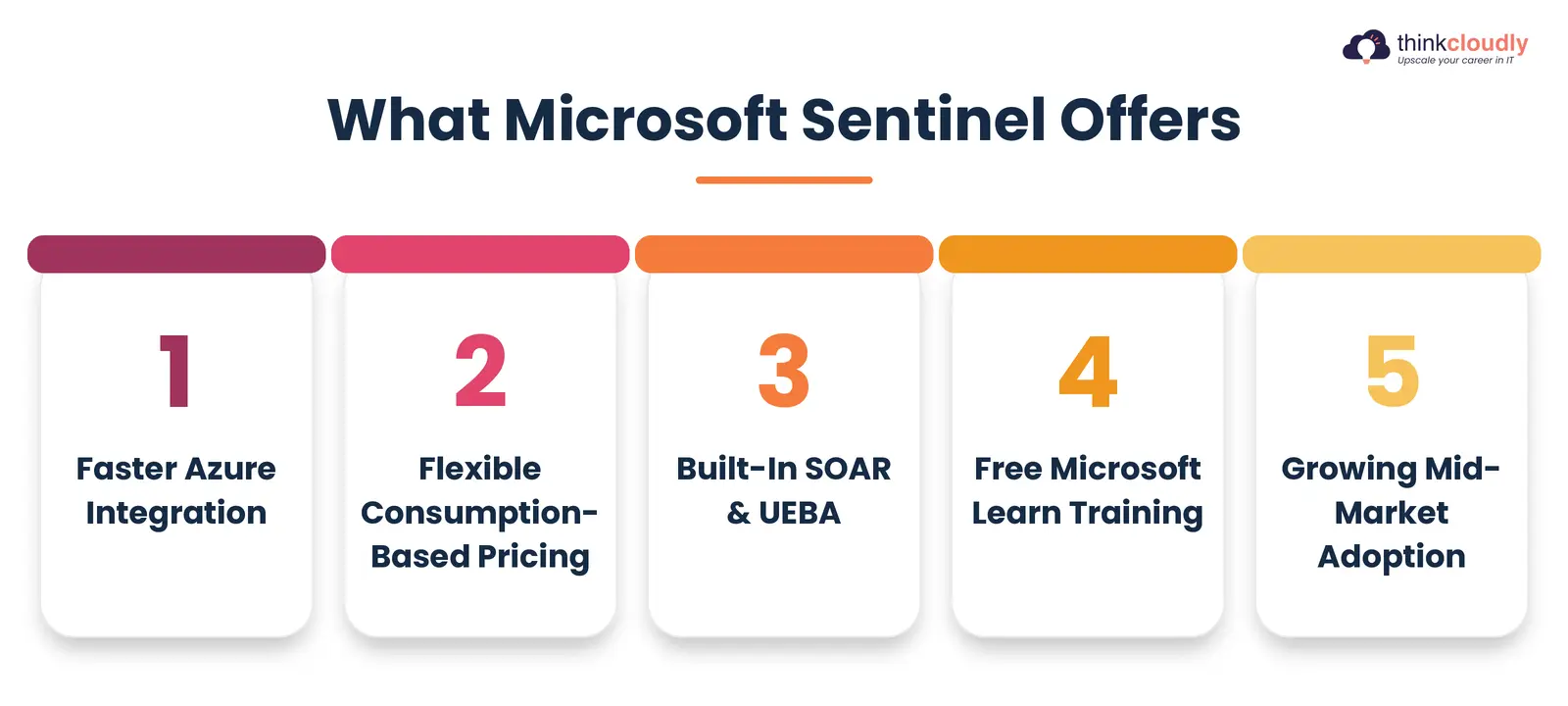
- Faster time-to-value for anyone already comfortable in Azure, Microsoft 365, or Defender tooling.
- A consumption-based pricing model that smaller teams and students find easier to experiment with.
- Built-in SOAR (security orchestration, automation, and response) and UEBA (user and entity behavior analytics) without needing a separate add-on product.
- Free, structured Microsoft Sentinel training available through Microsoft Learn, which lowers the barrier for beginners with no budget.
- Strong growth in adoption among mid-market companies migrating away from legacy, on-premises log management tools.
Splunk vs Microsoft Sentinel: A Side-by-Side Comparison
The table below sums up the Splunk vs Microsoft Sentinel comparison across the metrics that matter most to someone deciding where to invest their study time.
|
Factor |
Splunk |
Microsoft Sentinel |
|
Query language |
SPL (Search Processing Language) |
KQL (Kusto Query Language) |
|
Deployment model |
On-prem, cloud, or hybrid |
Cloud-native (Azure only) |
|
Pricing structure |
Data volume indexed per day |
Consumption-based (data ingested) |
|
Learning curve |
Steeper; more configuration flexibility |
Gentler, especially for Azure users |
|
Best fit for |
Multi-vendor, large or complex environments | Microsoft-centric organizations |
|
Community reviews |
4.3/5 on G2, 400+ reviews |
4.4/5 on G2, 200+ reviews |
|
Typical time to implement |
Around 6 months in enterprise settings |
Around 6 months in enterprise settings |
|
Certification recognition |
Long-established, widely recognized |
Newer, growing fast with Azure demand |
These figures come from G2’s side-by-side comparison of Microsoft Sentinel and Splunk Enterprise, which pulls directly from verified user reviews rather than vendor marketing. Notice that review scores are close, implementation timelines are nearly identical, and the real differentiator is architecture and ecosystem fit, not raw quality.
Sentinel vs Splunk Jobs: What Recruiters Actually Want
Here’s where the conversation usually gets practical. Looking at Sentinel vs Splunk jobs on any major job board tells a fairly clear story: both skill sets are in demand, but they cluster around different employers.
Large enterprises, defense contractors, and finance firms tend to list Splunk requirements, often alongside a Splunk Core Certified credential. Mid-market companies, Microsoft resellers, and cloud-first teams are far more likely to be hiring for Sentinel skills, frequently alongside Azure or Defender experience.
According to the latest UK hiring data, median salaries for SIEM-related roles sit around £65,411 nationally, with demand for SIEM skills climbing again after a dip the previous year. That’s a useful signal: the Sentinel vs Splunk jobs split is roughly even in most Western markets, but overall demand for either skill set is recovering, not shrinking.
When you search Sentinel vs Splunk jobs postings directly, a pattern emerges fast: employers rarely ask for just one. Many postings list “Splunk or Sentinel (or equivalent SIEM)” as the requirement, which means a candidate who understands core SIEM concepts—correlation rules, detection logic, incident triage—can usually pick up either tool on the job faster than they expect. The underlying skill of a Security Information and Event Management specialist is more transferable than the specific product name on the resume.
That said, if you want to maximize your options rather than bet on one ecosystem, pairing Microsoft Sentinel training with a Splunk fundamentals course is a reasonable hedge for anyone early in their career. It costs a bit more time up front, but it means you’re not locked out of either side of the market when the next hiring cycle turns.
Which SIEM to Learn First: A Decision Framework
So, which SIEM to learn first? Rather than giving you a single verdict, here’s a framework based on where you’re starting from—and on whether you’ve already put any hours into Microsoft Sentinel training or a Splunk fundamentals course:
Learn Splunk first if:
- You want to work in large enterprises, government, or regulated industries.
- You enjoy writing queries and don’t mind a steeper initial learning curve.
- You’re targeting roles that explicitly list Splunk certifications as a requirement.
Learn Microsoft Sentinel first if:
- You’re already comfortable with Azure, Microsoft 365, or Defender products.
- You have a limited budget and want free, structured Microsoft Sentinel training to start.
- You’re applying to mid-market or cloud-native companies.
If none of that narrows it down, default to whichever tool your target employer actually uses. Check the job descriptions you’re aiming for, not general popularity rankings, because the honest answer to which SIEM to learn depends on where you want to work, not which tool trends better on social media this quarter.
Security Information and Event Management Beyond the Big Two
It’s worth saying plainly: Splunk and Microsoft Sentinel are not the only SIEM platforms out there. Exabeam, IBM QRadar, and several others compete in the same space, and some employers still run older, on-premises logging setups without a full detection layer at all.
But Splunk vs Microsoft Sentinel dominates hiring conversations in North America, the UK, and most of Western Europe because they cover the largest share of enterprise deployments between them, according to Exabeam’s comparison of the two platforms, which breaks down architecture, pricing, and scalability differences in more technical detail than most vendor pages offer.
That dominance has only grown since Cisco completed its acquisition of Splunk in 2024, folding Splunk’s SIEM and observability stack into Cisco’s wider security portfolio, while Microsoft keeps pushing Sentinel deeper into its own unified security platform.
Two of the largest technology vendors in the world now have a direct stake in which SIEM wins the next wave of hiring, which is exactly why this comparison keeps resurfacing in 2027 budget and training conversations.
A Security Information and Event Management specialism, broadly speaking, remains one of the steadier corners of cybersecurity hiring. Detection engineering, threat hunting, and SOC analyst roles all lean on SIEM fluency as a baseline skill, regardless of which specific product sits underneath.
A Personal Note
I still get asked about Sentinel vs Splunk jobs almost every week, usually by someone who’s two courses deep into a cybersecurity bootcamp and panicking about which certification to chase next. My honest advice hasn’t changed in years: pick the one that matches the job postings you’re actually looking at, finish a real project in it — not just a tutorial — and stop treating the choice as permanent.
I’ve watched analysts move from Splunk-heavy SOCs into Sentinel-based teams within eighteen months, and the transition took them a few weeks, not a few years. The query syntax changes; the way you think about an incident doesn’t. Whichever tool you pick first, keep it in perspective: it’s a skill you’re adding, not an identity you’re choosing.
If you’re still undecided after reading this, pick whichever platform has a free trial you can start today, and give yourself thirty days with real data before you let it become your specialism.